

By Prof. Giorgi Pkhakadze, MD, MPH, PhD · 15/09/2026
Georgia became Christian before Rome did, and it did so because of one woman. Her convent at Bodbe, on a wooded slope with the whole of the Alazani valley and the Caucasus beyond it, is where every Georgian comes at least once, and where the story of the country’s faith begins.
Who she was
Nino came from Cappadocia, in what is now central Turkey, around the year 320. She was young, she was alone, and she walked. The chronicle says she entered Georgia from the south, lived for a time in Mtskheta, the royal capital, and there began to heal and to preach. She bound two vine branches together with strands of her own hair to make a cross — the drooping-armed cross that is still Georgia’s own — and carried it with her.
The king, Mirian III, was hostile. Then, out hunting, he was caught in darkness at noon — an eclipse, the historians say — and in his terror called on Nino’s God. The light returned. In 337 he and his queen Nana were baptised, the kingdom followed, and Georgia became the second nation on earth, after Armenia, to adopt Christianity as its state religion. Nino spent her last years in Kakheti, in the village of Bodbe, and died there. Mirian built a church over her grave.
What is there now
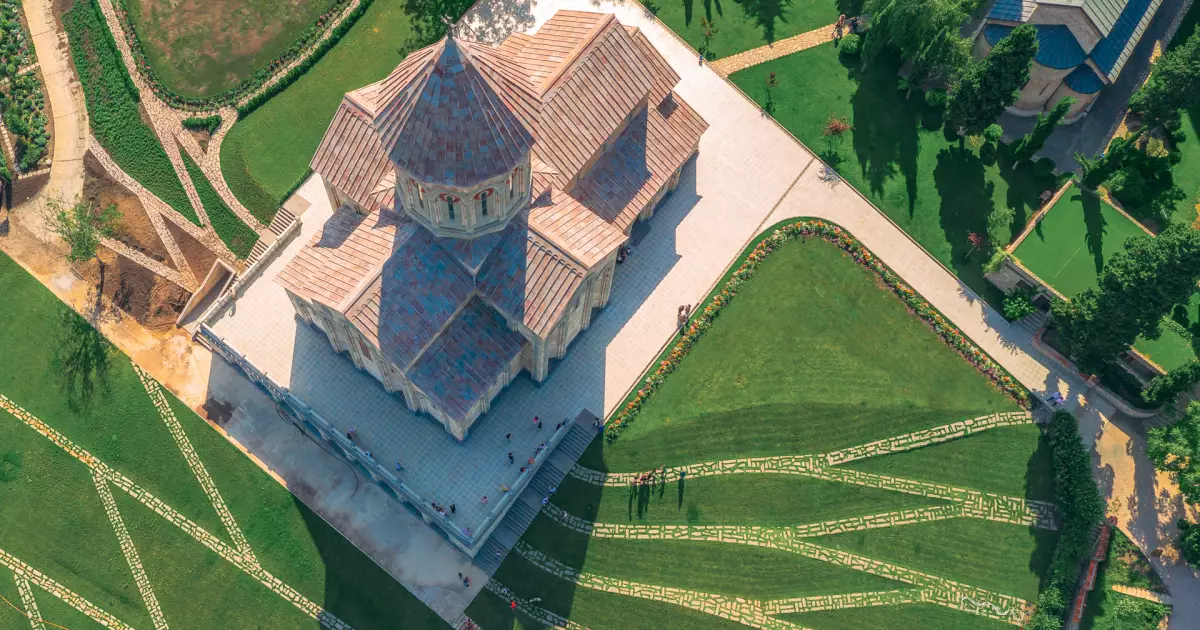
The convent has been rebuilt many times; the present church is a modest 9th-century basilica, restored, with a 19th-century bell tower and a newer, larger cathedral beside it. Nino’s tomb is in the small church, under a canopy on the right of the altar, and there is almost always someone kneeling there. The nuns keep gardens of roses and cypresses that are among the most peaceful places in Kakheti, and the terrace looks across forty kilometres of vineyards to the snow line.
Below the convent, a steep path of about 800 steps leads down through the woods to Saint Nino’s spring, a bathhouse where pilgrims immerse themselves in cold water said to have appeared at the saint’s prayer. Going down takes fifteen minutes; coming up, considerably longer. There is a road for those who prefer it.
How to visit
Modest dress is required — skirts and headscarves are provided for women at the gate, and men should not wear shorts. Photography is fine in the grounds, discouraged inside. Mornings are quiet; Sundays and the feast of Saint Nino, 27 January and 1 June, are not. Bodbe pairs naturally with Sighnaghi, two kilometres away, and with a winery below in the valley.
See it with GTour
Bodbe opens the Sighnaghi & Bodbe day trip and the Kakheti wine country day; it is the third morning of the Grand Wine & Heritage tour.
ქართულად: ბოდბე — ქალი, რომელმაც სამეფო მოაქცია
