

By Prof. Giorgi Pkhakadze, MD, MPH, PhD · 15/09/2026
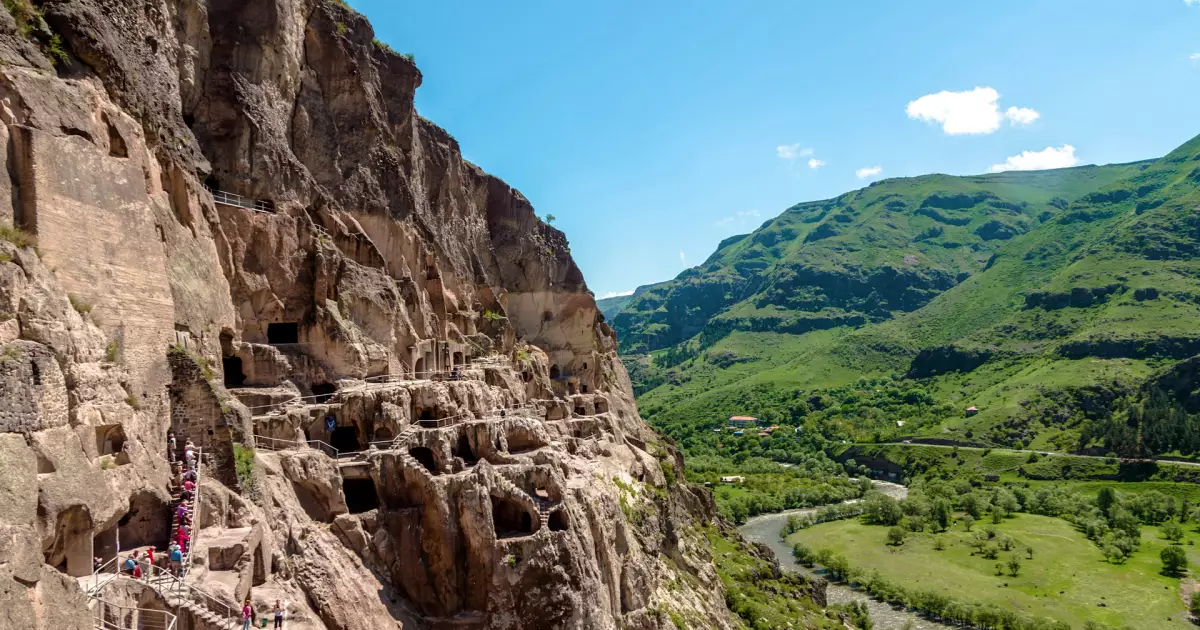
The cliff comes into view around a bend in the Kura gorge, south of Aspindza: a wall of yellow-brown rock a kilometre long, pocked with hundreds of dark openings like a sponge. From the road it takes a moment to realise the openings are doors and windows, that the ledges are streets, and that the whole cliff face is a town.
Tamar’s town
Vardzia was begun under King Giorgi III in the 1180s and completed by his daughter Tamar, the queen who ruled Georgia at the height of its medieval power, from 1184 to 1213. The site was chosen for defence — the Kura valley here was the southern frontier, facing the Seljuk Turks — and the plan was extraordinary: a fortified monastery cut entirely into the rock, invisible from the valley, entered through hidden tunnels, with living quarters, refectories, wine cellars, bakeries, a pharmacy, meeting halls and a church, all connected by internal stairs and served by an aqueduct that brought spring water through the mountain. Estimates put the original at three thousand rooms on thirteen levels, with room for several thousand people and their animals.
Tamar had her own quarters here; the chronicle says she prayed at Vardzia before the battle of Basiani in 1202, which she won, and the church holds the only near-contemporary portrait of her: a slim young woman in a red robe, holding a model of the church, painted on the north wall around 1185, before she was thirty.
What happened to it
In 1283 an earthquake sheared off the front of the cliff and brought down the outer walls of most of the rooms, exposing what had been hidden. Vardzia became a monastery in the open air. The Persians sacked it in 1551, and it was abandoned. Soviet archaeologists cleared it in the 20th century; a handful of monks returned in 1989, and it has been a working monastery again since — you may meet one on the ledges.
Walking it
The visit is a climb: a path zigzags up the cliff to the lowest inhabited level, then stairs and tunnels lead up and along, level by level, past rooms with carved niches and blackened ceilings, wine cellars with rows of qvevri holes in the floor, the bell tower, and the church of the Dormition at the centre, with Tamar’s portrait and a cycle of frescoes that survived the earthquake and the Persians. A long tunnel leads down from the church through the rock to the spring — the aqueduct’s source — and out at the bottom. Allow two hours; the paths are uneven and there are stretches of steep steps in the dark, so it is not for the unsteady, but it is unforgettable.
Practical
Vardzia is 250 kilometres from Tbilisi — a long day trip, or better a night in Borjomi or Akhaltsikhe. Spring and autumn are ideal; summer afternoons on the south-facing rock are hot. Khertvisi fortress, one of Georgia’s oldest, stands at the junction ten kilometres before, and Rabati at Akhaltsikhe on the way.
See it with GTour
Vardzia is the Vardzia cave city day trip from Tbilisi, or, at a kinder pace with a night in Borjomi, the Vardzia, Rabati & Borjomi two-day tour.
This story in Georgian — ქართულად: shenidasveneba.ge
ქართულად: ვარძია — დედოფალი, რომელმაც ქალაქი კლდეში გამოკვეთა
