

By Prof. Giorgi Pkhakadze, MD, MPH, PhD · 15/09/2026
Ten minutes from Kutaisi, the road enters a park of enormous old trees and, among them, buildings that make no sense: neoclassical palaces with columns three storeys high, curved colonnades, grand staircases, all of it empty, windows gone, trees growing through the porticoes. This was Tskaltubo, the Soviet Union’s most prestigious spa, and it still is a spa; it is also a monument to the way empires end.
The water
Tskaltubo sits on radon-carbonate springs at a constant 33 to 35 degrees — warm enough to bathe in without heating, mildly radioactive, and long believed to cure arthritis, circulatory and skin complaints. The Georgians had used them for centuries. In the 1920s the new Soviet state, which took spa medicine seriously, decided to build here the largest balneological resort in the USSR.
The town
Between 1930 and 1960 Tskaltubo was laid out as a garden city: a circular park with nine bathhouses at its centre, each numbered, each a temple of marble and mosaic, and around the park twenty-odd sanatoriums, each belonging to a Soviet ministry or union — the Railway Workers, the Metallurgists, the Ministry of Defence — each a palace in the Stalinist classical style, with dining halls for five hundred, cinemas, libraries and gardens. A direct train ran from Moscow. Workers came on state vouchers for three-week cures; at its height, 125,000 a year. Bathhouse No. 6 had a private wing for Stalin, who came from Tbilisi; his marble bath and the mosaic of his motorcade are still there, and Bathhouse 6 still operates.
What happened
1991. The Union ended, the vouchers ended, the trains stopped. In 1993 the sanatoriums filled again — with 9,000 refugees from the war in Abkhazia, who were housed in the ballrooms and dining halls and, thirty years later, some of them are still there, curtains in the windows of the Sanatorium Medea and washing on the balconies of the Metallurgists. The rest decayed. Tskaltubo became one of the world’s great abandoned landscapes: colonnades in the mist, spiral staircases open to the sky, mosaics of Soviet athletes fading under the rain. Photographers came, then urban explorers, then everyone.
Now
The town is coming back. Several bathhouses are open — you can take the radon waters for a few lari in Bathhouse 6 or the renovated Bathhouse 2, among a clientele of Georgian pensioners and curious foreigners. The Tskaltubo Spa Resort and the Legends hotel have restored two sanatoriums to something like their original grandeur, and the government has begun selling the others for renovation. Go soon: in ten years it will be a resort again, and the strangeness will be gone.
Practical
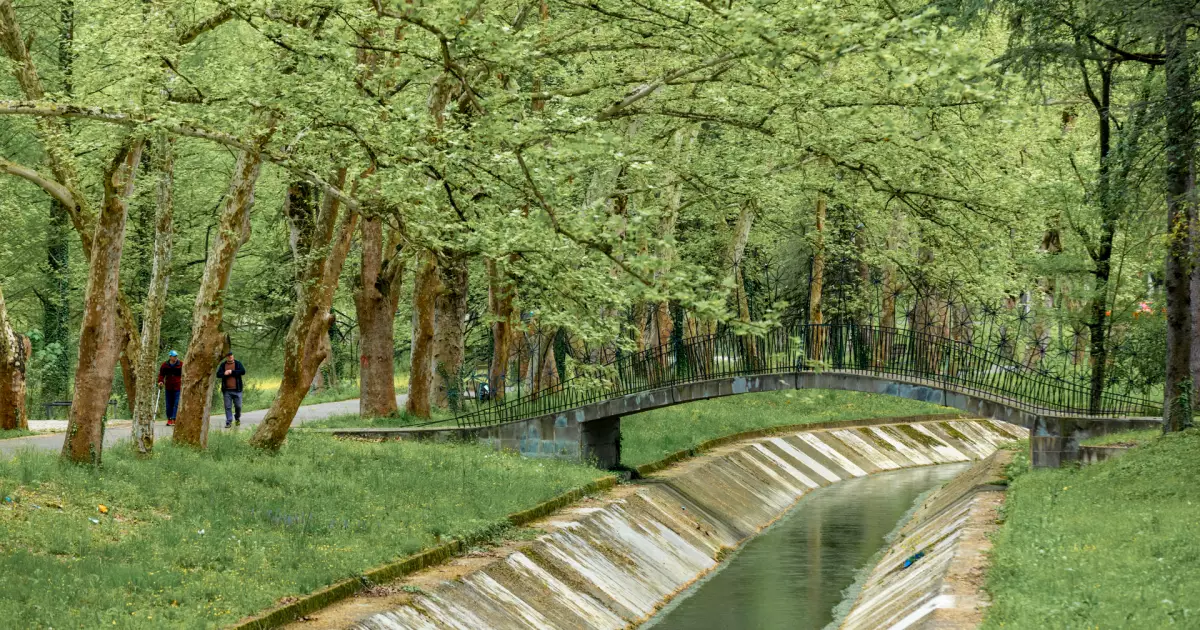
The abandoned buildings are unfenced and unsafe — floors missing, stairs unsupported. Look from the outside, or enter only the ground floors with care. Respect the people still living there. The park is beautiful in itself: a walk of an hour under the plane trees takes you past the grandest façades.
See it with GTour
Tskaltubo is the afternoon of day two on the Kutaisi & Western Georgia three-day tour, after Gelati and the Prometheus cave, with a bath in the radon water for anyone who wants one.
ქართულად: წყალტუბო — სტალინის აბანო და მოჩვენება-სანატორიუმები
