

By Prof. Giorgi Pkhakadze, MD, MPH, PhD · 15/09/2026
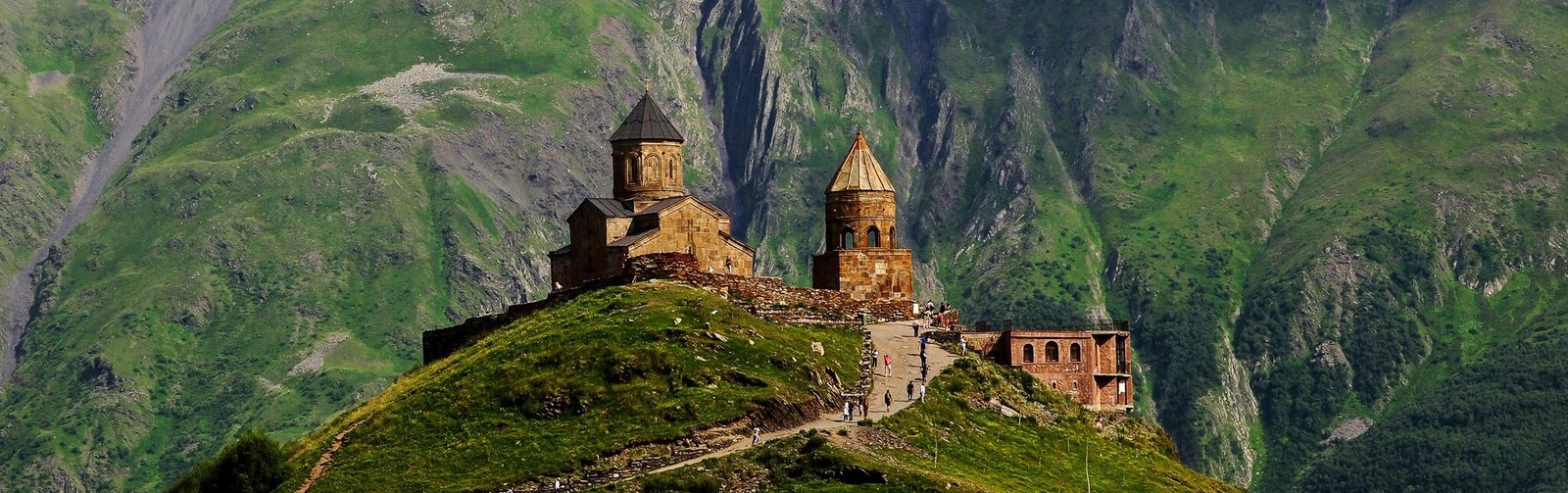
Drive north from Tbilisi for three hours and the Georgian Military Highway delivers you to Stepantsminda, a small town in a bowl of mountains. Look up and to the left. On a ridge that seems to have no business holding anything, there is a church — small, grey, a cone-roofed tower beside it — and behind it, filling the sky, the white pyramid of Mount Kazbek, 5,054 metres high.
This is Gergeti Trinity, Tsminda Sameba in Georgian. It was built in the 1300s, and the first question every visitor asks is the right one: why here?
A church you had to earn
Medieval Georgia built churches the way other kingdoms built castles — as statements. But most were placed where people lived. Gergeti is different. It sits 400 metres above the nearest village, on a saddle exposed to every wind the Caucasus can produce, with no water and no fields. Nobody lived there. Nobody was supposed to.
The answer lies in what the church was for. The Khevi region, of which Stepantsminda is the centre, was Georgia’s northern gate — the one land route through the Great Caucasus to the steppe beyond. Whoever held Khevi held the door. A church on the ridge was a beacon: visible from the whole valley and from the pass, a claim of faith planted at the frontier. And it was a vault. When the lowlands were overrun — by Timur in the 1390s, by the Persians two centuries later — the treasures of the Georgian church were carried up here for safekeeping. Among them, tradition says, the cross of Saint Nino, the woman who converted Georgia in the 4th century.
A church that is hard to reach is a church that is hard to rob.
What you actually see
The building is modest by design. A single-nave cruciform church of grey stone, a separate bell tower, a low wall. Inside, it is dark and cold even in July; the frescoes are mostly gone, and what remains is smoke-darkened and intimate. Georgians come to light candles, not to admire architecture. The architecture is outside: the placement, the scale of the mountains against the scale of the church, the way the building looks like a chess piece set down by someone who understood exactly how the game would be watched.
Stand with your back to the church, facing south-west, and the valley unrolls beneath you — the town, the river Terek beginning its journey to Russia, the road you came on. Turn around and Kazbek fills everything. In Georgian myth this is where Amirani, the Prometheus of the Caucasus, was chained for giving fire to humans. On a clear day the glacier is close enough that you understand why they put him here.
How to reach it, and when
Until 2018 the only way up was a rough two-hour walk or a battered 4×4 taxi from the town square. There is now a paved road, and GTour’s driver takes you to the top; if you want to walk, the path from the village of Gergeti takes about ninety minutes at an easy pace, through birch woods and then open meadow, and it is worth it for the moment the church appears above you.
Timing matters more here than almost anywhere in Georgia. Cloud gathers on Kazbek by early afternoon in summer; the best light on the church is between 10 and 1. In autumn the meadows turn copper and the summit is often clear all day. In winter the ridge is white, the church is black against it, and the road is cleared most days — the most dramatic version of the view, and the least visited.
See it with GTour
Gergeti is the heart of our Kazbegi day trip from Tbilisi, which also stops at Ananuri fortress and the Gudauri pass. If you want the church twice — in afternoon light and again at dawn, before anyone else arrives — take the two-day mountain journey with a night in Stepantsminda and a morning in the Juta valley.
ქართულად: გერგეთის სამება — რატომ ააშენეს ეკლესია იქ, სადაც არავინ ცხოვრობს
