

By Mariam Lomidze, Culture & Events Reporter · 30/10/2026
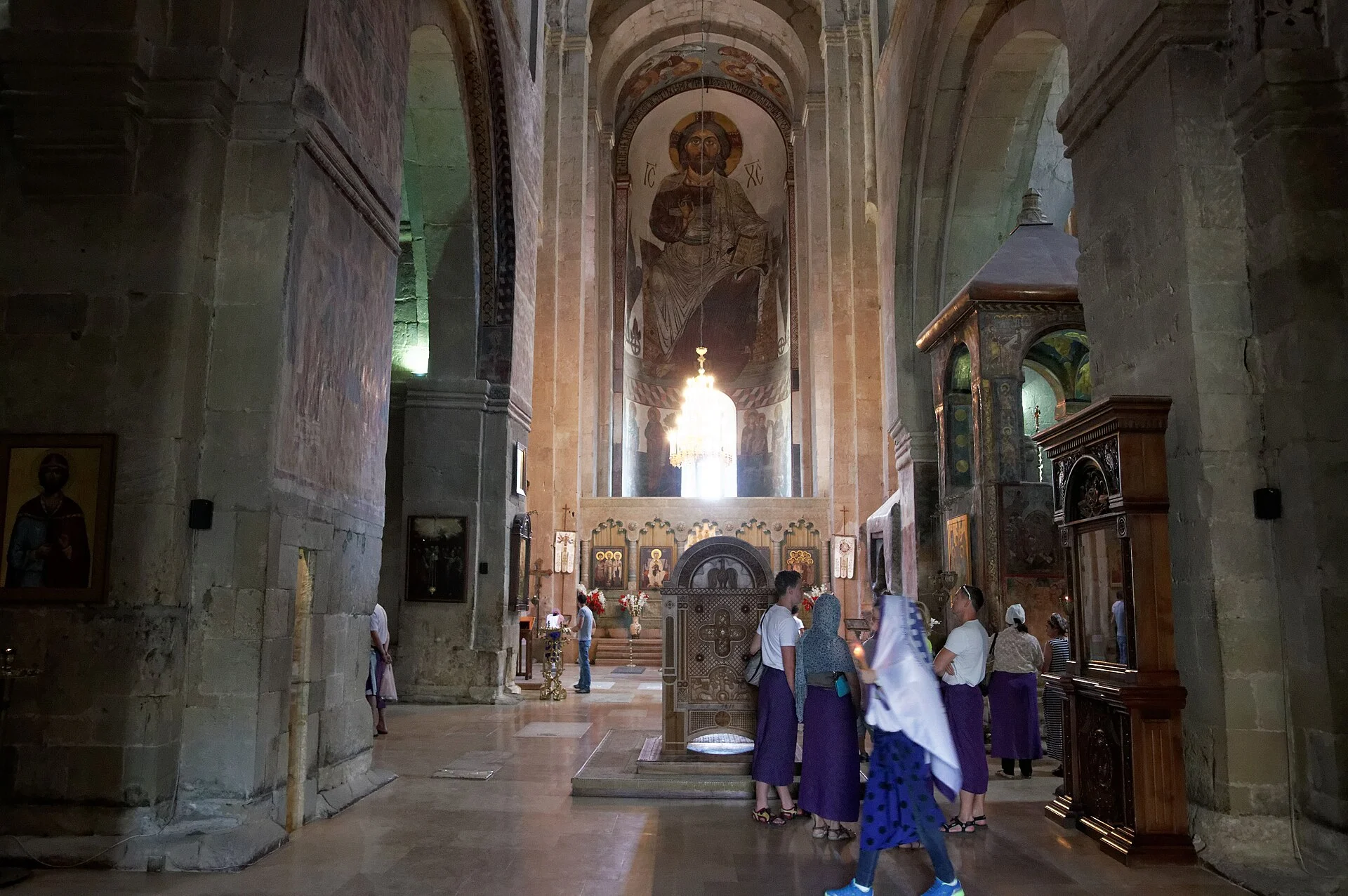
Yes, there is a dress code for Georgian Orthodox churches and monasteries, and it applies to every visitor regardless of faith: shoulders and knees covered for everyone, a headscarf for women, and long trousers rather than shorts for men. Photography of the building is usually fine, but not during an active service, not with flash near old frescoes, and never pointed at worshippers without asking. The rules are not written on a single national sign, so the surest approach is to watch what Georgians do at the door, borrow a scarf or wrap skirt if one is offered, and lower your voice once you are inside.
This guide sets out what to wear, how candles and icons work, when the liturgy happens, and the specifics of three sites every visitor asks about: Jvari, Svetitskhoveli and Gelati. It also flags monasteries where parts of the complex are closed to visitors, or to one sex, so you are not caught out on the day. Because practice varies slightly between a village church with one priest and a monastery that receives thousands of tourists, treat this as a reliable baseline and confirm anything specific to a working community through your guide or the parish itself before you go.
What to wear: skirts, trousers and head covering
Women are expected to cover their heads, shoulders and knees. A long skirt or a wrap over trousers is accepted at almost every working church and monastery; trousers alone are usually tolerated at major tourist sites such as Svetitskhoveli but not inside more conservative convents. Most well-visited churches keep a basket of headscarves and cloth wrap-skirts at the entrance, free to borrow and meant to be returned on the way out. Bring your own scarf if you prefer not to rely on a shared basket, and carry a light shawl in your daybag on any itinerary that includes churches, since you will rarely know in advance how strict a particular parish is.
Men should wear trousers, not shorts, and keep shoulders covered; a T-shirt is fine, a vest is not. Hats and caps come off indoors. Neither sex is required to remove shoes, which marks Georgian practice apart from mosques, though shoes are sometimes left at the door of very small chapels by local custom rather than rule.
- Women: headscarf, shoulders and knees covered, skirt or trousers with a wrap
- Men: long trousers, shoulders covered, hat off indoors
- Both: quiet voices, phones silent, no eating or drinking inside
Photography, phones and drones
General photography of church exteriors and courtyards is normally unrestricted. Inside, most monasteries allow photographs of architecture and frescoes without flash, but you should stop photographing the moment a service begins, and never photograph a priest mid-liturgy, a confession, or mourners at a funeral without permission. Tripods and monopods are discouraged in small churches where space is tight and worshippers are moving between icons. At UNESCO-listed complexes such as the Historical Monuments of Mtskheta and the Gelati Monastery, drones require prior permission from the relevant heritage authority and are not something to fly casually over an active monastic community; ask your guide or check with the site office on arrival rather than assume.
Candles, icons and basic behaviour
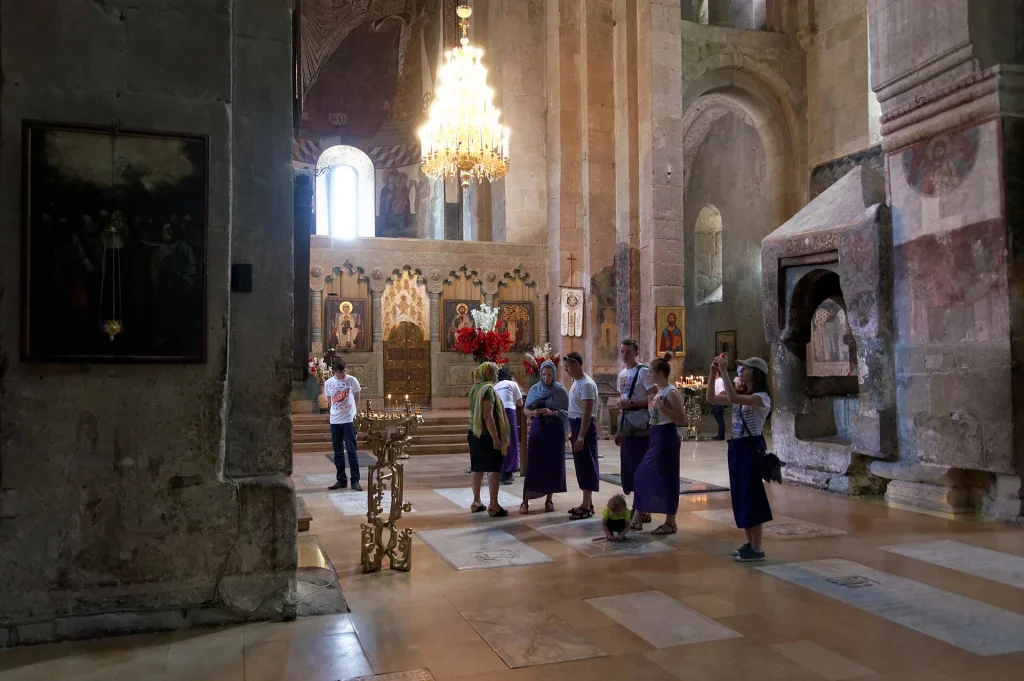
Candles are sold at a small stand just inside the door, usually for a modest lari donation left in an open box rather than a fixed price. There are generally two stands: one, often shaped like a cross or with many sockets near the centre of the church, is for candles lit for the living; a lower table near the edge or close to a memorial icon is for candles lit for the dead. If you are unsure which is which, watch where other visitors place theirs or ask a church attendant quietly.
Icons are approached, not touched with bare hands beyond a brief kiss on the edge of the frame or the saint’s hand or foot, never the face. It is normal to see people cross themselves on entering and before an icon; visitors who are not Orthodox are not expected to copy this, but should avoid walking directly in front of someone who is praying or lighting a candle. Keep to the edges of the nave during a service, and do not sit on pews reserved for the elderly or infirm, which in many Georgian churches are the only seating available since congregations traditionally stand throughout.
When the liturgy happens
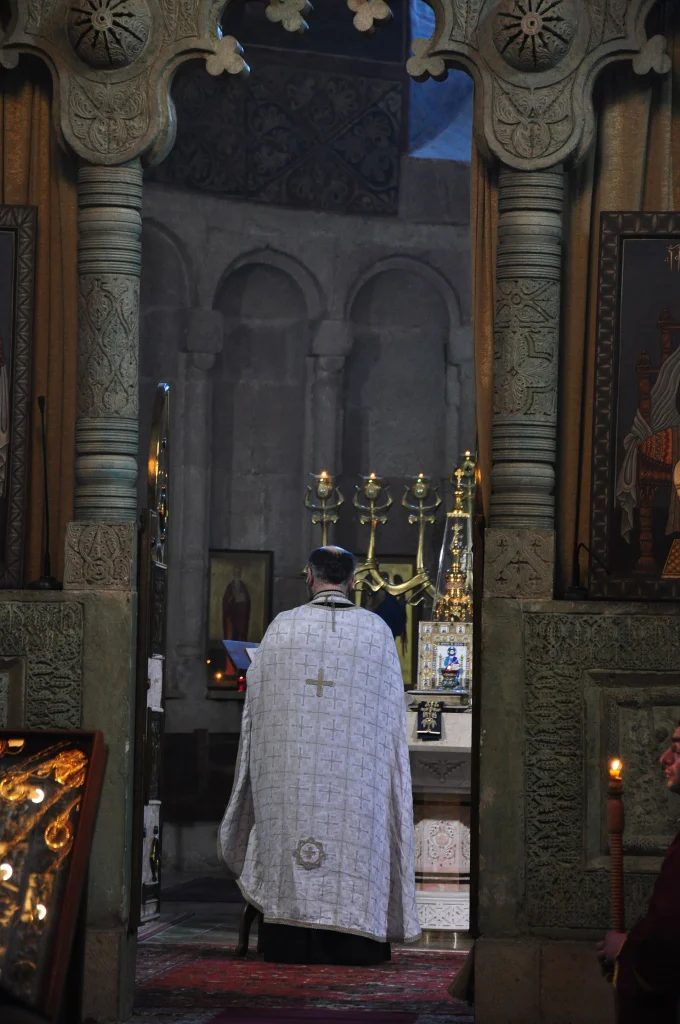
Georgian Orthodox parishes generally hold an evening service around 17:00 to 18:00 and a morning Divine Liturgy starting between 08:00 and 10:00, longer and more fully attended on Sundays and major feast days. Village monasteries sometimes follow a monastic rather than a parish timetable, with an earlier office before dawn. None of this is fixed nationally, and times shift for Lent, Christmas and Easter, so treat any schedule here as indicative rather than guaranteed, and ask locally or through your guide on the day. If you arrive during a liturgy, you are welcome to stand quietly at the back; do not walk the length of the church, photograph the altar area, or leave mid-service through the main doors if you can avoid it.
Jvari Monastery: the clifftop church above Mtskheta
Jvari sits on a narrow ridge above the confluence of the Mtkvari and Aragvi rivers, part of the Historical Monuments of Mtskheta UNESCO inscription. It is a small sixth-century domed church built around the site of a wooden cross raised by Saint Nino, and the interior is compact, so groups queue in turns rather than all entering at once. The dress code applies in full: headscarves for women are commonly offered at the door given how many coach groups pass through. Because the platform outside is popular for the panoramic view over Mtskheta, keep photography outside the building itself where there is more room, and move promptly once you have taken your photographs so others can do the same in the small interior.
Svetitskhoveli Cathedral: Georgia’s main cathedral
Svetitskhoveli, in the centre of Mtskheta, is the seat of the Catholicos-Patriarch and one of the largest and most visited churches in the country. As a major cathedral it sees a steady flow of pilgrims and tour groups, and it is one of the few sites where trousers alone are generally tolerated for women, though a headscarf is still expected and skirts or wrap-cloths are kept at the entrance for anyone who prefers one. Weddings, baptisms and funerals take place regularly inside, and visitors should step back and lower cameras if a private ceremony is underway, even if it was not announced. The courtyard and surrounding wall are open for photography; inside, avoid flash near the old frescoes and icon screen.
Gelati Monastery: frescoes, academy and a working community
Gelati, outside Kutaisi, is a functioning monastery as well as a UNESCO World Heritage Site, home to the tomb of King David the Builder and to some of the best-preserved medieval frescoes in the country. Because monks live and worship here, the dress code is applied more consistently than at purely touristic churches, and quiet is expected even in the courtyard. Photography without flash is generally permitted in the main church, but the smaller side chapels and the Academy building may have their own signs restricting photography to protect the paintings; follow any posted notice rather than the general rule. If a service is in progress in the main church, visitors are usually still allowed to view other buildings in the complex.
Monasteries with restricted areas, and women’s and men’s sections
A handful of Georgian monastic sites have areas that are closed to general visitors, or to one sex, usually because the community is small, the space is a working monk’s or nun’s cell, or the site sits in a sensitive border zone. At Davit Gareja, the upper cave complex of Udabno and the frescoed caves of Bertubani lie close to or across the administrative line with Azerbaijan; access to Bertubani in particular has been intermittently restricted for border reasons rather than gender, and this changes without much notice, so check current access with your guide or tour operator before planning a visit that depends on reaching it. Some smaller active monasteries operate as single-sex communities, meaning the inner cells and monks’ or nuns’ quarters are not open to the opposite sex or to any visitor; the public church itself remains open to all. Inside a church during a service, it is common in Georgian tradition for men to stand toward the right of the nave, nearer the altar side, and women toward the left, though this is custom rather than strict law and is not enforced on casual visitors outside service times. When in doubt, a quiet question to an attendant, monk or your guide before stepping past a rope or half-open door is always the right move, rather than assuming a space is open because it looks accessible.
Travellers who want all of this handled without guesswork can book a guided route built around churches and monasteries, such as the Mtskheta Half-Day — Jvari and Svetitskhoveli from Tbilisi, the Gelati, Motsameta and Tskaltubo — Kings, Saints and Soviet Spas day trip from Kutaisi, the longer Monasteries of Georgia — Mtskheta, the Thirteen Fathers and Kakheti in 3 Days, the Christian Georgia — Pilgrimage and Sacred Heritage in 8 Days itinerary, or the David Gareji — Desert Monasteries on the Edge of Georgia day trip, all of which include a licensed guide who can explain etiquette and check access on the day.
If this guide is part of a trip you are planning, our Western Georgia in 6 Days — Kutaisi, Svaneti and the Sea and Mestia to Kutaisi or Zugdidi Transfer cover the places it describes with a private guide and driver; a GTour travel expert adapts the route to your dates.
Practical summary
- Women: headscarf, covered shoulders and knees, skirt or wrap over trousers; borrow a scarf at the door if needed
- Men: long trousers, covered shoulders, no hat indoors
- No flash photography near old frescoes; stop photographing entirely once a liturgy begins
- Drones over monastery complexes need prior permission, not a spur-of-the-moment flight
- Light candles at the correct stand: upright for the living, the lower table for the dead
- Services typically run roughly 08:00 to 10:00 and 17:00 to 18:00, longer on Sundays and feast days; confirm locally, schedules shift for Lent, Christmas and Easter
- Some areas at Davit Gareji and at small active monasteries may be closed to visitors or to one sex; ask before entering
- Verify anything time-sensitive through your guide, the parish, or the official heritage site before you travel
Sources
- Historical Monuments of Mtskheta
- Bagrati Cathedral and Gelati Monastery
- UNESCO World Heritage – Upper Svaneti
- UNESCO Intangible Cultural Heritage – Georgia (state party page)
- Lonely Planet – Mtskheta Destination Guide
- Lonely Planet – Kutaisi Destination Guide (Gelati access)
- Lonely Planet – Svaneti Destination Guide
Questions this guide does not answer? Write to info@castle.ge or WhatsApp +995 577 41 63 14 — a person in Tbilisi replies. See also our travel services and all guides.
Women in headscarves and long skirts visit Svetitskhoveli Cathedral, showing the expected dress code. · Photo: Vyacheslav Argenberg / Wikimedia Commons, CC BY 4.0
Been to Georgia? Tell us how it went — the best stories are published here.
Share your tripOne email a week: what changed for travellers in Georgia — rules, roads, flights, seasons — plus one place worth the trip. Written by the GTour desk, no advertising, unsubscribe in one click.
This story across our partner network — ქართულად: შენი დასვენება
