

By Mariam Lomidze, Culture & Events Reporter · 01/11/2026
Kutaisi, Georgia’s second city and the historic capital of the ancient kingdom of Colchis, sits on the Rioni river about 220 km west of Tbilisi and makes the natural base for exploring Imereti. In a single day you can stand inside an 11th-century cathedral, climb to a UNESCO-listed monastery that once housed a medieval academy, and walk a canyon-top steel walkway bolted to limestone cliffs; in two or three you can add the radon spa town of Tskaltubo and a proper Imeretian table of khachapuri and badrijani.
This guide covers the six things visitors actually ask about: Kutaisi’s double role as capital of Colchis and later of a unified Georgia, the Bagrati Cathedral restoration that cost it UNESCO status, Gelati Monastery which kept it, the Motsameta cliff church, the Prometheus Cave–Sataplia–Okatse cluster of karst attractions, and the Tskaltubo spa quarter. Distances are short enough that most of this is doable as day trips from Kutaisi, Batumi or even Tbilisi, and Kutaisi International Airport puts the whole region within an hour of landing.
Kutaisi as capital of Colchis and later of Georgia
Kutaisi’s documented history runs back to the first millennium BC, when the Greek world placed the kingdom of Colchis on the Rioni (then the Phasis), the setting of the Argonauts and Golden Fleece story that still colours how the region markets itself. The city later became capital of the Egrisi and Abkhazian kingdoms, and in 1008 King Bagrat III crowned the unification of western and eastern Georgia here, making Kutaisi capital of the first single Georgian kingdom before Tbilisi took over that role under David the Builder’s successors. Kutaisi briefly served again as the seat of Georgia’s parliament between 2012 and 2018, a modern coda to a long political history. For background on the ancient kingdom and its Greek-world contacts, Britannica’s overview of Colchis is a reasonable starting point, and the UNESCO World Heritage entry for the Gelati property sets out the medieval context in more detail.
A short walking tour (Kutaisi Walking Tour) or a half-day combining Bagrati with the Green Bazaar (Kutaisi Half-Day) covers the old town, the bridges over the Rioni and the market in two to four hours.
Bagrati Cathedral: an 11th-century crown and a restoration dispute
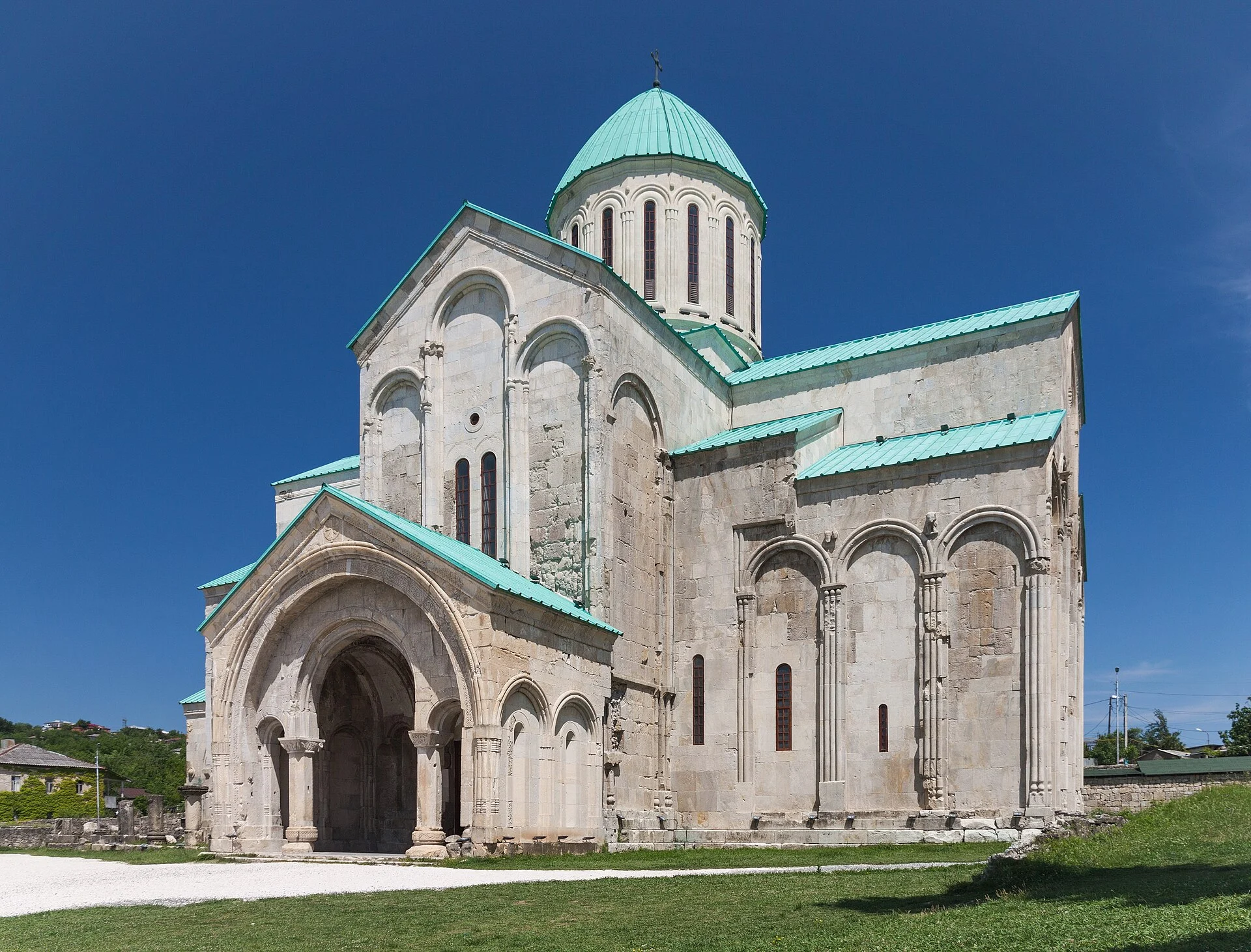
Bagrati Cathedral was built in 1003 on the Ukimerioni hill above the Rioni, under the king for whom it is named, and stood as the coronation church of the unified Georgian kingdom. Ottoman forces blew up its dome in 1691, and for three centuries it stood as a roofless ruin, revered but structurally frozen. Between 2009 and 2012 the Georgian government carried out a full reconstruction, adding a new dome, glass sections and modern materials rather than restoring the building to its ruined state or rebuilding it archaeologically.
UNESCO’s World Heritage Committee had inscribed “Bagrati Cathedral and Gelati Monastery” together in 1994. The committee judged the 2012 reconstruction to have compromised the cathedral’s authenticity under the Venice Charter principles that govern World Heritage conservation, and in 2017 it removed Bagrati from the property, renaming the listing simply “Gelati Monastery.” The decision remains a reference case in heritage circles for how far reconstruction can go before a monument loses its World Heritage value; Georgian authorities maintain the church is now a living place of worship rather than a frozen ruin. Readers wanting the primary record should check the official UNESCO documentation for the property, since committee decisions and boundary descriptions can be revisited.
Gelati Monastery: still on the UNESCO list, still a working academy site
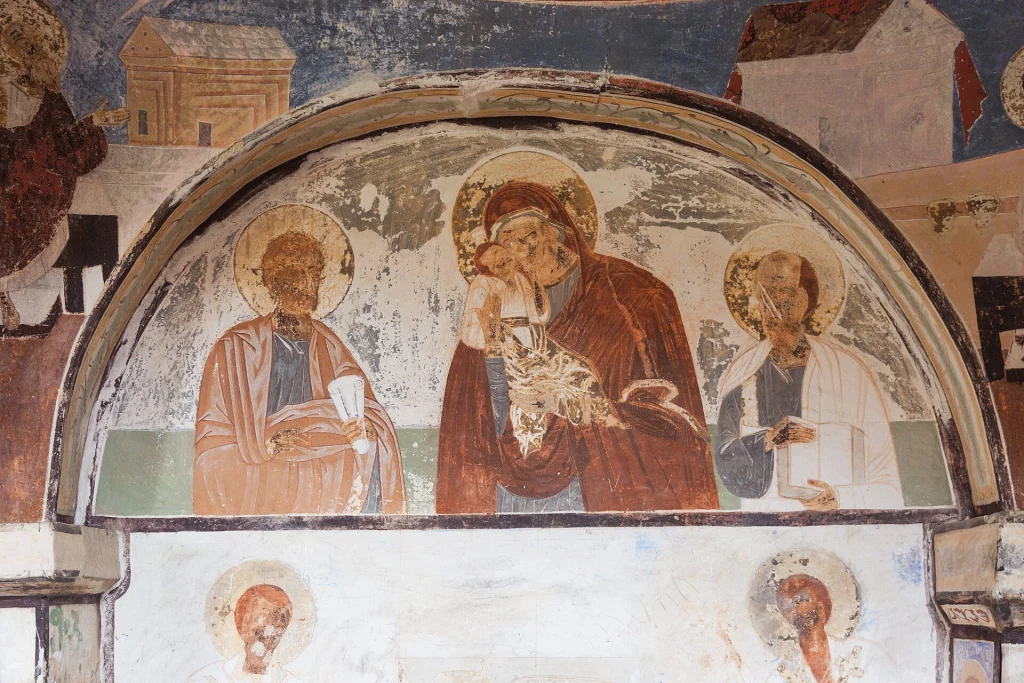
Gelati, founded in 1106 by King David the Builder a few kilometres outside Kutaisi, kept its full World Heritage status when Bagrati lost its share of the listing. It functioned as a monastery, royal mausoleum and one of medieval Georgia’s main centres of learning, with an academy that combined theology, philosophy, science and rhetoric and that attracted scholars after the fall of Byzantine academic centres. The main Cathedral of the Virgin, the chapels of Saint Nicholas and Saint George, and the surviving mosaic of the Virgin and Child in the apse are the core reasons it is usually paired with Bagrati on a single itinerary, even though only Gelati carries the UNESCO designation today. David the Builder is buried at the monastery gate, reputedly asking to be interred where visitors would step over him.
Gelati, Motsameta and the Tskaltubo spa quarter fit neatly into a single half-day loop from Kutaisi (Gelati, Motsameta and Tskaltubo — Kings, Saints and Soviet Spas), and both monasteries also appear on the wider UNESCO-themed route (Georgia’s UNESCO Heritage in 5 Days).
Motsameta: a cliffside memorial above the Tskaltsitela
Motsameta Monastery sits on a rocky spur above the Tskaltsitela river gorge, a short drive from Gelati. It commemorates two eighth-century Georgian noblemen, David and Constantine Mkheidze, martyred by Arab invaders and later canonised; their relics rest inside the small church, and local tradition holds that crawling three times under the reliquary brings a wish. The site is small compared with Gelati, and its value is as much the setting, perched above the gorge with the river visible far below, as the building itself. It is usually visited together with Gelati on the same short outing rather than as a separate trip.
Caves and canyons: Prometheus, Sataplia and Okatse
Imereti’s karst limestone has produced some of Georgia’s most visited natural attractions, all within 30 to 45 minutes of Kutaisi.
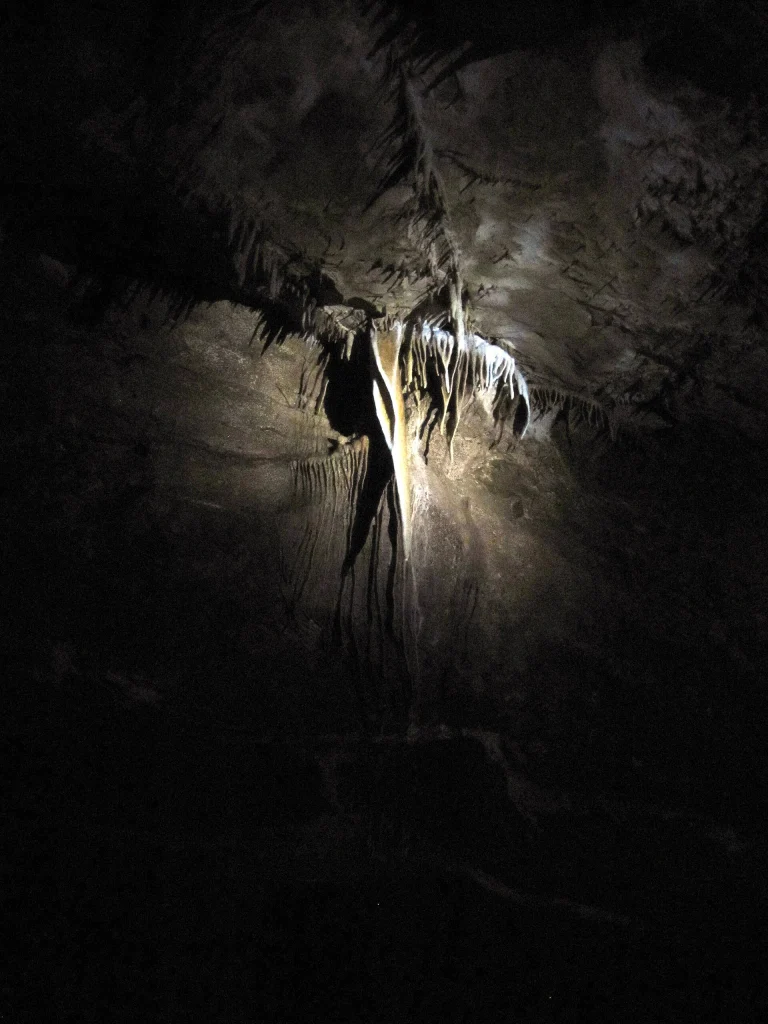
- Prometheus Cave (Kumistavi Cave), near Tskaltubo, is a large show cave with illuminated stalactite chambers and an underground river; a boat ride covers part of the route.
- Sataplia Nature Reserve, closer to Kutaisi, combines a cave with fossilised dinosaur footprints and a glass-floored viewing platform over the karst landscape and, on clear days, towards the Black Sea.
- Okatse Canyon, in the hills toward Samegrelo, offers a cantilevered steel walkway bolted into the canyon wall roughly 100 metres above the Khikha river, not for those uneasy with heights or exposed drops.
These three protected areas are managed under Georgia’s state nature reserve and protected landscape system; current opening hours, ticket prices and any seasonal closures should always be checked on the Agency of Protected Areas site before travelling, since hours shift between summer and winter seasons. Martvili Canyon, slightly further west in Samegrelo, is commonly combined with Okatse and Prometheus on the same long day.
| Tour | Duration | Solo | Per person, 2 | Per person, 4–6 |
|---|---|---|---|---|
| Prometheus Cave, Martvili Canyon and Okatse — the Big Three from Kutaisi | 9 hours | €304 | €190 | €162 |
| Martvili & Okatse Canyons + Prometheus Cave — Day Trip from Kutaisi | 9 hours | €304 | €190 | €162 |
| Prometheus Cave and Martvili Canyon from Batumi | 11 hours | €344 | €215 | €183 |
| Katskhi Pillar and Chiatura — the Monk’s Rock and the Cable-Car Town | 7 hours | €272 | €170 | €145 |
Tskaltubo: Soviet spa grandeur and radon-carbonate water
Tskaltubo, 10 km from Kutaisi, built its reputation on naturally warm, slightly radioactive radon-carbonate mineral water, used since the Soviet era for balneological treatment of joint, circulatory and nervous conditions. Nineteen grand sanatoria were built here between the 1920s and 1970s, most now abandoned or partially restored, and several bathhouses and a handful of renovated sanatoria still operate working baths. As with any treatment involving radon water or mud therapy, benefits and contraindications depend on individual health, and anyone with a specific condition should discuss a spa cure with their own doctor before booking; general, population-level health guidance for Georgia is published by the National Center for Disease Control and Public Health. We run both a short introduction and a full cure (Tskaltubo Short Cure — 3 Nights and Tskaltubo Cure — 7 Nights), and Tskaltubo also appears as part of the Gelati–Motsameta loop above.
Imeretian cuisine and the Kolkheti lowlands
Imereti gave Georgia its most widely eaten regional dish, Imeretian khachapuri, a round bread filled with a mild, slightly tart local cheese rather than the egg-and-butter boat of its Adjarian cousin. Local tables also lean on ghomi (a cornmeal porridge related to mchadi), lobio bean dishes, satsivi walnut sauce, and the abundant greens and pickles of the Rioni valley. Imereti’s wines, made mostly from Tsitska and Tsolikouri grapes, tend lighter and drier than eastern Kakheti‘s amber wines; a dedicated route covers both this and neighbouring Racha (Western Wine — Imereti and Racha in 3 Days).
The lowland strip west of Kutaisi, toward Poti and the Black Sea, carries the name Kolkheti in its modern form too: Kolkheti National Park protects relict wetland forest and is listed as a Ramsar wetland of international importance, a different, flatter landscape from the karst hills around Kutaisi itself. Those heading that way can combine it with the coast on a day trip (To the Black Sea — Poti, Paliastomi Lake and Ureki Magnetic Sand); the formal designation can be checked on the Ramsar Secretariat’s site listings.
If this guide is part of a trip you are planning, our Western Georgia in 6 Days — Kutaisi, Svaneti and the Sea and Mestia to Kutaisi or Zugdidi Transfer cover the places it describes with a private guide and driver; a GTour travel expert adapts the route to your dates.
Practical summary
- Base yourself in Kutaisi; Bagrati, Gelati and Motsameta are each under 20 minutes away, Tskaltubo and the cave cluster under 45 minutes.
- Bagrati Cathedral (1003) was removed from UNESCO’s joint listing in 2017 after its 2009–2012 reconstruction; only Gelati Monastery (1106) now carries World Heritage status, verify current status at whc.unesco.org.
- Prometheus Cave, Sataplia and Okatse are managed as protected areas with seasonal hours, check apa.gov.ge before you go.
- Radon-carbonate baths at Tskaltubo should be discussed with your own doctor if you have a specific medical condition.
- Kutaisi International Airport makes western Georgia a practical arrival point without transiting Tbilisi; see our airport transfer and multi-day western routes, including Kutaisi & Western Georgia in 3 Days and Western Georgia in 5 Days.
- Try Imeretian khachapuri in Kutaisi’s Green Bazaar before comparing it with Adjarian versions on the coast.
Sources
- UNESCO World Heritage listing, Gelati Monastery
- Agency of Protected Areas
- Georgia National Tourism Administration
- Agenda.ge
- Georgia Today
Questions this guide does not answer? Write to info@castle.ge or WhatsApp +995 577 41 63 14 — a person in Tbilisi replies. See also our travel services and all guides.
Bagrati Cathedral (1003) crowns the hill above Kutaisi, Georgia's medieval capital. · Photo: Marcin Konsek / Wikimedia Commons, CC BY-SA 4.0
Been to Georgia? Tell us how it went — the best stories are published here.
Share your tripOne email a week: what changed for travellers in Georgia — rules, roads, flights, seasons — plus one place worth the trip. Written by the GTour desk, no advertising, unsubscribe in one click.
This story across our partner network — ქართულად: შენი დასვენება
