

By Prof. Giorgi Pkhakadze, MD, MPH, PhD · 15/09/2026
Mtskheta is a small town with a very large church. Svetitskhoveli fills its centre the way a cathedral fills a French village — out of all proportion, deliberately. It is the burial place of Georgian kings, the seat of the Georgian church for fifteen centuries, and the site of a story that every Georgian child can tell.
The story
In the first century, so it goes, a Jewish merchant from Mtskheta named Elias was in Jerusalem on the day of the crucifixion. He bought the robe of Christ from a soldier and brought it home. His sister Sidonia took it in her hands, was overcome, and died holding it; the robe could not be prised from her grip, and she was buried with it. From her grave grew a cedar.
Three hundred years later, when Saint Nino brought Christianity to Georgia and King Mirian ordered a church built on the spot, the cedar was cut into seven pillars. Six were raised. The seventh rose into the air by itself and would not come down until Nino prayed all night; then it settled, and from it flowed a sap that healed the sick. Sveti-tskhoveli means “the life-giving pillar”. The cathedral you see was built around the place where it stood.
You do not have to believe this to understand what it did. It gave a small kingdom at the edge of the Roman and Persian worlds a claim to the centre of the Christian story — a relic to rival anything in Constantinople. Georgia has been arguing for its place among the great civilisations ever since, and Svetitskhoveli is the argument in stone.
The building
The church of King Mirian is gone; so is the one that replaced it. The cathedral standing today was finished in 1029, under the architect Arsukisdze, whose name is carved over the north gate with a severed hand beside it — legend says the king had it cut off so that nothing finer could ever be built. It is a cross-domed church of golden sandstone, immense inside, with a drum and cone that dominate the valley. Earthquakes, Timur and the Persians all damaged it; each time it was rebuilt to the same plan.
Inside, the pillar is marked by a stone canopy painted with scenes from the story. Around it, the floor is a map of Georgian history: the graves of Vakhtang Gorgasali, who founded Tbilisi; of Erekle II, the last king of Kartli-Kakheti; of the Bagrationi dynasty that ruled for a thousand years. A copy of the Jerusalem chapel of the Holy Sepulchre stands in one corner. The frescoes are 17th-century, faded, with a zodiac wheel that surprises everyone.
The town and the view
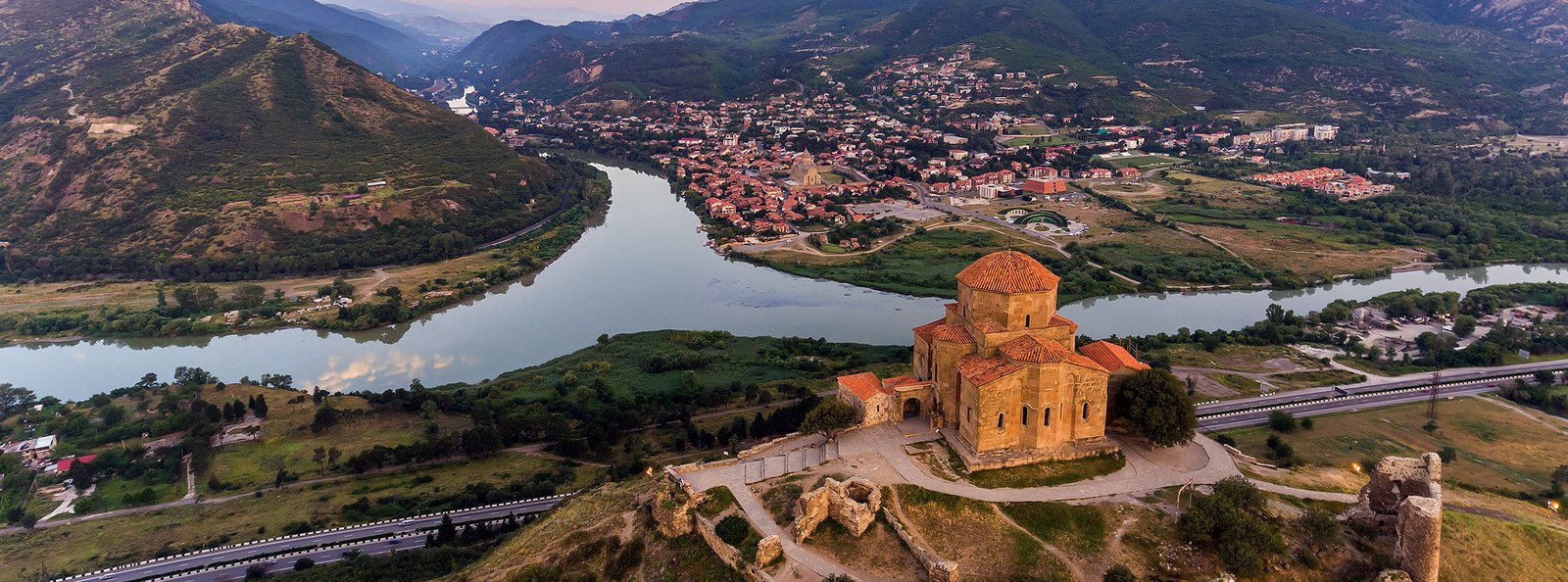
Mtskheta was Georgia’s capital until the 5th century, and it sits where the Aragvi meets the Kura — a strategic junction then, a picture now. Across the river, on a bluff, is Jvari, the 6th-century church built where Nino planted her first cross; from its terrace you look straight down on the cathedral and the confluence, the view that decorates every book about Georgia. The two churches are meant to be seen together: Jvari the cross, Svetitskhoveli the pillar.
See it with GTour
Svetitskhoveli and Jvari are the afternoon of our Tbilisi & Mtskheta essential first day, and the first stop on the road north in the Kazbegi 2-day journey and the Georgia in 7 days grand tour.
ქართულად: სვეტიცხოველი — ქრისტეს კვართი და კედარი, რომელიც მისგან ამოვიდა
