

By David Kiknadze, Transport & Openings Reporter · 29/10/2026
Georgia’s wildlife risk, in plain terms, is lower than most hikers imagine for bears, wolves and lynx, and higher than most imagine for livestock-guarding dogs, ticks and the occasional viper. Brown bears, grey wolves and lynx all live in Georgia’s forests and high pastures, and the Caucasian tur grazes the alpine ridges above Tusheti, Khevsureti, Svaneti and Kazbegi, but genuine predator attacks on hikers are rare and not the thing that actually hurts people in the mountains each summer.
The real, statistically ordinary danger on a Georgian trail is a large, unleashed Caucasian shepherd dog defending a flock, followed by tick bites, dehydration and falls on scree. This guide sets out what lives where, how to behave around bears, wolves and lynx, how to watch tur and bearded vultures responsibly, what makes Vashlovani’s steppe fauna different from the mountains, and the national-park rules that keep both you and the animals safe. Where a rule, fee or closure date could change, we say so and link the agency that keeps it current.
What lives where: a quick regional map
Georgia sits across the Caucasus ecoregion, and its protected areas were drawn to cover distinct habitats, from alpine ridge to semi-desert. The table below is a starting point, not a guarantee of sightings; most of these animals are shy and nocturnal or crepuscular.
| Species | Typical habitat | Where to look |
|---|---|---|
| Brown bear | Mixed and coniferous forest, forest edge | Borjomi-Kharagauli, Lagodekhi, Racha, Svaneti forests |
| Grey wolf | Forest and high pasture, wider range in winter | Widespread; more visible near summer pastures |
| Lynx | Remote, dense forest | Rarely seen anywhere; mostly camera-trap records |
| Caucasian tur (two species) | Alpine and subalpine cliffs, 2,500–4,000 m | Tusheti, Khevsureti, Kazbegi, Svaneti ridgelines |
| Bearded vulture (lammergeier) | High cliffs and gorges | Kazbegi, Svaneti, and the canyons of Vashlovani |
| Goitered gazelle | Steppe and semi-desert | Vashlovani National Park |
| Striped hyena | Semi-desert, scrub | Vashlovani area, nocturnal and seldom seen |
For current species lists and park boundaries, the Agency of Protected Areas maintains pages for each national park, including Borjomi-Kharagauli, Lagodekhi, Tusheti and Vashlovani, which is worth checking before any trip since trail status and seasonal closures change.
The real risk is the dog, not the bear
Ask Georgian rangers and mountain guides what actually sends hikers to hospital, and the honest answer is rarely a predator. It is Caucasian shepherd dogs, large, territorial breeds left with flocks on summer pastures in Tusheti, Khevsureti, Racha and the Kazbegi highlands, with no human in sight for long stretches. These dogs are working animals, not pets, and they treat an approaching hiker exactly as they treat a wolf: as a threat to the flock.
The second most common problem is not glamorous either: ticks (some carrying tick-borne encephalitis or Crimean-Congo haemorrhagic fever in parts of the region), dehydration, sunburn above the tree line, and falls on wet scree or river crossings. None of this is unique to Georgia, but it is far more likely to end your trip than a bear is.
- If dogs approach: stop, do not run, avoid direct eye contact, keep your body side-on, and back away slowly toward the shepherd or the road. A raised trekking pole and a calm, low voice work better than shouting.
- Carry a stick or poles on any route that crosses summer pasture, and check for dogs before approaching a flock from a distance.
- Check your skin and clothing for ticks after walking through long grass or scrub; remove any promptly and watch the bite site for days afterward.
- Any animal bite, dog or wild, should be treated as a possible rabies exposure: wash the wound thoroughly and see a doctor without delay, since Georgia does report rabies in foxes and dogs. This is medical advice to act on, not to assess yourself.
Bears, wolves and lynx: how to behave
Brown bears in Georgia are shy of people and most encounters, when they happen at all, are a brief glimpse before the animal moves off. Standard forest practice reduces the odds of a surprise meeting: talk or make occasional noise on blind corners and in berry season, keep food sealed and never left in a tent, and give any bear you do see plenty of space and a way to retreat. Never approach a bear with cubs, and never run; back away slowly while facing the animal.
Wolves in Georgia overwhelmingly avoid humans and attacks on people are not a realistic concern for hikers; the more relevant interaction is wolves taking livestock, which is part of why shepherd dogs are so vigilant. Lynx are solitary, nocturnal and so elusive that most Georgian naturalists go years without a confirmed sighting outside a camera trap; they pose essentially no risk to hikers.
None of this removes the value of planning with people who know the ground. A guide familiar with current bear activity, dog placements and river levels is worth more than any single rule of thumb, which is the reasoning behind routes such as Borjomi-Kharagauli National Park Trek and Tusheti — Georgia’s Last Wild Frontier, both run with local guides who know the season’s conditions.
The Caucasian tur and the bearded vulture
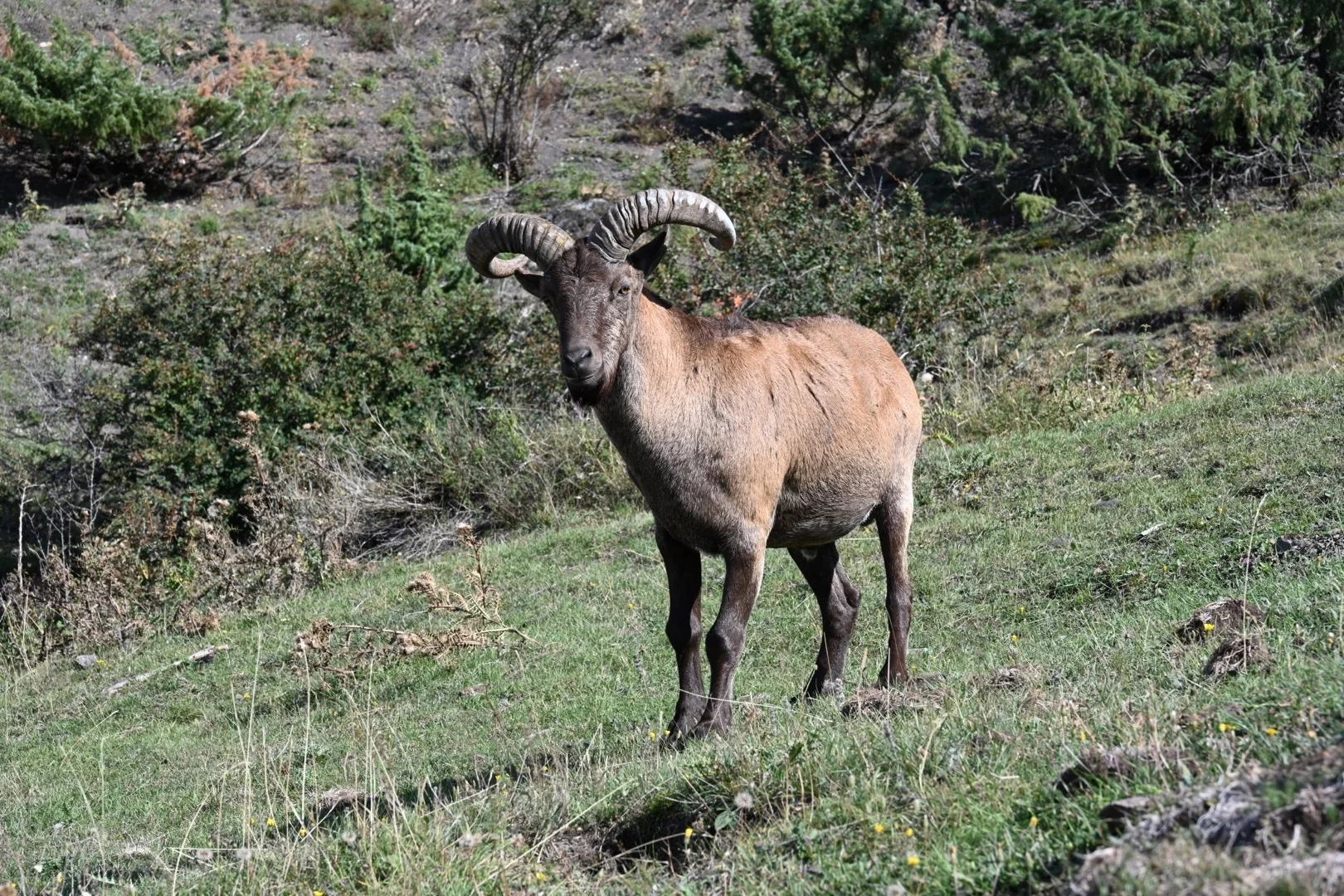
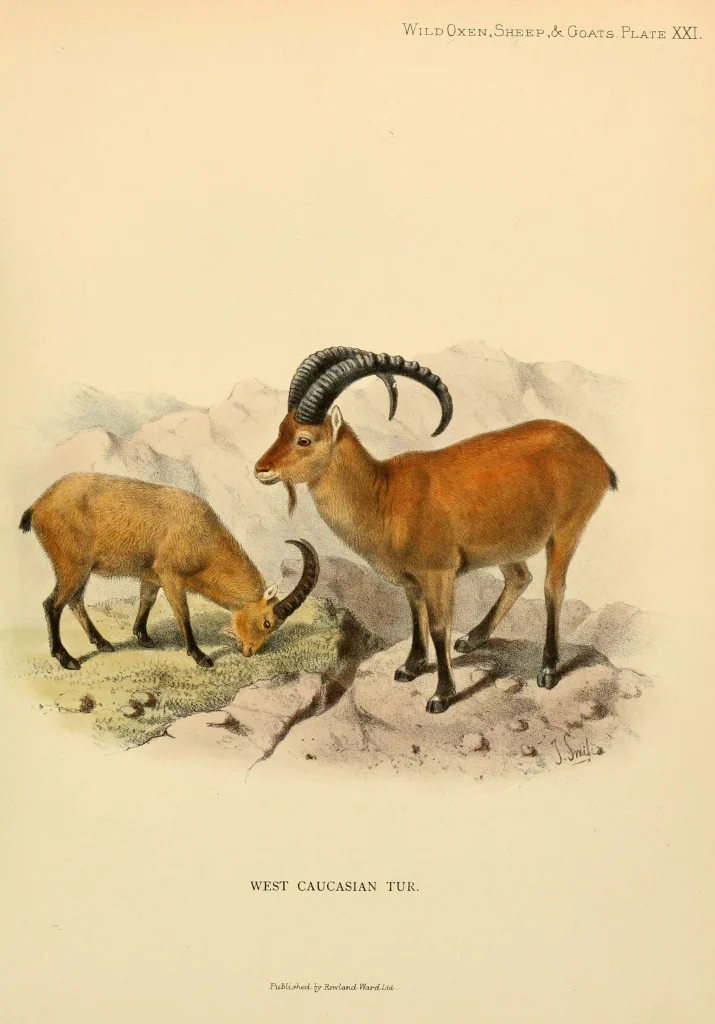
The Caucasian tur, a stocky wild goat with backswept horns, is split by biologists into two closely related species, the West Caucasian tur and the East Caucasian tur, and Georgia’s high ridges hold populations of the eastern form. Tur graze steep alpine slopes well above the tree line and are most visible at dawn and dusk, often as small herds picked out against scree or snow patches. Binoculars matter more than a long lens here: the animals are genuinely distant, and a guide who knows which ridge a herd has favoured that week saves hours of scanning. Good vantage points include the ridgelines around Juta and the Chaukhi massif, reached on the Chaukhi Pass Day Hike, and the high pastures above Mestia and Ushguli covered on Svaneti Day Hikes and the Mestia to Ushguli Trek.
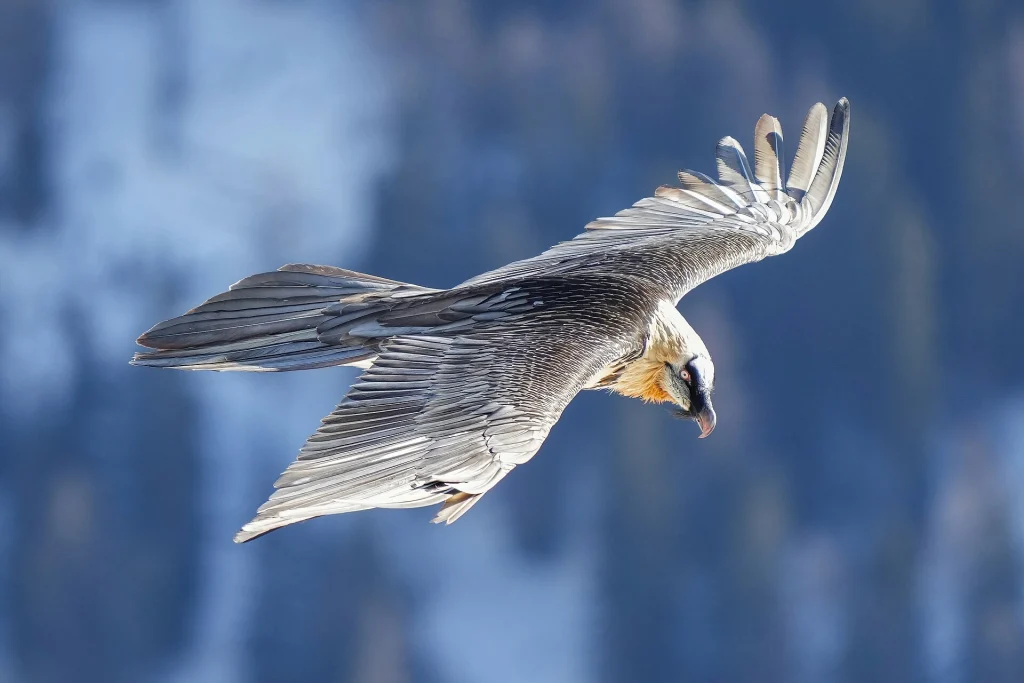
The bearded vulture, also called the lammergeier, is the Caucasus’s most striking raptor, a huge bird with a diamond-shaped tail that feeds largely on bone marrow, dropping large bones onto rocks to split them open. It nests on inaccessible cliff ledges in the high Caucasus and in the canyon walls of Vashlovani, and its population across its range is assessed as Near Threatened, so sightings should be enjoyed from a distance that does not disturb nesting pairs, particularly in spring. The bird is a strong argument for travelling with binoculars whenever a trek brings you near cliffs, whether on the Gergeti Glacier and Kazbek Base Camp route or a Vashlovani day in the canyons.
Vashlovani: Georgia’s steppe and semi-desert fauna
Vashlovani National Park, in the far southeast corner of the country on the border with Azerbaijan, is a different Georgia entirely: semi-desert, dry steppe and badland canyons rather than forest and snow. Its signature mammal is the goitered gazelle, a small, pale antelope that was pushed to the edge of extinction in the region by the mid-twentieth century and has recovered under protection; sightings require patience, open ground and, usually, a 4×4 and a local guide who knows which gullies the herds favour that season. Striped hyena are present but rarely seen, being nocturnal and wary, and the park’s cliffs and canyons also host bearded vultures, Egyptian vultures and other raptors that are easier to spot than the mammals.
Vashlovani’s climate is a hazard in its own right: summer heat is severe, water sources are limited away from the Alazani river, and flash floods can close canyon routes after rain with little warning, which is why rangers restrict access on short notice in bad weather. Reptiles, including vipers, are more common here than in the mountains, so sturdy boots and watching where you place your hands on rocks matter more in Vashlovani than almost anywhere else in Georgia. We do not currently run a dedicated Vashlovani tour, but travellers who want this landscape typically pair it with the nearby semi-desert of Davit Gareji — Desert Monasteries on the Edge of Georgia, or arrange a custom day with Car with Driver by the Day and a specialist guide booked in advance.
Watching wildlife responsibly in the national parks
Georgia’s national parks, administered by the Agency of Protected Areas, generally require visitors to register with a ranger station, stay on marked trails in zones with wildlife protection, and avoid any feeding, baiting or close approach of animals. Hunting is banned inside national park core zones, and some wildlife, including the tur and the bearded vulture, has additional legal protection as a matter of national law, so photographing from a respectful distance is both the safer and the lawful choice. Rules, entrance fees and seasonal trail closures vary park by park and do change, so the agency’s own pages for each park are the reference to check close to your travel date, including the current status for Tusheti and Vashlovani.
- Register at the ranger station or visitor centre on arrival, and ask directly about recent bear, dog or weather issues on your planned route.
- Keep at least 100 metres from any tur, vulture nest or other wildlife where possible, and never attempt to feed or herd animals for a photograph.
- Carry a printed or offline map; mobile coverage disappears quickly in Tusheti, Khevsureti and much of Vashlovani.
- Book a guide for anything beyond a short marked loop. Licensed Private Guide by the Day covers wildlife-aware itineraries across these regions, and multi-day routes such as 4×4 Expedition — Tusheti, Khevsureti and Kazbegi in 8 Days build in the local knowledge that keeps both dog and weather problems manageable.
If this guide is part of a trip you are planning, our Western Georgia in 6 Days — Kutaisi, Svaneti and the Sea and Mestia to Kutaisi or Zugdidi Transfer cover the places it describes with a private guide and driver; a GTour travel expert adapts the route to your dates.
Practical summary
- Biggest real risk: shepherd dogs on summer pastures, not bears, wolves or lynx.
- Dog encounter: stop, do not run, avoid eye contact, back away slowly toward the shepherd.
- Bears: make noise on blind corners, never approach cubs, store food sealed, back away slowly if seen.
- Any bite from a dog or wild animal: wash thoroughly and see a doctor promptly for rabies risk assessment.
- Tur and bearded vultures: watch from distance with binoculars, best at dawn and dusk on high ridges.
- Vashlovani: expect heat, flash-flood risk and vipers; travel with a guide and a 4×4.
- Check current park rules and closures with the Agency of Protected Areas before you go.
- Book guided routes for remote areas: a local guide reduces dog, weather and route-finding risk at once.
Sources
- Ministry of Environmental Protection and Agriculture
- Caucasian Tur species page, IUCN
- Agenda.ge, shepherd dogs warning for hikers
Questions this guide does not answer? Write to info@castle.ge or WhatsApp +995 577 41 63 14 — a person in Tbilisi replies. See also our travel services and all guides.
The East Caucasian tur, a wild mountain goat species found in Georgia's high peaks. · Photo: Лариса Артемьева / Wikimedia Commons, CC0
Been to Georgia? Tell us how it went — the best stories are published here.
Share your tripOne email a week: what changed for travellers in Georgia — rules, roads, flights, seasons — plus one place worth the trip. Written by the GTour desk, no advertising, unsubscribe in one click.
This story across our partner network — ქართულად: შენი დასვენება
