

Stalin Museum, Gori — opening hours, tickets, how to get there and what to see
The Stalin Museum sits in central Gori, Shida Kartli, built around the wooden house where Joseph Stalin was born in 1878 and the personal railway carriage he used to travel to the Tehran, Yalta and Potsdam conferences in the 1940s. It opened in its current form in 1957 and remains one of the only state-run museums anywhere still presenting its subject largely as a national historical figure rather than a wartime dictator responsible for mass repression. For travellers it is usually paired with the cave town of Uplistsikhe, 10 kilometres east, on a half-day trip from Tbilisi.
What you see
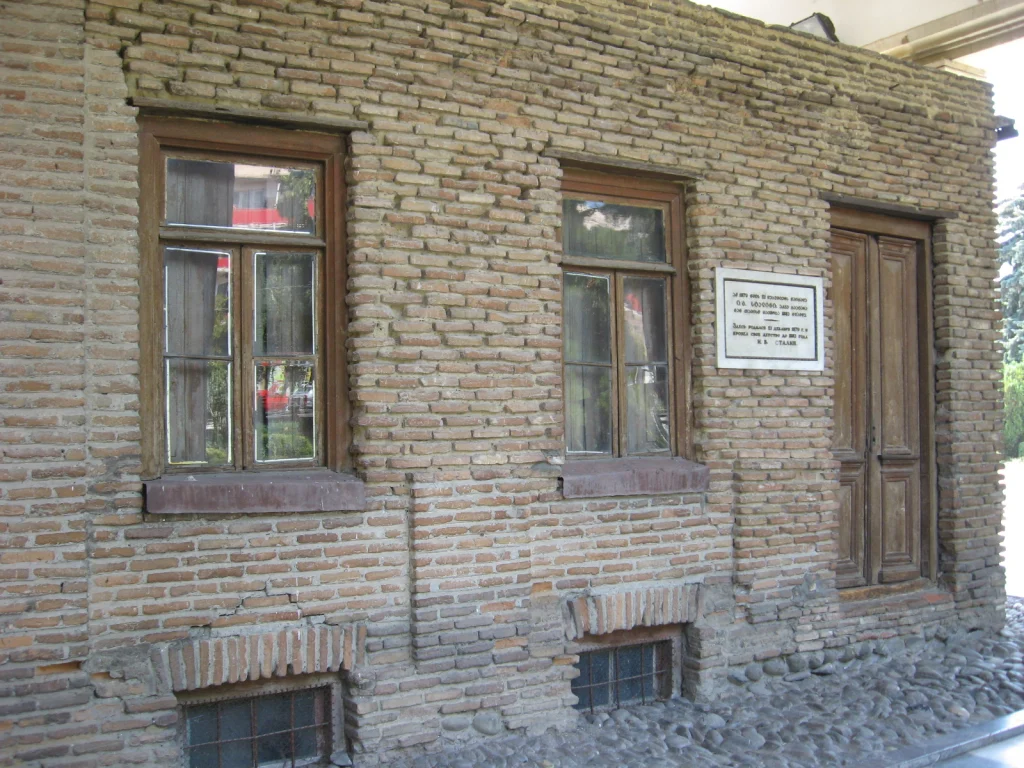
The complex occupies a city-block park on Stalin Avenue in central Gori and has three parts. A small single-room wooden house, where Stalin was born in December 1878, stands under a stone and glass pavilion built to protect it in the 1930s. Behind it, a grand Stalinist-era building completed in the 1950s houses the main museum: photographs, personal effects, gifts sent to Stalin from across the world, his desk and library items, death masks, and a room devoted to his years as a seminary student in Gori and Tbilisi. A separate pavilion in the garden holds his armoured personal railway carriage, fitted out with a bedroom, bathroom and meeting room, which he used instead of flying for trips to the wartime Allied conferences. A small basement room, added after years of international criticism, addresses the purges and labour camps of the Soviet period in a few panels, a notably smaller presence than the rest of the exhibition.
History
Stalin was born in Gori in December 1878 and left the town as a teenager; the house was preserved by Soviet authorities from the 1930s onward as his birthplace became a site of political pilgrimage. The main museum building was constructed through the 1950s and formally opened in 1957, four years after Stalin’s death, under the patronage of local and Georgian Soviet officials rather than as a central Moscow project. His personal rail carriage, used during the Second World War conferences, was added to the grounds in the 1980s. After Georgian independence the museum’s uncritical framing became a point of international comment; the Georgian government has periodically discussed relocating or reframing it, including proposals around 2010 to add context on Soviet-era repression, reported at the time by international press (The Guardian, BBC). The museum continues to operate under Georgia’s National Museum system; background on the country’s state museum network is available via the Georgian National Museum.
Opening hours and tickets
| Item | Usual pattern |
|---|---|
| Days | Open daily, including most public holidays |
| Hours | Roughly 10:00–18:00, last entry around 17:00 |
| Main museum ticket | Around 15 GEL for international visitors |
| Birth house and railway carriage | Usually included in the combined ticket; sometimes sold separately |
| Guided tour in English | Available on site for an extra fee, or arranged in advance |
Hours and prices change without much notice and are not consistently published online; treat the above as the usual pattern and confirm at booking or on arrival.
How to get there
Gori is about 76 kilometres and roughly 1 hour 10 minutes by car from Tbilisi via the S1 highway, and about 2 hours 15 minutes from Kutaisi. From Batumi it is a 4-hour drive. Frequent marshrutkas run from Tbilisi’s Didube station to Gori, taking around 1 hour 30 minutes with traffic and stops; the museum is a short walk or taxi ride from Gori’s bus station. Trains on the Tbilisi–Kutaisi/Batumi line also stop at Gori; check current timetables with Georgian Railway. With us, the half-day Gori & Uplistsikhe — Cave City Day Trip (9 hours) covers both sites from Tbilisi with a private vehicle, from €119 per person for a group of four to six. A car with English-speaking driver for a day around Tbilisi, Mtskheta, Kakheti or Gori costs €150 for a sedan, and a licensed specialist guide is €180 per day if you want deeper historical context.
How long and the best time
Allow 60 to 90 minutes for the museum building, plus 15 to 20 minutes each for the birth house and the railway carriage: 1.5 to 2 hours in total. Most visitors combine it with Uplistsikhe in a single day trip from Tbilisi, which uses most of a day door to door. Spring (April–May) and autumn (September–October) offer mild weather for the outdoor parts of the visit; midsummer in Gori is hot with little shade in the park. The museum is busiest with tour groups around midday.
Tips
- Photography is generally allowed inside the main exhibition halls; check current rules for the railway carriage, where flash is often restricted.
- The exhibition text is presented with minimal critical framing of the Stalin era; visitors expecting a balanced account of the purges should read background beforehand.
- Wear comfortable shoes, the complex involves walking between three separate buildings across an open garden.
- Combine the visit with Uplistsikhe cave town, 10 kilometres east, to make full use of the drive from Tbilisi.
- Gori’s Goristsikhe fortress, on a hill a short walk from the museum, is a quick add-on with views over the town.
- Card payment is not always reliable at the ticket desk; carry some Georgian lari in cash.
Nearby
- Goristsikhe fortress (Gori Citadel)
- Uplistsikhe cave town
- Gori History and Ethnography Museum
- Ateni Sioni church, in the Tana valley south of Gori
- Mtskheta, on the way back to Tbilisi
Stalin Museum, Gori is on these private tours: Mtskheta, Gori and Uplistsikhe — Kartli in a Day · Gori & Uplistsikhe — Cave City Day Trip · The Grand Tour of Georgia in 14 Days — Every Region, Mountains to Sea. A travel expert adapts any of them to your dates.
Questions
Is the Stalin Museum balanced about the Soviet period?
No, the main exhibition presents Stalin largely in celebratory terms; a small basement room added in recent years covers repression and labour camps but remains limited compared with the rest of the museum.
Can I visit the birth house and the railway carriage on the same ticket as the museum?
Usually yes, as a combined ticket, though this has changed before; confirm current pricing at the ticket desk or at booking.
Is Gori safe to visit given its proximity to South Ossetia?
Gori town itself is safely accessible and well within government-controlled territory; check current travel advice before heading toward the administrative boundary line itself.
How do I combine Gori with Uplistsikhe in one day from Tbilisi?
Both sites are close together east of Gori and are commonly visited together; a private half-day tour or car with driver from Tbilisi covers both comfortably.
Sources
Statue of Stalin stands amid pine trees in the museum garden in Gori. · Photo: Sasha India / Wikimedia Commons, CC BY 2.0