

Shio-Mgvime Monastery — opening hours, tickets, how to get there and what to see
Shio-Mgvime Monastery is a 6th-century cave monastery hidden in a narrow limestone gorge of the Mtkvari valley, about 25 km northwest of Tbilisi and a short drive from Mtskheta. It was founded around AD 560 by Shio, one of the Thirteen Syrian (Assyrian) Fathers who came to Georgia to reinforce the Christianity adopted as state religion two centuries earlier, and it remains a working monastery today. Its plain early church, rock-cut cells and 12th-century water channel make it one of the best-preserved examples of early Georgian monastic architecture.
What you see
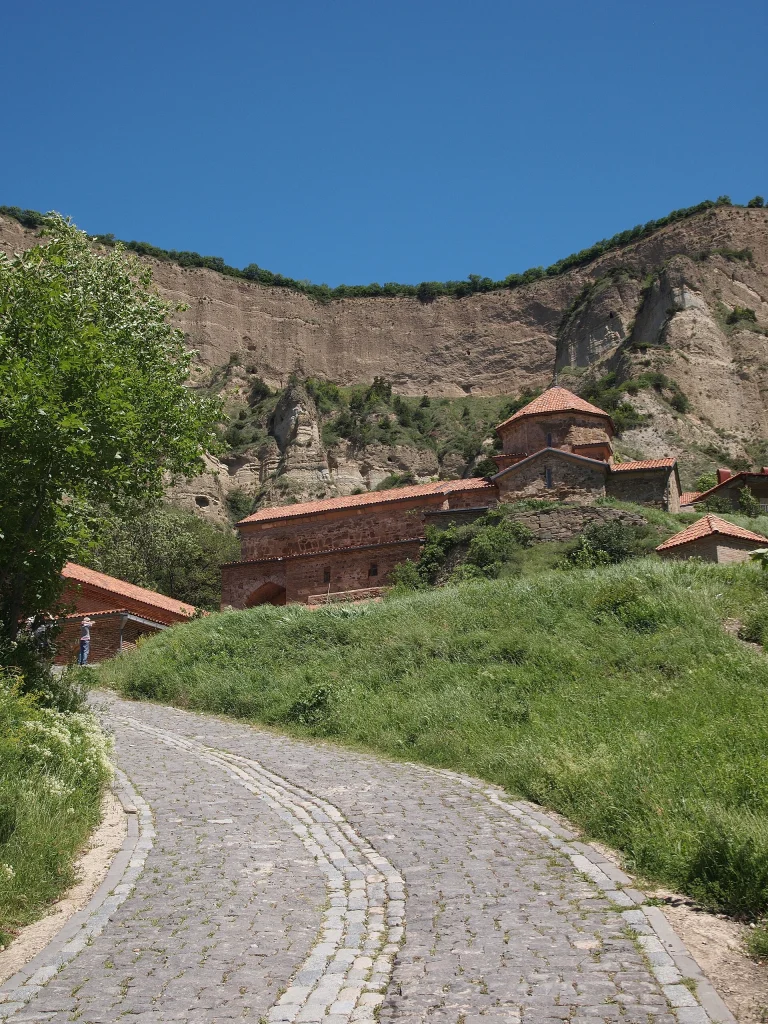
The monastery sits on a terrace cut into bare rock, with cliffs rising on three sides and the gorge opening toward the Mtkvari river. The core building is the small Church of St John the Baptist, a domed basilica dated to the second half of the 6th century, one of the oldest standing churches in Georgia, built with minimal decoration in keeping with the austere life of its founder. Around it are a refectory, a bell tower, later monastic cells, and a scatter of hermit caves cut into the cliff face above, some reachable by a marked path. A long stone water channel, attributed to the 12th-century king David the Builder, once carried water from the Mtkvari valley to the monastery; sections of the aqueduct are still visible on the approach road. The tomb of Shio himself, in a cave chapel, remains a focus of pilgrimage. The setting is quiet and functional rather than ornate, and the working community of monks is still part of daily life here, so visitors share the site with people at prayer.
History
According to Georgian Orthodox tradition, Shio arrived from Antioch with twelve companions in the mid-6th century, part of a group remembered as the Thirteen Syrian Fathers who helped consolidate Christianity after its adoption as the state religion of Kartli in the early 4th century. Shio is said to have withdrawn into this gorge as a hermit, living in a cave before a monastic community formed around him; he died around the 560s and was buried on the site. The main church was built in the following decades and expanded over the following centuries as the monastery grew into one of the most important in Georgia, attracting royal patronage. King David the Builder, who reunified Georgia in the 12th century, is associated with the aqueduct that still partly survives and is said to have intended Shio-Mgvime as his own burial place before ultimately being buried at Gelati. The monastery suffered repeated damage from Persian and other invasions through the medieval and early modern periods and was restored several times. Monastic life was interrupted under Soviet rule, when religious institutions across Georgia were closed or repurposed, and the community returned to live and work at Shio-Mgvime in the early 1990s, after Georgia regained independence. The wider Mtskheta area, including Jvari Monastery, Svetitskhoveli Cathedral and Samtavro, was inscribed by UNESCO as Historical Monuments of Mtskheta in 1994; Shio-Mgvime lies just outside the core inscribed boundary but is part of the same historic monastic landscape (UNESCO World Heritage Centre).
Opening hours and tickets
| Item | Typical pattern |
|---|---|
| Opening hours | Daily, roughly dawn to dusk (about 9:00–19:00 in summer, 9:00–18:00 in winter) |
| Entry fee | Free; donations welcome |
| Dress code | Headscarf and long skirt for women (available to borrow at the entrance), long trousers for men, shoulders covered |
| Note | This is an active monastery, not a museum; hours can shift around services and holy days — checked at booking |
How to get there
From Tbilisi, the monastery is about 25–30 km, a 35–45 minute drive: take the road toward Mtskheta, then follow signs west into the gorge for the final 4–5 km on a narrower, winding approach road. There is no direct public transport; the usual route by marshrutka is to Mtskheta’s central stop and then a taxi for the last stretch, since no scheduled minibus runs into the gorge itself. From Kutaisi or Batumi it is a long way (around 3.5–5 hours by road), so most visitors see it as part of a Tbilisi-area day, not a stand-alone trip from the west. With us, Shio-Mgvime fits naturally into a half-day Mtskheta itinerary alongside Jvari and Svetitskhoveli; see our Tbilisi & Mtskheta — The Essential First Day, St Nino’s Way — Mtskheta, Sioni and Bodbe in a Day, or Monasteries of Georgia — Mtskheta, the Thirteen Fathers and Kakheti in 3 Days. A car with driver for the day from Tbilisi is also available (see our price table) if you prefer your own schedule.
How long and the best time
Allow 45 minutes to an hour on site, more if you want to walk up to the hermit caves above the main complex. Morning visits are quieter, before tour groups arrive from Tbilisi mid-morning. Spring and autumn give the gorge its best colour and mild walking conditions; summer is hot with little shade on the approach; winter can be cold and occasionally icy on the access road, worth checking road conditions before driving yourself.
Tips
- Dress modestly before arrival; borrowed wraps are usually available but queues form at peak times.
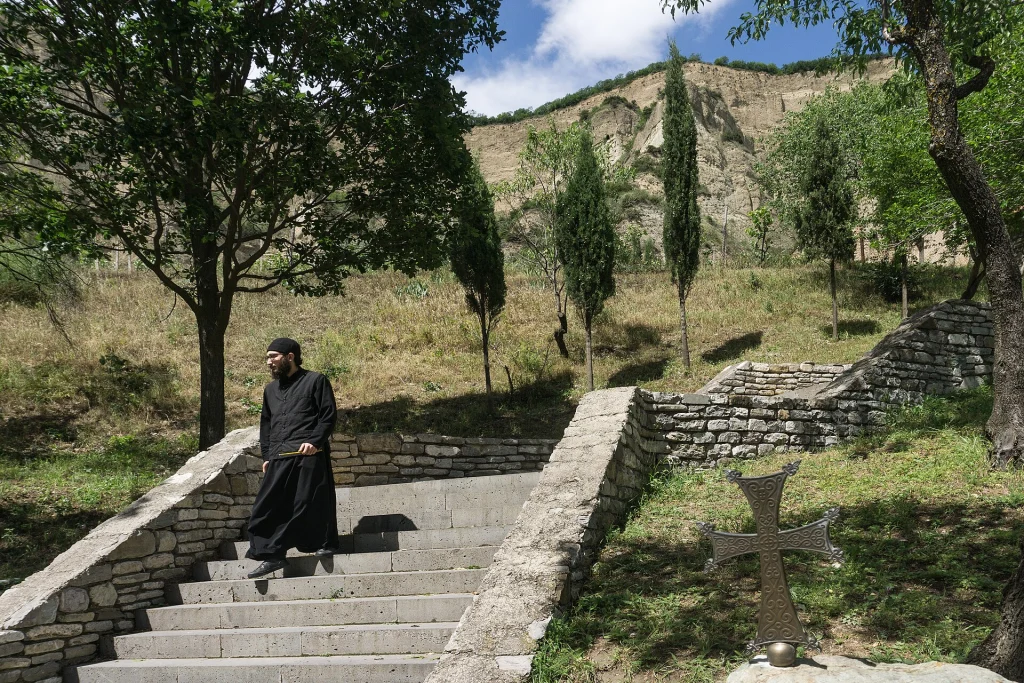
- Photography is generally allowed in the courtyard and of the buildings, but avoid photographing monks directly or during services.
- The access road is narrow with blind bends; drive carefully and allow extra time on weekends.
- There is little shade and few facilities on site, so bring water, especially in summer.
- Combine the visit with Mtskheta’s old town, a 10–15 minute drive away, to see Svetitskhoveli Cathedral and Jvari Monastery on the same outing.
Nearby
- Jvari Monastery
- Svetitskhoveli Cathedral
- Samtavro Convent and Church
- Mtskheta old town
- Saguramo (Ilia Chavchavadze house museum)
Shio-Mgvime Monastery is on these private tours: Georgia in 10 Days — Tbilisi to Svaneti to the Sea · Tbilisi in a Day — Old Town, Sulphur Baths, Mtatsminda and the Markets · Mtskheta, Gori and Uplistsikhe — Kartli in a Day. A travel expert adapts any of them to your dates.
Questions
Is Shio-Mgvime part of the UNESCO-listed Mtskheta site?
No, the inscribed UNESCO site covers Jvari Monastery, Svetitskhoveli Cathedral and Samtavro; Shio-Mgvime lies nearby in the same historic monastic landscape but outside the core boundary.
Is there an entrance fee?
No, entry is free, though donations are welcome; dress code (covered shoulders, headscarf for women, trousers for men) is enforced.
Can I visit without a car?
There is no direct public transport into the gorge; the practical options are a taxi from Mtskheta, a private car with driver, or a guided day tour from Tbilisi.
Are monks still living there?
Yes, it is an active Georgian Orthodox monastery, with community life resumed in the early 1990s after the Soviet-era closure.
Sources
Shio-Mgvime Monastery complex nestled in a dramatic limestone canyon near Mtskheta. · Photo: Kober / Wikimedia Commons, Public domain