

Kukushka Narrow-Gauge Train, Borjomi–Bakuriani — opening hours, tickets, how to get there and what to see
The Kukushka (“cuckoo”) is Georgia’s historic 900mm narrow-gauge railway linking the spa town of Borjomi with the mountain resort of Bakuriani, climbing about 900 metres over 37 kilometres of pine forest on a line opened in 1902. It was built to carry the Russian imperial family and Tbilisi’s elite from the Borjomi valley up to the Bakuriani plateau, and its slow, switchback ascent remains one of the few working narrow-gauge passenger lines left in the Caucasus. Service has been reduced and repeatedly suspended for repairs in recent years, so current travellers should treat it as a seasonal curiosity rather than a reliable transport link.
What you see
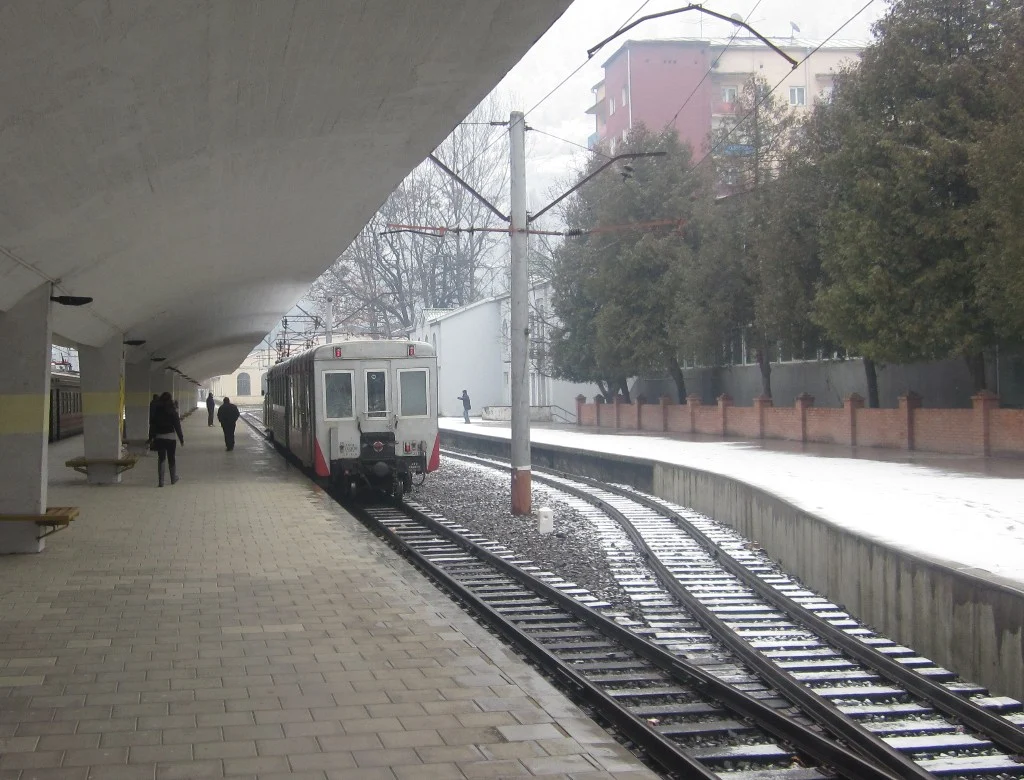
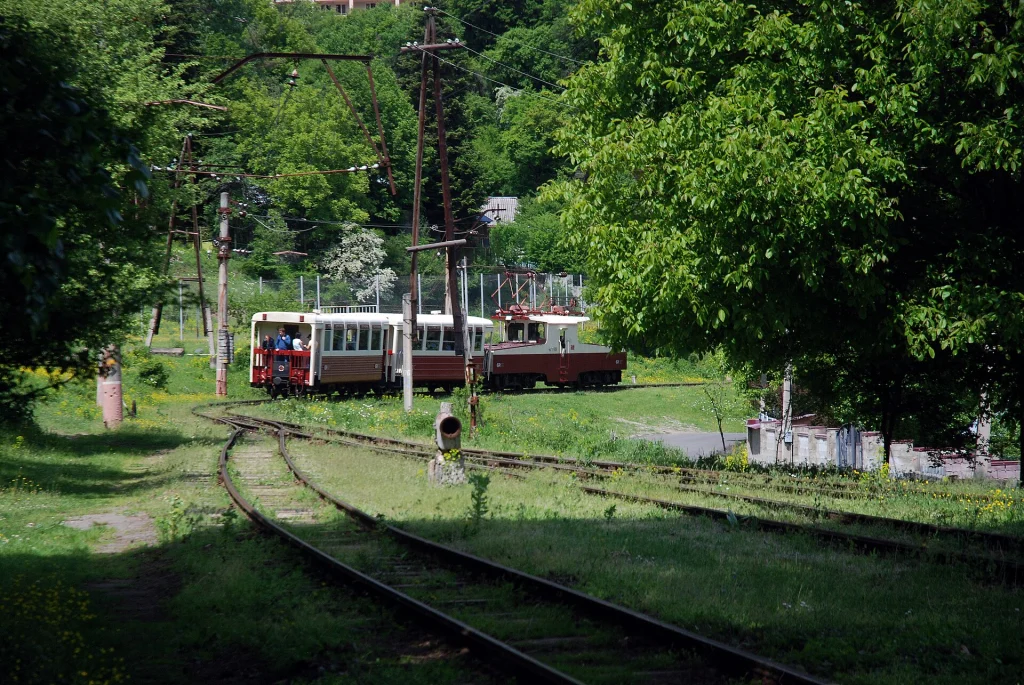
The line itself is the attraction: small blue-and-yellow narrow-gauge carriages pulled by a diesel railcar (the original steam engines are retired, though one is preserved as a static display near Bakuriani station), threading through spruce and pine forest along the upper Mtkvari valley. The signature feature is the switchback near Tsemi station, where the gradient is too steep for a direct climb and the train reverses direction on a zigzag section to gain height, a solution typical of early twentieth-century mountain railways. Along the way there are open views down into the Borjomi gorge and, in the final stretch, across the Bakuriani plateau to the Trialeti ridge. Stations are modest wooden or stone buildings, several dating from the original construction, and the overall feel is closer to an industrial heritage ride than a scenic express.
History
The Borjomi-Bakuriani line was built in 1902 under the Russian imperial administration, primarily to connect the Borjomi spa and the Romanov family’s summer palace at Likani with the forested Bakuriani plateau, which supplied timber and, increasingly, summer and winter recreation for the Tbilisi and Russian nobility. The narrow 900mm gauge was chosen for its tighter curves and lower construction cost on steep terrain, a standard choice for mountain lines of the period. Through the Soviet era the railway continued as a commuter and freight link for the resort, carrying skiers and holidaymakers as Bakuriani developed into Georgia’s main domestic ski destination. Since the 2010s, Georgian Railway (the state operator) has repeatedly announced technical repair works on sections of the track, and passenger service has at times been reduced to a single daily railcar or suspended altogether in favour of shuttle buses, a pattern reported periodically in the Georgian press (Agenda.ge, Georgia Today). As of the 2026 season the line is not running on a fixed year-round timetable; travellers should check directly with Georgian Railway before planning a trip around it (Georgian Railway).
Opening hours and tickets
| Item | Usual pattern |
|---|---|
| Season | Partial service in ski season (December–March) and sometimes in summer (June–September); frequently suspended for repairs, checked at booking |
| Departures | Historically one to two trains a day each way when running; journey time about 2.5 hours for 37 km, checked at booking |
| Ticket price | A few GEL per person when the line operates, bought at the station ticket window shortly before departure, checked at booking |
| Booking | No advance online booking; confirm current status with Georgian Railway or a local guesthouse before travelling to the station |
How to get there
Bakuriani is about 160 km from Tbilisi, roughly 2.5 to 3 hours by car via Khashuri and Borjomi, and about 30 minutes further up from Borjomi itself. From Kutaisi the distance is around 140 km, a similar 2.5-hour drive. From Batumi it is about 250 km, roughly 4 hours. Marshrutka minibuses run from Tbilisi’s Didube station to Borjomi and on to Bakuriani, with a change often needed at Borjomi; there is also a regular mainline train between Tbilisi and Borjomi, separate from the narrow-gauge Kukushka, which starts from Borjomi’s own station. With us, a private sedan transfer from Tbilisi to Bakuriani is a fixed €120 one way (see our price list, gtour.ge/data), and our two-day Borjomi, Bakuriani and Rabati tour covers the town, the railway when it is running, and nearby Rabati Castle as a single planned trip (https://gtour.ge/tour/borjomi-bakuriani-rabati-2-days/).
How long and the best time
A one-way ride, when the line is operating, takes about 2 to 2.5 hours for the full 37 km; many visitors ride one direction and return by road. Allow extra time at either end to check the schedule in person, since timetables are not always posted online. Winter (December to March) suits the railway best in spirit, coinciding with Bakuriani’s ski season, though the line’s actual operating days vary from year to year regardless of season. Weekday mornings tend to be quieter than weekends in peak ski season.
Tips
- Confirm whether the train is running before travelling to either station; buses often substitute without much advance notice.
- Dress in layers: unheated or lightly heated carriages are common, and mountain temperatures drop quickly after sunset.
- The switchback near Tsemi is the best photography point; a window seat on the uphill side gives the clearer forest views.
- Queues are rarely an issue given low ridership, but ticket windows do not always take cards, so carry small GEL notes.
- Combine the ride with Borjomi Central Park and mineral water springs at one end, and Bakuriani’s ski lifts or summer walking trails at the other.
Nearby
- Borjomi Central Park and mineral springs
- Likani Palace (former Romanov summer residence)
- Bakuriani ski lifts and the Kokhta-Mitarbi cable car
- Rabati Castle, Akhaltsikhe
- Green Monastery (Sameba), near Bakuriani
Kukushka Narrow-Gauge Train, Borjomi–Bakuriani is on these private tours: Borjomi and Bakuriani — Spa Town and Mountain Air in a Day · Borjomi, Bakuriani & Rabati — 2 Days · The South in 3 Days — Borjomi, Vardzia, Rabati and Abastumani. A travel expert adapts any of them to your dates.
Questions
Is the Kukushka train currently running?
Service has been reduced and repeatedly suspended for track repairs in recent years, so confirm the current schedule with Georgian Railway before travelling, checked at booking.
How long is the Borjomi–Bakuriani railway?
About 37 kilometres, climbing roughly 900 metres from Borjomi to Bakuriani, with a journey time of around 2 to 2.5 hours when the line is operating.
Why is it called the Kukushka?
Kukushka means "cuckoo" in Russian, a nickname given to the small narrow-gauge train for the sound of its whistle, common to similar lines across the former Russian Empire.
Can I combine the train with a day trip from Tbilisi?
It is possible but risky given the uncertain schedule; most visitors base the ride around an overnight stay in Borjomi or Bakuriani, such as on our two-day Borjomi, Bakuriani and Rabati tour.
Sources
The 'Kukushka' narrow-gauge train stands at the station platform in Bakuriani. · Photo: Alexjtb / Wikimedia Commons, CC BY-SA 4.0