

Juta and the Chaukhi Massif — opening hours, tickets, how to get there and what to see
Juta is a small highland village at the head of the Sno Valley in Kazbegi municipality, Mtskheta-Mtianeti region, sitting at roughly 2,200 metres below the jagged Chaukhi massif, whose main summit reaches about 3,842 metres. The village of around 24 permanent residents is the last point reachable by road before trails climb to the Chaukhi massif, the Abudelauri lakes and the multi-day Chaukhi Pass route into Khevsureti. It matters as the trailhead for one of Georgia’s best-known high-mountain hikes, open in practice from roughly June to September each year, conditions permitting.
What you see
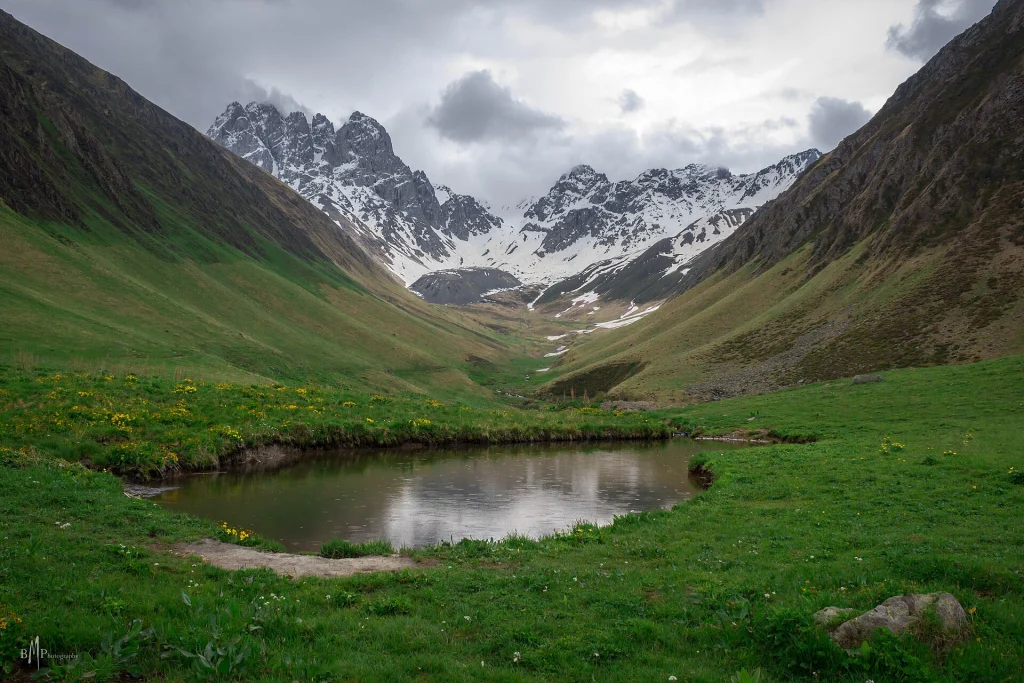
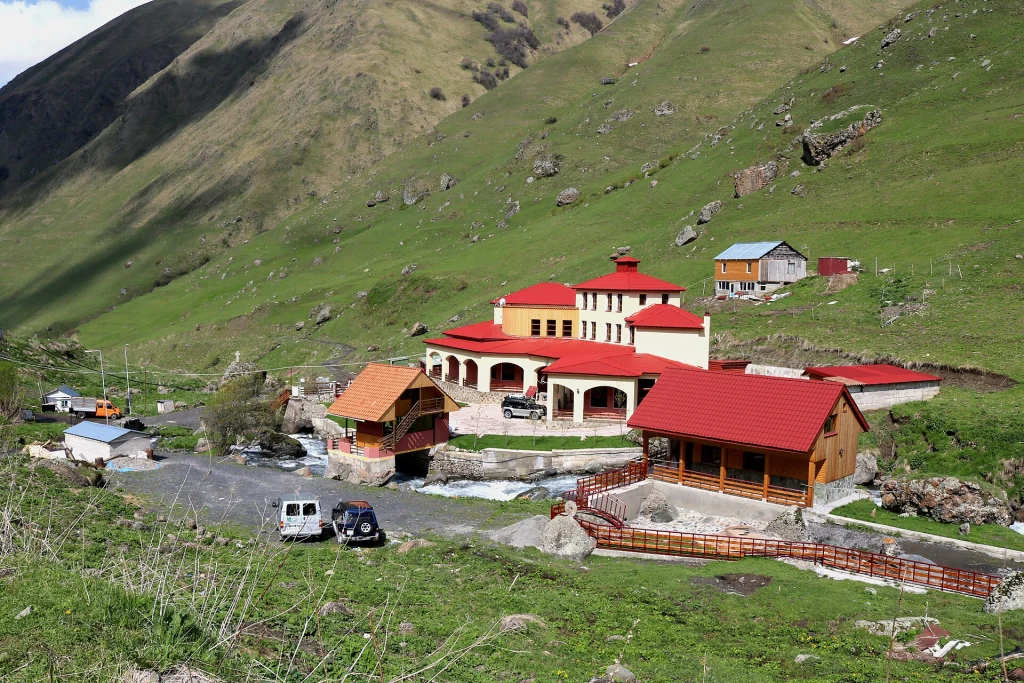
Juta itself is a cluster of stone and timber guesthouses strung along a single dirt track, with hayfields, grazing cattle and a small chapel marking the edge of settled land. Above the village the view is dominated by the Chaukhi massif, a serrated ridge of granite-grey peaks quite different in shape from the volcanic cone of nearby Mount Kazbek. From Juta, trails fan out in three main directions: a half-day loop to the base of Chaukhi for close views of the rock towers; a longer out-and-back to the Abudelauri lakes (commonly described as the White, Blue-Green and Green lakes, each a different colour depending on glacial silt and depth); and the long-distance route over the Chaukhi Pass, at around 2,700–2,800 metres, down into the historic highland province of Khevsureti, finishing at the village of Roshka near the Roshka lakes.
History
Juta and the wider Sno Valley belong to Khevi, a historic highland district whose villages have herded livestock on these summer pastures for centuries, moving down to lower valleys for winter. The area’s modern profile as a trekking destination is recent: foreign and domestic hikers began arriving in meaningful numbers only after Georgia’s roads and guesthouse network opened up through the 2000s and 2010s, and Juta’s handful of families built simple guesthouses to meet the demand. The Chaukhi–Roshka route crosses from Khevi into Khevsureti, a province whose distinct tower villages, dialect and customs are documented by Georgia’s national tourism administration and by independent travel writers; see Lonely Planet’s Kazbegi guide for background on the wider Khevi region.
Opening hours and tickets
Juta is open countryside with no gate, ticket or fixed hours. Access depends on the season and on the dirt road from Sno, which can be rutted or washed out after heavy rain and is generally considered unreliable in winter and early spring. There is no entrance fee for the valley, the lakes or the pass; guesthouses and any guided activity are priced separately and should be checked at booking.
| Item | Usual pattern |
|---|---|
| Road access (Sno–Juta, ~12 km unpaved) | Passable roughly May–October; checked at booking for current conditions |
| Trekking season (Chaukhi Pass to Roshka) | Late June to mid-September typically; snow can linger on the pass into July |
| Entrance fee | None — open valley, no ticket required |
| Guesthouse beds / camping | Available in season, price and availability checked at booking |
How to get there
From Tbilisi, Juta is about 150 kilometres, roughly 3 hours 35 minutes by car via the Georgian Military Highway over the Jvari Pass through Kazbegi (Stepantsminda), then a turn at Sno village onto a 12-kilometre dirt track that climbs steeply to Juta. A standard sedan can struggle on the final stretch after rain, so a 4×4 or a high-clearance vehicle is the usual recommendation. Public marshrutka minibuses run from Tbilisi to Kazbegi and on to Sno, but onward transport to Juta is irregular; most visitors arrange a taxi from Sno or Kazbegi for the last leg, or walk it as part of the hike. From Kutaisi, the drive is around 6–7 hours via Tbilisi, long enough that most visitors treat Kazbegi and Juta as an overnight trip rather than a day trip. With us, this route is covered by a 4×4 car with driver (from €220 a day around Tbilisi, €230 a day on multi-day touring) or built into the Kazbegi — 2-Day Mountain Journey tour; for the Chaukhi Pass crossing itself, a certified mountain guide (from €220 a day) is the sensible option rather than attempting the high route solo.
How long and the best time
A half-day trip from Kazbegi to Juta and back, with a short walk toward the Chaukhi base, takes about 4–5 hours including driving. The Abudelauri lakes are a full day from Juta (around 6–7 hours round trip on foot). The Chaukhi Pass to Roshka is a serious undertaking, usually done over two days with a night at a pass-side camp or an early single-day push of 10–12 hours for fit, well-equipped hikers. The best window is July to September, when snow has mostly cleared from the pass; June can still have snow patches at altitude, and by October overnight frost and shortening daylight make the high route unreliable.
Tips
- Dress in layers: temperatures at 2,200–2,800 metres swing sharply between sun and shade, and wind on the pass can be strong even in summer.
- Carry a paper map or offline GPS track for the Chaukhi Pass route; signal is unreliable beyond Juta.
- Weather changes quickly in the Greater Caucasus; afternoon cloud and rain are common, so start long hikes early.
- Book a guesthouse room ahead in July and August, the village’s busiest weeks, when beds fill up.
- Photography is best in early morning light on the Chaukhi towers, before afternoon haze builds up.
- Combine Juta with Kazbegi and Gergeti Trinity Church for a fuller two-day look at the region rather than a rushed single day.
Nearby
- Kazbegi (Stepantsminda) town
- Gergeti Trinity Church
- Sno village and the Sno Valley
- Abudelauri lakes
- Roshka village, Khevsureti
Juta and the Chaukhi Massif is on these private tours: Georgia Classic in 7 Days — Tbilisi, Kazbegi, Kakheti and Mtskheta · Kazbegi and Kakheti Photography — 3 Days of Mountains and Vineyards · New Year in Georgia — Tbilisi Fireworks, Kakheti Supra and Gudauri Snow, 6 Days. A travel expert adapts any of them to your dates.
Questions
Do you need a 4×4 to reach Juta
A 4×4 or high-clearance vehicle is recommended for the final 12-kilometre dirt road from Sno, especially after rain; sedans can manage in dry conditions but it is checked at booking.
Is the Chaukhi Pass trek suitable for beginners
No, it is a long, high-altitude route over rough terrain with possible snow, better suited to experienced hikers or those with a certified mountain guide.
Can Juta be visited as a day trip from Tbilisi
Yes for the valley and lower trails, at around 7–8 hours round trip in total, but the full Chaukhi Pass crossing needs two days.
Is there an entrance fee for Juta or the Chaukhi massif
No, there is no ticket or entrance fee; the valley is open countryside.
Sources
The jagged Chaukhi Massif rises above a green valley near Juta. · Photo: franek2 / Wikimedia Commons, CC BY-SA 3.0