

Gveleti Waterfalls — opening hours, tickets, how to get there and what to see
Gveleti Waterfalls are two cascades on the Gveletistskali stream, in a side gorge near Gveleti village about 9 km north of Stepantsminda, close to the Dariali Gorge and the Russian border. They sit inside Kazbegi National Park, within walking distance of each other but requiring different amounts of effort, and have been a fixture of Georgian Military Highway travel since at least Soviet-era tourism. In May 2014 a large debris flow from the nearby Devdoraki glacier swept through Dariali Gorge just north of here, a reminder that this is an active high-mountain landscape.
What you see
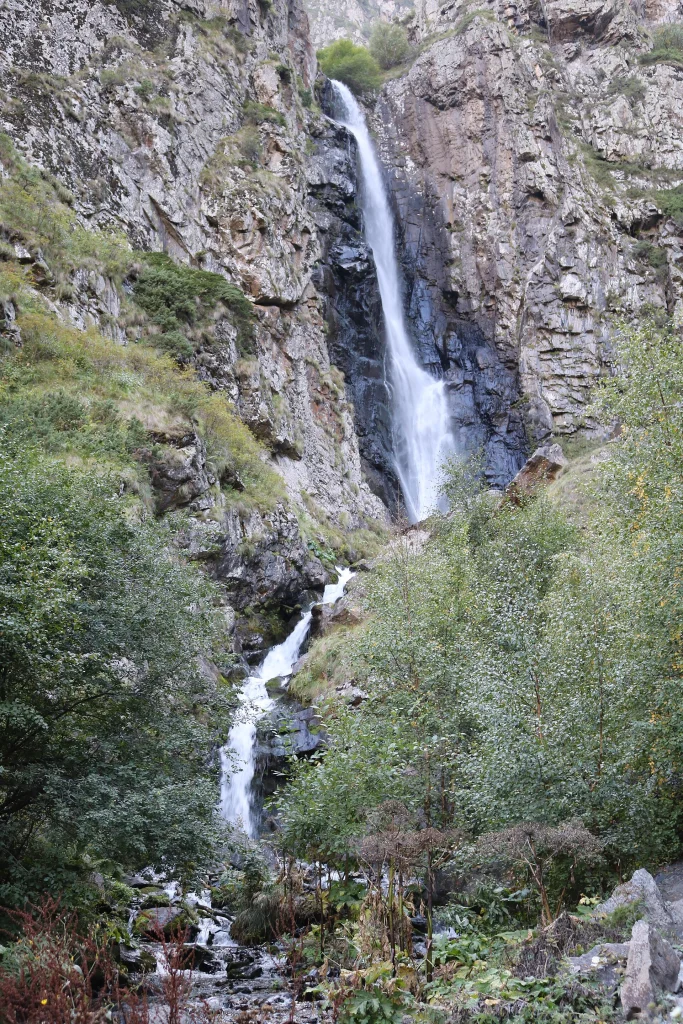
“Gveleti Waterfalls” refers to two separate falls on streams that drop from the slopes around Mount Kazbek into the Tergi (Terek) valley near Gveleti village. The Lesser Gveleti waterfall is close to the road, reached by a short gravel path along a narrow ravine, and drops over a rock ledge into a shallow pool that most visitors can reach in well under an hour round trip. The Greater Gveleti waterfall sits deeper inside a side gorge, reached by a longer trail that follows the Gveletistskali stream, crosses it several times on makeshift log or plank bridges, and climbs through pine forest and scree before opening onto a taller fall enclosed by steep rock walls. Neither waterfall has a fixed, independently measured height published by a park authority; guidebooks and local operators usually describe the greater fall as the more dramatic of the two, running strongest with spring snowmelt and after summer rain.
History
The valley the waterfalls sit in opens onto the Dariali Gorge, the narrow defile that has carried the main route across the central Caucasus since antiquity and which classical geographers knew as one of the “Caucasian Gates” (Britannica, Darial Gorge). The surrounding high country, including Gveleti, was brought under formal nature protection in the Soviet period and later reorganised as Kazbegi National Park, now managed by Georgia’s Agency of Protected Areas (Agency of Protected Areas of Georgia). The gorge remains geologically active: in May 2014 a major rock-ice avalanche from the Devdoraki glacier above Dariali triggered a debris flow that blocked the highway and damaged infrastructure close to the waterfalls’ side valley, an event reported at the time by regional and international outlets and still referenced by geologists studying the area (Agenda.ge, Georgia news archive). The village of Gveleti itself is small and largely pastoral, with tourism to the falls growing mainly since the 2000s as road access to Stepantsminda improved.
Opening hours and tickets
The waterfalls are open-access natural sites with no gate, no ticket booth and no fixed hours; they fall within Kazbegi National Park, where entry to the general recreation zone is free. There is no official overnight closure, but the trail to the greater waterfall is unmarked in places and unsafe to attempt after dark or in poor weather. Pattern below, checked at booking.
| Item | Usual pattern |
|---|---|
| Access | Open year-round, no ticket, no gate |
| Daylight hiking window | Roughly 08:00–18:00, shorter in winter |
| Trail condition in winter | Often icy or snow-covered; stream crossings harder |
| Border-zone status | Gorge lies close to Dariali checkpoint; carry ID, checked at booking |
How to get there
From Tbilisi, Stepantsminda is about 155 km north along the Georgian Military Highway, a drive of roughly 2.5–3 hours depending on border traffic and weather on the Gudauri pass. From Stepantsminda, Gveleti village is a further 9 km north toward the Russian border, about 15–20 minutes by taxi or private car; the last stretch to the trailhead is on a rough side track. Marshrutkas run from Tbilisi’s Didube station to Stepantsminda several times a day, after which a local taxi covers the last leg to Gveleti. There is no rail option this far into the mountains. With us, the waterfalls fit naturally onto a Kazbegi day or overnight itinerary: see Kazbegi — Gergeti Trinity Church in a Day or Kazbegi — 2-Day Mountain Journey, or book a private car with driver from Tbilisi for a flexible stop at Gveleti on the way to or from Stepantsminda.
How long and the best time
Allow 30–45 minutes round trip for the Lesser Gveleti waterfall alone, or 3–4 hours round trip if continuing to the Greater Gveleti waterfall, including rest stops and stream crossings. Late May to September is the most reliable window, when snowmelt has eased and paths are drier, though the stream is also at its fullest and most photogenic in late spring. Early morning light works best for photographs in the narrow gorge section.
Tips
- Wear boots with grip and be ready to get your feet wet; crossings are on loose stones or simple log bridges with no railings.
- Carry water and a layer for wind, since the gorge stays cool even when Stepantsminda is warm.
- Weather changes quickly at this altitude; turn back if rain or fog closes in, since the trail is unmarked above the lower section.
- The area sits near the Dariali border checkpoint, so carry identification and avoid wandering off the obvious path.
- There are no facilities at the trailhead; use toilets and buy supplies in Stepantsminda first.
- Queues are rare outside peak midsummer weekends, when parking near the trailhead is the main bottleneck.
Nearby
- Stepantsminda town
- Gergeti Trinity Church
- Dariali Gorge and border area
- Sno Valley and Sno fortress
- Juta valley trailhead
Gveleti Waterfalls is on these private tours: Georgia Classic in 7 Days — Tbilisi, Kazbegi, Kakheti and Mtskheta · Kazbegi and Kakheti Photography — 3 Days of Mountains and Vineyards · New Year in Georgia — Tbilisi Fireworks, Kakheti Supra and Gudauri Snow, 6 Days. A travel expert adapts any of them to your dates.
Questions
Is there an entrance fee for Gveleti Waterfalls?
No, access is free; the site has no gate or ticket booth, checked at booking.
How hard is the hike to the Greater Gveleti waterfall?
Moderate, with several unmarked stream crossings on logs or stones; sturdy footwear is needed.
Can I visit Gveleti Waterfalls in winter?
The lower, lesser waterfall is often reachable, but the longer trail can be icy or snow-covered and is best avoided without local advice.
How far is Gveleti from Stepantsminda?
About 9 km, roughly 15–20 minutes by car or taxi.
Sources
The Gveleti waterfall cascades down a rocky gorge near Stepantsminda. · Photo: UG-GE / Wikimedia Commons, CC BY-SA 4.0