

Russia–Georgia Friendship Monument, Gudauri — opening hours, tickets, how to get there and what to see
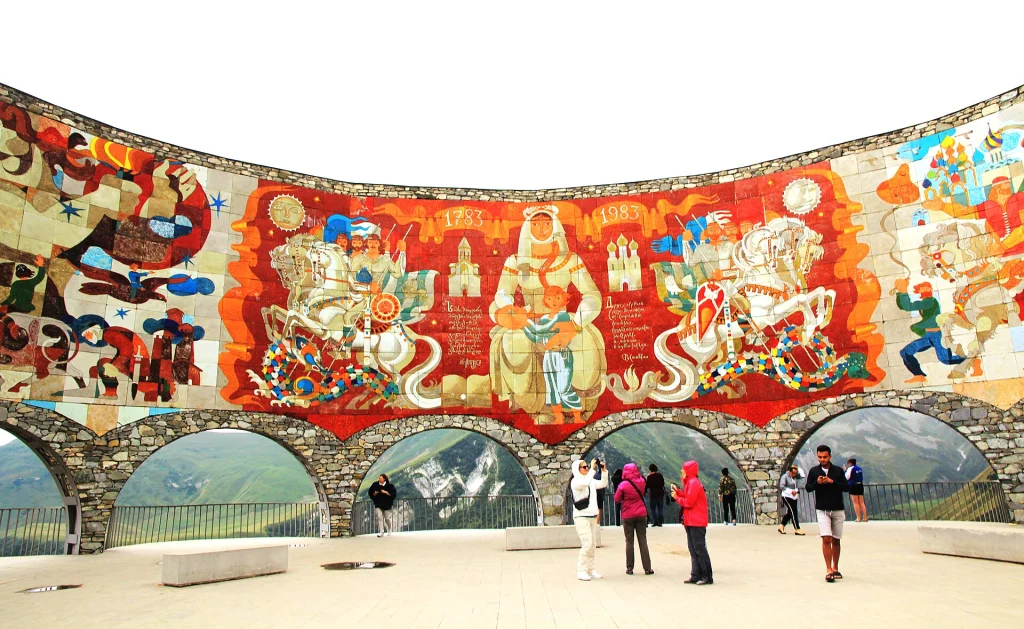
The Russia–Georgia Friendship Monument is a round, open-sided viewpoint on the Georgian Military Highway a few kilometres below Gudauri, built in 1983 to mark the 200th anniversary of the Treaty of Georgievsk. Its interior mosaic mural, showing scenes from Georgian and Russian history, overlooks the Aragvi valley from about 2,170 metres and remains one of the most photographed roadside stops in the Caucasus. It is free, unfenced and open at all hours, weather and road conditions permitting.
What you see
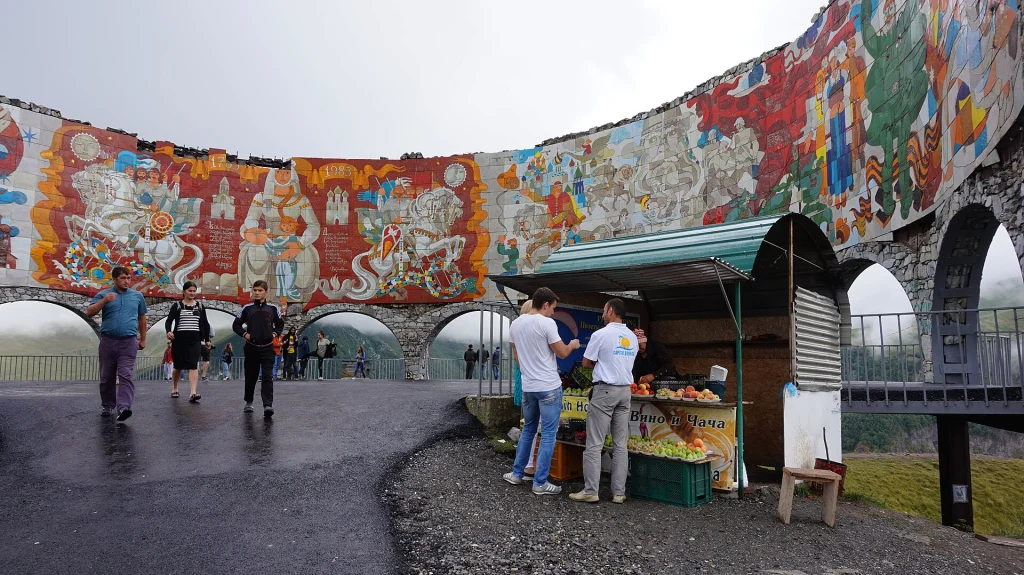
The monument is a circular, roofless concrete structure set on a cliff edge above a bend in the Georgian Military Highway, roughly midway between the village of Pasanauri and the Gudauri ski resort. Visitors walk through a low opening into a round enclosure whose inner wall carries a long mosaic and painted-relief mural. The imagery mixes Georgian and Russian motifs: vine leaves, churches, folk figures, battle scenes and lines of verse, built in the bright tile-and-plaster style typical of late-Soviet public art. The structure has no roof, so the mural is lit by daylight and changes character through the day. Stepping out on the far side, the ground drops away into the Aragvi gorge, giving an open view over the valley, the switchbacks of the road climbing toward Gudauri, and on clear days the ridgeline of the Greater Caucasus. There is no admission booth, shop or signage beyond a weathered information panel, and no barrier stops visitors from walking along the cliff edge, so care is needed, especially with children.
History
The monument was built in 1983 to mark the 200th anniversary of the Treaty of Georgievsk of 1783, by which the Kingdom of Kartli-Kakheti under Erekle II placed itself under Russian protection, a step that later Russian and Soviet historiography presented as the founding moment of a lasting Georgian-Russian friendship (britannica.com). It was one of several such anniversary monuments commissioned across the Soviet Union in the early 1980s, and its roadside site on the Georgian Military Highway was chosen deliberately, since that route has carried traffic between Tbilisi and the North Caucasus since the early 19th century. The monument has no official custodian today, and its name sits uneasily with recent history: Georgia and Russia fought a war in 2008, Russia continues to occupy Abkhazia and South Ossetia, and direct land traffic across the Russian border at Verkhny Lars has been intermittent for ordinary travellers in the years since. Despite this, the structure itself has not been removed or renamed, and it continues to function simply as a scenic overlook and photo stop on the drive to Gudauri and Stepantsminda.
Opening hours and tickets
| Item | Pattern | Price |
|---|---|---|
| Access to the monument and viewpoint | Open-air, no gate, generally accessible whenever the Georgian Military Highway is open | Free |
| Parking at the pull-off | Informal roadside parking, space for several cars and buses | Free |
| Winter closures | The highway can close for hours during heavy snow or avalanche control near the Gudauri pass; check current status before travelling | Not applicable |
There is no ticket, fence or staff. Conditions change with weather; checked at booking, and see our road status page for the current state of the Georgian Military Highway.
How to get there
From Tbilisi, the monument is about 100 km north on the Georgian Military Highway, roughly 2 hours by car in normal conditions, a little longer in winter or heavy traffic. Marshrutkas from Tbilisi’s Didube station to Stepantsminda and Gudauri pass directly below the monument, but drivers rarely stop there on a shared service, so it suits private transport better than public transport. From Kutaisi or Batumi, it is a long detour, 5 to 6 hours each way, and is not usually combined with a day trip from the west.
With us, the monument is normally included as a short stop on the way to Gudauri or Kazbegi rather than a destination of its own. Our Gudauri — Mountain Escape day tour and our Kazbegi — Gergeti Trinity Church in a Day tour both pass this point, and our Georgia in Winter — Gudauri Skiing, Tbilisi & Kakheti and Kazbegi — 2-Day Mountain Journey trips stop here on the drive north. If you prefer your own schedule, a car with an English-speaking driver from Tbilisi to Gudauri is €120 for a sedan, including the stop at the monument; see current tour prices and service rates on our price table.
How long and the best time
Most visitors need 10 to 15 minutes: enough to walk through the mural, take photographs and look over the valley. Morning to early afternoon gives the clearest light on the mountains behind, and spring through autumn offers the best visibility, since low cloud and fog are common on this stretch of road in winter. In winter the stop can be bitterly cold and windy, and the mural itself is sometimes partly snowed in.
Tips
- Wear warm, windproof layers even in summer, since the site sits above 2,100 metres and is exposed on all sides.
- Photograph the mural in the late morning, when direct sun lights the interior without harsh shadow.
- There is no barrier at the cliff edge; keep a close eye on children and avoid the edge in wind or ice.
- Tour buses and private cars often stop at the same time in high season, so expect brief crowding at midday in summer and during ski weekends in winter.
- Combine the stop with Gudauri, a 10 to 15 minute drive further north, or continue on to Stepantsminda and the Gergeti Trinity Church.
Nearby
- Gudauri ski resort
- Jvari Pass (Cross Pass)
- Ananuri fortress and church complex
- Stepantsminda and Gergeti Trinity Church
- Aragvi river valley viewpoints along the Georgian Military Highway
Russia–Georgia Friendship Monument, Gudauri is on these private tours: New Year in Georgia — Tbilisi Fireworks, Kakheti Supra and Gudauri Snow, 6 Days · Georgian Military Highway — Ananuri, Gudauri and Gergeti in a Day · Georgia Classic in 7 Days — Tbilisi, Kazbegi, Kakheti and Mtskheta. A travel expert adapts any of them to your dates.
Questions
Is there an entrance fee for the Russia–Georgia Friendship Monument?
No, it is an open-air roadside structure with no ticket, gate or staff.
How far is it from Gudauri?
About 5 to 10 minutes by car, on the Georgian Military Highway toward Tbilisi.
Can I visit it on a public marshrutka?
In practice this is difficult, since shared Tbilisi–Stepantsminda marshrutkas rarely stop there; a private car or tour is more reliable.
Is the monument affected by winter road closures?
Yes, the Georgian Military Highway near the Gudauri pass can close temporarily for snow clearance or avalanche control; check current status before travelling.
Sources
The Russia–Georgia Friendship Monument stands on a ridge above Gudauri with its vivid mosaic mural. · Photo: This Photo was taken by Supanut Arunoprayote.
Feel free to / Wikimedia Commons, CC BY 4.0