

Dartlo Village — opening hours, tickets, how to get there and what to see
Dartlo is a stone tower village in Tusheti, in Georgia’s northeastern highlands, reached only by a seasonal road over the Abano Pass. It preserves one of the best-surviving clusters of medieval Tush defensive towers and dwellings, largely untouched because the access road is closed by snow for most of the year. The village sits inside the Tusheti Protected Landscape, managed since 2003 by Georgia’s Agency of Protected Areas.
What you see
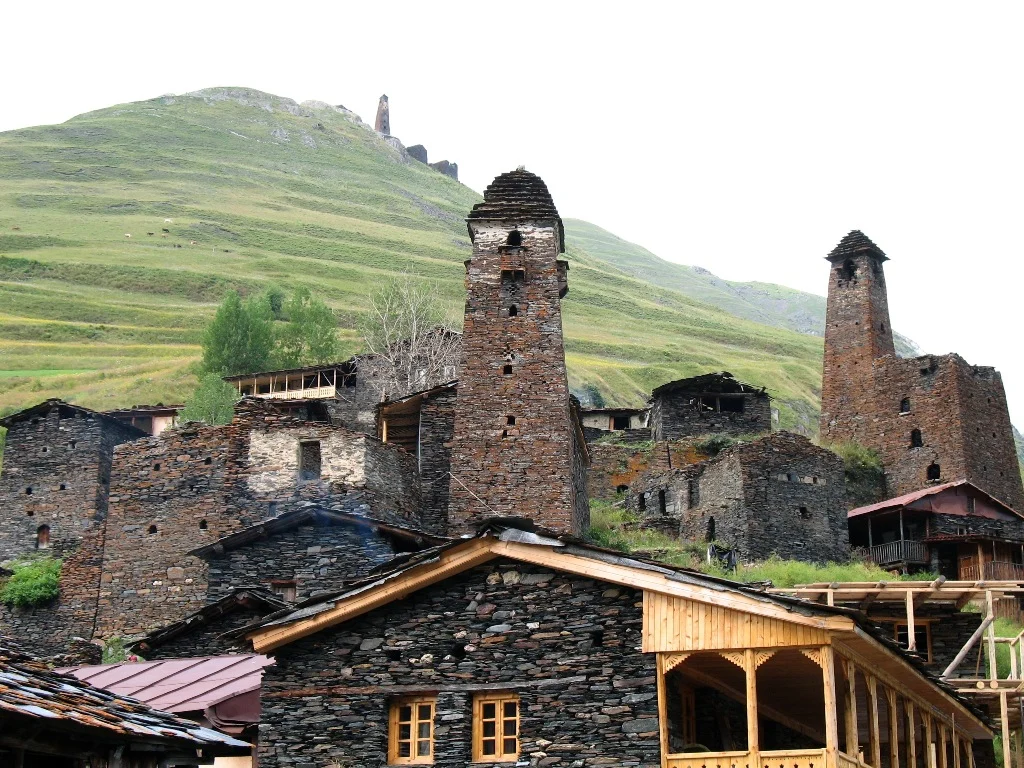
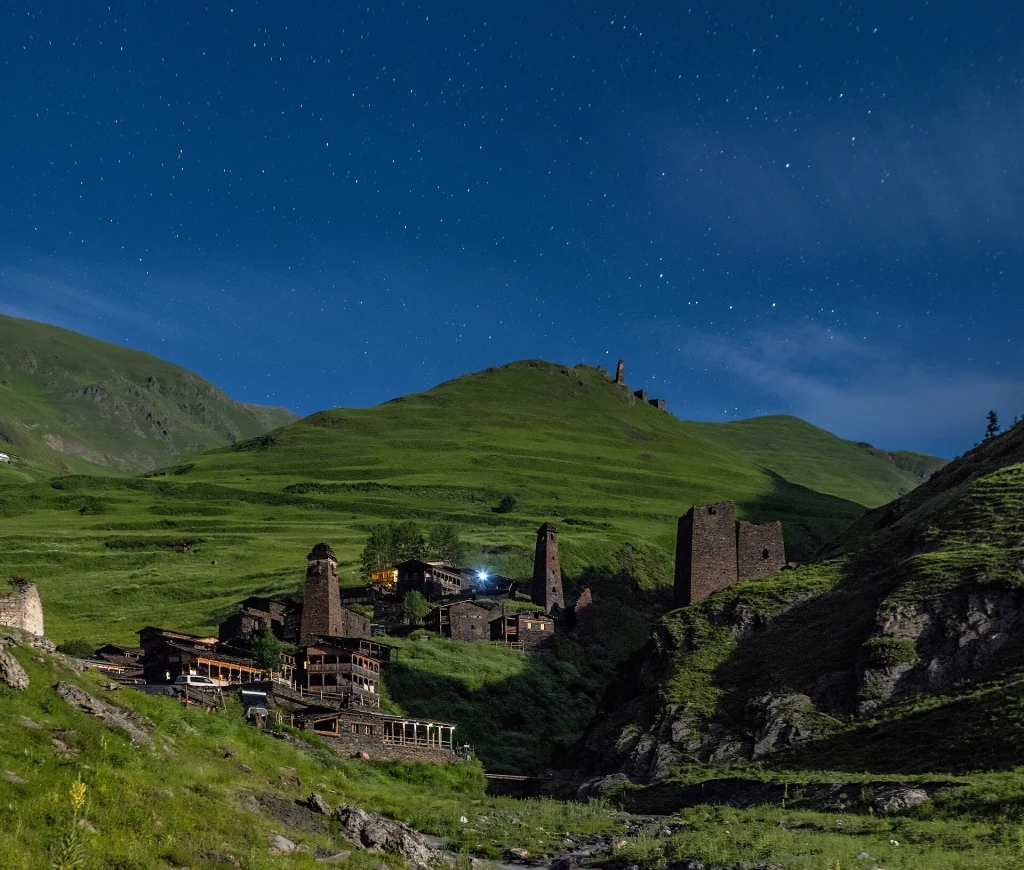
Dartlo stands at about 1,870 metres in the Pirikiti Alazani gorge, a short stone-paved climb from the riverbank. The village is a compact grouping of two- and three-storey tower-houses (koshki) built from local slate and roughly dressed stone, several still topped with their original timber-and-earth roofs. Narrow lanes run between the towers, linking household courtyards, hay barns and a small cluster of chapels associated with Tush religious practice, which blends Orthodox Christianity with older highland customs. On the slope above the main cluster stand the ruins of a watchtower and a small defensive complex that once controlled the approach along the gorge. There is no museum building or ticket booth; the village is a lived-in settlement, with a handful of families still farming and keeping guesthouses in summer, so visitors walk through an active community rather than a roped-off monument.
History
Tusheti’s tower villages, including Dartlo, developed from the medieval period onward as the Tush built fortified homes against raids from the northern Caucasus passes, with most of the surviving towers dated by local tradition and building style to the 16th–18th centuries. The settlement pattern, extended families clustered around defensive towers with shared watch points, is characteristic of highland Georgian architecture also seen in Svaneti, though built in a different stone and roof technique suited to Tusheti’s climate. Dartlo and the wider Tusheti area were brought under formal protection in 2003 with the creation of the Tusheti Protected Landscape and Tusheti National Park, administered by Georgia’s Agency of Protected Areas, which covers conservation of both the natural landscape and its historic settlements (apa.gov.ge). Several of the towers and dwellings in Dartlo are separately listed as immovable cultural heritage monuments under Georgian law, which restricts alteration of their exterior fabric (heritagesites.ge). Because the only vehicle access, over the 2,826-metre Abano Pass, is snowbound for roughly eight months of the year, Dartlo saw little of the concrete rebuilding that affected more accessible Georgian villages in the Soviet period, which is why its tower architecture remains close to its original form.
Opening hours and tickets
| Item | Typical pattern |
|---|---|
| Access to the village | Open at any hour, no gate or ticket; it is a working settlement |
| Road over Abano Pass | Usually passable roughly June to mid-October, closed by snow the rest of the year — check current status before travelling |
| Entrance fee | None for walking through Dartlo or the Pirikiti gorge |
| Guesthouses and small cafés | Open only in the road-open season, roughly June to September/October |
Road conditions change year to year depending on snowfall and repair work; confirm the current state of the Abano Pass before setting out (see our road status page), checked at booking.
How to get there
From Tbilisi, the route runs via Alvani (about 170 km of paved road, 2.5–3 hours) and then climbs an unpaved mountain track over the Abano Pass to Omalo, a further 70 km that takes 4–5 hours in a 4×4 due to switchbacks and river crossings; Dartlo lies another 12 km beyond Omalo along the Pirikiti gorge, roughly 30–45 minutes further. A sedan cannot make the Alvani–Omalo stretch; a 4×4 vehicle is required. In the open season a seasonal marshrutka runs once daily from Tbilisi to Omalo, usually departing early morning, but schedules are irregular and subject to road conditions. There is no train or scheduled flight option; Kutaisi and Batumi are not practical gateways, as both add a long additional drive to reach Alvani. With GTour, the trip is normally arranged as part of a multi-day Tusheti itinerary with a 4×4 and driver-guide, since a single-day return from Tbilisi is not realistic given the driving time.
How long and the best time
Most visitors spend two to three hours walking through Dartlo itself, but reaching it is the larger commitment: a worthwhile visit to Tusheti generally needs at least two full days, and three to four days allows time to also see Omalo, Shenako or Diklo without rushing the mountain roads. The road-open window, roughly June through September, with early October often still possible, is the only realistic time to visit; outside this window the pass is closed by snow and Dartlo is effectively cut off by road. Late June to early September brings the most stable weather and open guesthouses; July and August are busiest with hikers.
Tips
- Dress in layers and bring a windproof jacket even in summer, as the gorge sits above 1,800 metres and evenings turn cold quickly.
- Photograph the towers from the lower approach path for the full cluster in one frame, and ask before photographing residents or private courtyards.
- Weather on the Abano Pass can close or restrict the road with little warning after heavy rain or early snow, even within the usual season.
- Queues are not an issue here; the constraint is road access and daylight hours for driving, not crowding at the site.
- Carry cash, as there are no card machines in Dartlo or Omalo, and fuel up fully before leaving Alvani.
- A certified driver experienced on the Abano Pass is strongly recommended; this is not a route for a rented sedan or an inexperienced driver.
Nearby
- Omalo, the administrative centre of Tusheti, with the Keselo fortress complex
- Shenako, a village known for its red-roofed church and wooden balconies
- Diklo, a border village with its own tower cluster, further up the valley
- Girevi, a smaller Pirikiti gorge village near Dartlo
- Dano, a short walk from Dartlo along the river
Dartlo Village is on these private tours: Georgia Classic in 7 Days — Tbilisi, Kazbegi, Kakheti and Mtskheta · Tbilisi or Kutaisi to Mestia — Private 4×4 Transfer · Tbilisi to Batumi — Private Transfer, 6 Hours with Stops. A travel expert adapts any of them to your dates.
Questions
Is there an entrance fee to visit Dartlo?
No, the village is open and free to walk through; there is no ticket or gate.
Can I reach Dartlo in a normal rental car?
No, the Alvani–Omalo road over the Abano Pass requires a 4×4; a sedan cannot make the climb safely.
When is the road to Dartlo closed?
Typically from mid-October to June, depending on snowfall; check current status before travelling.
How long does the drive from Tbilisi take?
Around 7–8 hours to Omalo in good conditions, plus another 30–45 minutes on to Dartlo.
Sources
Aerial view of Dartlo village with its stone towers perched above the Tusheti gorge. · Photo: Paata vardanashvili / Wikimedia Commons, CC BY-SA 4.0