

Dariali Gorge and Monastery — opening hours, tickets, how to get there and what to see
Dariali Gorge is a narrow defile of the Tergi (Terek) river on the Georgian Military Highway, a few kilometres north of Stepantsminda and right up against the Russian border crossing at Verkhny Lars. Known to classical geographers as the “Caucasian Gates,” it has controlled the only practicable route through the central Caucasus for over two thousand years, and today holds both the ruins of a medieval fortress and a modern Georgian Orthodox monastery built into the cliffs above the river. Archaeological fieldwork at the fortress site, carried out since 2013 by Georgian and German teams, has identified building phases spanning roughly the 4th to the 17th century.
What you see
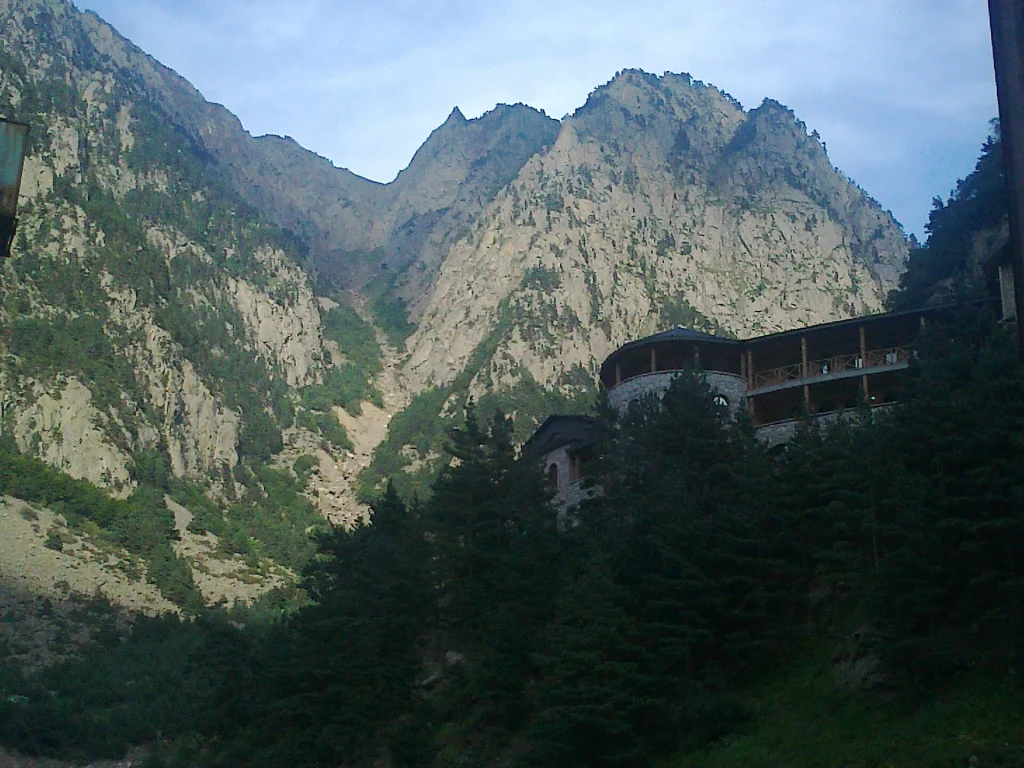
The gorge is a short, steep-walled corridor where the Georgian Military Highway, the Tergi river and the railway-era mule track are squeezed together between cliffs that in places rise almost vertically for hundreds of metres. On a rock spur above the road stand the remains of Dariali Fortress, a stone watch-post that once blocked the pass to anyone moving between the South Caucasus and the North Caucasus steppe. Opposite and slightly north, a modern monastic complex, built into the hillside in pale stone with a bell tower and chapel, overlooks the river; it is an active working monastery rather than a historic monument, and visitors are welcome to step into the chapel in appropriate dress. Downstream toward Stepantsminda, a side valley leads to the Gveleti waterfalls, a popular short walk from the main road.
History
Classical and early medieval writers referred to this defile as the “Caucasian Gates” or “Gates of the Alans,” recognising it as the single realistic crossing point through the central Caucasus range (see the Britannica entry on Darial Gorge). Control of the pass mattered to every power that bordered it, from Sassanid Persia to medieval Georgian kingdoms and the polities of the North Caucasus, because whoever held the fortress could tax or close the route. Excavations at the fortress site, resumed in the 2010s under Georgia’s heritage authorities, have uncovered several distinct construction phases and defensive walls, work that is recorded in the national monuments inventory (National Agency for Cultural Heritage Preservation of Georgia). The monastery seen today is a recent addition, built in the 2010s as a working religious community and pilgrim stop close to the border; it has no medieval fabric of its own but stands inside a landscape that has been fought over and fortified since antiquity. The gorge’s strategic value did not end with empires: the modern Georgian Military Highway follows the same line, and the Russian border post at Verkhny Lars, a few hundred metres further on, remains one of the few functioning road crossings between Georgia and Russia, subject to periodic closures that are posted by Georgia’s road authority (Georgian Road Department).
Opening hours and tickets
| Item | Access | Notes |
|---|---|---|
| Dariali Gorge (viewing from the road) | Open at all hours, daylight recommended | No ticket; part of the public highway |
| Dariali Monastery chapel | Typically open during daylight hours | Free entry, donations welcome; checked at booking |
| Dariali Fortress ruins | Viewed from the roadside; not a managed site with fixed hours | No ticket; fencing or access may change during ongoing excavation |
| Verkhny Lars border zone beyond the monastery | Restricted to border traffic | Photography and stopping are not permitted near the checkpoint |
How to get there
From Tbilisi, Dariali Gorge is about 160 km and typically 2.5 to 3 hours by car on the Georgian Military Highway via Mtskheta, Ananuri and Gudauri, continuing about 8 km past Stepantsminda toward the border. Shared marshrutkas running from Tbilisi’s Didube station to Stepantsminda pass along the same road and can drop passengers near the gorge, though most visitors see it as a short stop on the way to or from the town. There is no rail link; the Military Highway is the only route. Winter snow, avalanche risk and periodic border-related closures affect this stretch more than any other section of the road, so checking conditions before travelling is worthwhile (road status, Georgian Road Department). We run this as part of our Kazbegi tours, with drivers who watch the pass conditions daily: see Kazbegi — Gergeti Trinity Church in a Day and Kazbegi — 2-Day Mountain Journey on gtour.ge, or book a private car with driver from Tbilisi for a fixed day rate.
How long and the best time
Most visitors spend 20 to 40 minutes at the gorge and monastery, usually as a stop on a longer day in Kazbegi, or combined with the Gveleti waterfalls for a half-day add-on. Late spring through early autumn, roughly May to October, gives the most reliable road conditions and the clearest light on the cliffs; the gorge is at its most dramatic with the afternoon sun low against the rock walls. Winter visits are possible but depend entirely on snow clearance and border traffic, and the road can close without much notice.
Tips
- Dress modestly for the monastery chapel: shoulders and knees covered, headscarves for women are usually available at the door.
- Photograph the gorge from the roadside pull-offs rather than near the border fencing, where photography is restricted.
- Bring a layer even in summer; wind funnels through the narrow gorge and temperatures drop quickly once the sun is behind the cliffs.
- Traffic can back up for hours at Verkhny Lars when the border is busy, so build in spare time if your route continues north of the monastery.
- Combine the stop with Gveleti waterfalls, a short walk off the main road a few kilometres south.
Nearby
- Gveleti waterfalls
- Stepantsminda town
- Gergeti Trinity Church
- Kazbegi National Park
- Sno and Juta valleys
Dariali Gorge and Monastery is on these private tours: Georgia Classic in 7 Days — Tbilisi, Kazbegi, Kakheti and Mtskheta · Kazbegi and Kakheti Photography — 3 Days of Mountains and Vineyards · New Year in Georgia — Tbilisi Fireworks, Kakheti Supra and Gudauri Snow, 6 Days. A travel expert adapts any of them to your dates.
Questions
Is there an entry fee for Dariali Gorge or the monastery?
No fixed ticket; the gorge is viewed from the public road and the monastery chapel asks only for donations, checked at booking.
Can I cross the border at Verkhny Lars from here?
Yes, this is a functioning road crossing into Russia, but it is for travellers with the correct visas and documents, and closures are common; check status before relying on it.
How far is Dariali Gorge from Stepantsminda?
About 8 km north, a short drive along the Georgian Military Highway toward the Russian border.
Is the fortress open to walk through?
The ruins are an active archaeological site viewed from the roadside rather than a site with managed visitor access.
Sources
The newly built monastery of the Archangels nestles beneath the rugged peaks of Dariali Gorge. · Photo: shankar s. from Dubai, united arab emirates / Wikimedia Commons, CC BY 2.0