

By Mariam Lomidze, Culture & Events Reporter · 29/10/2026
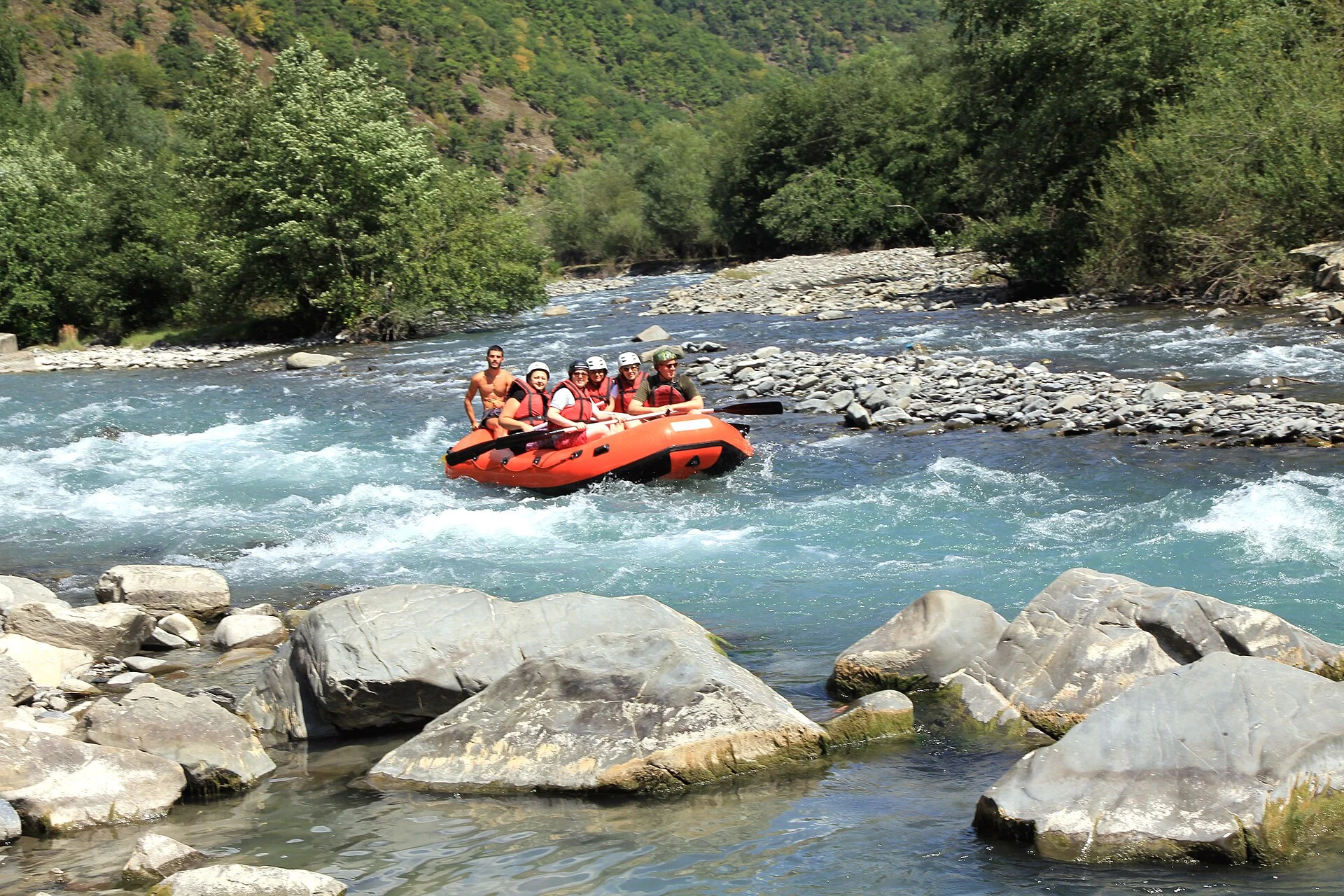
Georgia’s whitewater season runs roughly from April to October, but the standout rivers for rafting and kayaking are the Aragvi near Tbilisi, the Rioni and Tskhenistskali in the west near Kutaisi, and the Mtkvari (Kura) through its mountain gorges near Borjomi. Snowmelt pushes all four rivers to their highest, fastest and coldest in May and June, which is when the whitewater is most exciting and when beginners should expect a wetter, bumpier ride than later in summer. For calm paddling rather than whitewater, the flat Tbilisi Sea reservoir and the Black Sea coast at Batumi and Kobuleti are the places for kayaking and stand-up paddleboarding.
This guide sets out what each river offers, when to go, how half-day trips work from Tbilisi and Kutaisi, what to ask about safety and children’s minimum ages, and where to paddle flat water if whitewater is not what you are after. Prices for commercial rafting trips in Georgia are set by individual river operators rather than by GTour or any state price list, so treat the figures below as the range commonly quoted and always confirm the exact price, grade and inclusions with the operator before you book.
The four rivers at a glance
Grading below follows the International Scale of River Difficulty (class I, easiest, to class V) as commonly used by Georgian operators. Grades shift with water level and season, so the same rapid can be class II in August and class IV in June. Always ask the operator for the specific section’s grade on the day you plan to paddle.
| River | Typical grade | Best base | High-water window | Character |
|---|---|---|---|---|
| Aragvi | II–III | Tbilisi (1.5–2 hours) | May–June | Short, accessible runs near Pasanauri and Ananuri along the Georgian Military Highway |
| Rioni | I–IV depending on section | Kutaisi | May–June, runnable into September | Gentle stretches through Kutaisi city; faster water upstream toward Racha |
| Tskhenistskali | III–IV | Kutaisi or Ambrolauri | May–June | Remote valley in Racha-Lechkhumi, fewer operators, more committing water |
| Mtkvari (Kura) | I–III depending on gorge | Borjomi / Akhaltsikhe | April–June | Mostly flat through Tbilisi; whitewater sections lie further upstream in the Borjomi gorge |
When to go: the May-June high water and what changes after it
Snowmelt from the Greater Caucasus and the mountains of Racha and Samtskhe-Javakheti keeps all four rivers at their fullest and fastest in May and June. This is the best window for experienced paddlers wanting genuine whitewater, but it is also colder, requiring a wetsuit, and less forgiving of mistakes, so first-time rafters should expect a guide to choose a gentler section even on the same river. By July and August, water levels drop, rapids become more technical but less powerful, and family-friendly floats on the Rioni near Kutaisi and the lower Aragvi become the norm. By October, several sections are too low to run commercially; ask your operator whether the river is open before travelling, and check the Georgian Road Department’s live conditions for the Georgian Military Highway if you are heading to the Aragvi valley, since the road can close in bad weather even when the river is fine.
Half-day rafting from Tbilisi: the Aragvi
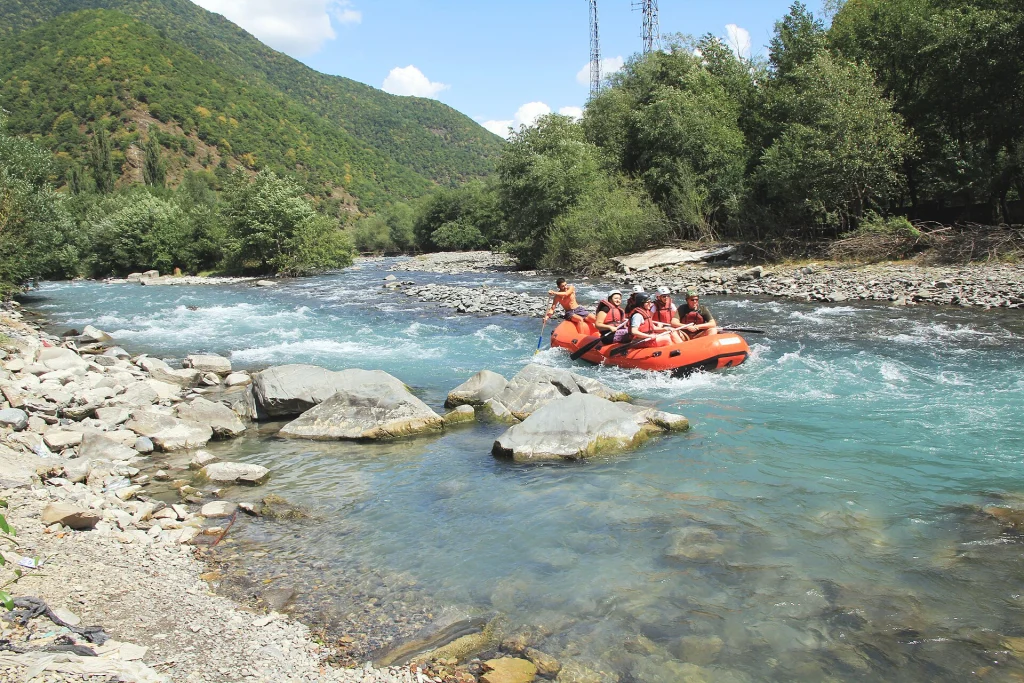
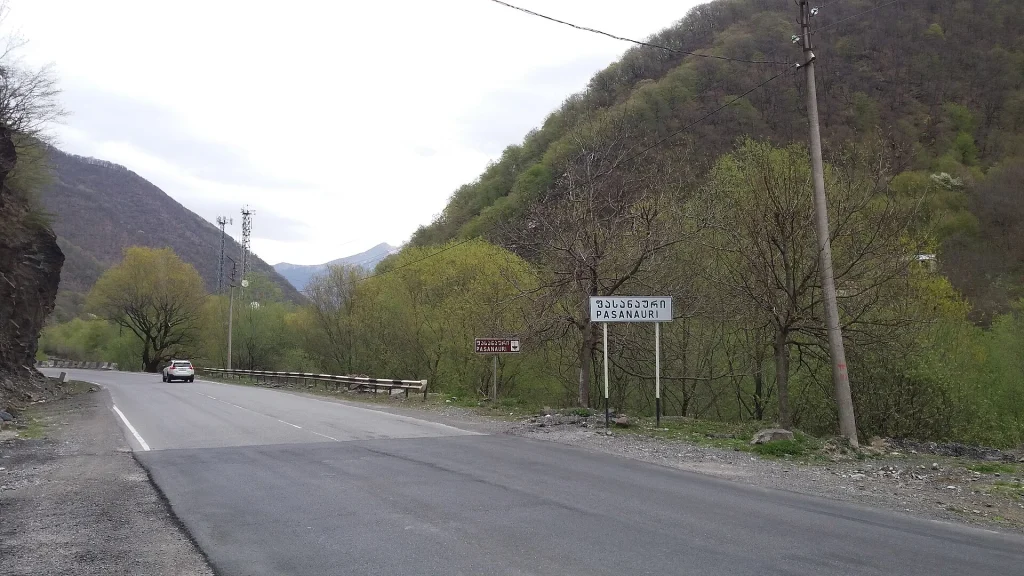
The Aragvi is the easiest river to combine with a short trip from the capital because it runs alongside the Georgian Military Highway, the same road used for day trips to Ananuri, Gudauri and Kazbegi. Commercial sections cluster around Pasanauri and Ananuri, roughly 90 minutes to two hours from Tbilisi, with half-day packages typically including transfer, equipment, a safety briefing and one to two hours on the water. If you would rather arrange your own schedule and combine rafting with sightseeing at Ananuri fortress, a private car with driver or the Georgian Military Highway — Ananuri, Gudauri and Gergeti in a Day itinerary from GTour gives you the flexibility to stop at a rafting put-in point along the way; speak to us about adding a river operator to that route.
Half-day rafting from Kutaisi: the Rioni and Tskhenistskali
Kutaisi sits directly on the Rioni, which makes the city the natural base for both gentle city-adjacent floats and more serious whitewater further upstream toward Racha. A short, low-grade paddle through Kutaisi suits families and first-timers, while trips organised from Ambrolauri or Oni reach faster, more technical water in the high-water months. The Tskhenistskali, in the neighbouring Lechkhumi valley, has fewer commercial operators and more committing rapids, and is usually booked as part of a wider Racha itinerary rather than a stand-alone half-day; the Racha and Lechkhumi by 4×4 — 3 Days tour and Racha in a Day — Shaori Lake, Nikortsminda and Khvanchkara both pass through this region and can be adapted to include a rafting stop. For a shorter outing, the Kutaisi Half-Day — Bagrati, the Green Bazaar and the Rioni gives a sense of the river’s path through the city before you decide whether to book whitewater further upstream.
The Mtkvari (Kura) through the Borjomi gorge
Through Tbilisi the Mtkvari is a wide, slow river with no commercial whitewater; the interesting paddling lies well upstream, in the gorges around Borjomi and toward Akhaltsikhe, where the river narrows and picks up pace, particularly in April to June. This stretch sees far fewer operators than the Aragvi or Rioni, so availability on any given day is less certain and it is worth confirming directly with a local operator before setting out, rather than assuming a trip is running. Parts of the upper river lie close to the Borjomi-Kharagauli National Park, administered by the Agency of Protected Areas, so check current access rules if your route takes you inside the park boundary. A Borjomi and Bakuriani — Spa Town and Mountain Air in a Day trip is a good way to see the gorge and the town before arranging river time separately with a licensed operator.
Children, safety standards and choosing an operator
Georgia has no single published national law setting a minimum rafting age or a mandatory safety certification scheme specific to river operators, so standards vary from company to company. In practice, most operators set a minimum age for gentler class I–II floats at around 8 to 12 years old, with higher minimums, sometimes 14 and up, for class III and above sections during high water. Before booking with children, ask the operator in writing what minimum age and weight apply to the specific section and water level on your date, not just the river’s general reputation. For all ages, expect and ask about: a safety briefing before launch, properly fitted buoyancy aids and helmets for everyone on the raft, wetsuits or drysuits supplied in the cold months, a qualified lead guide, and a safety kayaker or throw-bag cover on class III and above water. The Georgian National Tourism Administration maintains general information for visitors on licensed tourism activities; when in doubt, ask the operator for proof of guide training and public liability insurance, and if nothing can be shown, choose another company.
- Typical half-day commercial rafting trip: roughly 70 to 150 GEL per person depending on river, season and group size; always get the exact price in writing before paying.
- What should be included: transfer from the meeting point, wetsuit, helmet, buoyancy aid, guide, and often tea or a snack afterwards.
- What is commonly extra: photos and video, river-specific permits on protected sections, and transport from Tbilisi or Kutaisi city centre if not already included.
Kayaking and SUP on the Tbilisi Sea and the Black Sea
If whitewater is not what you are after, Georgia has two reliable flat-water options. The Tbilisi Sea, the reservoir northeast of the city centre, is used year-round for kayaking and stand-up paddleboarding, with rental points along the shore in the warmer months; mornings are calmest, and the water is cold enough from November to March that most rentals pause for the season. On the Black Sea coast, Batumi and the beaches north toward Kobuleti and Ureki offer sea kayaking and SUP, best in the morning before the afternoon onshore wind picks up chop; lifeguard-patrolled sections operate through the main summer season. Combine a coastal paddle with a Batumi Half-Day — Old Town, Boulevard and the Botanical Garden tour, or base yourself in Batumi for longer and arrange kayak or SUP rental directly through a beachfront operator on the day, checking current conditions before you go out, since the Black Sea’s wind and swell can change quickly.
If this guide is part of a trip you are planning, our Georgia Off the Beaten Track — 9 Days in Racha, Samegrelo and Guria and Batumi to Kutaisi Transfer — Private Car cover the places it describes with a private guide and driver; a GTour travel expert adapts the route to your dates.
Practical summary
- High-water, most exciting whitewater: May and June on the Aragvi, Rioni, Tskhenistskali and upper Mtkvari; gentler, warmer water from July through September.
- Easiest half-day from Tbilisi: the Aragvi near Pasanauri and Ananuri, about 1.5 to 2 hours’ drive.
- Easiest half-day from Kutaisi: the Rioni through the city; more serious whitewater lies upstream toward Racha.
- Tskhenistskali and the upper Mtkvari near Borjomi have fewer operators; confirm a trip is running before travelling.
- No single national minimum-age law exists; ask each operator for the age and weight limit that applies to your date and section.
- Always confirm in writing: helmets, buoyancy aids, wetsuits, guide qualifications, and public liability insurance.
- For flat water, use the Tbilisi Sea for kayaking or SUP year-round, or the Black Sea at Batumi and Kobuleti in summer, paddling in the calmer morning hours.
- Check road conditions to mountain put-in points, especially the Georgian Military Highway, before setting off.
Sources
- Georgian National Tourism Administration
- Georgian Road Department — road conditions
- Adjara tourism portal
- Visit Batumi
- Georgia Travel — official tourism portal
Questions this guide does not answer? Write to info@castle.ge or WhatsApp +995 577 41 63 14 — a person in Tbilisi replies. See also our travel services and all guides.
Rafters navigate the Aragvi River near its confluence in central Georgia. · Photo: Karelj / Wikimedia Commons, CC BY-SA 3.0
Been to Georgia? Tell us how it went — the best stories are published here.
Share your tripOne email a week: what changed for travellers in Georgia — rules, roads, flights, seasons — plus one place worth the trip. Written by the GTour desk, no advertising, unsubscribe in one click.
This story across our partner network — ქართულად: შენი დასვენება
