

By Prof. Giorgi Pkhakadze, MD, MPH, PhD · 15/09/2026
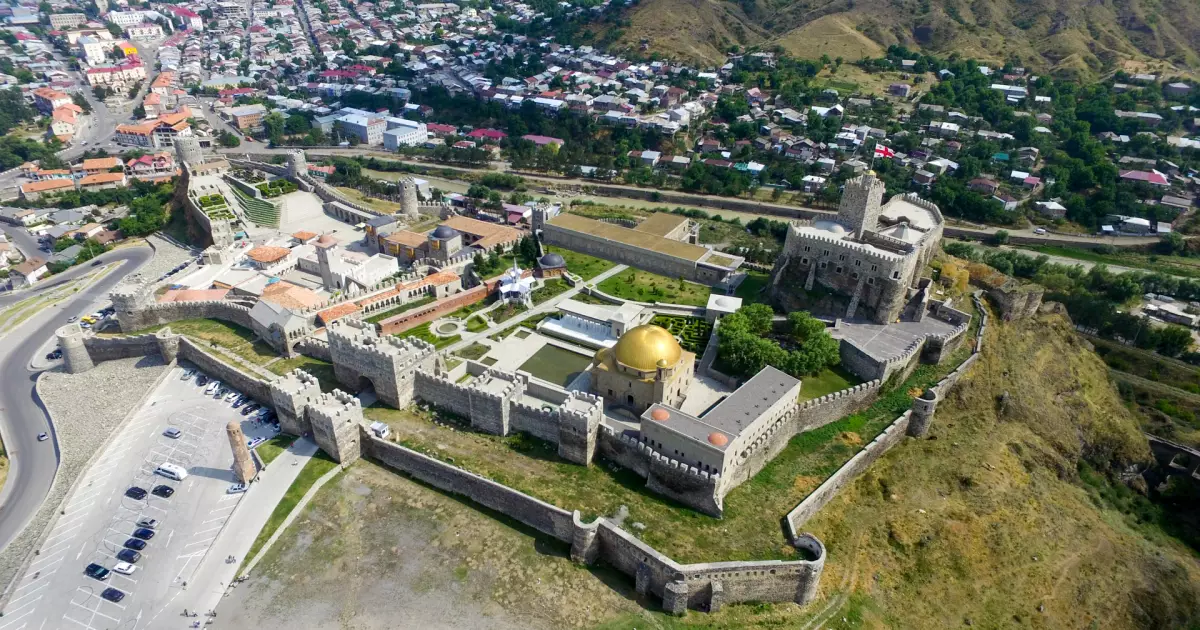
Akhaltsikhe means “new castle”, which tells you what the town was for. It sits where the road from Turkey enters the Kura valley, and whoever held the castle on the hill — Rabati — held the door to the south. For most of the last five hundred years that was the Ottomans; before them, Georgian princes; after them, the Russians. The fortress that reopened in 2012 after a complete reconstruction is a walk through all three.
The layers
The lower town, inside the outer wall, was the market and residential quarter, and it is now hotels, cafés and a small park. The upper citadel is the history: the Jakeli palace, home of the Georgian atabegs who ruled Samtskhe as a semi-independent principality from the 13th century, now the regional museum, with its collection of Meskhetian carpets, weapons and manuscripts; the Ahmediye mosque of 1752, with its gilded dome, built when the Jakelis had converted to Islam and become Ottoman pashas, and its madrasa and minaret; the Orthodox church of Saint Marina; and, down in the town below the walls, one of the two synagogues of a Jewish community that has lived in Akhaltsikhe for centuries. A Catholic church stands a street away. Four faiths, one hill — which was normal for the Georgian south for most of its history, and is unusual enough now to be worth pointing out.
The reconstruction
Rabati in 2011 was a ruin with a mosque in it. The Georgian government rebuilt the whole complex in a year — walls, towers, palace, mosque, gardens, pools, a glass-fronted museum — and the result divides opinion. Purists call it a theme park; most visitors call it beautiful, and on a summer evening, with the fountains on and the mosque’s dome lit against the mountains, it is hard to disagree. The mosque interior, with its restored painted ceiling, is the finest single room in the complex and is open to everyone.
Meskheti
The region around Akhaltsikhe, Samtskhe or Meskheti, has its own history, its own carpets and its own wine — a viticulture on terraced hillsides that was nearly lost when the Muslim population was deported in 1944 and has been replanted in the last twenty years. The tasting room in the lower town pours the revived Meskhetian varieties; nowhere else in Georgia tastes quite like it.
Practical
Two hours for the citadel and museum; add the town if you have time. Rabati is 200 kilometres from Tbilisi and pairs with Vardzia, an hour further south, and Borjomi, forty minutes north. The Sapara monastery, in a gorge ten kilometres away, is the region’s hidden gem — 13th-century, frescoed, almost always empty.
See it with GTour
Rabati is the first afternoon of the Vardzia, Rabati & Borjomi two-day tour and the last stop of the Borjomi, Bakuriani & Rabati tour; it is also on the Vardzia day trip.
This story in Georgian — ქართულად: shenidasveneba.ge
ქართულად: რაბათი — როგორ იტევს ერთი ციხე მეჩეთს, ეკლესიასა და სინაგოგას
