

By David Kiknadze, Transport & Openings Reporter · 29/10/2026
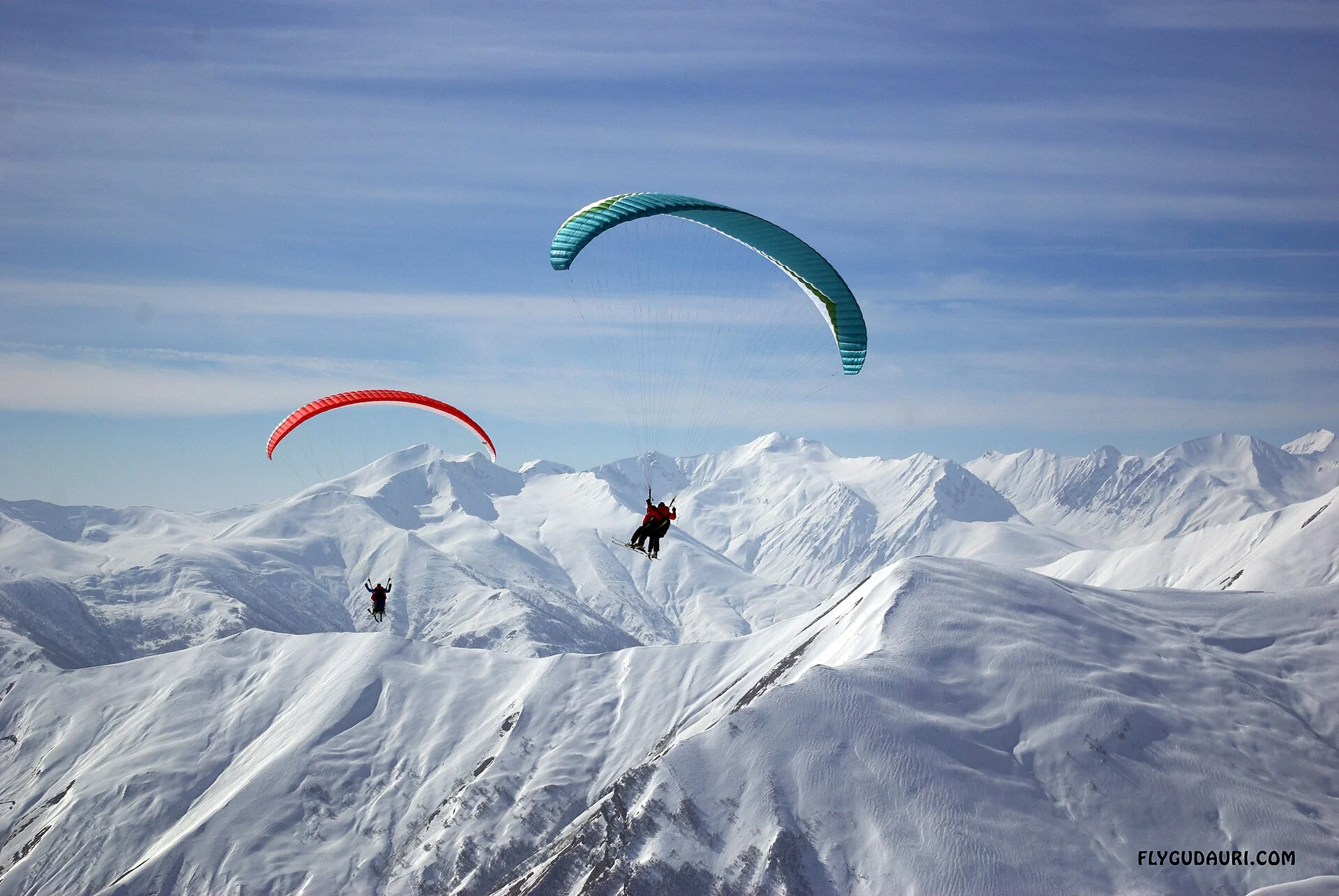
Tandem paragliding in Georgia runs for most of the year above Gudauri, the Georgian Military Highway‘s ski and adventure-sports town two hours north of Tbilisi, where local air currents off the Cross Pass keep flights possible even in winter. Shorter seasonal windows exist near Kazbegi (Stepantsminda), over the reservoir known as Tbilisi Sea on the capital’s eastern edge, and along the Black Sea coast at Batumi, where sea-breeze conditions suit lower, gentler flights. None of these are weather-guaranteed activities: every operator, everywhere, flies only when wind, visibility and cloud base allow, and cancellations or reschedules are normal rather than exceptional.
This guide sets out where flights actually happen, what a pilot’s “licence” does and does not mean in Georgia’s loosely regulated adventure-sports market, indicative 2026 prices, who can fly, and how to check the weather and insurance before you commit a day of your trip to it. Figures and rules below are conservative and dated to late October 2026; because tandem paragliding in Georgia is run by small operators rather than a single licensed national body, prices and even which hillsides are active can shift season to season, so we flag exactly where to verify before you fly.
Where tandem flights run
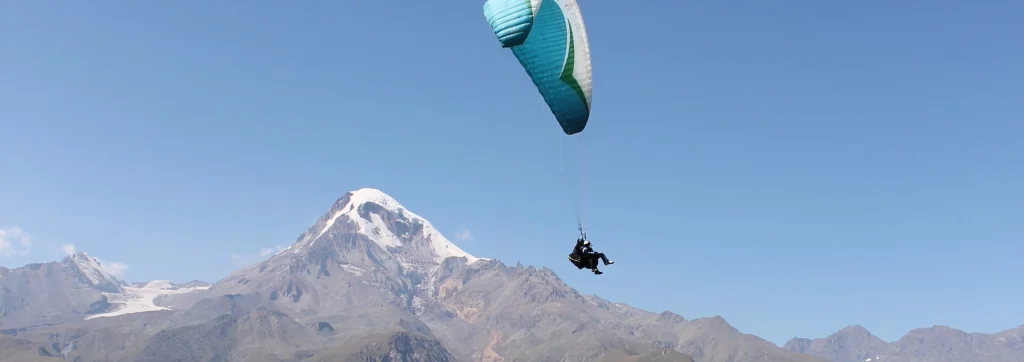
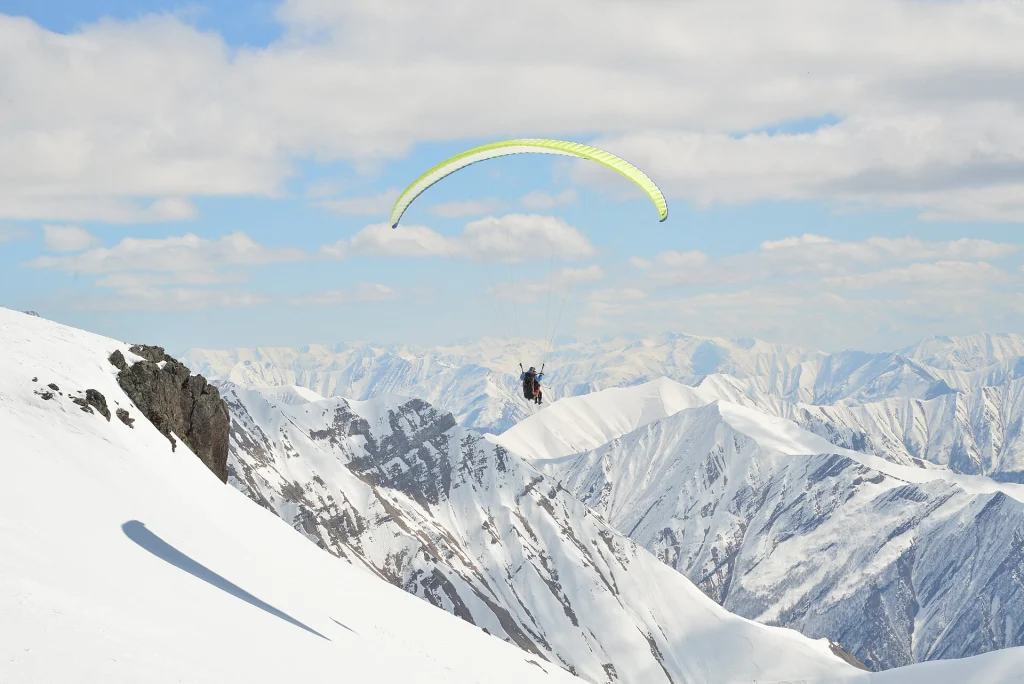
Gudauri is Georgia’s paragliding centre by a wide margin, with multiple launch points above the resort reachable by chairlift or 4×4, open roughly April to November for classic thermal flying and again in winter when cold, stable air over the snow produces short but reliable sled-ride flights. Kazbegi flights are fewer and more weather-sensitive, usually flown from spurs above the Gergeti valley with Mount Kazbek as a backdrop; many pilots who fly Kazbegi are the same Gudauri-based operators driving up on a good-forecast day. Tbilisi Sea hosts lower, shorter flights off modest hills on the city’s edge, useful for a quick taster without leaving town but offering less dramatic scenery and a shorter season. Batumi’s coastal paragliding depends on a steady onshore breeze and is the most weather-interrupted of the four, typically flown from the hills above the city or near Mtsvane Kontskhi (Green Cape).
| Location | Typical season | Flight length | Notes |
|---|---|---|---|
| Gudauri | Year-round, best April–November and mid-winter | 10–30 minutes | Largest operator base, chairlift access, combine with Gudauri — Mountain Escape or a ski package day |
| Kazbegi (Stepantsminda) | May–October, weather-dependent | 10–20 minutes | Fewer pilots, often booked as an add-on to a Georgian Military Highway — Ananuri, Gudauri and Gergeti in a Day trip |
| Tbilisi Sea | April–October | 5–15 minutes | Lowest altitude, shortest flights, convenient without a mountain transfer |
| Batumi | May–September, sea-breeze dependent | 10–20 minutes | Coastal views, more frequent weather cancellations than Gudauri |
Licensed operators and what a licence means
Georgia does not run a single, publicly searchable national licensing register specifically for tandem paragliding pilots, unlike mountain guiding or some other adventure disciplines. In practice, working tandem pilots in Gudauri and elsewhere typically hold a qualification from an international paragliding federation gained abroad, log their tandem hours informally, and carry their own liability insurance and equipment-inspection records. “Licensed” in local marketing usually means the pilot has a recognised tandem rating and current gear certification rather than a Georgian state permit. Before booking, ask directly to see proof of the pilot’s tandem rating, the date of the wing and harness’s last inspection, and the operator’s liability insurance certificate; a pilot or agency that cannot produce these on request is not one we recommend flying with. For the current state of tourism-safety oversight and any registration schemes that may be introduced, check the Ministry of Economy and Sustainable Development, which covers tourism regulation, at economy.ge, and the national tourism board at georgia.travel.
Prices in 2026
There is no fixed, government-set tariff for tandem paragliding in Georgia, so prices vary by operator, flight length and season and are usually quoted on the day in Georgian lari or US dollars at the launch site. The ranges below reflect the market as it stood in late October 2026 and should be treated as indicative only; always get your price confirmed in writing before you commit to a launch slot.
| Flight type | Typical length | Indicative price (2026) |
|---|---|---|
| Standard Gudauri tandem | 10–15 minutes | GEL 150–250 (about EUR 50–85) |
| Extended thermal flight | 20–30 minutes | GEL 300–450 (about EUR 105–155) |
| Kazbegi or Batumi tandem | 10–20 minutes | GEL 180–300 (about EUR 60–105) |
| Photo or video package | add-on | GEL 50–100 (about EUR 17–35) extra |
Figures are converted at the National Bank of Georgia’s reference rate; the lari amount quoted on the hillside is what matters, so confirm it with the pilot rather than relying on this table on the day.
Weight limits, age and fitness
Most Gudauri and Kazbegi operators accept passengers roughly between 35 and 110-120 kilograms, with a minimum age commonly set around 10-12 years and no fixed upper age limit beyond basic mobility to walk to the launch point and run a few steps on landing. Passengers well outside typical weight brackets, pregnant travellers, and anyone with a recent injury, uncontrolled heart condition, or inner-ear problem affecting balance should discuss the flight with a doctor before booking rather than relying on an operator’s informal assessment. Georgia’s public-health authorities do not issue paragliding-specific medical guidance, but general pre-travel health advice is available from the National Center for Disease Control and Public Health at ncgh.ge; for anything beyond routine fitness, see your own doctor first.
Weather windows and when flights are cancelled
Gudauri’s longer season exists because its topography produces flyable air in conditions that would ground pilots elsewhere in the Caucasus, but wind direction, gusting, low cloud and electrical storms still cancel flights regularly, especially in Kazbegi and Batumi where margins are tighter. Mornings tend to be calmer than afternoons in summer; winter flying depends on a stable high-pressure spell rather than a calendar date. Because reaching Gudauri and Kazbegi means crossing the Jvari (Cross) Pass on the Georgian Military Highway, check road status before you travel, particularly October to April, via the Georgian Road Department at georoad.gov.ge, and check a short-range wind and cloud forecast through Georgia’s National Environment Agency at nea.gov.ge. Build at least one spare day into a Gudauri or Kazbegi itinerary if the flight matters to you; operators will not fly in marginal conditions regardless of how far you have travelled.
What to wear and what to bring
- Layered clothing even in summer: launch altitudes above Gudauri sit well over 2,000 metres and wind chill in flight is significant.
- Closed, flat-soled shoes for the short run on launch and landing; sandals are usually refused.
- Sunglasses and sun protection; at altitude UV exposure is stronger than it feels.
- A charged phone or small camera if you want your own photos, though most operators film the flight for an extra fee.
- Cash in lari for the balance on the day, since card machines at hillside launch points are unreliable.
Insurance
Standard travel insurance policies frequently exclude paragliding or classify it as a hazardous activity requiring an add-on, so check your policy’s activities list before you fly rather than after. A policy that explicitly names “paragliding” or “aerial sports” as covered, with adequate medical evacuation cover for mountain terrain, is what you need; a generic travel policy without that wording may leave you liable for helicopter evacuation or hospital costs. Georgia’s Ministry of Foreign Affairs publishes general travel-safety guidance for visitors at mfa.gov.ge, and it is worth reading before any adventure activity, not only paragliding.
How G Tour books it
We do not operate flights ourselves; paragliding is weather-dependent and best left to specialist pilots rather than a touring company. What we do is build the logistics around it: transport to Gudauri or Kazbegi on a day with a workable forecast, a spare day where the itinerary allows, and a recommendation toward operators whose insurance and equipment records we have asked to see. A typical request comes through our Georgian Military Highway — Ananuri, Gudauri and Gergeti in a Day trip, our dedicated Gudauri — Mountain Escape day, or a Tbilisi to Gudauri Transfer paired with a Car with Driver by the Day for flexibility around the weather window; winter visitors often combine it with Winter Kazbegi — Snowshoes, Gergeti and the Rooms Hotel. If you want a guide on hand to translate and handle the booking at the launch site, add a Licensed Private Guide by the Day. We quote the transport and guiding separately from the flight fee, which you pay the pilot directly, so there is never a markup hidden inside an activity we do not control.
If this guide is part of a trip you are planning, our Georgia in 4 Days — Tbilisi, Kazbegi and Kakheti and Caucasus Highlands in 7 Days — Kazbegi, Khevsureti and Tusheti cover the places it describes with a private guide and driver; a GTour travel expert adapts the route to your dates.
Practical summary
- Gudauri flies nearly year-round; Kazbegi, Tbilisi Sea and Batumi are seasonal and more weather-sensitive.
- There is no single Georgian paragliding licence; ask to see the pilot’s tandem rating, equipment inspection date and insurance certificate before you fly.
- Expect roughly GEL 150-450 (about EUR 50-155) depending on flight length and location; confirm the price in writing on the day.
- Typical weight range is 35-110/120 kg with a minimum age near 10-12; see a doctor first if you have a heart, balance, or recent-injury concern, or are pregnant.
- Check Jvari Pass road status and the local wind forecast before travelling to Gudauri or Kazbegi, and build in a spare day.
- Confirm your travel insurance explicitly covers paragliding before you book; generic policies often exclude it.
- Wear layers and closed shoes, carry cash in lari, and treat any flight quote as provisional until the operator confirms on the day.
Sources
- Georgian Road Department (pass status)
- National Environment Agency (weather forecasts)
- Ministry of Foreign Affairs travel guidance
- Georgian National Tourism Administration
- Ministry of Economy and Sustainable Development
- Lonely Planet Georgia
Questions this guide does not answer? Write to info@castle.ge or WhatsApp +995 577 41 63 14 — a person in Tbilisi replies. See also our travel services and all guides.
Tandem paragliders soaring over the snowy peaks above Gudauri, Georgia. · Photo: Mykhaylo Aleksyeyenko / Wikimedia Commons, CC BY-SA 3.0
Been to Georgia? Tell us how it went — the best stories are published here.
Share your tripOne email a week: what changed for travellers in Georgia — rules, roads, flights, seasons — plus one place worth the trip. Written by the GTour desk, no advertising, unsubscribe in one click.
This story across our partner network — ქართულად: შენი დასვენება
