

By David Kiknadze, Transport & Openings Reporter · 05/11/2026
The honest answer: install Bolt and Yandex Go for city rides, Tbilisi Transport for the metro and buses, Glovo or Wolt for food, and download Organic Maps or Maps.me before you leave town, because mobile data thins out fast once you climb into Tusheti, Khevsureti or upper Svaneti. Add the 112 app for emergencies, a translation app that can read Georgian script through your camera, and either a physical SIM or an eSIM bought before or at the airport. None of this is exotic by 2026 standards, but the mix of apps that actually work here is specific to Georgia, and a few quirks (cash-only marshrutkas, card readers that reject foreign Visa in small villages, Yandex Go’s shifting payment rules) catch first-time visitors every season.
Card acceptance is good in Tbilisi, Batumi and Kutaisi hotels, restaurants and supermarkets, and patchy to nonexistent in mountain guesthouses, village shops and most shared taxis. Apple Pay and Google Pay work wherever contactless terminals are installed, which by 2026 is most urban retail. Carry Georgian lari in cash for villages, market stalls, church donation boxes and tips, and keep your passport details handy, since both ride-hailing apps occasionally ask for a photo ID to activate an account. Everything below is current for November 2026; verify anything price- or policy-sensitive against the official link given, since Georgian apps and fares change without much notice.
Ride-hailing: Bolt and Yandex Go
Bolt is the most reliable app for short-notice taxis in Tbilisi, Batumi, Kutaisi, Rustavi and several other towns. Fares are shown before you confirm, drivers rarely cancel, and in-app card payment generally accepts foreign Visa and Mastercard, though you should still keep cash as a backup if the app flags your card. Yandex Go has wider coverage in smaller towns and is often slightly cheaper, but its card-payment rules for foreign-issued cards have changed more than once in recent years, so confirm inside the app whether your card is accepted before relying on it, and keep lari in your pocket regardless. Both apps let you set pickup pins precisely, which matters in the Old Town’s narrow lanes where street addresses are unreliable. For routes beyond city limits, such as Kazbegi, Svaneti or a full day in Kakheti, a ride-hailing app is the wrong tool: use a car with driver by the day instead, which starts at €240 solo or €150 each for two travellers and includes fuel, tolls and waiting time.
Public transport: the Tbilisi Transport app and the metro
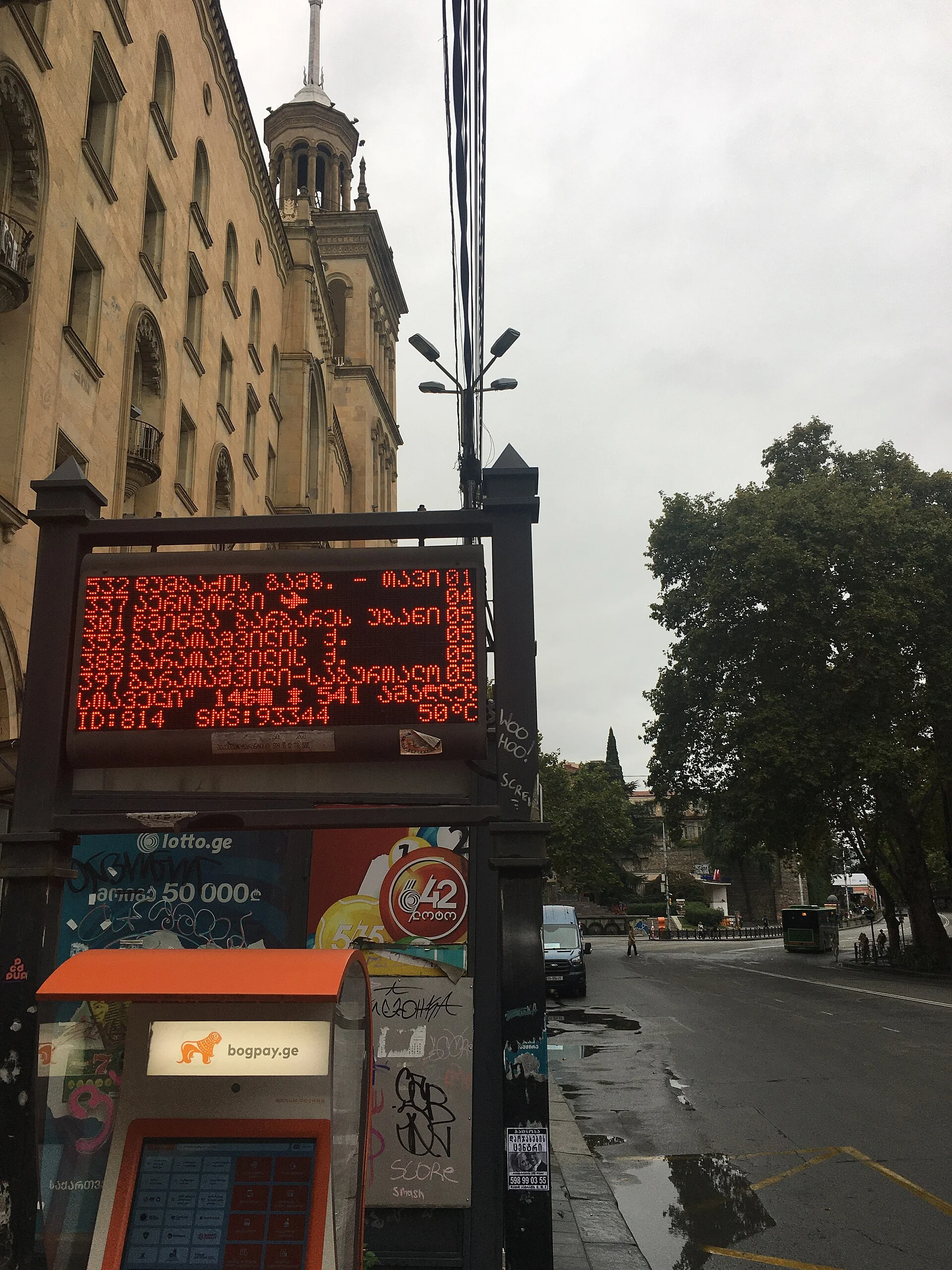
Tbilisi’s official transport app shows live bus and metro arrival times and lets you top up a Tbilisi Card (the city’s contactless transit card) from your phone. The metro itself does not accept Apple Pay or Google Pay directly at turnstiles in most stations; you need a physical Tbilisi Card, bought and topped up at metro kiosks or vending machines for a few lari. Buses use the same card system. The app is useful for planning but the card remains the actual payment method underground. Tbilisi City Hall maintains current route and fare information, which is worth checking before a long stay, since network changes happen a few times a year.

Trains: railway.ge
Georgian Railway’s own booking site and app, railway.ge, is the only reliable way to buy advance tickets for the Tbilisi–Batumi and Tbilisi–Zugdidi overnight and day services, including seat and sleeper classes. Buying at the station is possible but overnight trains to the coast sell out in summer and around holidays, so book ahead on railway.ge if your dates are fixed. The interface has an English option, accepts international cards, and sends an e-ticket you show as a QR code rather than a printed document. Note that schedules shift seasonally and the site is the only authoritative source for current timetables and fares; do not rely on third-party resellers for Georgian domestic trains.
Delivery: Glovo and Wolt
Glovo and Wolt both operate in Tbilisi and Batumi for restaurant and grocery delivery, and Wolt has extended to Kutaisi in recent seasons. Both accept international Visa and Mastercard, plus Apple Pay and Google Pay, inside the app, and both show delivery fees and estimated times before you order. Cash on delivery is available on some orders but not guaranteed, so check at checkout. Menus are usually in English as well as Georgian, though smaller independent restaurants sometimes list dishes only in Georgian script, which is where a translation app with camera input earns its keep (see below). Coverage thins fast outside the two main cities, so do not expect delivery in Kazbegi, Mestia or Kakheti wine villages.
Paying for things: cards, cash, TBC Pay, BOG Pay, Apple and Google Pay
Georgia’s two largest banks, TBC and Bank of Georgia, each run a mobile banking app (TBC Pay and BOG Pay) used for domestic QR and account-to-account payments. These are built around Georgian bank accounts and are not generally usable by a short-term visitor without one, so treat them as background infrastructure rather than tools for your trip. What matters for tourists is straightforward: international Visa and Mastercard work at the overwhelming majority of Tbilisi, Batumi and Kutaisi merchants, Apple Pay and Google Pay are accepted anywhere with a contactless terminal, and American Express is far less universal, so carry a Visa or Mastercard as backup. Outside the three main cities, card machines are less common and sometimes offline for stretches, particularly in mountain guesthouses, village shops, roadside churchkhela stalls and most marshrutka (shared minivan) services, all of which are cash-only. Withdraw lari from ATMs in towns before heading into Tusheti, Khevsureti, Racha or upper Svaneti, since cash machines thin out quickly past the last large town on your route.
| App | Main use | Cash accepted | Card / Apple & Google Pay | Quirk to know |
|---|---|---|---|---|
| Bolt | City taxis | Yes | Usually yes | Most reliable coverage |
| Yandex Go | City taxis | Yes | Policy varies | Check card status in-app each trip |
| Tbilisi Transport | Metro, bus timetables | No (card at gate) | No, needs Tbilisi Card | Card bought separately at kiosks |
| railway.ge | Train tickets | Station only | Yes online | Book ahead for overnight coastal trains |
| Glovo / Wolt | Food, grocery delivery | Sometimes | Yes | City coverage only |
| Organic Maps / Maps.me | Offline hiking and driving | n/a | n/a | Download region before leaving signal |
Offline maps for the mountains
Mobile data coverage drops to nothing on large stretches of the Abano Pass into Tusheti, much of the Khevsureti back roads, and parts of the Svaneti and Racha ranges, so an app that works with no signal is not optional for self-drive or hiking trips. Organic Maps and Maps.me both use downloadable offline OpenStreetMap data, let you save a region before you leave Tbilisi or Kutaisi, and show hiking trails reasonably well in Georgia, though trail accuracy varies by area and should not replace a paper map, a GPX track from a guide, or local advice on conditions. Google Maps can also cache a region for offline driving directions, but it is weaker on footpaths. If you are driving yourself toward Tusheti, Omalo, Shatili or the high Svaneti villages, check road and pass conditions before you go, since seasonal closures and landslides happen with little warning; our own road status page is updated for exactly this kind of route planning, and a 4×4 trip such as the Khevsureti and Tusheti by 4×4 itinerary removes the guesswork entirely.
Staying connected: eSIM apps and physical SIMs
Travellers increasingly buy an eSIM through apps such as Airalo before arrival, which activates on landing and avoids queueing at an airport kiosk. This works well for Tbilisi and the main towns but coverage and speed in deep mountain valleys depend on the carrier’s physical towers, not the eSIM provider, so no app guarantees signal in Tusheti or upper Svaneti regardless of plan. Physical SIM cards from Georgia’s main operators are sold at kiosks inside the arrivals halls at Tbilisi, Kutaisi and Batumi airports, usually cheaper per gigabyte than international eSIM bundles for longer stays, and a sensible backup even if you also carry an eSIM. Either way, download your offline maps and translation language packs while you still have working data, ideally at the airport or your first hotel’s wifi.
Emergency 112 and translating Georgian script
Georgia’s unified emergency number is 112, covering police, ambulance and fire, and it operates a mobile app that lets you send your GPS location directly to dispatchers, which is useful if you cannot describe exactly where you are on a mountain trail or an unmarked village road. English-speaking operators are generally available, but confirm current app functionality and any registration steps with Georgia’s official state information before you need it, and always carry the physical number 112 as a fallback even if the app fails to connect. For reading menus, road signs and shop fronts written in the Georgian alphabet (Mkhedruli), Google Translate’s camera mode is the most practical tool, since it overlays a live translation on signage without requiring you to type anything, and its Georgian language pack can be downloaded for offline use. It is not perfect with handwritten signs or stylised shop fonts, so treat translations of anything important, such as medical instructions or official notices, with caution and ask a local or your guide to confirm.
If this guide is part of a trip you are planning, our Tbilisi to Gudauri Transfer — Ski Season 4×4 and Mtskheta on Foot — the Ancient Capital in 2 Hours cover the places it describes with a private guide and driver; a GTour travel expert adapts the route to your dates.
Practical summary
- Install Bolt and Yandex Go before arrival; confirm card payment works in-app, carry lari as backup.
- Use the Tbilisi Transport app for timetables, but buy a physical Tbilisi Card for the metro and buses.
- Book coastal and sleeper trains in advance on railway.ge, not at the station, in high season.
- Glovo and Wolt cover Tbilisi and Batumi only; do not expect delivery in villages or mountain towns.
- Download Organic Maps or Maps.me for your route before leaving signal, especially toward Tusheti, Khevsureti and Svaneti.
- Buy an eSIM through an app like Airalo or a physical SIM at the airport; neither fixes mountain dead zones.
- Keep the 112 app and the number 112 as separate fallbacks for emergencies.
- Use Google Translate’s camera mode for Georgian script, and double-check anything medically or legally important with a person.
- Withdraw lari in towns before heading into the mountains; cash remains essential outside the three main cities.
Sources
- Georgian Railway booking
- Tbilisi City Hall
- Georgia National Tourism Administration
- Georgia Travel official site
- Ministry of Foreign Affairs of Georgia
Questions this guide does not answer? Write to info@castle.ge or WhatsApp +995 577 41 63 14 — a person in Tbilisi replies. See also our travel services and all guides.
A digital public-transport display in Tbilisi shows bus arrival times and a mobile payment kiosk. · Photo: Zblace / Wikimedia Commons, CC BY-SA 4.0
Been to Georgia? Tell us how it went — the best stories are published here.
Share your tripOne email a week: what changed for travellers in Georgia — rules, roads, flights, seasons — plus one place worth the trip. Written by the GTour desk, no advertising, unsubscribe in one click.
This story across our partner network — ქართულად: შენი დასვენება
