

By Mariam Lomidze, Culture & Events Reporter · 27/10/2026
Short answer: Uruguayan citizens currently do not need a visa for short tourist stays in Georgia, flights always involve at least one stop (commonly via Istanbul, Doha or Dubai), the lari is the only currency that matters in practice, and Spanish is rarely understood outside a handful of tour guides — but English covers most tourist situations in Tbilisi, Batumi and Kazbegi. Cards work in cities; cash still rules in villages, marshrutka minibuses and small guesthouses.
This guide sets out what changes for a traveller coming from Montevideo, Punta del Este or Colonia rather than from Europe or the Gulf: the realistic flight routing, the paperwork, the money and connectivity basics, where the food will feel surprisingly close to home, and where to be honest that Georgia and Uruguay simply do not have deep historical ties. Rules on entry and insurance move; always verify the live version on the official pages linked below before you book.
Visa and entry rules for Uruguayan citizens
Georgia runs a unilaterally generous entry regime, and citizens of Uruguay are presently among the nationalities allowed to enter and stay without a visa for tourism, typically for up to one year within a calendar year. This is a policy set by the Georgian government, not a bilateral treaty, and it has been adjusted before for other nationalities, so treat the duration as indicative rather than fixed. Before you buy tickets, check the current list and permitted stay length on Georgia’s Ministry of Foreign Affairs consular pages, and separately on the e-visa portal, which also lists which nationalities require an e-visa (category B) versus which enter visa-free. If your passport category, purpose of travel or planned length of stay falls outside the visa-free allowance, the e-visa application at evisa.gov.ge is processed online, with the site itself stating typical turnaround of several business days; apply well ahead of travel and keep the approval PDF with you at the border. Georgia’s separate consular registry at geoconsul.gov.ge is the place to check bilateral notes specific to Uruguay if any exist; it is not linked here because we only cite pages we can verify directly, so search it yourself close to your travel date.
Flights from Uruguay and connecting hubs
There is no direct flight from Montevideo, nor from anywhere in Uruguay, to Tbilisi, Kutaisi or Batumi, and none is likely soon given the distance and thin demand. Most Uruguayan travellers first reach Buenos Aires or São Paulo, the region’s long-haul gateways, then connect onward. From there, the practical one-stop or two-stop options to Georgia run through the hubs below.
| Connecting hub | Why it works | Notes |
|---|---|---|
| Istanbul | Turkish Airlines flies Buenos Aires and São Paulo to Istanbul, with frequent onward flights to Tbilisi, Kutaisi and Batumi | Usually the shortest total journey and widest schedule choice |
| Doha | Qatar Airways flies Buenos Aires to Doha, connecting to Tbilisi | Strong option if you are already routing through the Gulf |
| Dubai | Emirates or flydubai connections from Buenos Aires via Dubai to Tbilisi | Good if combining Georgia with a Gulf stopover |
Warsaw and Munich connections exist for European-based travellers but rarely make sense starting from South America, since they usually add a longer first leg to Europe before doubling back east. Kutaisi International Airport is worth watching for budget European carriers if your routing already touches Europe; Tbilisi International Airport handles the bulk of long-haul connections and Batumi International Airport serves mostly regional and seasonal routes. Confirm current routes and schedules directly with the airports before finalising your itinerary.
Driving licence, car rental and getting around
A Uruguayan driving licence is generally accepted for short tourist stays, but Georgian traffic law and rental-company policy both matter here, and both can differ from what a border officer tells you informally. Uruguay issues International Driving Permits under the 1949 Geneva Convention, and carrying one alongside your national licence and passport is the safest practice, since it removes any ambiguity for rental desks and police checks. Check the current rules on foreign licences on Georgia’s legislative database or the road authority’s page before renting, since requirements for self-drive visitors have been tightened and loosened in different years. Mountain roads to Kazbegi, Svaneti and Tusheti involve steep gravel sections, river crossings and winter closures; for these routes most visitors, Uruguayan or otherwise, are better served by a hired car with an English-speaking driver than by self-drive. Check seasonal closures on our road status page before planning a winter or shoulder-season mountain trip.
Money, cards and SIM
Georgia’s currency is the lari (GEL), and at the National Bank of Georgia’s reference rate on 27 October 2026, one euro bought roughly 2.908 lari and one US dollar roughly 2.597 lari; Uruguayan pesos are not exchangeable in Georgia, so bring euros or US dollars in cash as backup, or rely on a Visa or Mastercard debit or credit card, which are accepted in almost all city hotels, restaurants and supermarkets. ATMs are widespread in Tbilisi, Batumi, Kutaisi and regional towns, dispensing lari; small guesthouses, mountain villages and market stalls still expect cash. For connectivity, a local SIM from Magti, Geocell or Beeline, or a tourist eSIM bought online before arrival, both work well; SIM kiosks are at every international airport and most mobile shops sell a tourist package valid for the full trip at low cost. Carry your passport when buying a local SIM, since registration is required.
Language: Spanish, Georgian and English
Georgian is written in its own alphabet and is not related to Spanish or any Romance language, so visual cues from signage will not help the way they might in parts of Europe. Russian is still widely understood among older Georgians, English is increasingly common among younger staff in tourism, hospitality and in Tbilisi generally, but Spanish is spoken by very few people outside professional guiding. A translation app with offline Georgian and Spanish packs downloaded in advance is genuinely useful outside the capital. If a Spanish-speaking guide matters to you, our private guides are available in Spanish for a modest supplement over the standard English or Russian rate; see our services page for current figures.
Food and dietary notes for a Uruguayan palate
Georgian cuisine has more common ground with Uruguayan eating habits than most visitors expect, built as it is around grilled and roasted meat, bread and shared tables. Mtsvadi, skewered pork or beef grilled over vine-wood embers, sits comfortably alongside the asado tradition; a Georgian supra, the long ceremonial dinner with a toastmaster, functions socially much like a Uruguayan asado gathering, with similar emphasis on hospitality, wine and extended conversation. Khachapuri, the cheese-filled bread, and khinkali, the large soup dumplings eaten by hand, are the two dishes every visitor should try. Vegetarian travellers are well served: pkhali (walnut-and-herb vegetable pastes), lobio (bean stew) and badrijani (walnut-stuffed aubergine) are traditional, not token additions, and most restaurants in Tbilisi and Batumi now mark vegetarian and vegan options clearly. Halal food is available in Adjara, particularly around Batumi’s mosque district, reflecting the region’s Muslim Georgian population, though it is not the default elsewhere; ask ahead if this matters to you. Georgia’s qvevri clay-vessel winemaking tradition, recognised by UNESCO as intangible cultural heritage, is worth building a day around, especially in Kakheti.
Georgia and Uruguay: honest ties, embassies, holidays and seasons
It is fair to say directly that historical, trade and diaspora ties between Georgia and Uruguay are thin. Neither country maintains a resident embassy in the other’s capital; consular coverage is typically handled through a non-resident accreditation from a neighbouring country, which can change over time, so check the current arrangement on Georgia’s Ministry of Foreign Affairs site, and check with Uruguay’s own foreign ministry for which mission covers Georgia on their side. There is no significant historical exchange, no notable diaspora community in either direction, and trade volumes between the two countries are negligible; both are relatively small, wine-producing nations with a strong sense of national culinary identity, which is a more honest point of cultural connection than any formal bilateral history. Uruguayan travellers tend to come to Georgia either in Uruguay’s winter months, seeking the northern hemisphere’s summer in Tbilisi, Kakheti and the Black Sea coast around Batumi, or during Uruguay’s own summer in December to February, when Gudauri‘s ski season is at its peak and a snow trip makes an appealing contrast to a Montevideo summer.
Health, insurance, safety and what a G Tour guide adds
Georgia has at times required inbound travellers to hold valid travel medical insurance; this requirement has been introduced, relaxed and reinstated before, so confirm the current rule on Georgia’s official government portal or the Ministry of Foreign Affairs consular page shortly before you fly, regardless of what you read elsewhere. Independent of any legal requirement, carrying travel insurance that covers medical evacuation is sound practice for mountain regions like Svaneti, Kazbegi and Tusheti, where the nearest serious hospital can be hours away. Georgia is generally a safe destination with low rates of violent crime against tourists; usual city precautions apply around luggage and pickpockets in crowded markets. Etiquette notes specific to a Uruguayan visitor: dress modestly when entering working churches and monasteries, particularly for women covering shoulders and head with a scarf (usually provided free at the entrance); toasting customs at a supra are genuinely ritualised, and declining wine entirely is accepted but joining at least the first toast is appreciated; tipping ten percent in restaurants is standard and welcomed, unlike the more variable norm at home.
A private G Tour guide removes the two biggest friction points for a Spanish-speaking visitor: language on mountain roads and village stops where English thins out, and logistics across a country where public transport to places like Svaneti or Tusheti is slow or seasonal. Fixed airport transfers start at €25 for a sedan between Tbilisi airport and the city; a full day with an English or Russian-speaking licensed guide is €110, with Spanish available for a further €25 per day; and ready-made multi-day itineraries such as Georgia in 7 Days — The Classic Grand Tour or Kakheti Grand Wine & Heritage bundle transport, guiding and entrance fees into one quoted price, useful when you would rather spend your limited days on the ground than assembling logistics from Montevideo.
If this guide is part of a trip you are planning, our Georgia in 10 Days — Tbilisi to Svaneti to the Sea and Monasteries of Georgia — Mtskheta, the Thirteen Fathers and Kakheti in 3 Days cover the places it describes with a private guide and driver; a GTour travel expert adapts the route to your dates.
Practical summary
- Check Uruguay’s current visa-free allowance and any changes on Georgia’s MFA consular pages and evisa.gov.ge before booking flights.
- Plan on at least one stop via Istanbul, Doha or Dubai; there are no direct or Montevideo-origin routes.
- Carry an International Driving Permit alongside your Uruguayan licence if you plan to drive; use a hired driver for mountain routes.
- Bring euros or US dollars as cash backup; cards and ATMs cover most city spending.
- Buy a local SIM or eSIM on arrival; download offline translation packs, since Spanish is rarely spoken outside guiding.
- Verify current mandatory insurance rules on Georgia’s official government site shortly before departure, and carry evacuation-capable travel insurance regardless.
- Expect thin historical ties between the two countries; approach it as two small, proud food-and-wine cultures meeting for the first time.
Sources
- Georgia eVisa portal
- Georgia Ministry of Foreign Affairs
- UNESCO listing, Georgian qvevri wine-making
- Georgian Road Department
- Georgian National Tourism Administration
- Georgia.travel practical information
Questions this guide does not answer? Write to info@castle.ge or WhatsApp +995 577 41 63 14 — a person in Tbilisi replies. See also our travel services and all guides.
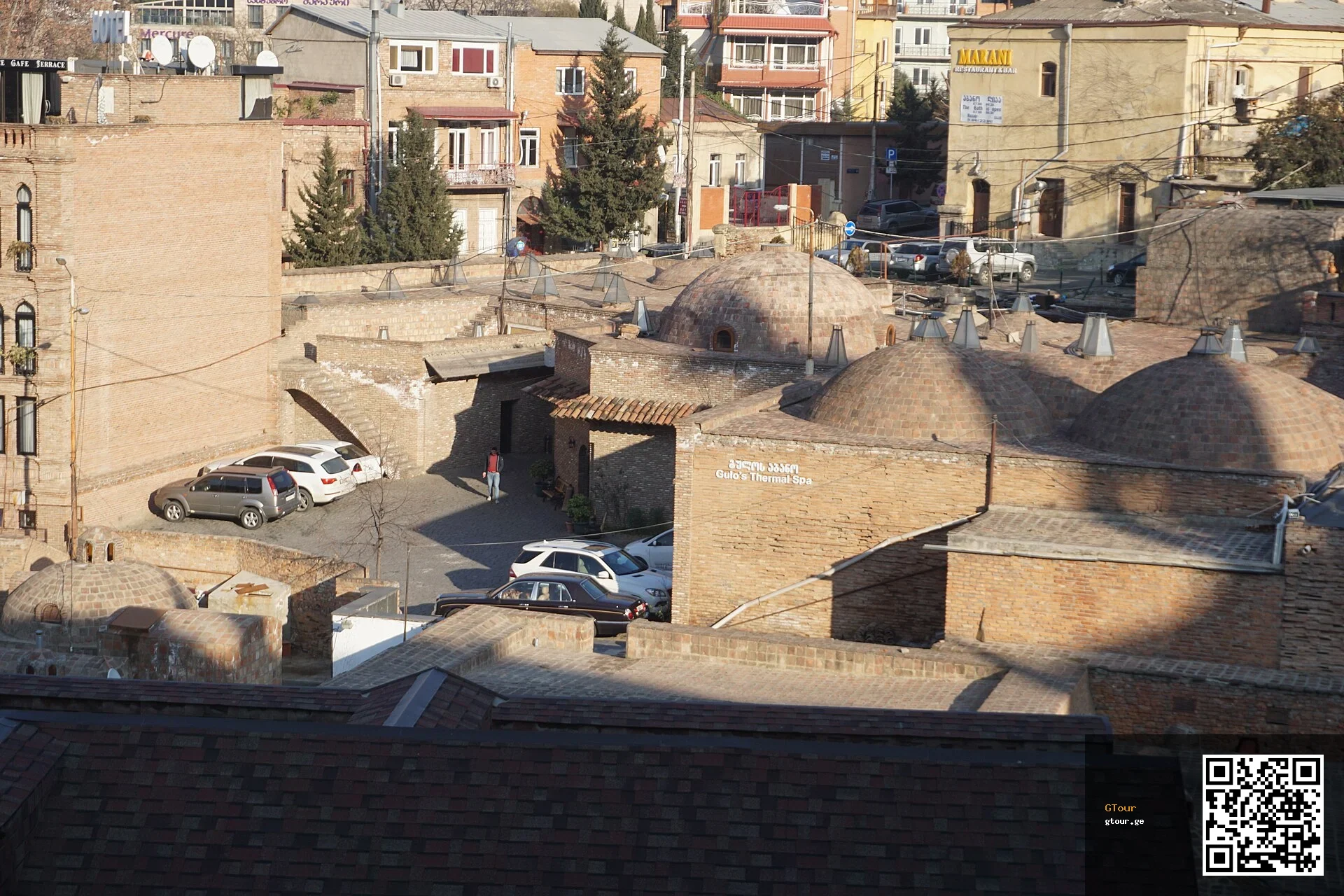
The historic Sulphur Baths district in Tbilisi's Old Town, a classic sight for visitors. · Photo: Andrew Milligan sumo / Wikimedia Commons, CC BY 2.0
Been to Georgia? Tell us how it went — the best stories are published here.
Share your tripOne email a week: what changed for travellers in Georgia — rules, roads, flights, seasons — plus one place worth the trip. Written by the GTour desk, no advertising, unsubscribe in one click.
This story across our partner network — ქართულად: შენი დასვენება