

By David Kiknadze, Transport & Openings Reporter · 27/10/2026
Yes, Myanmar citizens need to plan ahead for Georgia: a visa is normally required before travel, there is no direct flight from Yangon or Mandalay, and Burmese is not spoken or understood anywhere in the country. None of this makes Georgia hard to visit. It means doing three things early: checking the current visa rule for Myanmar passports, booking a one-stop flight through a hub such as Istanbul, Doha or Dubai, and arranging the mandatory travel insurance that Georgia asks visitors to carry. Once you land, cards work almost everywhere, SIM cards are cheap, and Georgian hospitality is generous even without a shared language.
Ties between Georgia and Myanmar are modest and we say so plainly rather than inflate them: there is no sizeable Myanmar diaspora in Georgia, no direct trade corridor to speak of, and no historical overlap beyond both countries sitting on old overland trade routes centuries apart. This guide focuses instead on what actually matters for a Myanmar traveller: paperwork, routes, money, food and the gaps a private guide closes.
Visa and entry rules for Myanmar passport holders
Myanmar is not on Georgia’s short list of visa-exempt nationalities, and visa policy is reviewed periodically, so never rely on a blog post, including this one, without checking the date. The two official places to verify the rule before you book anything are Georgia’s consular services portal and the e-Visa platform. If a visa is required for your passport, the standard route for most Asian nationalities who do need one is the e-Visa, applied for entirely online through evisa.gov.ge, with supporting documents (passport scan, a passport photo, proof of accommodation, return ticket and, where asked, proof of funds and travel insurance) uploaded in a single session. Processing is typically quoted as a matter of a few business days, though the portal itself states the current timeframe and fee for your specific case, and it can run longer at peak season, so apply at least two to three weeks before departure rather than the week before. Always cross-check the visa category and any exemptions against the consular portal at geoconsul.gov.ge, which lists the rules by nationality and is the authoritative source if this guide and the portal ever disagree.
Flights: routes and connecting hubs
There are no direct flights between Myanmar and Georgia, and none are likely to open given the thin passenger volume between the two countries. Nearly every itinerary from Yangon or Mandalay goes through a regional hub first (commonly Bangkok or Singapore) and then on to one of the West Asian or European gateways that do serve Tbilisi directly. The three hubs that realistically apply to Myanmar passengers are below; Warsaw and Munich mainly serve European-origin passengers and are not typical routings from Myanmar, so we leave them out.
| Connecting hub | Typical carriers on to Tbilisi | Notes |
|---|---|---|
| Istanbul (IST) | Turkish Airlines | Usually the shortest total journey; one change of aircraft |
| Doha (DOH) | Qatar Airways | Good onward frequency to Tbilisi |
| Dubai (DXB) | Emirates, flydubai | Often the easiest fare to find from Yangon via Bangkok or Singapore |
Always check live routes and schedules close to your travel date, since airlines adjust frequency seasonally; Tbilisi’s own airport page lists current destinations and carriers at tbilisiairport.com. Kutaisi International, used mainly by low-cost European carriers, and Batumi International, with seasonal links to Istanbul and parts of the Gulf, are secondary entry points worth checking only if your routing happens to connect better through them; see kutaisiairport.com and batumiairport.com.

Driving licence and getting around
A Myanmar driving licence printed in Burmese script is unlikely to be accepted at a Georgian car rental counter or recognised by traffic police without supporting documentation, since Georgian practice generally expects either a licence in Latin characters or an International Driving Permit (IDP) alongside the original. Obtain an IDP in Myanmar before you fly if you plan to self-drive; it is cheap and avoids an awkward conversation at the rental desk. Georgia drives on the right, mountain roads such as the Georgian Military Highway to Kazbegi can close in winter weather, and the official road-condition service is worth bookmarking before any drive north: georoad.gov.ge. Most Myanmar visitors find it simpler to skip self-driving altogether and book a car with an English-speaking driver, which also solves the language gap on road signs (Georgian script, with Latin transliteration on main routes but not always on rural ones).
Money, cards and SIM or eSIM
Georgia’s currency is the lari (GEL). The Myanmar kyat cannot be exchanged in Georgia, so arrive with US dollars or euros in cash as a backup and expect to do most spending on a debit or credit card, which is accepted at the overwhelming majority of hotels, restaurants and shops in Tbilisi, Batumi and Kutaisi. Cash is still useful in villages, small guesthouses, market stalls and for tipping. As a reference point, the National Bank of Georgia’s rate on 27 October 2026 was roughly 2.60 GEL to the US dollar and 2.91 GEL to the euro; rates move daily, so check a live source such as your card issuer’s app or gtour.ge/data/ before budgeting precisely. ATMs are common in every town tourists visit. For connectivity, a physical SIM from Magti, Geocell or Beeline at the airport, or an eSIM bought online before you fly, is the simplest route; coverage is reliable in cities and along main roads and patchier in remote mountain valleys such as Tusheti or parts of upper Svaneti.
Language, embassy and what to expect
Burmese is not spoken or taught in Georgia, and Myanmar visitors should not expect to be understood in it anywhere. Georgian is the national language; Russian remains widely understood among older residents and in regional towns; English is the practical bridge language in Tbilisi’s tourism sector, in Batumi, and with younger Georgians generally, but it thins out quickly outside the main visitor routes. Menus, signage and museum labels are increasingly bilingual in Georgian and English in cities, less so in villages. A guide or driver who speaks English fluently is the single biggest comfort upgrade for a Myanmar traveller, since it removes the daily friction of asking directions, ordering food or explaining a medical need.
Myanmar does not appear to maintain an embassy in Tbilisi, and Georgia has a similarly thin diplomatic footprint in Southeast Asia, so most Myanmar travellers will need to rely on Myanmar’s Ministry of Foreign Affairs in Yangon to confirm which of its regional embassies, if any, handles consular matters touching Georgia, since this changes from time to time. For the Georgian side, the full current list of Georgia’s diplomatic and consular missions abroad is published by the Ministry of Foreign Affairs at mfa.gov.ge; check it before departure rather than assume a posting that may have changed.
Food and dietary notes
Georgian cuisine leans heavily on pork, beef, dairy and wine, which differs from much of everyday Myanmar cooking and is worth knowing in advance. Halal certification is uncommon outside a handful of kebab and döner shops in Tbilisi and Batumi that cater to Gulf and Turkish visitors; if halal food matters to you, ask specifically and do not assume a restaurant’s meat is halal by default. Vegetarian Myanmar travellers, on the other hand, are well served: lobio (bean stew), pkhali (vegetable and walnut pâté), ajapsandali (vegetable stew), and khachapuri without meat toppings are all widely available and genuinely good. A few dishes feel familiar in structure if not in flavour: khinkali, the Georgian dumpling filled with meat or mushroom broth, sits in roughly the same culinary category as a Burmese dumpling, and the use of walnuts, coriander and pomegranate in Georgian sauces gives a brighter, herb-forward profile that may feel less unfamiliar than expected. Rice is not a Georgian staple in the way it is in Myanmar, so expect bread (puri, shoti) and maize-based mchadi to appear instead.
Ties, seasons, health and safety
We will not overstate the historical or trade relationship between Georgia and Myanmar, because it is thin: there is no meaningful diaspora community, no direct trade line, and the two countries’ historical contact, where it exists at all, is indirect and runs through much older Silk Road geography rather than any direct exchange. Travel between the two is a recent and still small phenomenon. Most Myanmar visitors who do come time their trip around Georgia’s better weather windows: late spring through early autumn (May to September) for hiking, wine country and the coast, or December to March for skiing in Gudauri and Bakuriani, which may suit travellers used to planning around Thingyan or school holiday breaks at home.
Georgia requires visitors, including those applying for a visa or e-Visa, to carry valid travel medical insurance for the duration of their stay; this is checked at the e-Visa application stage for nationalities that need one, and it is sensible to carry proof of it even if you enter visa-free, since border officers may ask. Buy a policy before you fly rather than on arrival, and confirm the current requirement on the e-Visa portal at evisa.gov.ge when you apply. For any medical concern once in Georgia, see a doctor or a hospital in Tbilisi or Batumi rather than self-treat; pharmacies are plentiful and generally well stocked, but language can be a barrier, so a guide or hotel reception can help translate symptoms. On safety and etiquette, Georgia is a low-crime destination by regional standards; the main precautions are the usual city ones (watch bags in crowded markets, agree taxi fares or use an app before the ride). Dress modestly when entering Orthodox churches and monasteries, Georgia’s dominant religious sites, which will be unfamiliar territory for Buddhist-majority Myanmar visitors: headscarves for women and knee-covering trousers or skirts for both sexes are expected, and wraps are usually available to borrow at the church door.
What a G Tour private guide adds
For a Myanmar traveller, the practical value of a private guide is less about sightseeing commentary and more about removing friction: a licensed English-speaking guide bridges the language gap that Burmese speakers will meet everywhere outside the main tourist strip, handles church etiquette and halal or vegetarian requests at restaurants on your behalf, and keeps a day running on time when road signs are in Georgian script only. Day tours such as Tbilisi & Mtskheta or Kakheti Wine Country Day Trip work well as an orientation first day, and multi-day private routes such as Georgia in 7 Days — The Classic Grand Tour or Kazbegi — 2-Day Mountain Journey suit travellers who want a fixed itinerary with a driver who already knows the mountain roads and their winter closures. All tour and service prices, including airport transfers, cars with drivers and guide day rates, are published with exact figures at gtour.ge/tours/ and gtour.ge/services/, so you can compare before booking rather than negotiate on arrival.
If this guide is part of a trip you are planning, our Georgia in 10 Days — Tbilisi to Svaneti to the Sea and Monasteries of Georgia — Mtskheta, the Thirteen Fathers and Kakheti in 3 Days cover the places it describes with a private guide and driver; a GTour travel expert adapts the route to your dates.
Practical summary
- Check the current visa requirement for Myanmar passports at geoconsul.gov.ge before booking flights; apply for an e-Visa at evisa.gov.ge two to three weeks ahead if one is required.
- No direct flights exist; route through Istanbul, Doha or Dubai, usually after a first connection via Bangkok or Singapore from Yangon or Mandalay.
- Bring an International Driving Permit if you plan to self-drive; otherwise book a car with an English-speaking driver.
- Carry US dollars or euros as backup cash; cards work in most cities; buy a local SIM or eSIM on arrival.
- Expect no Burmese understood anywhere; English in tourism settings, Georgian and Russian elsewhere.
- Confirm Myanmar’s nearest accredited embassy for Georgia with Myanmar’s own Ministry of Foreign Affairs, since no Myanmar embassy operates in Tbilisi.
- Ask specifically about halal food; vegetarian Georgian dishes (lobio, pkhali, cheese-free khachapuri) are easy to find.
- Buy travel medical insurance before departure; it is required for e-Visa applicants and sensible for everyone.
- Dress modestly for church visits and confirm live prices and road conditions at gtour.ge/data/ and gtour.ge/road-status/.
Sources
- Georgia e-Visa portal
- Georgia consular services, visa rules by nationality
- Ministry of Foreign Affairs of Georgia, diplomatic missions
- Georgia road conditions and closures
- General Visa Rules (Matsne Legislative Database)
- Georgia National Tourism Administration — Plan Your Trip
Questions this guide does not answer? Write to info@castle.ge or WhatsApp +995 577 41 63 14 — a person in Tbilisi replies. See also our travel services and all guides.
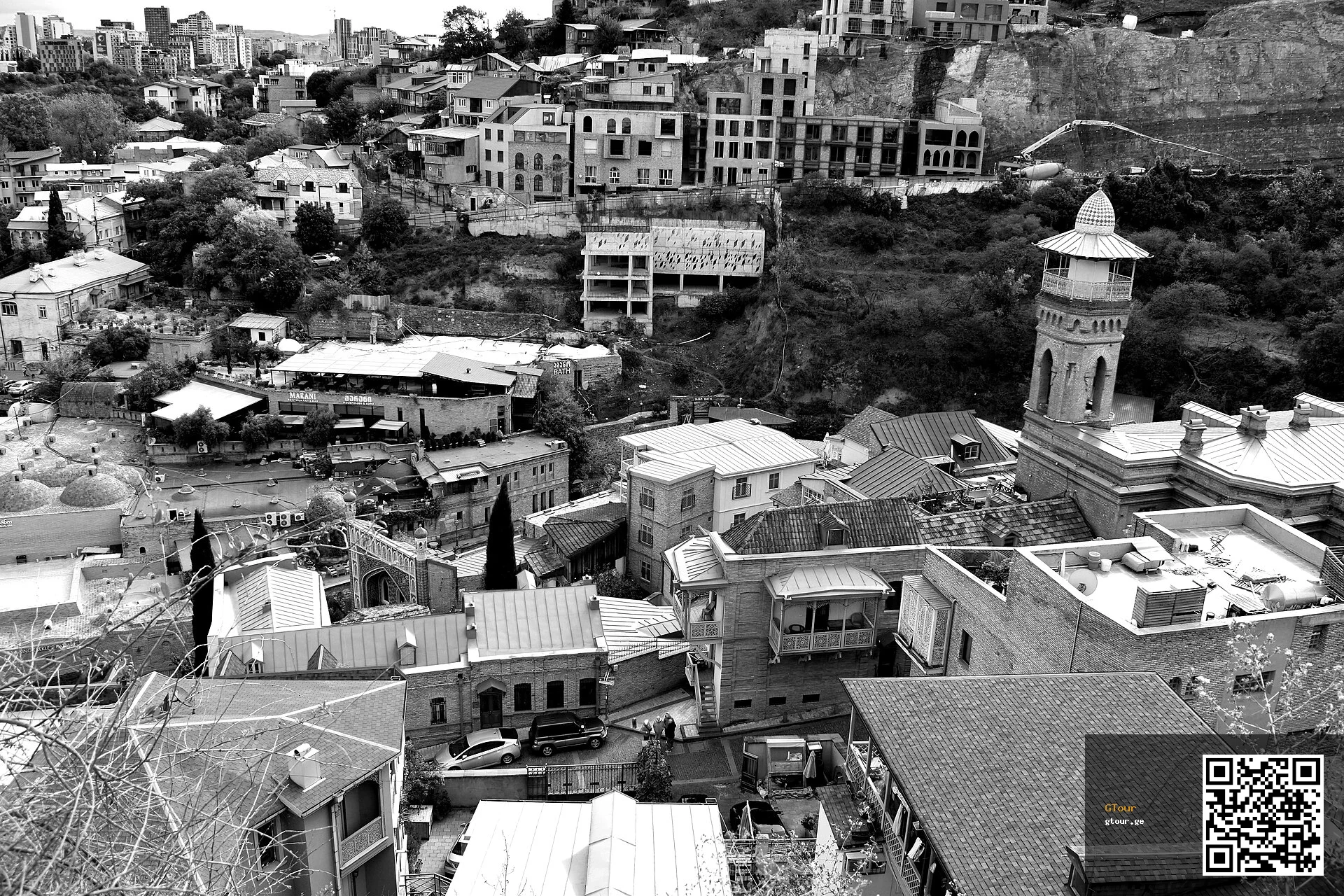
Cityscape of Old Tbilisi, the capital of Georgia, showing its hillside old town. · Photo: Misa.stefanovic.07 / Wikimedia Commons, CC BY-SA 4.0
Been to Georgia? Tell us how it went — the best stories are published here.
Share your tripOne email a week: what changed for travellers in Georgia — rules, roads, flights, seasons — plus one place worth the trip. Written by the GTour desk, no advertising, unsubscribe in one click.
This story across our partner network — ქართულად: შენი დასვენება