


By Mariam Lomidze, Culture & Events Reporter · 27/10/2026
Sudanese citizens travelling to Georgia in 2026 should plan on applying for an e-visa in advance, since Sudan is not on Georgia’s visa-free list, and should route through a hub such as Istanbul, Dubai or Doha because there are no direct flights between Sudan and Tbilisi. The practicalities — cash and cards, a working SIM, halal food, and a driving licence that is valid for a limited period — are all manageable with a little preparation, and this guide sets them out plainly, including where the rules can shift and how to check the current version before you fly.
Georgia and Sudan have thin historical ties: no shared colonial history, modest trade, and a small but real link through African students, many of them Sudanese, who study medicine at Georgian universities. We say that honestly rather than inflate it, and focus instead on what actually matters for a visitor — getting in, getting around, eating well, and staying safe.
Visa and entry rules for Sudanese citizens
As of October 2026, Sudanese passport holders generally require a visa to enter Georgia; Sudan does not appear on Georgia’s standard visa-free or visa-on-arrival lists. The practical route for most leisure travellers is Georgia’s electronic visa, applied for online through the official portal, evisa.gov.ge. The system typically asks for a passport scan, a passport photo, proof of accommodation, a return or onward ticket, and evidence of funds; processing is usually quoted at a few business days, though it can take longer during busy periods, so apply at least two to three weeks before travel. Visa categories, fees and required documents change periodically, so always check the current rules on the Ministry of Foreign Affairs consular pages before booking anything non-refundable, at mfa.gov.ge. If you are unsure which visa category applies to your trip, contact the nearest Georgian diplomatic mission directly rather than relying on secondhand advice, including from this article.
Georgia does not maintain an embassy in Sudan, and Sudan does not maintain one in Tbilisi, as far as we can confirm. Consular matters for Sudanese nationals are usually handled through the nearest accredited mission; check the current list of accredited embassies and consulates on the mfa.gov.ge site, and confirm with your own government which post covers Georgia for passport and emergency services.
Getting to Georgia: flights and connections
There are no direct flights between Sudan and Georgia. Sudanese travellers connect through a small number of hubs, and which ones work best depends on your departure city inside Sudan and on current airline schedules, which have been unsettled since the conflict that began in 2023 disrupted operations at Khartoum International Airport. The three hubs most commonly used for this routing are:
- Istanbul — Turkish Airlines connects to Tbilisi, Kutaisi and Batumi with some of the most frequent schedules from the region, and Istanbul is reachable from several Sudanese and regional departure points.
- Dubai — a common connection for Gulf-routed itineraries, with onward flights to Tbilisi.
- Doha — Qatar Airways serves Tbilisi, making this a workable alternative hub, particularly for travellers already routing through the Gulf.
Warsaw and Munich mainly serve European-origin passengers and are not typical connections from Sudan, so we have left them out. Before booking, check live arrivals and current routes directly with the airports you plan to use, since schedules to and from Georgia change by season: tbilisiairport.com, kutaisiairport.com, and batumiairport.com. Given the ongoing disruption to air travel within Sudan, build extra buffer time into any itinerary that starts or ends in Khartoum, and confirm your domestic routing to an international gateway well ahead of your international flight.
Driving, money, SIM and everyday logistics
A foreign driving licence is generally recognised in Georgia for a limited period after entry, and an International Driving Permit alongside your national licence is the safer option if you plan to rent a car, since rental companies often ask for one. Rules on exactly how long a foreign licence remains valid, and whether a notarised translation is needed, are set in Georgian traffic legislation and can be checked in the official legislative database, matsne.gov.ge; if you plan to drive yourself, confirm current requirements with your rental company before you arrive, or simply book a car with a driver and skip the question altogether.
Georgia’s currency is the lari (GEL). Cards are widely accepted in Tbilisi, Batumi and Kutaisi hotels, restaurants and larger shops, but cash is still useful for small guesthouses, markets, and rural areas such as Svaneti or Tusheti. There is no direct exchange for Sudanese pounds in Georgia, so bring US dollars, euros or UAE dirhams to convert at a bank or licensed exchange office on arrival; airport exchange counters and ATMs are available at all three international airports. As a reference point, the National Bank of Georgia’s rate on 27 October 2026 was roughly 2.60 GEL per US dollar, 2.91 GEL per euro and 0.71 GEL per UAE dirham — rates move daily, so check the current figure at the bank counter or via your card issuer rather than relying on any fixed number.
Local SIM cards from Magticom, Geocell or Beeline are sold at airport kiosks and city shops with your passport, and prepaid data packages are inexpensive; eSIM options from international providers also work well if your phone supports them and you want connectivity the moment you land.
Language, food and daily life
Georgian is the national language, and Russian is widely understood by older generations and in the tourism and hospitality trade. English is increasingly common in Tbilisi and Batumi hotels, restaurants and tour operations, less so in small towns and rural guesthouses. Arabic is not widely spoken, though Batumi’s hospitality sector, used to Gulf visitors, sometimes has Arabic-speaking staff in larger hotels; outside that, expect to rely on English, simple gestures, or a translation app.
Georgian cuisine centres on bread, grilled and stewed meats, walnuts, and fresh herbs, with some dishes that will feel familiar to Sudanese visitors, such as bean stews (lobio) and grilled skewered meat (mtsvadi). Pork and wine are prominent in Georgian food culture, so halal travellers need to plan ahead: Tbilisi and Batumi have halal-certified or Muslim-run restaurants, particularly Turkish, Azerbaijani and Middle Eastern establishments, and both cities have functioning mosques and established Muslim communities, including in Adjara and among the Azerbaijani population of Kvemo Kartli. Vegetarian and vegan eating is straightforward almost everywhere thanks to bean, eggplant and walnut-based dishes (lobio, badrijani, pkhali) and fresh market produce. When travelling with a private guide, flag dietary needs in advance so restaurant stops and village meals, including a traditional supra feast, are chosen accordingly.
Georgia and Sudan: thin but real connections
There is no significant trade relationship, no direct diplomatic history worth overstating, and no established Sudanese diaspora community in Georgia at any scale. We say this plainly rather than invent a connection that does not exist. The one genuine link is education: Georgia’s medical universities, particularly in Tbilisi, have attracted African students, including Sudanese nationals, for several years, drawn by English-language medical programmes and relatively lower costs than in Europe. If you are visiting a relative or friend studying here, build time around their term schedule, since Georgian academic terms run broadly in line with the European calendar. Beyond that, expect Georgia to be a genuinely new destination for most Sudanese travellers, with little cultural shorthand to lean on and plenty worth discovering on its own terms, from Tbilisi’s old town to the Svaneti mountains covered in our Mestia & Ushguli — 3 Days in Svaneti route.
When to go, health and insurance
Most international visitors, including those from the Gulf and wider Africa, come to Georgia between May and October for warm weather, wine harvest season in Kakheti, and hiking in Svaneti and Tusheti, or in winter for skiing in Gudauri and Bakuriani. If you are travelling around religious holidays, note that Georgia’s calendar is built around the Orthodox Christian year, so Eid dates do not affect opening hours or public transport the way they would at home; plan around Georgian public holidays instead, which cluster around Orthodox Christmas and Easter.
Georgia has, at various points, required visitors to hold valid travel medical insurance as a condition of entry or as supporting documentation for a visa application; this requirement has changed over time and may apply differently depending on your visa category. Confirm the current rule before booking through the official government portal, gov.ge, and through the e-visa application itself at evisa.gov.ge, since insurance proof is commonly requested there. Whether or not it is mandatory for your specific visa, travelling with adequate medical and evacuation insurance is sensible for any international trip, particularly to a mountainous country where emergency transport from remote areas such as Tusheti can be slow. For any personal health concern before or during travel, consult a qualified doctor or your national public health authority rather than relying on general guidance.
Safety, etiquette and what a G Tour guide adds
Georgia is generally safe for visitors, with low rates of violent crime against tourists; ordinary precautions around belongings in crowded areas apply as anywhere. Alcohol, particularly wine, is central to Georgian hospitality and the traditional supra; it is entirely acceptable to decline politely, and a good host or guide will not press the point once you have said so clearly. Dress modestly when visiting working Orthodox churches and monasteries, covering shoulders and, for women, the head with a scarf, which is usually provided at the door if needed.
Because Georgia is unfamiliar territory for most Sudanese travellers, with no shared language base and few established networks to rely on, a private guide removes much of the friction. A G Tour guide can help with halal and dietary planning before you arrive, coordinate airport pickup so there is no uncertainty after a long multi-leg flight (fixed from €25 for a sedan transfer at Tbilisi airport), and add an Arabic-speaking guide to any day tour or multi-day itinerary for an additional €25 per day on top of standard guide rates. For a first visit, the Tbilisi & Mtskheta — The Essential First Day tour is a practical, low-pressure introduction to the country, and the Kakheti Wine Country — Day Trip or Telavi & Kakheti Wine Region tour works well if you want a guide who can navigate the wine-and-food side of Georgian culture on your behalf, including sourcing halal or vegetarian stops along the way.
If this guide is part of a trip you are planning, our Georgia in 10 Days — Tbilisi to Svaneti to the Sea and Monasteries of Georgia — Mtskheta, the Thirteen Fathers and Kakheti in 3 Days cover the places it describes with a private guide and driver; a GTour travel expert adapts the route to your dates.
Practical summary
- Check Georgia’s current visa requirement for Sudanese passports and apply via evisa.gov.ge well ahead of travel; confirm details on mfa.gov.ge, since rules change.
- Plan a connecting flight via Istanbul, Dubai or Doha; there are no direct Sudan–Georgia flights, and Khartoum’s air links remain disrupted, so allow buffer time.
- Bring US dollars, euros or UAE dirhams in cash to exchange; Sudanese pounds cannot be exchanged in Georgia. Cards work in cities; carry some cash for rural areas.
- Carry an International Driving Permit alongside your national licence if self-driving, or book a car with an English-speaking driver instead.
- Buy a local SIM or activate an eSIM on arrival; English is common in Tbilisi and Batumi hospitality but less so elsewhere.
- For halal food, head to Tbilisi and Batumi’s Turkish, Azerbaijani and Middle Eastern restaurants, or ask your guide to plan meals in advance.
- Confirm whether mandatory travel insurance applies to your visa category before booking, and travel insured regardless.
- Consider a G Tour private guide, with an Arabic-speaking option, for a smoother first visit to an unfamiliar destination.
Sources
- Georgia e-visa portal
- Ministry of Foreign Affairs of Georgia
- Government of Georgia portal
- Georgian legislative database (traffic and visa law)
- National Tourism Administration of Georgia
Questions this guide does not answer? Write to info@castle.ge or WhatsApp +995 577 41 63 14 — a person in Tbilisi replies. See also our travel services and all guides.
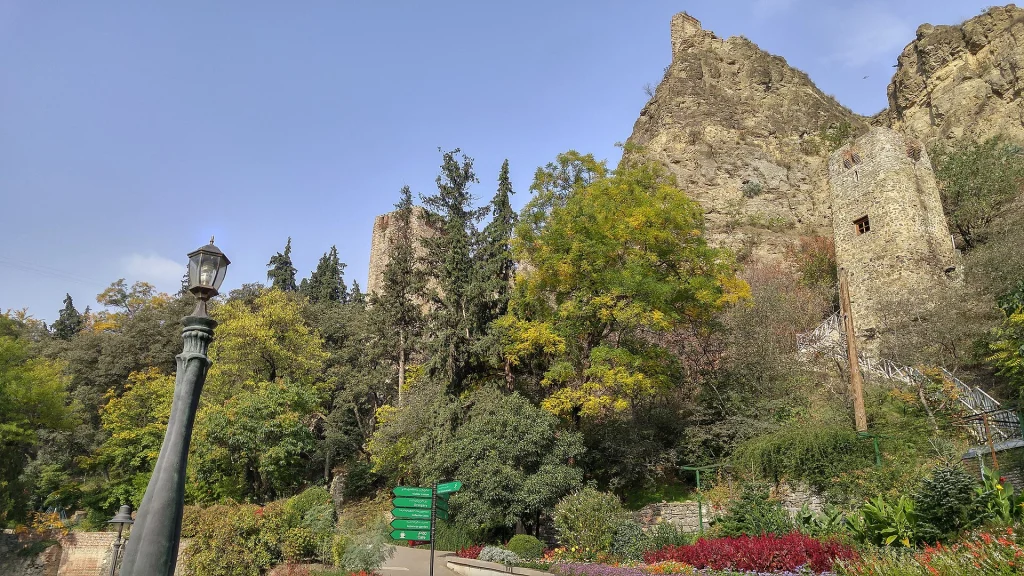
Narikala Fortress ruins rise above Tbilisi's National Botanical Garden, a popular sightseeing stop for visitors. · Photo: Mostafameraji / Wikimedia Commons, CC BY-SA 4.0
Been to Georgia? Tell us how it went — the best stories are published here.
Share your tripOne email a week: what changed for travellers in Georgia — rules, roads, flights, seasons — plus one place worth the trip. Written by the GTour desk, no advertising, unsubscribe in one click.
This story across our partner network — ქართულად: შენი დასვენება