

By David Kiknadze, Transport & Openings Reporter · 28/10/2026
Short answer: yes, almost all Papua New Guinean citizens need a visa for Georgia, there is no direct flight from Port Moresby so you will connect through a hub such as Doha, Dubai, Istanbul or Singapore, the currency is the Georgian lari (GEL) rather than the euro or US dollar, and English will get you through Tbilisi and Batumi‘s tourist areas comfortably but not everywhere. Georgia is a small, welcoming, Orthodox Christian country in the South Caucasus with mountains, a wine culture thousands of years old, and a food tradition that, with its pork, beans and root vegetables, will feel more familiar to a Pacific palate than many Georgians expect.
This guide sets out what a traveller from Papua New Guinea actually needs to check before departure, and is honest about where ties between the two countries are thin: there is no resident embassy of either country in the other’s capital, trade is negligible, and cultural contact is close to zero. What follows focuses on the practical questions that matter once your flight is booked.
Visa and entry rules for Papua New Guinean citizens
Georgia runs a long and changing list of nationalities who may enter visa-free; as of late 2026, Papua New Guinea is not understood to be on that list, so most PNG passport holders should plan to apply for an e-visa before travelling. The e-visa is handled entirely online through the government portal evisa.gov.ge, where you upload your passport, a photo, and your travel plans, and typically receive a decision within a few working days, though processing can stretch longer at busy periods. Because visa categories, fees and the list of visa-exempt countries are revised without much public notice, do not rely on secondhand summaries, including this one: check your eligibility directly on evisa.gov.ge and, for consular questions specific to your passport, the Ministry of Foreign Affairs at mfa.gov.ge before you book non-refundable flights.
Standard short-stay e-visas are usually issued for single or multiple entries with stays of up to 90 days within a set validity window; confirm the exact figure for your application, since durations differ by purpose and category. Carry a printed copy of your e-visa approval along with your passport, as border officers may ask for it.
Flights: no direct route, plan your connection
There is no direct or one-stop-from-Papua New Guinea service to Georgia. From Port Moresby, travellers typically fly first to a regional gateway such as Singapore, Brisbane or Cairns, then connect onward to one of the long-haul hubs that serve Tbilisi: Doha (Qatar Airways), Dubai (Emirates or flydubai), or Istanbul (Turkish Airlines), all of which operate frequent daily services into Tbilisi International Airport. Munich and Warsaw also connect to Georgia but add a third European leg for a Pacific traveller and are rarely the shortest option. In practice, Doha or Dubai then Tbilisi, or Singapore–Istanbul–Tbilisi, tend to be the routings travel agents quote most often; total journey time including connections commonly runs well over 24 hours, so build in a buffer night if your onward connection is tight.
Georgia has three international airports: Tbilisi, Kutaisi and Batumi. Check live information at tbilisiairport.com, kutaisiairport.com and batumiairport.com, since schedules and seasonal routes change. We meet arriving guests at all three; see the Tbilisi Airport Transfer and Kutaisi Airport to Tbilisi transfer pages for fixed, pre-agreed fares.
Money, cards and SIM cards
Georgia’s currency is the lari (GEL). At the National Bank of Georgia’s published rate for 28 October 2026, one euro bought roughly 2.89 lari and one US dollar roughly 2.60 lari; rates move daily, so check nbg.gov.ge before changing money. Visa and Mastercard are accepted in most hotels, restaurants and shops in Tbilisi, Batumi and Kutaisi; carry some cash for small guesthouses, mountain villages, market stalls and marshrutka minibuses, where card machines are patchy. ATMs are common in cities but thin on the ground in places like Tusheti or upper Svaneti, so withdraw what you need before heading into the mountains.
Local SIM cards from Magticom, Geocell or Beeline are sold at the airport and in city shops with a passport, and are inexpensive for data-heavy trips. International eSIM providers also cover Georgia if you prefer to arrive already connected; check coverage maps before you fly, since mountain valleys such as Tusheti or Khevsureti have limited or no signal at all.
Driving licence, language and getting around
Georgian law allows visitors to drive on a valid foreign national licence for a defined period of legal stay, and an International Driving Permit is recommended alongside it, particularly for car-hire companies and police checks outside the capital. Rules on exactly how long a foreign licence remains valid, and whether an IDP is compulsory, are set in Georgian traffic legislation and can be revised, so verify the current position through Georgia’s legislative database at matsne.gov.ge or the road authority at georoad.gov.ge before you rent a car, and carry your PNG licence, passport and any IDP together.
Georgian and Russian are the working languages outside the main tourist circuit. English is spoken reliably by younger staff in Tbilisi’s Old Town, Batumi’s seafront hotels, and at the airports, but expect to rely on gestures, translation apps or a guide once you are in rural Kakheti, Svaneti or Tusheti. For a Papua New Guinean traveller used to Tok Pisin, Hiri Motu and English coexisting, the pattern of a national language dominating daily life with English confined to cities and tourism will feel familiar. Many travellers find it easier to book a car with driver or a licensed guide for the full day rather than self-drive on unfamiliar mountain roads; see Car with Driver by the Day and Licensed Private Guide by the Day for fixed daily rates.
Food: halal, vegetarian and what will feel familiar
Georgian cuisine centres on bread, cheese, walnuts, beans and grilled meat, with pork featuring heavily in dishes like mtsvadi skewers, alongside beef and lamb. Travellers who keep halal should know that strict halal certification is uncommon outside Adjara‘s Muslim communities and Tbilisi’s mosque quarter in Abanotubani; ask directly at restaurants, and consider a guide who can explain dietary needs to kitchens in advance. Vegetarian and even vegan travellers generally eat very well in Georgia: lobio (bean stew), pkhali (walnut and vegetable pâté), badrijani nigvzit (walnut-stuffed aubergine) and fresh khachapuri without meat are on almost every menu.
For a Pacific palate, the comfort-food overlap is real: root vegetables, beans, greens cooked with walnuts, and grilled pork will not feel exotic. Khinkali (dumplings) and the various regional khachapuri are worth trying with a guide who can order a varied spread; our Cooking Class in Tbilisi and Supra Evening with a Tamada both build in that explanation as part of the experience.
Ties between Georgia and Papua New Guinea, and when to come
It would be misleading to claim deep ties: Georgia has no embassy in Port Moresby and Papua New Guinea has no embassy in Tbilisi, direct trade between the two countries is small enough that it rarely appears as a separate line in national trade statistics, and there is no recorded diaspora community of note in either direction. If you want to check current figures yourself, Georgia’s national statistics office publishes external trade data at geostat.ge. What the two countries share informally is a strength in oral storytelling and polyphonic or multi-part singing traditions, though this is a cultural parallel rather than a historical connection.
Given the long journey involved, most Pacific travellers combine Georgia with a wider Europe, Middle East or Central Asia itinerary rather than a single-destination trip. Georgia’s high season for hiking and wine is June to September; shoulder months of May and September to October bring the grape harvest (rtveli) in Kakheti and comfortable hiking weather; December to February suits skiing at Gudauri or Bakuriani but mountain passes like the Georgian Military Highway can close temporarily in snow, so check georoad.gov.ge for live road status if travelling in winter.
Health, insurance and safety
Travel medical insurance is required as part of most e-visa applications and is strongly advised for every visitor regardless of visa category, since Georgia’s public emergency system does not cover the full cost of hospital treatment for foreign tourists. Confirm current insurance requirements on evisa.gov.ge, and for general health guidance before travel, Georgia’s National Center for Disease Control and Public Health publishes advisories at ncgh.ge. If you take regular medication, bring enough for the full trip plus a margin, carry prescriptions in English, and discuss altitude or long-haul travel concerns with your own doctor before a Kazbegi or Svaneti itinerary that climbs above 2,000 metres.
Georgia is a generally safe destination with low rates of violent crime against tourists; usual city precautions apply around busy markets and nightlife areas. Georgian hospitality culture is warm and direct: a toast at a supra feast is a genuine social event, not a formality, and declining alcohol is accepted without offence if you explain you do not drink. Dress modestly when visiting churches and monasteries, and ask before photographing people in villages.
What a G Tour private guide adds
Given the distance and the fact that Georgia is an unfamiliar system for most Papua New Guinean travellers, a licensed local guide removes the guesswork around e-visa documents, mountain road conditions, dietary explanations to kitchens, and language gaps outside the capital. Our Licensed Private Guide by the Day and Car with Driver by the Day services can be combined into a full private itinerary, from an Old Tbilisi Walking Tour on arrival to a multi-day route like Georgia in 7 Days — The Classic Grand Tour, with airport transfers, hotel bookings and a single invoice handled in advance so nothing depends on guesswork once you land.
If this guide is part of a trip you are planning, our Tbilisi to Borjomi or Bakuriani Transfer and Mtskheta on Foot — the Ancient Capital in 2 Hours cover the places it describes with a private guide and driver; a GTour travel expert adapts the route to your dates.
Practical summary
- Confirm visa status and apply for an e-visa well ahead at evisa.gov.ge; do not assume visa-free entry
- Plan a connecting flight through Doha, Dubai, Istanbul or Singapore; there is no direct or one-stop route from Papua New Guinea
- Carry both your PNG driving licence and an International Driving Permit if you plan to drive, and verify current validity rules before renting a car
- Bring a mix of cards and lari cash; withdraw cash before heading into mountain regions with limited ATM access
- Buy a local SIM or activate an eSIM at the airport; expect no signal in parts of Tusheti, Khevsureti and upper Svaneti
- Arrange travel medical insurance before departure and keep proof with your travel documents
- Expect English in Tbilisi and Batumi’s tourist areas, Georgian and Russian elsewhere; a guide bridges the gap in rural regions
- Check georoad.gov.ge for winter pass closures if travelling December to February
Sources
- Georgia e-visa portal
- Ministry of Foreign Affairs of Georgia
- National Bank of Georgia exchange rates
- Georgian road department, road conditions
- Legislative Herald of Georgia (Matsne)
- Geostat, external trade statistics
Questions this guide does not answer? Write to info@castle.ge or WhatsApp +995 577 41 63 14 — a person in Tbilisi replies. See also our travel services and all guides.
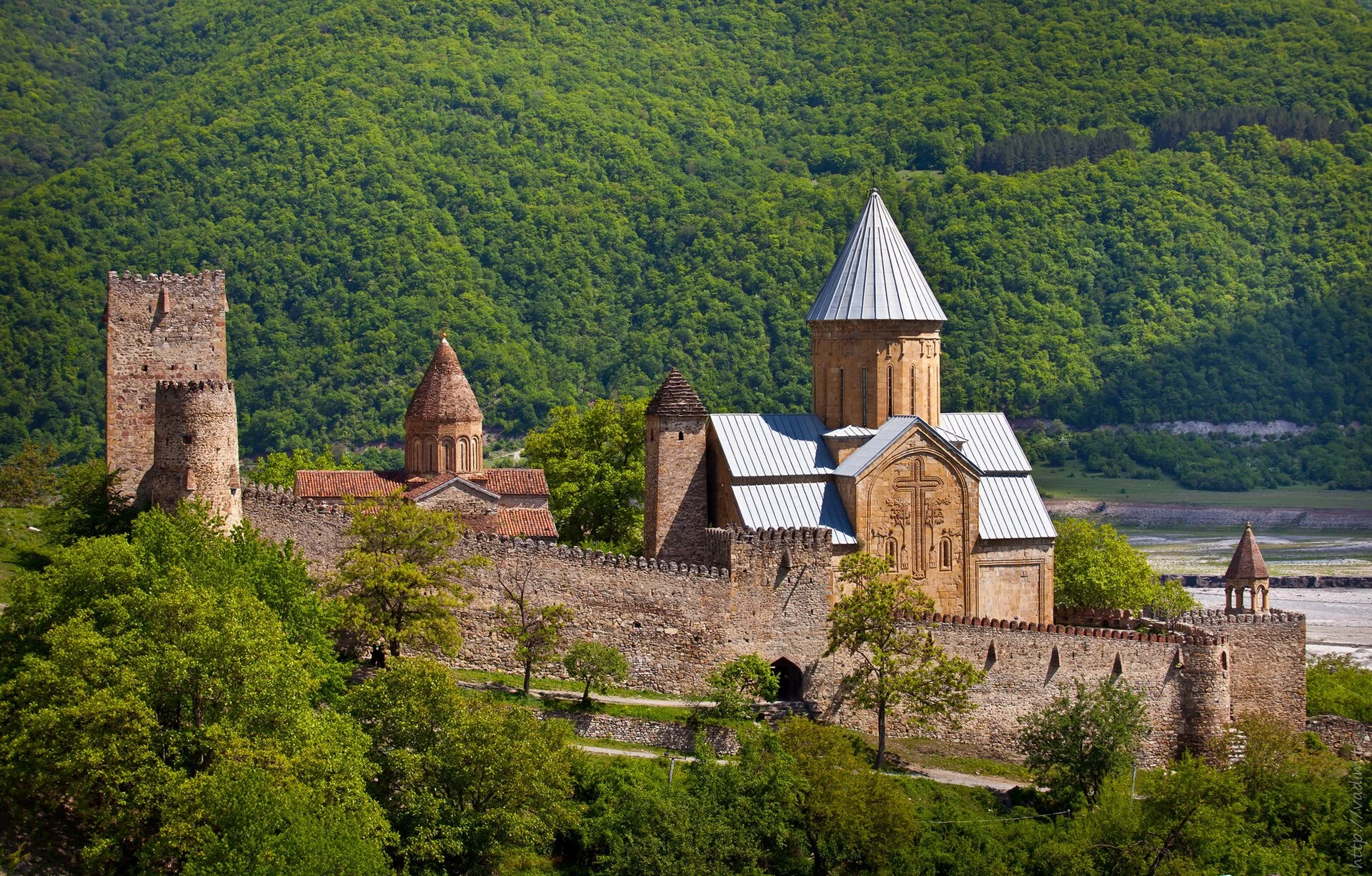
Ananuri fortress complex on the Aragvi River, one of Georgia's iconic sightseeing stops. · Photo: Vadim Tolbatov / Wikimedia Commons, CC BY-SA 3.0
Been to Georgia? Tell us how it went — the best stories are published here.
Share your tripOne email a week: what changed for travellers in Georgia — rules, roads, flights, seasons — plus one place worth the trip. Written by the GTour desk, no advertising, unsubscribe in one click.
This story across our partner network — ქართულად: შენი დასვენება
