

By Mariam Lomidze, Culture & Events Reporter · 10/11/2026
Georgia works well for travellers over 65, but only if the plan respects three things: long single-lane roads through mountains, a surprising number of steps and cobbles at even famous sites, and altitude that rises faster than the map suggests. None of this rules out Svaneti towers, the Georgian Military Highway or a monastery on a cliff. It means choosing a 4×4 instead of a footpath to Gergeti, building in rest days, and picking hotels that actually have a working lift rather than a “boutique” staircase.
The honest version: Tbilisi, Batumi, Kutaisi, Borjomi and Kakheti are gentle and well served by modern clinics. Svaneti, Tusheti, Khevsureti and the high passes are spectacular but remote, with long drives, basic guesthouses and limited medical cover. The right itinerary mixes both, with more nights than kilometres. Our Slow Georgia for Seniors — 10 Unhurried Days with Rest Days was built on exactly this logic, and the plan below sets out the thinking behind it so you can also adapt a private Car with Driver by the Day route of your own.
Roads and drive times: pacing the distances
Georgia looks compact on a map and is not, because almost every scenic road climbs or bends. Tbilisi to Kazbegi (Stepantsminda) is roughly 150 kilometres but takes about 3.5 hours each way on the Georgian Military Highway, with a 2,379-metre pass at Gudauri that can close in bad weather. Tbilisi to Batumi is around 6 hours, Tbilisi to Mestia closer to 8 by sedan and longer by the winding final stretch. For anyone over 65, the rule we give clients is simple: no return day-trip beyond about 2.5 hours of driving each way without an overnight stay, and never schedule a long drive the day after a flight. Current pass closures and winter restrictions are posted by the Georgian Road Department, which is worth checking the morning you travel rather than relying on an old print-out.
- Short, repeatable drives: Tbilisi–Mtskheta (40 minutes), Tbilisi–Kakheti (2 hours), Tbilisi–Gudauri (2–2.5 hours)
- Long but doable with a stop: Tbilisi–Kazbegi, Tbilisi–Borjomi, Kutaisi–Batumi
- Split over two days at this pace: Tbilisi–Mestia, Tbilisi–Tusheti (the Abano Pass is 4×4-only and seasonal)
Steps, cobbles and church floors
Old Tbilisi’s lanes are cobbled and sloped, Sighnaghi‘s streets climb steadily, and Vardzia’s cave monastery involves ladders and uneven rock steps cut into the cliff. Uplistsikhe is open-air walking over worn stone. None of this is dangerous for a careful walker with good shoes and a stick, but it is not flat, and wheelchairs or standard walking frames struggle at most of these sites. Where a cable car exists, such as Narikala in Tbilisi, it removes the climb entirely; where it does not, plan to see less and sit more, rather than push through. Church floors are often uneven flagstone with a threshold step at the door, including at Svetitskhoveli and Jvari in Mtskheta, so a slow pace and a hand on the frame work better than rushing.
Gergeti Trinity Church: by 4×4, not on foot
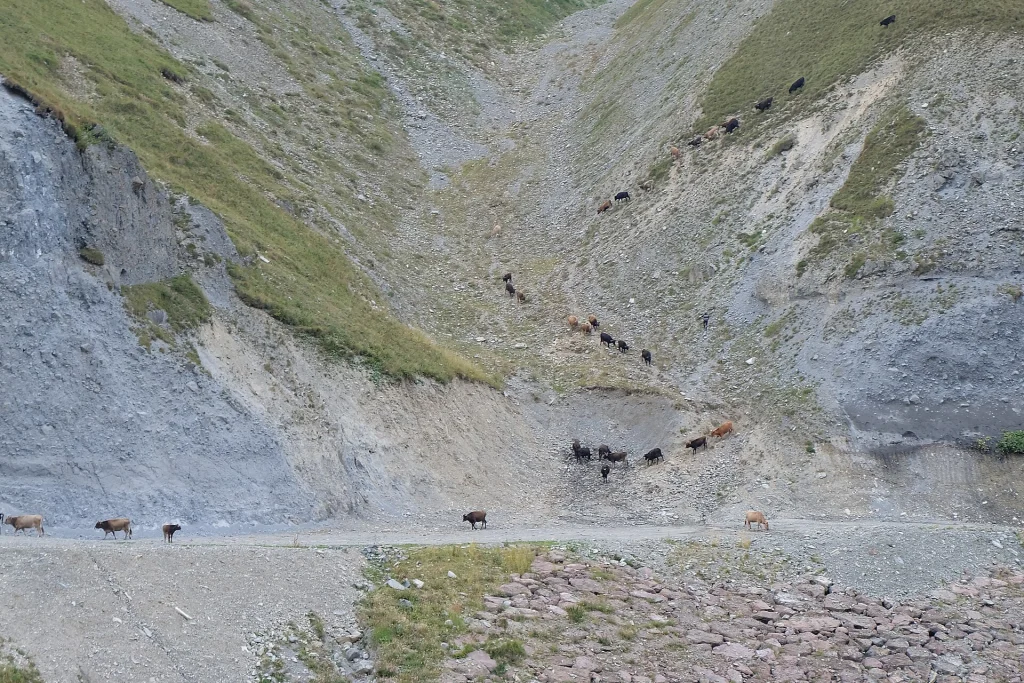
The postcard view of Gergeti Trinity Church above Stepantsminda is reached by a steep path that gains close to 800 metres and takes most walkers three to four hours uphill. We do not recommend this hike for travellers over 65 unless you already hike regularly at altitude. The alternative, which most visitors of any age now use, is a shared or private jeep up the rough access track, a journey of about twenty minutes each way with time to walk the last flat stretch to the church and back. Our Georgian Military Highway — Ananuri, Gudauri and Gergeti in a Day and Kazbegi — Gergeti Trinity Church in a Day tours are built around the jeep ascent, with the walking kept to the church courtyard itself.
Altitude at Gudauri and Juta: what the numbers mean
Gudauri sits at about 2,196 metres and the Krestovy (Cross) Pass above it at 2,379 metres; Juta village in Khevsureti is close to 2,200 metres, with the Chaukhi Pass above it rising to around 3,338 metres. Altitude sickness becomes a realistic risk above roughly 2,500 metres, and the usual advice is to ascend gradually, drink more water than usual, avoid alcohol on the first day at height, and descend if you develop a persistent headache, nausea or breathlessness that does not settle with rest. These are general public-health points, not a substitute for medical advice: anyone with heart, lung or blood-pressure conditions should ask their own doctor before a trip that includes Gudauri, Juta or any point above 2,000 metres, and Georgia’s National Center for Disease Control and Public Health publishes general travel-health guidance worth reading beforehand. In practice, this means enjoying Gudauri and Juta village itself, which are both reachable by vehicle, while treating the Chaukhi Pass hike as a young and fit travellers’ route rather than a target.
Spa towns for a slower rhythm: Borjomi and Tskaltubo
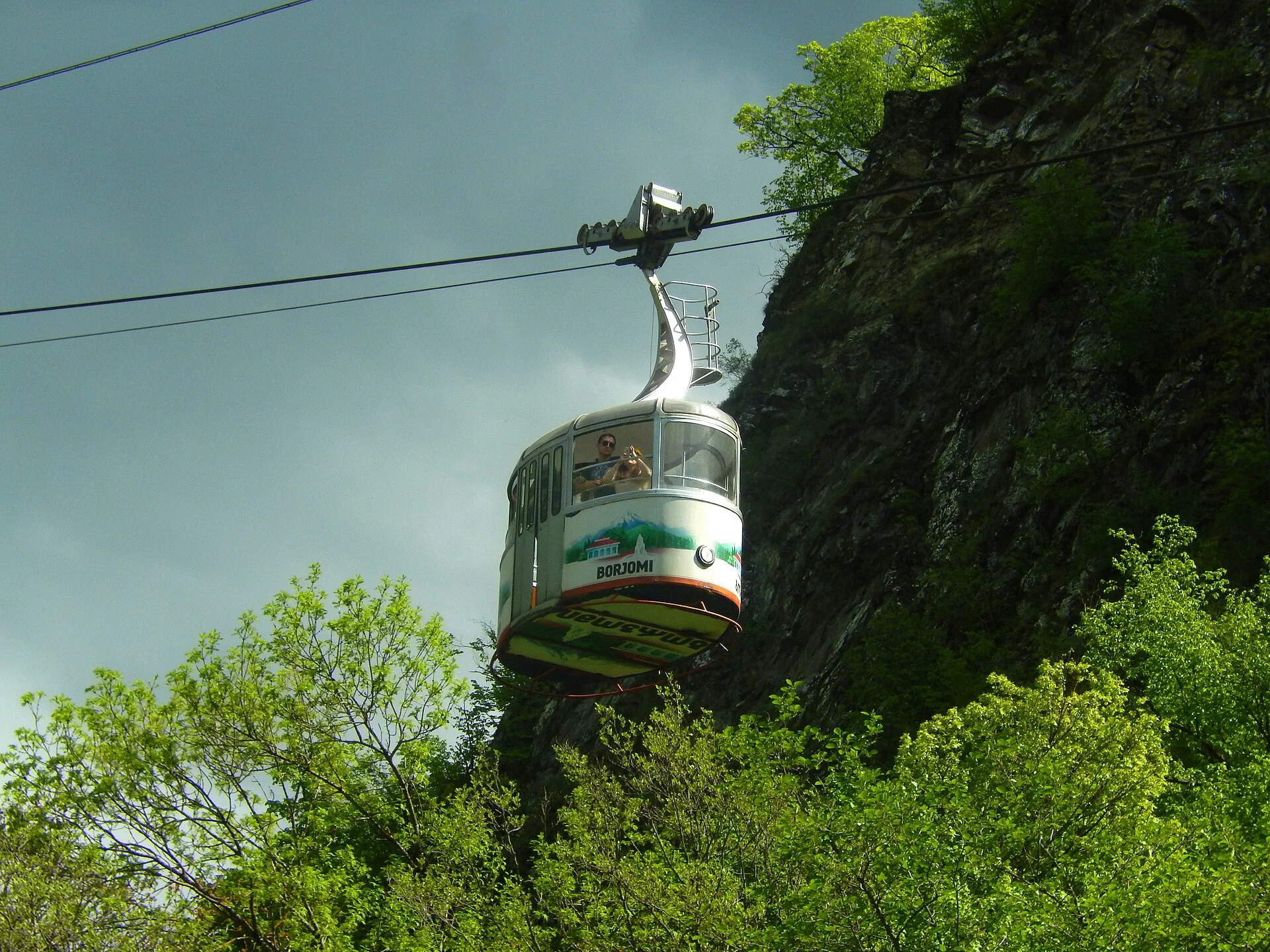
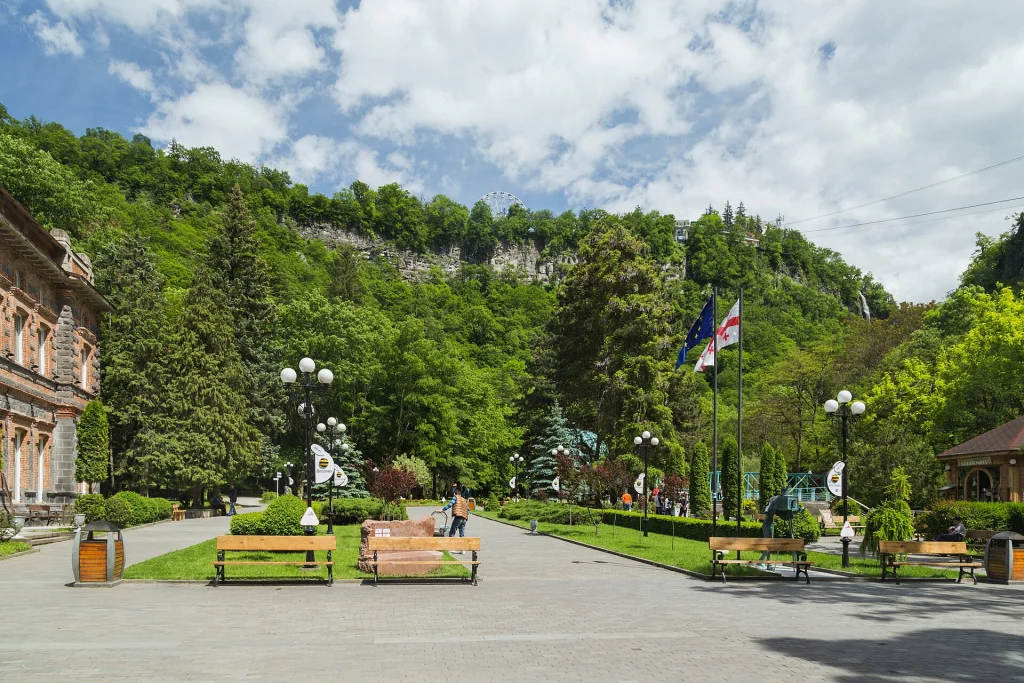
Borjomi and Tskaltubo are the two places in Georgia built, historically, around rest rather than sightseeing, which makes them natural anchors for an older traveller’s itinerary. Borjomi’s mineral park has flat paved paths, benches every few hundred metres and a cable car up to the viewpoint, so a full afternoon there involves almost no climbing. Tskaltubo’s radon-carbonate baths, some in restored Soviet-era bathhouses and some in newer private clinics, are usually step-free at the treatment level even where the surrounding building is not. Our Borjomi Spa Week — 5 Nights of Mineral Water, Forest and Likani and Tskaltubo Cure — 7 Nights of Radon-Carbonate Baths and Mud are both paced around short outings and long afternoons rather than a packed schedule, and the shorter Tskaltubo Short Cure — 3 Nights of Radon Baths suits a first visit or a mid-trip rest.
Hotels with lifts and accessible bases
A working lift is not automatic even in a well-reviewed Georgian hotel, particularly in converted townhouses in Old Tbilisi, Sighnaghi or Kutaisi, where character often means a narrow original staircase. Larger modern hotels in central Tbilisi, Batumi’s seafront, Kutaisi and Borjomi are the safer bet for a guaranteed lift and a ground-floor restaurant. In the mountains, the picture changes: most Kazbegi, Svaneti and Tusheti guesthouses are family-run, multi-storey and stairs-only, which is one more reason to treat those regions as shorter, well-supported add-ons rather than the backbone of a trip for anyone with mobility concerns. When we book on a traveller’s behalf we ask directly about lift access and ground-floor rooms before confirming, and we would recommend doing the same with any operator, in writing, rather than trusting a hotel’s own marketing photos.
Medical access, pharmacies and insurance
Tbilisi and Batumi have modern multi-profile hospitals and clinics with English-speaking staff and short waiting times for private consultations; pharmacies are plentiful and many medicines are available over the counter that would require a prescription elsewhere, though this is not a reason to arrive without your own supply and a written list of names and dosages. Outside the two main cities, and especially in Svaneti, Tusheti and Khevsureti, medical facilities are basic, distances to a proper hospital are long, and mobile signal is patchy on the high passes. Comprehensive travel insurance that explicitly covers emergency evacuation from remote or high-altitude areas is worth checking before booking a 4×4 route, and Georgia’s Ministry of Foreign Affairs publishes general travel-advisory guidance that is worth a look before departure, alongside your own country’s foreign-office advice.
The slow 10-day plan
This is the structure we use for the Slow Georgia for Seniors — 10 Unhurried Days with Rest Days itinerary, and it adapts well as a private Car with Driver by the Day route with a Licensed Private Guide by the Day for the city sections.
| Days | Focus | Pace note |
|---|---|---|
| 1–2 | Tbilisi: Old Town, cable car to Narikala, sulphur baths | Flat where possible, cobbles in short bursts |
| 3 | Mtskheta half-day | Short drive, church thresholds, benches available |
| 4 | Kakheti wine day, Sighnaghi and a cellar | Vineyard paths are flat; town streets slope |
| 5 | Rest day in Tbilisi or Telavi | No driving |
| 6–7 | Kazbegi via the Military Highway, Gergeti by 4×4 | Longest single drive of the trip, split with stops |
| 8 | Borjomi, mineral park and forest air | Flat paths, cable car, early finish |
| 9 | Return to Tbilisi, free afternoon | Short drive, no evening activity booked |
| 10 | Departure | Private transfer, generous airport buffer |
If this guide is part of a trip you are planning, our Tbilisi to Gudauri Transfer — Ski Season 4×4 and Winter Kazbegi — Snowshoes, Gergeti and the Rooms Hotel, 2 Days cover the places it describes with a private guide and driver; a GTour travel expert adapts the route to your dates.
Practical summary
- Cap single drives at around 2.5 hours each way unless you are staying overnight at the destination
- See Gergeti Trinity Church by 4×4, not by hiking the uphill path
- Treat Gudauri and Juta village as fine by vehicle; leave high passes like Chaukhi to fitter hikers, and ask your own doctor first if you have heart or lung conditions
- Expect cobbles, slopes and uneven church floors at nearly every historic site; use cable cars where they exist
- Choose Borjomi and Tskaltubo for genuinely restful days with flat paths and step-free treatment areas
- Confirm a working lift and ground-floor options in writing before booking any hotel, especially outside Tbilisi and Batumi
- Carry your own medicine list and dosages, and buy travel insurance that covers emergency evacuation from remote areas
- Build in a rest day every three to four days rather than a packed daily schedule
Sources
- Georgian Road Department, pass and winter road status
- Georgian National Tourism Administration
- Gudauri resort information
- Georgia Travel official portal
- Ministry of Foreign Affairs of Georgia, travel advice
- Georgian Railway
Questions this guide does not answer? Write to info@castle.ge or WhatsApp +995 577 41 63 14 — a person in Tbilisi replies. See also our travel services and all guides.
The Borjomi cable car offers an easy, step-free way to enjoy mountain views without strenuous climbing. · Photo: Armineaghayan / Wikimedia Commons, CC BY-SA 4.0
Been to Georgia? Tell us how it went — the best stories are published here.
Share your tripOne email a week: what changed for travellers in Georgia — rules, roads, flights, seasons — plus one place worth the trip. Written by the GTour desk, no advertising, unsubscribe in one click.
This story across our partner network — ქართულად: შენი დასვენება
