

By Mariam Lomidze, Culture & Events Reporter · 14/11/2026
Georgia’s best-known fortresses trace a line of defence that runs from the high Caucasus passes down to the Black Sea coast, and the single best place to watch the sun set behind stone walls is Narikala, the citadel above Tbilisi‘s Old Town, where the Mother of Georgia statue and the sulphur-bath domes catch the last light at the same time. For history with fewer crowds, Khertvisi, Tmogvi, Birtvisi, Kldekari and Khornabuji reward the detour, while Ananuri, Rabati and Gonio remain the three most complete and most visited complexes, each restored to a different standard and each telling a different chapter of the country’s long habit of building on rock.
This guide works south to north and coast to mountain: Ananuri and Khertvisi on the Georgian Military Highway and the road to Vardzia; Rabati in Akhaltsikhe, Georgia’s most thoroughly rebuilt fortress town; Gonio and Petra on the Adjara coast; Narikala in the capital; and the quieter sites, Tmogvi, Birtvisi, Kldekari, Khornabuji and Shatili, that see a fraction of the visitors but none of the compromise. Entrance fees and opening hours at state-run sites change between seasons, so figures below are given as a guide only, with the official page to check before you go.
Ananuri and Khertvisi: fortresses on the road
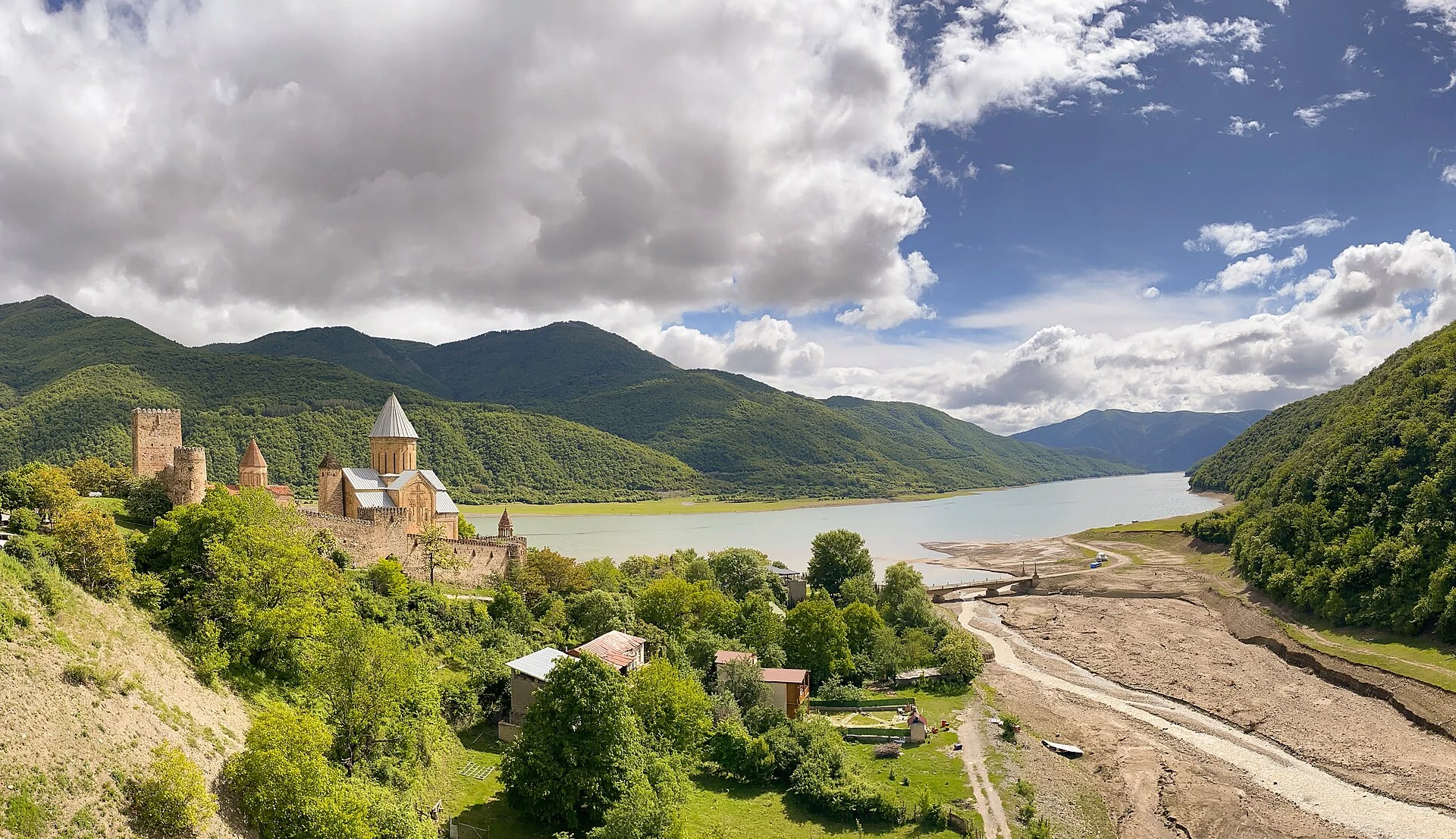
Ananuri sits on the Aragvi River, now the edge of the Zhinvali reservoir, about an hour north of Tbilisi on the Georgian Military Highway. It was the seat of the Aragvi eristavi, a dynasty of dukes who controlled this stretch of the road into the Caucasus from the thirteenth century, and the complex grew in stages: an upper fortress, a lower fortress, two churches and a watchtower, most of what stands today dating from the seventeenth century. The Aragvi dukes fought a long and often brutal rivalry with the eristavi of Ksani over control of the highway, and Ananuri was burned at least once during that feud, in 1739, which is why the surviving masonry mixes older foundations with later rebuilding.
Khertvisi, by contrast, guards the Mtkvari valley near the Turkish border in Samtskhe-Javakheti, on the road to Vardzia. Local tradition and early chronicles place a fortress here since antiquity, with the present walls largely from the tenth to fourteenth centuries, rebuilt after Mongol and later Ottoman incursions. It is one of the oldest fortified sites still standing in Georgia and controlled the junction of two valley routes, which made it a prize fought over by Georgian kings, Ottoman governors and Persian forces in turn. Entry to both sites is unticketed or carries a nominal fee at the gate; current hours are listed by the Georgian National Tourism Administration at georgia.travel. Ananuri is an easy half-day from Tbilisi and features on the Georgian Military Highway — Ananuri, Gudauri and Gergeti in a Day tour; Khertvisi sits en route on the Vardzia and Rabati — the Long Day South and Vardzia Cave City Day Trip itineraries.
Rabati in Akhaltsikhe: a fortress rebuilt for walking
Rabati’s history is layered rather than linear. A fortress existed here from at least the ninth century, but the site took its lasting shape under the Jakeli dukes of Samtskhe from the twelfth century and then under three centuries of Ottoman rule after 1578, when Akhaltsikhe became the seat of an Ottoman pashalik. That is why Rabati today holds a mosque, a citadel, a madrasa and a synagogue quarter within one perimeter, a mix unusual for a Georgian fortress and a direct record of the valley’s shifting rulers.
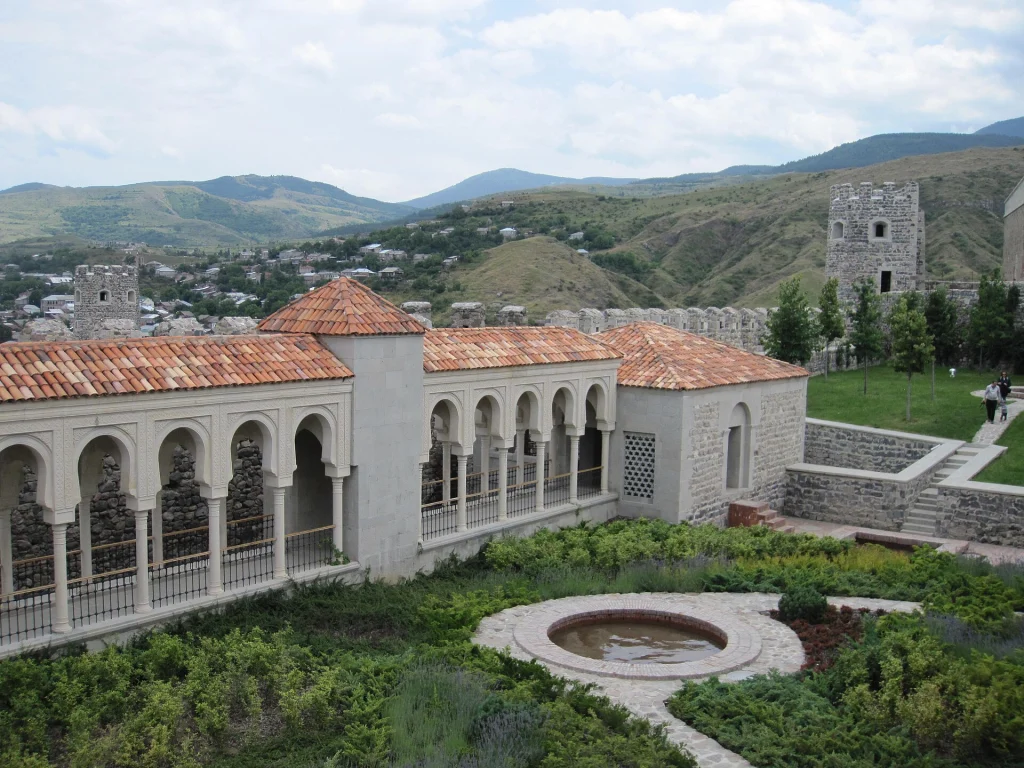
What visitors see now is largely the product of a 2011–2012 state restoration that rebuilt roofs, re-laid stone and added modern lighting and museum spaces, a project that remains debated among heritage specialists for how far it reconstructed rather than conserved. The result is Georgia’s most polished fortress experience: paved paths, a working citadel museum, a hilltop restaurant and views over the Potskhovi valley. Tickets are sold at the gate, with separate charges for the citadel museum and the mosque and synagogue interiors; check current prices via the Samtskhe-Javakheti pages at georgia.travel before travelling. Akhaltsikhe is covered on The South in 3 Days — Borjomi, Vardzia, Rabati and Abastumani, Vardzia, Rabati & Borjomi — 2 Days, and the Vardzia and Rabati — the Long Day South day trip.
Gonio and Petra: Rome and Byzantium on the coast
Gonio-Apsaros, a few kilometres south of Batumi toward the Turkish border, began as a Roman military camp in the first century, mentioned by classical geographers under the name Apsaros, and grew into a walled garrison town that Byzantine forces later held against Ottoman expansion. Local and church tradition associates the site with the burial of the Apostle Matthias, a claim archaeologists have not confirmed but which still draws pilgrims. Excavations continue inside the walls, and finds from Roman baths, a hippodrome and barracks are displayed in an on-site museum.
Petra, north of Batumi near Kobuleti, is smaller and less visited: a Byzantine-era fortress built under Emperor Justinian in the sixth century to anchor the empire’s eastern Black Sea frontier, later contested by the Ottomans, whose name for it, Petra, has stuck. Both sites keep regular hours with a modest entrance fee; confirm current times through gobatumi.com or adjara.gov.ge. Gonio features on the Gonio Fortress, Sarpi and the Batumi Botanical Garden half-day; Petra on North of Batumi — Petra Fortress, Kobuleti and the Shekvetili Pines.
Narikala above Tbilisi: the citadel and the best sunset
Narikala’s walls have stood over the Mtkvari gorge since at least the fourth century, when a Persian fortress first occupied the ridge; Arab governors expanded it in the eighth century, and the Georgian kings who reclaimed Tbilisi rebuilt it further, with most of the visible stonework dating from the sixteenth to seventeenth centuries. An earthquake in 1827 destroyed its gunpowder store and much of the upper structure, which is why Narikala today is more ruin than intact castle, but the ramparts and St Nicholas Church, rebuilt in 1996–1997, remain open and free to walk.
For sunset specifically, Narikala is the clear choice among Georgia’s fortresses: it sits directly above the Old Town and the sulphur baths of Abanotubani, faces west across the river toward Mtatsminda, and is reachable on foot or by a short cable-car ride from Rike Park, meaning visitors can time their arrival for golden hour without a long drive back afterwards. The climb and cable car both operate daily; confirm current cable-car hours through tbilisi.gov.ge. Narikala appears on the Old Tbilisi Walking Tour and the Tbilisi Photo Walk — Old Town to Mtatsminda at Dusk, both designed around this light.
The quieter fortresses
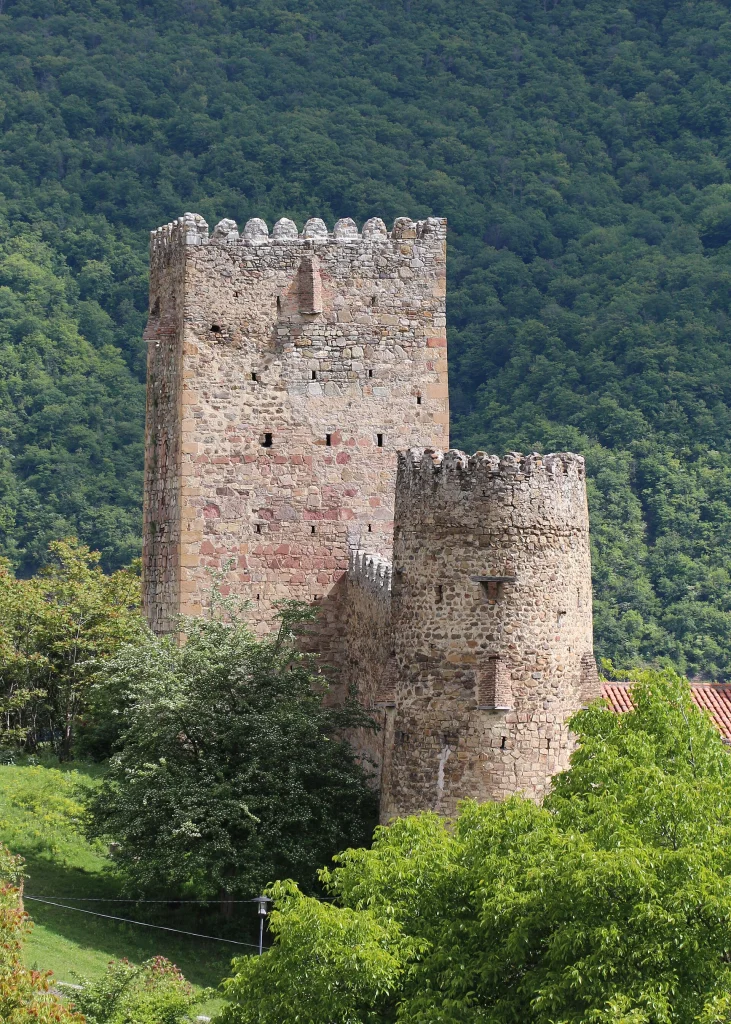
Several of Georgia’s most atmospheric fortresses see only a trickle of visitors, usually because they require a walk rather than a car park at the gate. Tmogvi, across the gorge from Vardzia’s cave monastery, was a tenth-to-thirteenth-century stronghold of the Javakheli dukes, now an unticketed ruin reached by a steep path; it pairs naturally with a Vardzia visit for travellers willing to add an hour. Birtvisi, in a narrow limestone canyon south of Tbilisi, was a near-impregnable medieval refuge that resisted a Mongol siege in the thirteenth century according to chronicle accounts, and today is reached only on foot through Dashbashi-adjacent canyon country. Kldekari, near Khashuri, guarded the approach to the Likhi range and changed hands repeatedly between Georgian nobles in the medieval period; its remains are modest and rarely signposted. Khornabuji, in Kakheti near Dedoplistsqaro, is one of the region’s oldest fortified sites, with foundations attributed to the early medieval kingdom of Kakheti-Hereti, overlooking a wide steppe view toward Azerbaijan.
| Fortress | Access | Note |
|---|---|---|
| Tmogvi | Unmarked path opposite Vardzia, no ticket | Combine with a Vardzia day trip |
| Birtvisi | Hiking trail only, no vehicle access to the fortress itself | Guided hike recommended for the canyon sections |
| Kldekari | Short walk from a village road near Khashuri | No facilities, minimal signage |
| Khornabuji | Dirt track and short climb, Dedoplistsqaro district | Best combined with eastern Kakheti itineraries |
None of the four charge an entrance fee as a rule, though this can change; there is no substitute for asking locally or checking with a guide the week you travel. Birtvisi is the easiest of the four to plan around, covered on the Birtvisi Fortress Hike and Dashbashi Canyon day trip.
Gori and Shatili: a citadel and a living fortress village
Gori’s fortress, on the mound above the modern town, has origins contested between the sixth and twelfth centuries and was rebuilt repeatedly as control of the Mtkvari valley passed between Georgian kings, Ottoman and Persian forces. It was damaged again in the 1920 earthquake and in Soviet-era remodelling of the town, leaving a compact set of walls with wide views that make it a short, worthwhile stop rather than a destination in itself, usually paired with the cave city of Uplistsikhe nearby on the Gori & Uplistsikhe — Cave City Day Trip.
Shatili, deep in Khevsureti near the Chechen border, is something else entirely: not a single fortress but a fortified village of stacked defensive towers, inhabited into the twentieth century and still partly lived in today, built from the medieval period onward by Khevsureti clans without state oversight, which is why its architecture looks closer to a hill town than a royal stronghold. It remains difficult to reach, a long 4×4 day from Tbilisi over unpaved mountain roads, and is covered on Shatili and Mutso — Khevsureti in One Long Day (4×4) and as part of longer Khevsureti and Tusheti itineraries.
Access and tickets at a glance
| Site | Typical access | Tickets |
|---|---|---|
| Ananuri | Self-drive or tour, 1 hour from Tbilisi | Nominal fee, pay at gate |
| Khertvisi | Self-drive or tour, en route to Vardzia | Free or nominal |
| Rabati | Self-drive or tour to Akhaltsikhe | Ticketed, citadel and mosque priced separately |
| Gonio | Short drive from Batumi | Ticketed, museum included |
| Petra | Short drive north of Batumi | Nominal fee |
| Narikala | Walk or cable car from Tbilisi Old Town | Free; cable car ticketed separately |
| Gori | Short drive or tour, 1.5 hours from Tbilisi | Free or nominal |
| Shatili | 4×4 day trip, long unpaved road | Free |
Always confirm current fees and seasonal hours through georgia.travel or the relevant municipal site before setting out, since several fortresses adjust hours in winter.
If this guide is part of a trip you are planning, our Georgia Off the Beaten Track — 9 Days in Racha, Samegrelo and Guria and Tbilisi to Borjomi or Bakuriani Transfer cover the places it describes with a private guide and driver; a GTour travel expert adapts the route to your dates.
Practical summary
- Best for sunset: Narikala, reached on foot or by cable car from Tbilisi’s Old Town.
- Most complete and visitor-ready: Rabati in Akhaltsikhe, with a museum, mosque and synagogue inside one complex.
- Closest to Tbilisi for a half day: Ananuri, on the Georgian Military Highway.
- Best paired with another site: Khertvisi and Tmogvi with Vardzia; Gonio or Petra with a Batumi coastal day.
- For hikers only: Birtvisi, Tmogvi and Kldekari have no vehicle access at the fortress itself.
- Furthest and most demanding: Shatili, a long 4×4 day from Tbilisi into Khevsureti.
- Verify fees and hours before travel at georgia.travel or the relevant municipal site, as these change seasonally.
Sources
- Georgia travel official site
- Gonio-Apsaros fortress information
- Tbilisi city government portal
- Agenda.ge heritage and culture coverage
- Georgia Today heritage coverage
Questions this guide does not answer? Write to info@castle.ge or WhatsApp +995 555 42 38 45 — a person in Tbilisi replies. See also our travel services and all guides.
Ananuri fortress complex rises above the turquoise Aragvi reservoir, surrounded by green hills. · Photo: Bernard Gagnon / Wikimedia Commons, CC BY 4.0
Been to Georgia? Tell us how it went — the best stories are published here.
Share your tripOne email a week: what changed for travellers in Georgia — rules, roads, flights, seasons — plus one place worth the trip. Written by the GTour desk, no advertising, unsubscribe in one click.
This story across our partner network — ქართულად: შენი დასვენება
