

By Prof. Giorgi Pkhakadze, MD, MPH, PhD · 15/09/2026
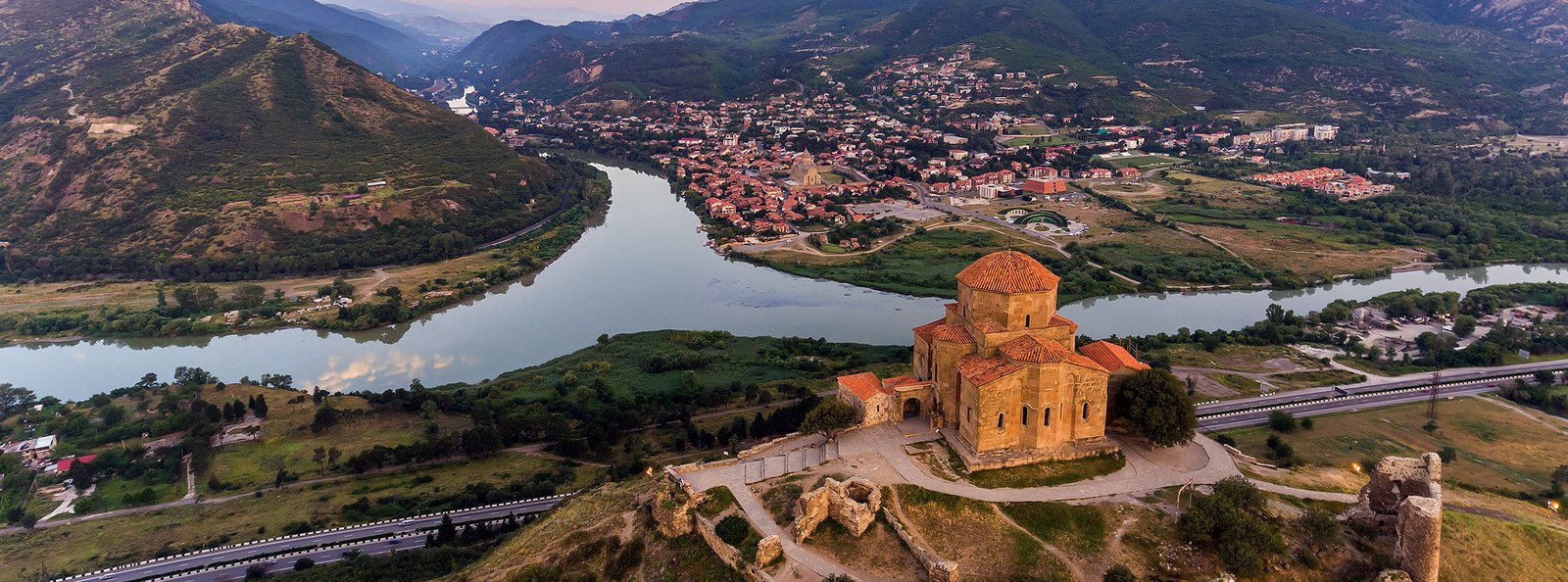
Jvari means “cross”. The church stands on the hill where, in the 4th century, Saint Nino raised a wooden cross over the pagan capital of Mtskheta below, and the church built around that spot two hundred years later has hardly changed since. It is the oldest surviving example of its kind in Georgia and the model for a thousand churches after it — and it commands the single most photographed view in the country.
The building
Jvari was finished around 605, a tetraconch: four apses around a central dome, a plan Georgian architects had been refining for a century and here brought to a form so clean it still looks modern. The stone is a warm grey-gold, the exterior carved with reliefs of the princes who paid for it, kneeling before Christ and the cross — the earliest portraits in Georgian art. Inside is a single space under the dome, bare and quiet, with the base of the original cross at its centre. Nothing was added later because nothing needed to be.
Its position was chosen for visibility, not shelter: Jvari sits on the edge of a ridge exposed to the wind that comes up the Kura gorge, and the church has been shedding stones to it for fourteen centuries. Restorers work on it constantly. Stand on the terrace and you understand why they bother.
The view
Below, the Aragvi comes in from the north, grey-green, and the Kura from the west, brown, and they run side by side for a moment before they merge. On the tongue of land between them is Mtskheta, with Svetitskhoveli’s dome and cone at its centre. Behind, the hills; beyond, on a clear day, the Caucasus. Lermontov opened his poem Mtsyri here — “where the rivers embrace like two sisters” — and every Georgian schoolchild knows the lines. In the late afternoon the light comes across the valley and the cathedral turns gold. That is the photograph.
The two churches
Jvari and Svetitskhoveli were built to be seen together, one from the other. From Jvari you look down on the cathedral; from the cathedral courtyard you look up at the cross on the hill. Nino’s cross above, the life-giving pillar below: the whole conversion story in two buildings and one view. The Mtskheta monuments have been a UNESCO World Heritage site since 1994.
Practical
The road to Jvari leaves the highway on the east bank and climbs for ten minutes; the last stretch is a short walk from the car park. The wind is real — bring a layer even in summer. Twenty minutes is enough for the church; the terrace deserves longer. Do not miss the view from the far end of the ridge, past the church, where the rivers are directly below you.
See it with GTour
Jvari is the last stop of the Tbilisi & Mtskheta first day and the first stop of the Gori & Uplistsikhe day; every journey north on the Military Highway passes beneath it.
ქართულად: ჯვარი — ხედი, რომელმაც საქართველო რუკაზე დასვა
