

By Mariam Lomidze, Culture & Events Reporter · 01/11/2026
Racha and Lechkhumi, Georgia’s mountainous northwest, pack an eleventh-century cathedral, a disappearing Jewish community, two of the country’s most prized reds, a turquoise reservoir and a resort village still recovering from a fatal landslide into one compact, little-visited loop. The short answer: come between late May and early October for open roads and full services, base yourself in Ambrolauri or Oni, allow three to five days to do it properly, and check current road and weather advisories before heading to Shovi or Udziro lake, since conditions above 1,500 metres change quickly and some sections were damaged by the August 2023 landslide.
This guide covers what each site actually is, what has changed recently, how to move between them, and where official information is updated, so you can plan with confidence rather than guesswork. Where a detail (an opening time, a closure, a safety advisory) is the kind of thing that changes year to year, we say so and point you to the agency that keeps it current.
Getting there and road conditions
Most visitors reach Racha from Kutaisi, about three hours by car via Tskaltubo and the Nakerala Pass (roughly 1,000 metres), which is tarmacked but narrow and winds through forest; it closes occasionally after heavy snow or fog in winter. From Tbilisi, allow five to six hours. There is no scheduled rail service into Racha; a car is the only practical option, and a 4×4 is strongly advised beyond Ambrolauri toward Shovi, Shaori and especially Udziro lake, where the final stretches are unpaved. Check GTour’s road status page before departure, and for official closures and works consult Georgia’s Roads Department. If you would rather not navigate mountain roads yourself, GTour runs a Racha in a Day tour from Kutaisi covering Shaori, Nikortsminda and Khvanchkara in eleven hours, and a three-day 4×4 Racha and Lechkhumi trip for those who want to go further.
Nikortsminda Cathedral and Barakoni Church
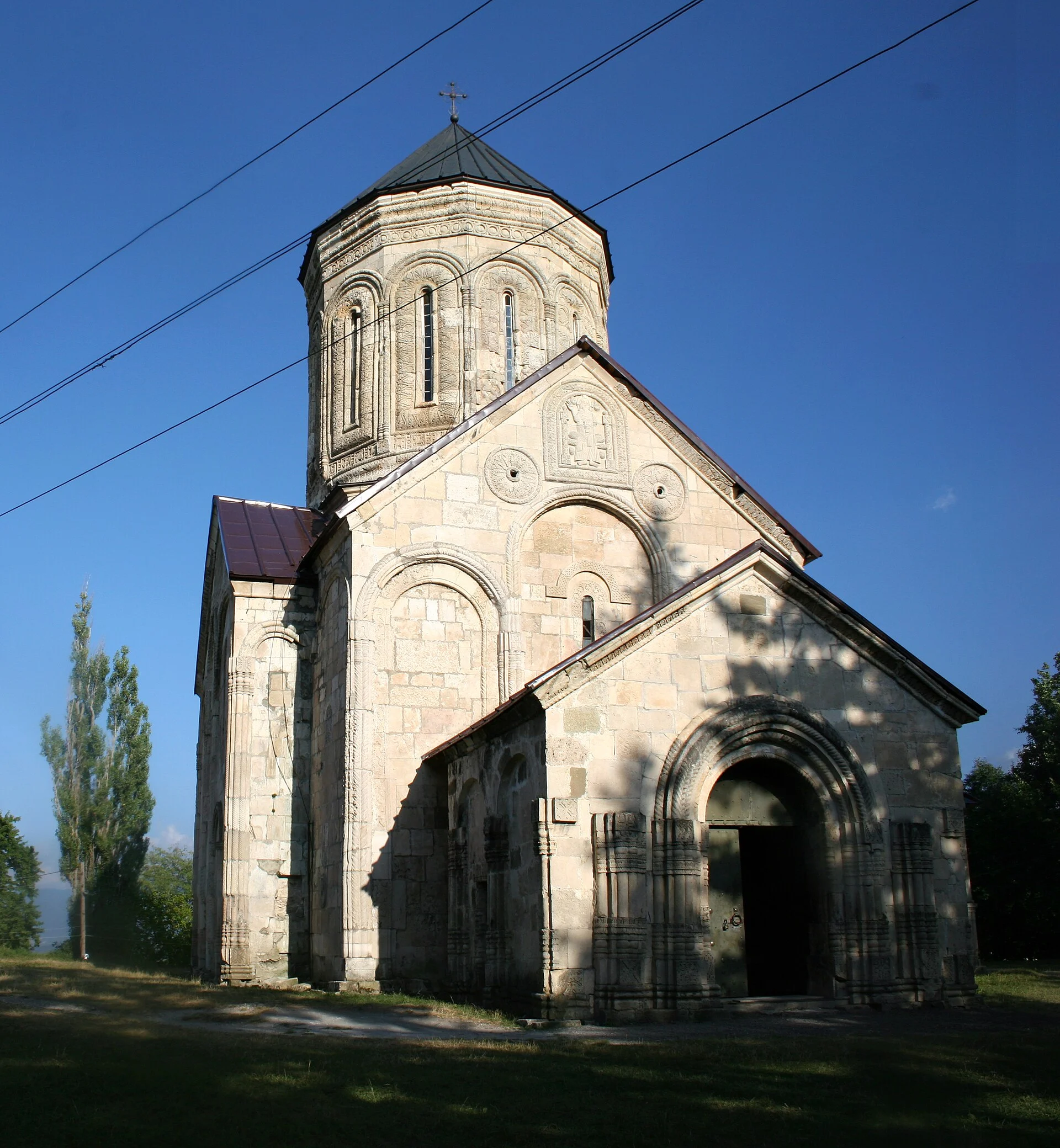
Nikortsminda Cathedral, built in 1010–1014 under King Bagrat III’s successors, is the region’s architectural centrepiece: a domed cross-in-square church covered outside in elaborate carved stone ornament unusual for its period, and inside with layered frescoes largely from the sixteenth to eighteenth centuries, repainted over an earlier scheme. It is a working church, so dress modestly and expect services on Sundays and feast days; there is no fixed entry fee but a donation is customary. The monument is on Georgia’s state list of immovable cultural heritage; for protection status and any restoration notices check the National Agency for Cultural Heritage Preservation. Barakoni Church of the Dormition, about 20 minutes from Ambrolauri near Tsesi, is a smaller but equally refined eighteenth-century baroque-Georgian building, known for its carved facades and a dramatic hilltop setting; it is easily combined with Nikortsminda in a half-day loop.
Oni and its synagogue
Oni was, until the mid-twentieth century, home to one of Georgia’s largest Jewish communities outside Tbilisi and Kutaisi, and its 1895–1898 Oni Synagogue, a large brick building with twin towers, remains one of the Caucasus’s most significant Jewish monuments even though most of the congregation emigrated to Israel from the 1970s onward. The building is generally viewable from outside and sometimes opens for visitors; because hours are informal and not centrally published, ask locally or through your guide before planning a visit around it, and treat it as a heritage stop rather than an active synagogue with regular services. Oni itself, a quiet administrative town on the Rioni’s tributary, makes a sensible overnight base for Shovi and Udziro.
Khvanchkara and Usakhelouri wines
Racha gave Georgia two of its most distinctive reds. Khvanchkara is a naturally semi-sweet wine from Aleksandrouli and Mujuretuli grapes grown around the villages of Khvanchkara, Bugiauri and Tolebi near Ambrolauri; it was reputedly a favourite of Stalin’s and carries protected designation of origin status, meaning only grapes from this defined zone, vinified by the traditional method, may use the name. Usakhelouri, from the Usakhelouri grape grown in a handful of Lechkhumi villages at altitude, is rarer, lighter and more delicate, and harder to find outside the region or specialist Tbilisi wine shops. For the current legal boundaries and rules governing appellation wines, the National Wine Agency publishes the registered geographical indications. Tastings are best arranged through a family cellar in Ambrolauri or on an organised day; GTour’s Racha — Khvanchkara Wine and Mountain Lakes two-day trip and the Western Wine — Imereti and Racha three-day tour both build in cellar visits with a guide who can translate the winemaker’s explanations.
Shaori reservoir and Udziro lake
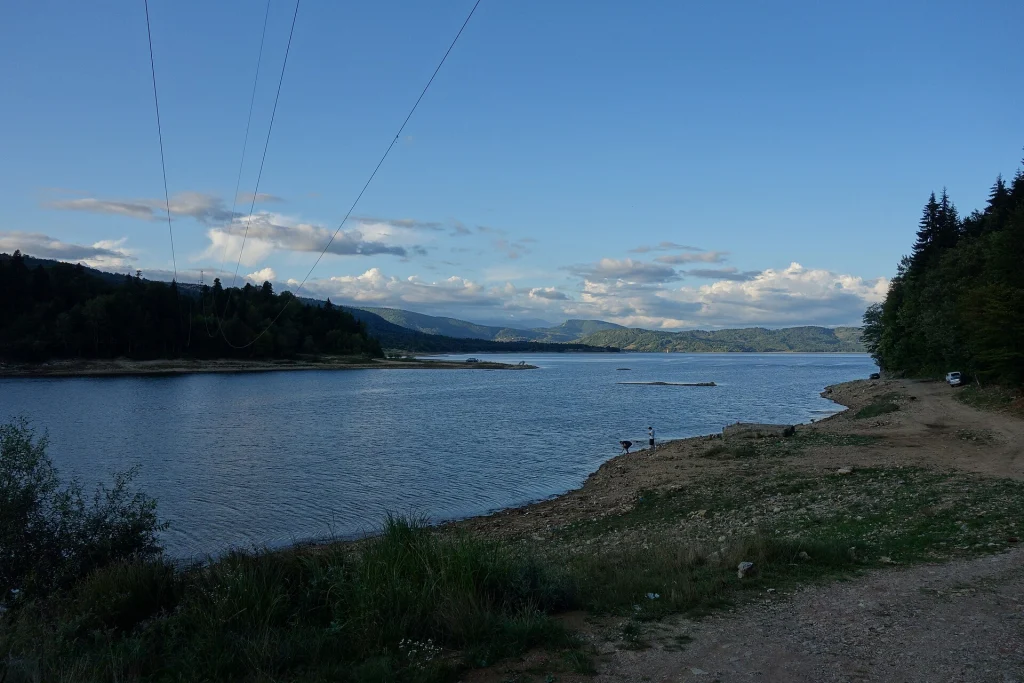
Shaori is a man-made reservoir built in the Soviet period for hydropower, sitting at around 1,400 metres amid pine forest; its still, pale-turquoise water and empty shoreline make it one of Racha’s most photographed spots, with a short unpaved access road off the main Ambrolauri–Oni route. Udziro, a natural lake higher in the mountains near Shovi, is harder to reach, typically requiring a 4×4 for the final approach or a hike of a few hours depending on the season, and is only sensibly attempted between June and September when snow has cleared and the track is passable. Neither site has formal visitor infrastructure (no ticket office, limited signage), so carry water, check weather, and tell someone your return time if driving or hiking independently.
Shovi and the 2023 landslide
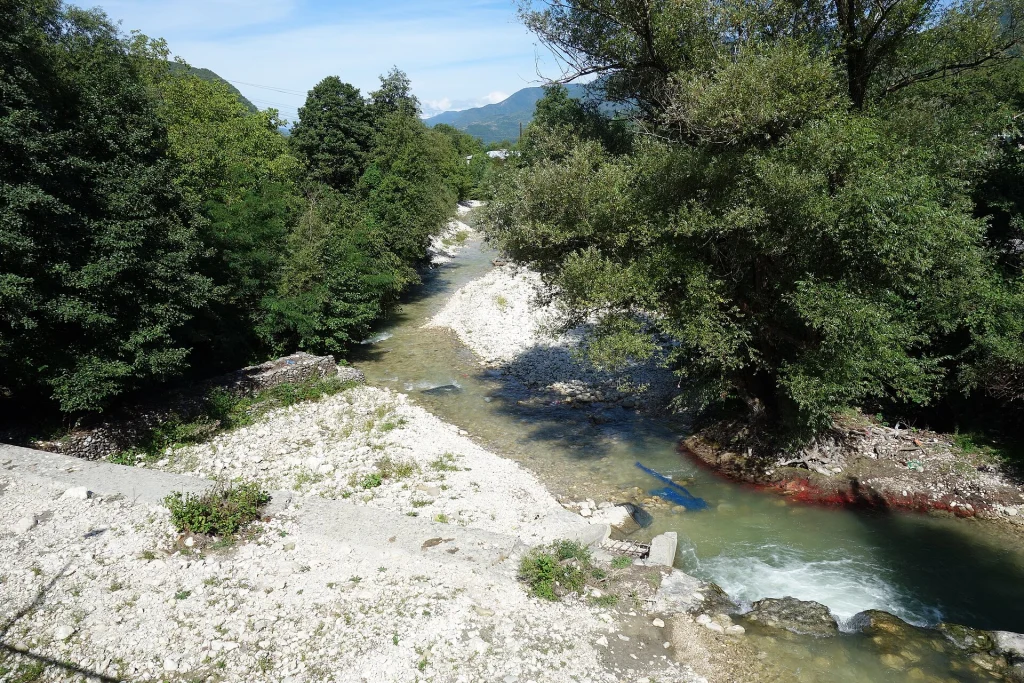
Shovi, a small alpine resort at the head of the valley above Oni, has long been a base for hiking toward Udziro and the surrounding 3,000-metre peaks. On 3 August 2023 a major landslide and debris flow struck the Buba River valley near Shovi, destroying part of a holiday camp and causing multiple deaths; it remains one of the deadliest natural disasters in Georgia’s recent history and prompted a review of hazard monitoring in mountain valleys. Reconstruction and slope stabilisation work has continued since, and access, accommodation availability and which trails are open can change season to season. Before planning a trip into the Shovi area, check current advisories from Georgia’s National Environment Agency, which monitors geological hazards, and recent reporting from Civil Georgia or Agenda.ge, both of which covered the disaster and its aftermath in detail. Treat any advice you receive locally about closed valleys or unstable slopes as authoritative, and do not approach the Buba riverbed or camp near steep, denuded slopes after heavy rain.
Seasons and when to go
| Season | Conditions | Notes |
|---|---|---|
| Late May–June | Roads clear, rivers high, meadows green | Good for Nikortsminda, Shaori; Udziro may still hold snow |
| July–August | Warmest, most reliable access to Shovi and Udziro | Peak season for hiking; book Ambrolauri and Oni guesthouses ahead |
| September–October | Grape harvest, clear light, fewer crowds | Best for wine visits; Khvanchkara cellars most active |
| November–April | Nakerala Pass and side roads can close after snow | Nikortsminda and Oni still reachable with care; Shovi and Udziro largely inaccessible |
For the most reliable snapshot of current conditions, GTour updates a dedicated road status page, and the national tourism administration publishes seasonal advisories at georgia.travel and gnta.ge.
Planning your visit with GTour
If you prefer not to self-drive, GTour runs several ready-made itineraries through the region. The Racha in a Day tour (11 hours, from €376 solo, €200 each for four to six) covers Shaori, Nikortsminda and a Khvanchkara tasting from Kutaisi. The two-day Khvanchkara and mountain lakes trip (from €896 solo, €476 each for four to six) adds an overnight and more time at the lakes. For a deeper exploration including Lechkhumi’s Usakhelouri villages, the three-day 4×4 Racha and Lechkhumi tour (from €1,344 solo, €714 each for four to six) is the better fit, and travellers combining Racha with Samegrelo and Guria can look at the nine-day Georgia Off the Beaten Track itinerary. For independent travel, a car with driver by the day (from €240 solo) or a licensed guide by the day (from €224 solo) can be booked as standalone services and combined with your own hotel choices; see all services and current price tables.
If this guide is part of a trip you are planning, our Georgian Wine Grand Tour — 8 Days, Five Regions and Georgia Off the Beaten Track — 9 Days in Racha, Samegrelo and Guria cover the places it describes with a private guide and driver; a GTour travel expert adapts the route to your dates.
Practical summary
- Best window: late May to early October; Shovi and Udziro realistically open June–September only.
- Base yourself in Ambrolauri (for Nikortsminda, Barakoni, Khvanchkara) or Oni (for the synagogue, Shaori, Shovi).
- A 4×4 is advisable beyond Ambrolauri; the Nakerala Pass road is tarmacked but can close in winter.
- Before any Shovi or Udziro trip, check hazard advisories from Georgia’s National Environment Agency and recent local news, given the August 2023 landslide.
- Khvanchkara and Usakhelouri are both protected-designation wines; verify current appellation rules with the National Wine Agency if buying for export.
- Oni Synagogue hours are informal; ask locally or through a guide rather than expecting fixed opening times.
- No ticket offices at Shaori or Udziro: carry water, check weather, and tell someone your return plan.
- If self-driving is not for you, GTour’s day and multi-day Racha tours bundle transport, a guide and cellar visits into one price.
Sources
- National Wine Agency, geographical indications
- Georgia Roads Department, road conditions
- National Agency for Cultural Heritage Preservation
- National Environment Agency, hazard monitoring
- Civil Georgia, Shovi landslide coverage
- Agenda.ge, Shovi disaster reporting
- Georgia Travel, regions
- Georgian National Tourism Administration
Questions this guide does not answer? Write to info@castle.ge or WhatsApp +995 577 41 63 14 — a person in Tbilisi replies. See also our travel services and all guides.
Nikortsminda Cathedral, the famous 11th-century church featured in the Racha travel guide. · Photo: ალ-ო / Wikimedia Commons, CC BY-SA 3.0
Been to Georgia? Tell us how it went — the best stories are published here.
Share your tripOne email a week: what changed for travellers in Georgia — rules, roads, flights, seasons — plus one place worth the trip. Written by the GTour desk, no advertising, unsubscribe in one click.
This story across our partner network — ქართულად: შენი დასვენება
