

By Mariam Lomidze, Culture & Events Reporter · 29/10/2026
Driving in Georgia in 2026 means juggling three separate systems that rarely talk to each other: Tbilisi‘s paid parking zones and the Tbilisi Transport app, a fuel market dominated by five international and local brands with prices that move with the lari and global crude, and an EV charging network that is real but still thin outside the capital. Short answer: pay for Tbilisi parking through the app or by SMS the moment you park, expect petrol brands like Wissol, Rompetrol, Socar, Gulf and Lukoil at broadly similar pump prices, trust diesel from the major chains more than from unbranded roadside stations, and if you are driving an EV plan your route around Tbilisi, Batumi, Rustavi and the main highway corridors rather than assuming a charger will appear in the mountains.
This guide sets out what we tell clients who self-drive, and what our own drivers do every day on the roads we cover for our car with driver and self-drive itineraries. Rules, fines and charger networks change faster than any printed guide, so every section below tells you exactly where to check the current figure before you rely on it.
Tbilisi’s paid parking zones and the app
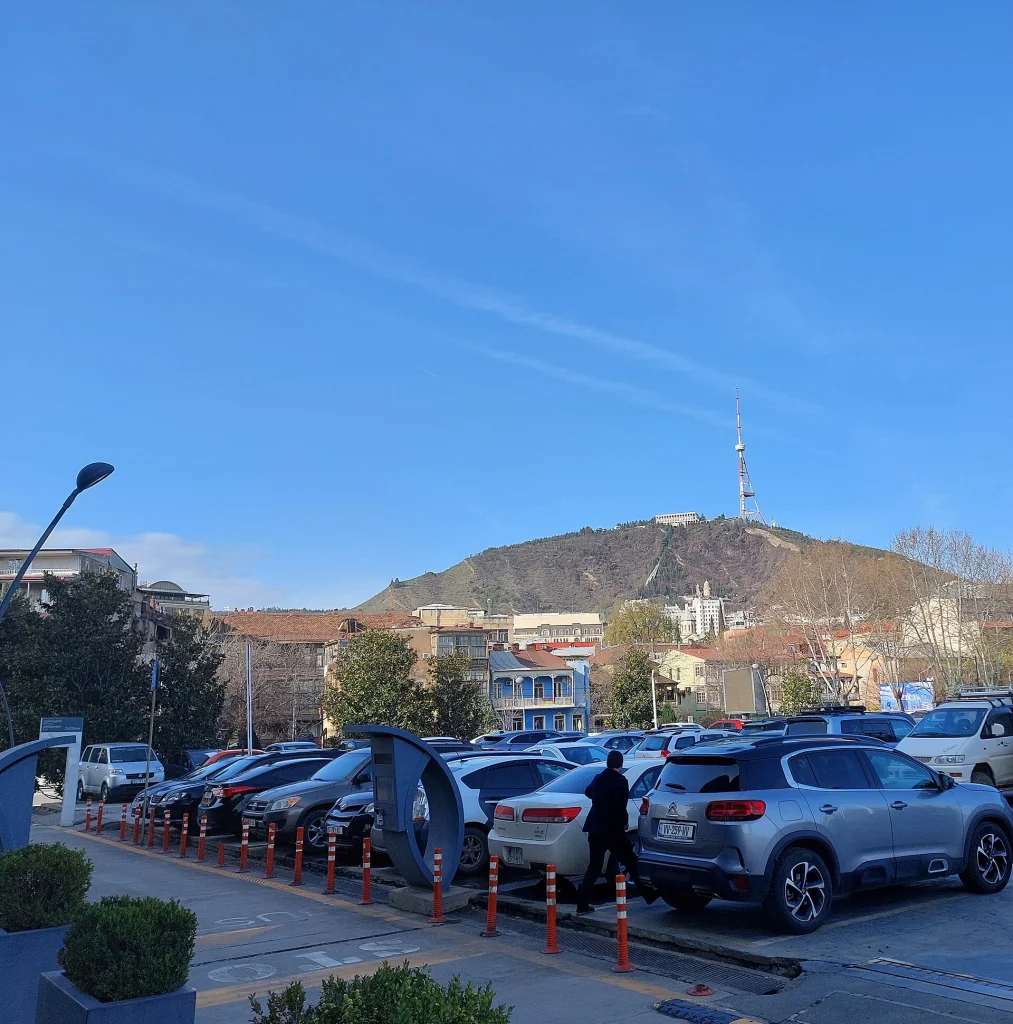
Tbilisi City Hall runs a zonal paid parking system across the central districts, roughly the area bounded by Rustaveli Avenue, Vake, Vera and parts of Saburtalo, with blue roadside signage marking the zone number and hours of operation. Payment is normally made through the official parking app or by sending an SMS to a short code displayed on the nearby sign, both of which require you to enter the zone number and your car’s plate. Visitors without a local SIM sometimes struggle with SMS payment, so downloading the app and linking a card before you start driving is the safer option. Zone boundaries and the exact app name have shifted more than once in recent years as the city has digitised the system, so always confirm the current app and zone map on the Tbilisi City Hall site rather than from an old screenshot.
Free parking generally applies on Sundays and after the evening cut-off shown on the sign, but this varies by zone and has been adjusted before, so check the sign itself every time, not just your memory of the last visit. Outside the paid zones, side streets in Vake, Saburtalo and Old Tbilisi are mostly free but increasingly congested, and many hotels and guesthouses offer private parking that is worth asking about when you book.
Parking fines and enforcement
Unpaid parking in a marked zone, and parking that blocks a pavement, crossing or bus lane, can result in a fine issued by city inspectors or captured by camera, with the vehicle’s number plate used to trace the registered keeper, which matters for rental cars since the fine is usually passed on to the renter. Fine amounts and the rules for reduced early payment are set by Tbilisi City Hall regulation and by the national Code of Administrative Offences, and both have been revised in the past, so we deliberately do not quote a lari figure here that could be out of date by the time you read this. Confirm the current fine schedule on the Tbilisi City Hall website or via Matsne, the Legislative Herald, where parking by-laws are published. If you are driving one of our rental referrals or a self-drive car, keep the rental agency’s contact details handy, since most can tell you immediately whether a fine has been registered against the plate.
Towing and wheel-clamping exist for serious obstructions, particularly around Rustaveli Avenue during state events and processions, and around Freedom Square. If your car is missing, the city’s parking department is the first call, followed by the local police station.
Petrol brands, grades and prices
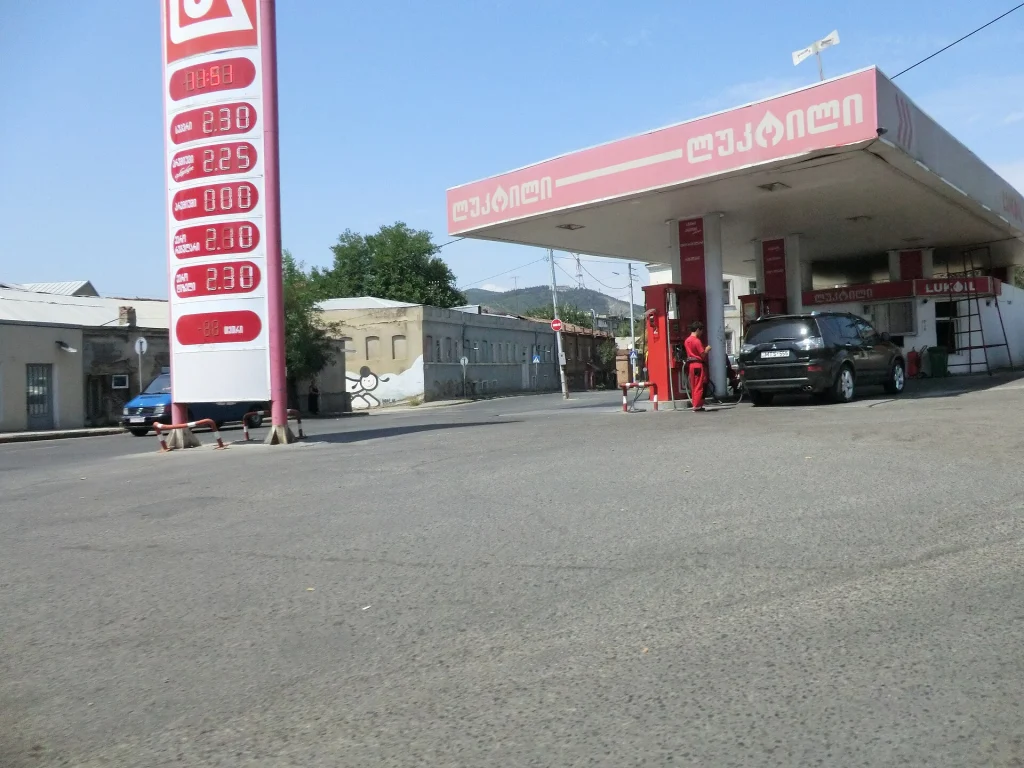
Georgia’s retail fuel market is split between a handful of chains that cover almost every town on the main routes: Wissol, Rompetrol, Socar, Gulf and Lukoil, alongside smaller local brands concentrated in specific regions. Regular (92/95-equivalent) and premium grades are available at all the major chains, and prices are quoted in lari per litre and move with international crude prices and the lari-dollar rate, so a figure printed today can be a few tetri off within weeks. As a planning benchmark, mid-2026 pump prices for regular petrol across the major brands sat broadly in a narrow band, with premium grades a little above and diesel close to or slightly below petrol; always check the live national average, which the statistics office and some fuel retailers publish, rather than relying on a number in this article.
| Brand | Coverage | Notes |
|---|---|---|
| Wissol | Nationwide, strongest on highways and mountain roads | Wide network, good coverage toward Kazbegi and Svaneti |
| Socar | Nationwide, strong in Tbilisi and the east | Azerbaijani state operator, consistent quality |
| Rompetrol | Nationwide, strong in Tbilisi and Imereti | Romanian-owned, often has loyalty apps |
| Gulf | Tbilisi and main highway corridors | International brand, premium grades available |
| Lukoil | Nationwide | Long-established, widespread rural coverage |
We recommend filling up at one of these five brands rather than an unbranded station, especially before mountain routes such as the Georgian Military Highway toward Gudauri or the road to Mestia, where the next reliable station can be well over an hour away. For current average prices by city and fuel type, check the National Statistics Office of Georgia, which publishes periodic price data.
Diesel quality in Georgia
Georgia has progressively tightened fuel quality rules to align with European sulphur and emissions standards, and the major chains listed above generally sell diesel that is suitable for modern Euro-standard diesel engines without additional treatment. Quality is less consistent at small unbranded stations in remote areas, where storage conditions and turnover are harder to verify, and travellers with older or sensitive diesel engines sometimes report rougher running after filling at these outlets. If you are self-driving a diesel vehicle on a long rural loop, it is sensible to top up at a major brand in a larger town before heading into Racha, Tusheti or Svaneti rather than relying on finding fuel along the way. Georgia’s technical regulations on liquid fuel quality are published through the government’s legal portal; check the current standard via Matsne, the Legislative Herald, and via the Ministry of Economy’s pages on energy and fuel policy if you need the regulatory detail for a commercial fleet.
EV charging networks: where you can actually charge
Electric vehicle uptake in Georgia is still modest, but charging infrastructure has grown steadily in Tbilisi and along the main east-west and Tbilisi-Batumi corridors, with a mix of fast (DC) and slower (AC) chargers installed by several competing operators, some tied to fuel retailers and some independent. Coverage is dense enough in central Tbilisi, Rustavi and along the main highway to Kutaisi and Batumi that a reasonably charged EV can complete the classic Tbilisi-Batumi run with careful planning, but it thins out quickly once you leave the trunk roads. Because networks, apps and even operator names have changed more than once in the past two years, do not rely on an old blog post or a printed map; use a live charger-finder app before setting out, and treat any single charger as potentially out of service, since rural and semi-rural units are not always promptly repaired.
| Where | What to expect |
|---|---|
| Central Tbilisi | Multiple operators, mix of AC and DC, generally reliable |
| Tbilisi–Kutaisi–Batumi highway | Scattered DC fast chargers at service stations and shopping centres |
| Secondary towns (Telavi, Gori, Zugdidi) | Limited, usually one or two slower AC points |
| Mountain regions (Svaneti, Tusheti, Racha) | Essentially none; plan to arrive with a full charge |
For a route that genuinely needs certainty, our car with driver service uses conventional fuel vehicles precisely because charging infrastructure cannot yet guarantee a mountain itinerary. If you are bringing or renting an EV, confirm current charger locations and uptime through your charging app’s live map rather than a static list, and cross-check against general transport guidance on georgia.travel or the Georgian National Tourism Administration.
Charging in the mountains: Gudauri and the Rikoti road
Gudauri, the main winter resort on the Georgian Military Highway, has seen EV charging points appear at some hotels and at the resort’s lower stations in recent seasons, largely to serve guests arriving from Tbilisi rather than long-distance through traffic; availability is tied to individual properties, so if you are staying for our Gudauri ski package or driving up independently, ask your hotel directly whether it has a working charger rather than assuming one exists. The Georgian Military Highway itself, including the approach through Ananuri and the Jvari Pass, has no dense charging corridor, and winter closures for snow and avalanche risk are common, so any EV trip toward Kazbegi should be timed around both charger uptime and the current road status, which we track daily, alongside the official Georgian Road Department updates.
The Rikoti Pass, on the main east-west highway between Tbilisi and Kutaisi, is a busier commercial corridor with fuel stations of all five major brands on both approaches, and a small but growing number of fast chargers at service areas near Khashuri and Zestaponi. This is currently one of the more dependable sections of the country for an EV crossing between east and west Georgia, but tunnel works and seasonal fog can still close lanes, so check the Road Department’s page before a winter crossing.
Batumi and Kutaisi: the situation outside Tbilisi
Batumi has a reasonable spread of the five major fuel brands along Chavchavadze Avenue and the approach roads, and a handful of EV chargers have appeared at hotels and shopping centres in recent years, but the city has not published a dedicated paid-parking app comparable to Tbilisi’s; street parking in the old town and along the boulevard is largely metered by attendants or regulated by signage rather than a city-wide digital system, so carry small lari notes and check current arrangements with Batumi City Hall or the Adjara regional government before relying on an app. Our Batumi Old Town walk and airport transfer clients generally find fuel and basic parking straightforward, with EV charging still the exception rather than the rule.
Kutaisi, as Georgia’s second city and the gateway for western Georgia touring, has fewer EV chargers than Tbilisi or Batumi, concentrated mainly around the city centre and the airport road, and parking is mostly free or informally managed rather than zoned. Fuel coverage from the major brands is good on the roads toward Martvili, Svaneti and the coast, but, as with the rest of western Georgia, EV infrastructure lags the fuel network, so plan EV routes conservatively and check current charger status via a live app rather than this or any other static guide.
If this guide is part of a trip you are planning, our Batumi to Kutaisi Transfer — Private Car and Prometheus Cave and Martvili Canyon from Batumi cover the places it describes with a private guide and driver; a GTour travel expert adapts the route to your dates.
Practical summary
- Pay Tbilisi parking through the official app or SMS the moment you park; confirm the current app and zone map at tbilisi.gov.ge.
- Check the current fine schedule and any free hours before relying on memory; rules are revised periodically via city regulation and Matsne.
- Fill up at Wissol, Socar, Rompetrol, Gulf or Lukoil rather than unbranded stations, especially before mountain routes.
- Diesel quality is reliable at major brands; be cautious at small rural stations with older diesel engines.
- EV charging is workable in Tbilisi and along the main Tbilisi-Kutaisi-Batumi highway, including the Rikoti Pass area, but essentially absent in Svaneti, Tusheti and Racha.
- Gudauri charging depends on individual hotels; check directly and watch the road status for winter closures.
- Batumi and Kutaisi have fuel coverage but limited, scattered EV charging and no major digital parking system; carry cash for street parking.
- Use a live charger-finder app, not a static article, for any EV route planning.
Sources
- Tbilisi City Hall
- Legislative Herald of Georgia (Matsne)
- Georgian Road Department
- Ministry of Economy and Sustainable Development
- National Statistics Office of Georgia
- Georgian National Tourism Administration
- Official Georgia travel portal
- Batumi City Hall
- Kutaisi travel information
Questions this guide does not answer? Write to info@castle.ge or WhatsApp +995 577 41 63 14 — a person in Tbilisi replies. See also our travel services and all guides.
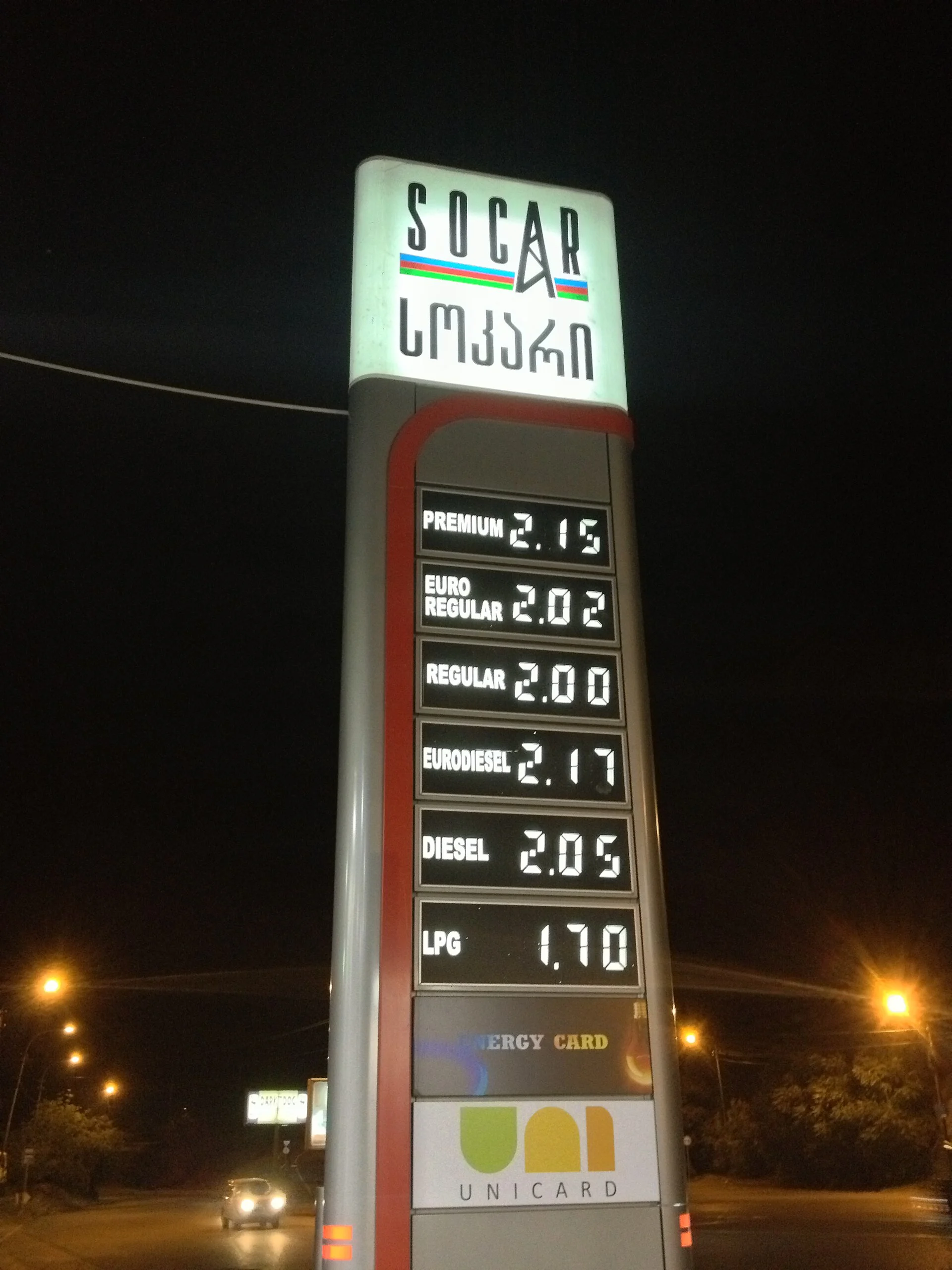
A SOCAR fuel price board in Tbilisi lists current petrol and diesel rates in lari. · Photo: Dalibor Z. Chvatal / Wikimedia Commons, CC BY 3.0
Been to Georgia? Tell us how it went — the best stories are published here.
Share your tripOne email a week: what changed for travellers in Georgia — rules, roads, flights, seasons — plus one place worth the trip. Written by the GTour desk, no advertising, unsubscribe in one click.
This story across our partner network — ქართულად: შენი დასვენება
