

By David Kiknadze, Transport & Openings Reporter · 28/10/2026
Basotho citizens are not on Georgia’s current visa-free list, so in most cases you will need an e-visa before you fly, applied for online rather than at a consulate. There is no Georgian embassy in Lesotho and no Lesotho mission in Tbilisi, so everything from the visa application to emergency consular help happens through third-country offices or online portals, which makes a little extra planning worthwhile.
This guide sets out, plainly, what a traveller from Maseru or any other Lesotho town needs to know for 2026: the visa process, the realistic flight routing (there is no direct or near-direct service, and the journey from Lesotho involves at least two connections), money and cards, language, food, and what little documented history connects the two countries. Where a rule could change before your trip, we say so and point you to the official page to check on the week you book.
Visa and entry: what Basotho travellers need
Georgia’s entry rules are set out by the Ministry of Foreign Affairs and the e-visa authority, and both can amend the list of visa-exempt countries without much notice, so always verify before buying tickets. As of this writing, Lesotho is not among the nationalities exempted from a visa for short tourist stays, which means Basotho passport holders should apply through Georgia’s e-visa portal before departure rather than expect a visa on arrival. The e-visa portal is the only route the government recommends; processing is typically stated as a small number of business days once a complete application, passport scan, photo and travel proof are submitted, though the site itself gives the current guaranteed timeframe and fee, which have both changed in recent years.
Before you apply, check the up-to-date country list and document requirements on the Ministry’s own consular pages, since Georgia periodically revises visa categories and the list of countries eligible for e-visa versus full consular visa. The Ministry of Foreign Affairs of Georgia publishes the authoritative version; if in doubt, or if your passport situation is unusual (diplomatic passport, dual nationality, minor travelling alone), a short email to them or to the nearest Georgian diplomatic mission is worth the wait.
Flights: getting from Lesotho to Georgia
There are no direct flights between Lesotho and Georgia, and there will not be a genuine one-stop option either, because Lesotho’s own international air links are limited. Moshoeshoe I International Airport near Maseru mainly serves regional flights to Johannesburg. From there, long-haul carriers connect onward to the hubs that serve Tbilisi: Istanbul, Doha and Dubai are the three realistic gateways, each with established onward service to Tbilisi International Airport.
| Typical routing from Lesotho | Connecting hub | Notes |
|---|---|---|
| Maseru to Johannesburg | regional hop | Usually the only way out of Lesotho by air |
| Johannesburg to Istanbul | Turkish Airlines hub | Istanbul to Tbilisi is a short onward sector |
| Johannesburg to Doha | Qatar Airways hub | Doha to Tbilisi runs several times weekly |
| Johannesburg to Dubai | Emirates and flydubai hub | Dubai to Tbilisi is served by multiple carriers |
In practice this means a journey of two connections rather than one, so build in a comfortable layover, particularly in Johannesburg where regional and intercontinental terminals can be some distance apart. Check live routings, schedules and any seasonal changes directly with the airlines, and confirm arrival details for whichever Georgian airport you land at: Tbilisi International Airport, Kutaisi International Airport, which handles a number of low-cost European routes, or Batumi International Airport on the coast, useful if your itinerary begins in Adjara. If you land in Kutaisi or Batumi and your trip starts in Tbilisi, we run fixed-price private transfers between all three.
Driving, money and staying connected
Lesotho driving licences are not automatically recognised for long stays in Georgia. Foreign licences are generally usable for a limited period after entry, and an International Driving Permit alongside your Lesotho licence is the safer option if you plan to self-drive, particularly on mountain roads. Confirm the current rule, which falls under Georgian road legislation and can be checked via the Georgian Road Department, before relying on your home licence for more than a short period; many visitors simply book a car with a local driver instead, which avoids the question entirely.
Georgia’s currency is the lari (GEL). Lesotho’s loti is not exchangeable in Georgia, so carry US dollars, euros or a bank card instead; South African rand, which the loti is pegged to at par, is also not commonly exchanged in Georgian banks or kiosks, so convert to USD or EUR before you travel if you are carrying cash. Visa and Mastercard are widely accepted in Tbilisi, Batumi and Kutaisi, and increasingly in smaller towns, but mountain villages, small guesthouses and local markets often take cash only. ATMs are common in cities; at the time of writing, 1 EUR converts to roughly 2.89 GEL and 1 USD to roughly 2.60 GEL, according to the National Bank of Georgia’s daily rate, which moves and should be checked on the day you change money.
Prepaid SIM cards from Georgia’s main operators are sold at the airport and in city shops, and eSIM options are increasingly available for travellers who prefer to avoid a physical card swap; either works well for navigation, ride-hailing apps and calling home.
Language and what to expect
Georgian is the official language and uses its own script, which is not related to Sesotho, English or Afrikaans in any way, so street signs and menus outside tourist areas can be genuinely unfamiliar. English is spoken reasonably well in Tbilisi’s hotels, restaurants and by younger staff in Batumi and Kutaisi, and Russian is still widely understood by an older generation, but in villages and smaller towns neither English nor Russian can be assumed. A translation app, a printed hotel address in Georgian script, and patience go a long way. Hiring a Licensed Private Guide by the Day removes this friction entirely for day trips or longer touring, and is often the single most useful thing a first-time visitor can book.
This work is in t / Wikimedia Commons, Public domain
Consular coverage: embassy and consulate for Lesotho
Georgia does not maintain a resident embassy in Lesotho, and Lesotho does not maintain one in Georgia, which is common for two small countries with limited direct travel between them. This means consular matters for Basotho citizens in Georgia, and for Georgian citizens in Lesotho, are typically handled by the nearest accredited mission rather than a dedicated office in either capital. The current arrangement, including which embassy is formally accredited to cover Lesotho, is published by the Ministry of Foreign Affairs of Georgia, and we recommend checking it directly before travel rather than relying on a fixed address here, since non-resident accreditations are occasionally reassigned.
Food and dietary notes
Georgian food is built around bread, cheese, grilled and stewed meat, and bean dishes, which gives Basotho visitors more common ground than the unfamiliar alphabet might suggest. Khachapuri, a cheese-filled bread, and mtsvadi, skewered grilled meat, sit comfortably alongside the kind of hearty, bread-and-meat meals familiar from home. Khinkali, the large soup dumplings eaten by hand, are worth trying at least once and are usually explained patiently by staff.
- Vegetarian travellers are well served: lobio (bean stew), pkhali (vegetable pâtés) and fresh bread are everywhere, including in villages.
- Halal food is not mainstream in Georgia, a historically Orthodox Christian country, and dedicated halal restaurants are mostly limited to central Tbilisi and Batumi; ask your guide or hotel to point you to one if this matters to you.
- Pork appears often in Georgian cooking (in khinkali fillings and some stews), so if you avoid it, check ingredients rather than assume.
- A Cooking Class in Tbilisi or the Supra Evening with a tamada are good low-risk ways to try a wide range of dishes with an explanation of each one.
Ties between Georgia and Lesotho: honestly thin
There is no significant recorded history, trade relationship or established diaspora connecting Georgia and Lesotho, and it would be misleading to suggest otherwise. Both countries are United Nations member states and have exchanged diplomatic recognition since Georgia’s post-Soviet independence, but neither government maintains a resident mission in the other’s capital, and bilateral trade volumes, where tracked at all, are negligible rather than a meaningful part of either economy. There is no known organised Basotho community in Georgia, nor a Georgian one in Lesotho. For a first visit, this is simply a reason to come with curiosity rather than expectation: Georgia will be unfamiliar territory, and that is part of its appeal, not a gap to apologise for.
Best time to visit, health insurance and safety etiquette
Lesotho’s own seasons run opposite to Georgia’s, so travellers used to a dry, cool Lesotho winter (June to August) may find Georgia’s summer months (June to August) warm and occasionally humid in the lowlands, while Georgia’s own winter (December to February) brings genuine snow to the mountains, useful if skiing in Gudauri or Bakuriani is part of the plan. September and October, the grape harvest season in Kakheti, and April to May are generally considered the most comfortable months for first-time visitors.
Travel medical insurance requirements for entry to Georgia have changed more than once in recent years and may apply depending on your visa category; check the current requirement on the e-visa portal at the time you apply, and separately confirm general public health guidance with Georgia’s health authorities via the national centre for health. Regardless of what is legally required, travelling without valid medical insurance that covers Georgia, including mountain evacuation if you plan to hike or ski, is not advisable; speak to your own doctor or a travel clinic before departure about any vaccination or altitude advice relevant to your health history.
Georgia is generally considered safe for travellers, with low rates of violent crime against tourists. Normal precautions apply in crowded markets and at night in unfamiliar areas. Dress modestly and cover your head if visiting Orthodox churches and monasteries, expect to be offered food or wine generously at a Georgian table and know that declining a toast outright can seem abrupt, a small sip is usually enough. Photographing people, particularly in villages, is best done after asking.
What a G Tour private guide adds
For a nationality with no established travel pattern to Georgia and no embassy on the ground, the main value of a private guide and driver is removing uncertainty at every step: a Tbilisi Airport Transfer waiting with a name board after a long multi-connection flight, a Licensed Private Guide by the Day who can translate menus, road signs and the finer points of a toast, and a Car with Driver by the Day for routes where your home driving licence’s validity is in question. For a full first trip, something like Georgia in 7 Days — The Classic Grand Tour bundles the logistics so the only decision left is how much wine to bring home.
If this guide is part of a trip you are planning, our Tbilisi to Borjomi or Bakuriani Transfer and Mtskheta on Foot — the Ancient Capital in 2 Hours cover the places it describes with a private guide and driver; a GTour travel expert adapts the route to your dates.
Practical summary
- Visa: apply via evisa.gov.ge before travel; confirm Lesotho’s current status on mfa.gov.ge, as rules change.
- Flights: no direct or single-stop route; expect Maseru to Johannesburg, then Istanbul, Doha or Dubai, then Tbilisi.
- Driving: carry an International Driving Permit alongside your Lesotho licence; check current validity rules on georoad.gov.ge.
- Money: bring USD or EUR cash and a Visa or Mastercard; loti and rand are not readily exchangeable in Georgia.
- SIM: buy a local SIM or eSIM on arrival for navigation and connectivity.
- Language: English works in cities; Georgian script and language are unfamiliar elsewhere, a guide helps.
- Embassy: no resident mission for Lesotho in Georgia or vice versa; check mfa.gov.ge for current accredited coverage.
- Food: hearty bread, cheese and meat dishes feel familiar; halal options are limited, vegetarian options are easy.
- Ties: historically and commercially thin between the two countries; come for the trip itself, not a connection.
- Health: confirm insurance requirements on evisa.gov.ge and see a doctor before travel for personal advice.
Sources
- Georgia e-visa portal
- Ministry of Foreign Affairs of Georgia
- Georgian Road Department
- Georgian Railway – Timetable
- Geostat – International Visitor Arrivals Statistics
- Agenda.ge – Georgia Expands Visa-Free and E-Visa Regime News
Questions this guide does not answer? Write to info@castle.ge or WhatsApp +995 577 41 63 14 — a person in Tbilisi replies. See also our travel services and all guides.
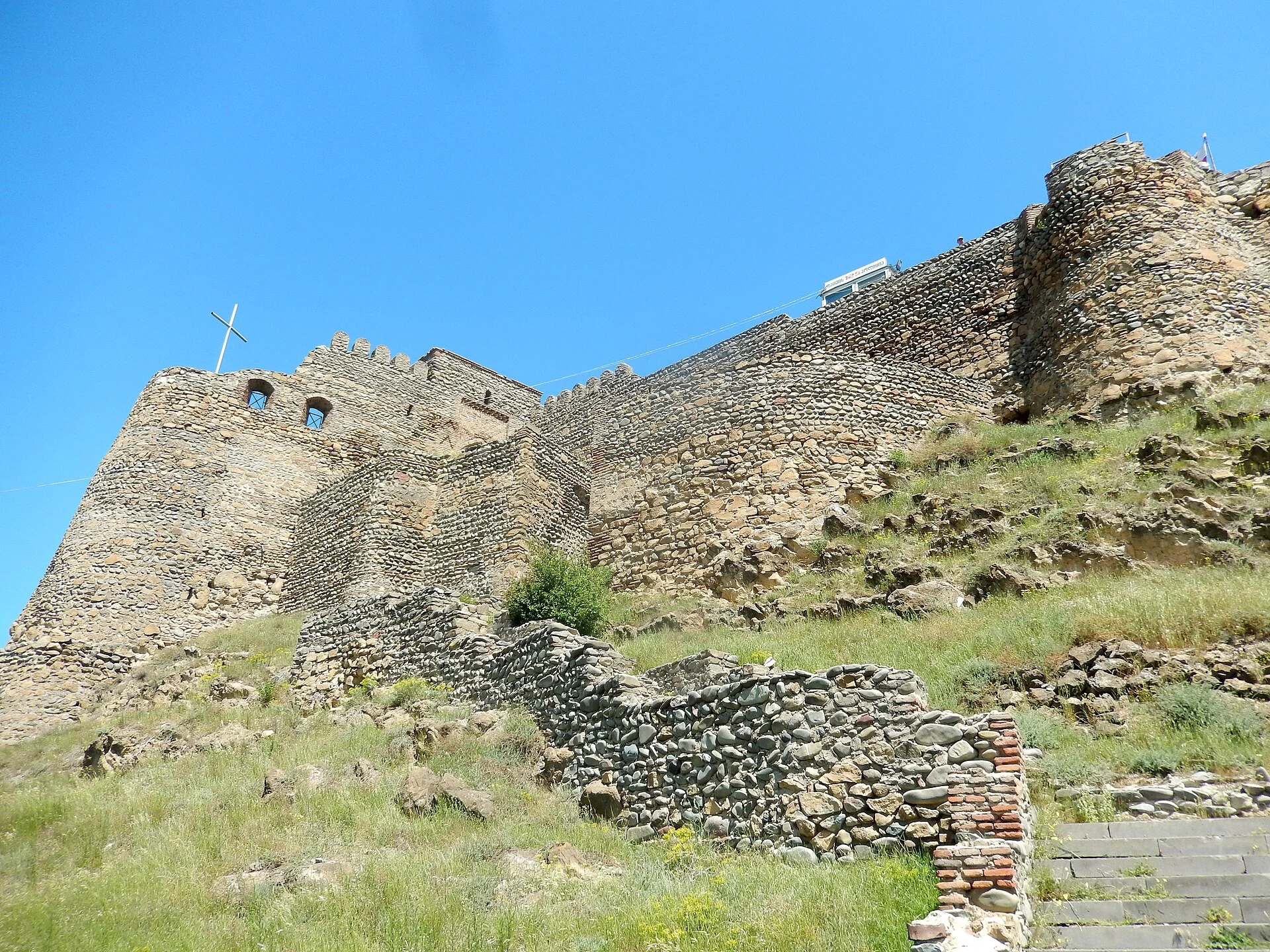
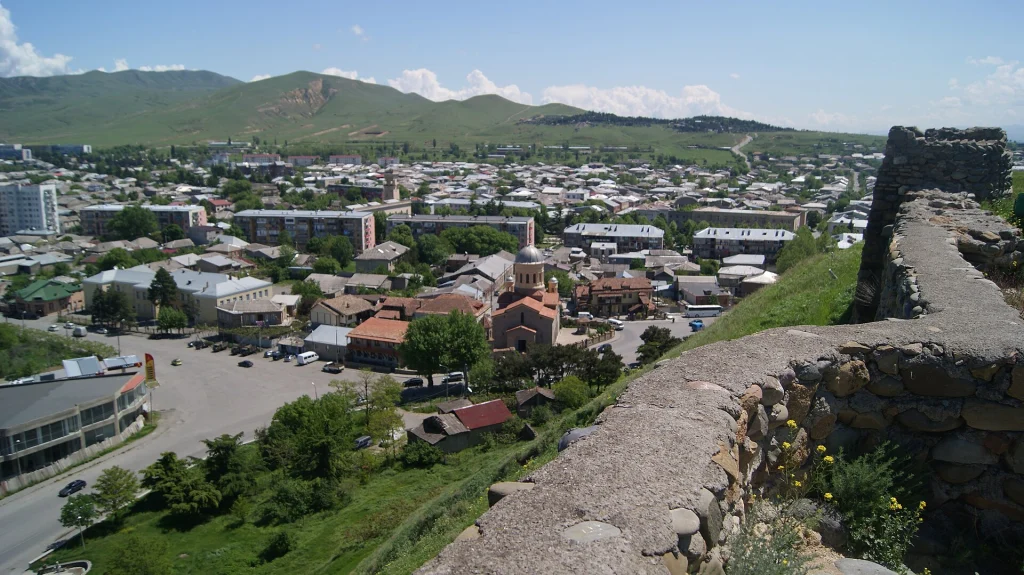
A historic Georgian fortress overlooking a Caucasus town, echoing the country's deep heritage. · Photo: Armineaghayan / Wikimedia Commons, CC BY-SA 4.0
Been to Georgia? Tell us how it went — the best stories are published here.
Share your tripOne email a week: what changed for travellers in Georgia — rules, roads, flights, seasons — plus one place worth the trip. Written by the GTour desk, no advertising, unsubscribe in one click.
This story across our partner network — ქართულად: შენი დასვენება
