

By David Kiknadze, Transport & Openings Reporter · 28/10/2026
Yes, citizens of Botswana can visit Georgia, but almost certainly not visa-free. Botswana does not appear on Georgia’s short list of nationalities with unconditional visa-free entry, so in most cases you will need to apply for an e-visa before you travel, through the official portal at evisa.gov.ge. There are no direct flights from Botswana, so expect at least one regional hop (commonly through Johannesburg) before joining a long-haul connection through Doha, Dubai or Istanbul into Tbilisi, Kutaisi or Batumi. The currency is the Georgian lari (GEL), cards work well in towns, and English gets you through most of the tourist circuit, though a guide or driver who speaks Georgian or Russian is genuinely useful once you leave the main routes.
This guide sets out what a traveller from Botswana needs to check, book and pack, and is honest about where the ties between the two countries are thin. Georgia and Botswana have no significant trade relationship, no resident diaspora of note, and no direct diplomatic representation in each other’s capital, so this is a practical guide for independent travellers rather than a story of old connections. Rules on visas, insurance and entry change without much notice, so every section below tells you exactly which official page to check before you book flights.
Visa and entry rules for Botswana citizens
Georgia operates three broad categories for foreign visitors: a short list of nationalities who enter visa-free, a longer list who can apply online for an e-visa, and everyone else who needs a visa through a Georgian consulate or embassy. As of October 2026, Botswana is not on Georgia’s visa-free list, which means an e-visa is the normal route for a tourist trip. Apply through evisa.gov.ge, where you upload your passport, a passport photo, proof of accommodation, and in many categories proof of travel medical insurance and sufficient funds. Processing is typically quoted at a few working days, though the portal itself gives the current service-level target and fee, which both change from time to time.
Because visa rules and fee categories are revised periodically and because an e-visa does not guarantee entry, confirm your category and required documents directly on evisa.gov.ge and the Ministry of Foreign Affairs consular pages at geoconsul.gov.ge before booking non-refundable flights. If your plan involves business meetings, study, or a stay beyond a short tourist visit, check the specific category on the same portal, since the tourist e-visa rules do not automatically extend to other purposes.
| Item | What to expect | Verify here |
|---|---|---|
| Visa requirement | E-visa normally required for Botswana passport holders | evisa.gov.ge |
| Processing time | Typically a few working days; apply well ahead of travel | evisa.gov.ge |
| Consular guidance | Categories, documents and current fees | geoconsul.gov.ge |
| Driving licence | Carry an International Driving Permit alongside your Botswana licence | matsne.gov.ge |
Getting there: flights and the usual connecting hubs
There is no direct flight between Botswana and Georgia, and none is likely to open given the size of the market. The realistic routing from Gaborone or Francistown is a regional flight to Johannesburg, followed by a long-haul leg to one of the hubs that serve Tbilisi directly: Doha, Dubai or Istanbul. From there, onward service reaches Tbilisi International Airport, and in some seasons Kutaisi or Batumi. Warsaw and Munich, which feature in some European nationality guides to Georgia, are not realistic connections from southern Africa and can usually be ignored when planning from Botswana.
- Doha: long-haul from Johannesburg, then a Gulf carrier onward to Tbilisi.
- Dubai: similar routing, with a wide choice of onward times to Tbilisi.
- Istanbul: often the easiest single-connection option onward from a Gulf or European leg, given Turkish Airlines’ dense Tbilisi schedule.
Expect a total journey of around 16 to 22 hours including the regional hop and layovers, so build in a buffer night if your connection is tight. Check live arrivals, terminal maps and current routes directly with the airports before you fly: tbilisiairport.com, kutaisiairport.com and batumiairport.com. If you land at Kutaisi or Batumi rather than Tbilisi, we run fixed-price private transfers between airports and the main cities, including Kutaisi Airport to Tbilisi and Batumi Airport Transfer.
Driving licence, money, cards and cash
Georgian law allows foreign driving licences to be used for a limited period, but recognition depends on which international conventions your home country has signed. We cannot confirm Botswana’s exact status under the relevant conventions as they apply in Georgia, so the safe approach is to carry an International Driving Permit alongside your Botswana licence for any car hire or self-drive plan, and to check current rules on matsne.gov.ge or with the rental company before you arrive. If you would rather not drive unfamiliar mountain roads on the wrong side of a long journey, a private car with an English-speaking driver removes the question entirely; see our Car with Driver by the Day.
The currency is the Georgian lari (GEL). On 28 October 2026 the National Bank of Georgia’s reference rate was approximately 2.596 GEL per US dollar and 2.894 GEL per euro; rates move daily, so check the live figure at nbg.gov.ge before you travel. Botswana pula is not a currency Georgian banks or exchange bureaux handle, so bring US dollars or euros in cash as a backup and plan to withdraw lari from ATMs or pay by card for most spending. Visa and Mastercard are accepted in hotels, restaurants and most shops in Tbilisi, Batumi and Kutaisi; smaller guesthouses in Svaneti, Tusheti or Khevsureti may be cash-only, so carry lari when heading into the mountains. Always ask to be charged in lari rather than your home currency if a card terminal offers a conversion, since the on-screen “home currency” rate is usually worse.
Connectivity: SIM and eSIM
Georgia has three main mobile operators, and prepaid SIM cards are sold at both Tbilisi and Batumi airports on arrival with a passport. Coverage is solid in cities and along the main highways, and patchier in remote valleys such as Tusheti, where you should not expect reliable data at all. If your phone supports eSIM, activating a Georgian or regional eSIM before departure saves time at the airport and keeps your Botswana number free for calls and verification codes. Hotel and guesthouse wifi is near-universal in towns.
Language, food, and what to expect day to day
Georgian is the official language, written in its own script, and Russian is still widely understood among older Georgians, particularly outside Tbilisi. English is used confidently in central Tbilisi, Batumi’s seafront, and at the main heritage sites, among younger staff, guides and hospitality workers, but it thins out quickly in villages and smaller towns. As an English-speaking visitor from Botswana, you will manage well on the standard tourist circuit; a licensed guide who can bridge Georgian, Russian and English is worth having for Svaneti, Tusheti, Khevsureti or any deep rural day trip, and our Licensed Private Guide by the Day covers exactly this.
Georgian food is meat-forward and shares some common ground with southern African cooking, built around grilled and stewed beef, lamb and pork, fresh bread, and strong hospitality rituals around the table. Khinkali (dumplings) and khachapuri (cheese bread) are the dishes every visitor tries; mtsvadi, skewered grilled meat, will feel familiar to anyone used to a braai. Vegetarian travellers are well served by bean stews (lobio), walnut-based pkhali, and fresh vegetables, which appear on nearly every menu. Halal food is not standard outside Muslim-majority areas such as parts of Adjara and Kvemo Kartli, so halal-observant travellers should ask ahead or confirm with restaurant staff in Tbilisi and Batumi, where some kitchens will prepare meat dishes without pork or alcohol on request. For a structured introduction, our Cooking Class in Tbilisi and Supra Evening with a Tamada both explain the etiquette of the table as you eat.
Ties between Georgia and Botswana, and your nearest embassy
We should be direct here: historical, trade and cultural ties between Georgia and Botswana are minimal. There is no meaningful trade flow in either direction, no established diaspora community, and no record of a sustained cultural exchange beyond occasional diplomatic contact at multilateral bodies such as the United Nations. This is not a connection-driven visit, and travellers from Botswana should plan this trip on its own merits as a mountain, wine and heritage destination rather than expecting shared history to shape the itinerary.
Neither country maintains a resident embassy in the other’s capital. Georgia has no embassy in Gaborone, and we are not aware of a Botswana embassy or honorary consulate in Tbilisi. In practice this means that in an emergency you should contact Botswana’s Ministry of International Affairs and Cooperation for guidance on which accredited mission (commonly one covering the wider region) can assist you, and separately check Georgia’s Ministry of Foreign Affairs at mfa.gov.ge for the list of foreign missions accredited to Georgia and any reciprocal arrangements that might apply to Commonwealth citizens. Register your trip with your own foreign ministry before departure, and keep both Georgian police (112) and your travel insurer’s emergency number saved on your phone.
Health, insurance, safety and etiquette
Georgia asks for proof of travel medical insurance valid for the duration of your stay as part of many e-visa applications; confirm the exact requirement for your category on evisa.gov.ge and geoconsul.gov.ge, since insurance thresholds and accepted providers can change. Buy a policy that covers mountain evacuation if you plan to hike in Svaneti, Tusheti or Khevsureti, as rescue in remote terrain is expensive and not automatically covered by basic travel plans. There are no mandatory vaccinations for entry from Botswana as of this writing, but check current health advisories with Georgia’s National Center for Disease Control at ncgh.ge and consult your own doctor or a travel health clinic before departure, particularly if you have pre-existing conditions or plan high-altitude trekking.
Georgia is, by regional standards, a safe destination for independent travellers, with low rates of violent crime against tourists. Standard precautions apply in markets and on night transport. Culturally, Georgians are warm and hospitality-focused; a toast at a supra (feast) is a genuine social institution, not a formality, and declining food or wine outright can read as impolite, though a polite “I don’t drink” is always respected. Dress modestly when visiting working churches and monasteries, Orthodox Christianity being the majority faith, and remove hats inside. Tipping 10 percent in restaurants is appreciated but not obligatory.
What a G Tour private guide adds
For a first visit from this far away, the value of a private guide is less about translation and more about turning a long-haul trip into efficient days. A licensed driver-guide builds a route around your flight times, handles the e-visa and insurance questions before you leave home, and knows which mountain roads need a 4×4 and which do not. Our Georgia Classic in 7 Days and Georgia Essentials in 3 Days are built for travellers arriving with limited time after a long connection, while Car with Driver by the Day and Licensed Private Guide by the Day let you build a looser, custom route. All our guides are licensed and briefed on current visa, insurance and road conditions, which matters most on a trip where the home-country information available to you is thin.
If this guide is part of a trip you are planning, our Tbilisi to Borjomi or Bakuriani Transfer and Mtskheta on Foot — the Ancient Capital in 2 Hours cover the places it describes with a private guide and driver; a GTour travel expert adapts the route to your dates.
Practical summary
- Apply for a Georgian e-visa in advance at evisa.gov.ge; confirm your exact category and documents at geoconsul.gov.ge.
- Plan a routing via Johannesburg, then Doha, Dubai or Istanbul; there are no direct flights and no realistic Warsaw or Munich connection from Botswana.
- Carry an International Driving Permit with your Botswana licence if you plan to drive; verify recognition rules before booking a rental.
- Bring US dollars or euros as backup cash; use GEL for daily spending and always pay in lari on card terminals.
- Buy a local SIM or activate an eSIM on arrival; expect weak coverage in Tusheti and remote valleys.
- English works in Tbilisi and Batumi’s tourist areas; book a guide for rural regions and for Georgian or Russian translation.
- There is no Botswana embassy in Georgia and no Georgian embassy in Botswana; check mfa.gov.ge and your own foreign ministry for emergency arrangements.
- Buy travel medical insurance that covers mountain evacuation and confirm current health advisories at ncgh.ge before you fly.
Sources
- Georgia e-visa portal
- Consular services and visa categories
- Ministry of Foreign Affairs, foreign missions
- National Bank of Georgia exchange rates
- Georgian legislative database, driving and transport rules
Questions this guide does not answer? Write to info@castle.ge or WhatsApp +995 577 41 63 14 — a person in Tbilisi replies. See also our travel services and all guides.
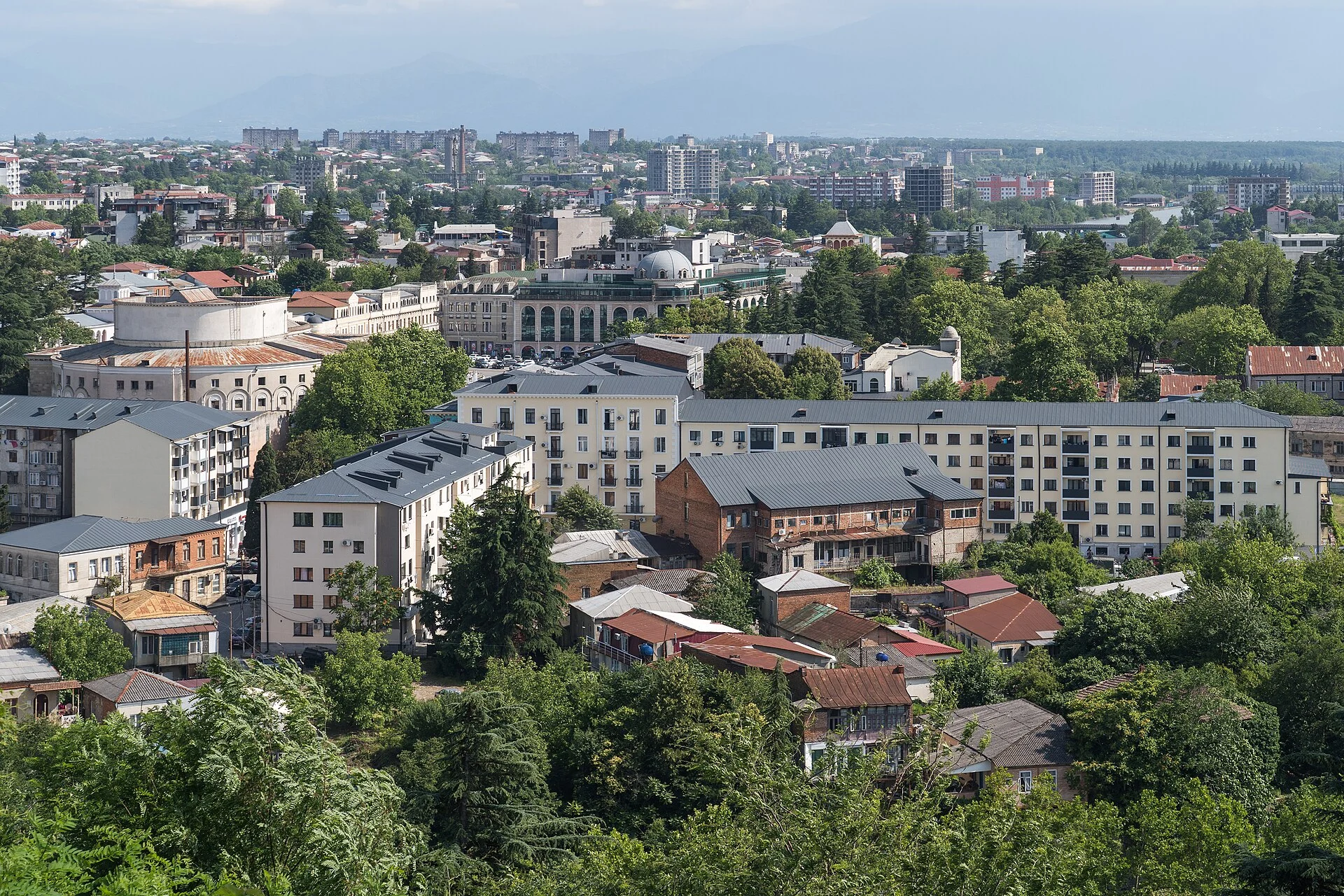
View of Kutaisi, a major city in Georgia that travellers may visit. · Photo: Alexkom000 / Wikimedia Commons, CC BY 4.0
Been to Georgia? Tell us how it went — the best stories are published here.
Share your tripOne email a week: what changed for travellers in Georgia — rules, roads, flights, seasons — plus one place worth the trip. Written by the GTour desk, no advertising, unsubscribe in one click.
This story across our partner network — ქართულად: შენი დასვენება
