

By Nino Gelashvili, Travel News Editor · 28/10/2026
Georgia does not currently appear on Benin’s short list of familiar destinations, and travellers from Cotonou or Porto-Novo will find no direct flight, no Beninese embassy, and only a handful of previous visitors to ask for advice. That does not make the trip impractical. Georgia is a straightforward, safe, mid-cost destination reachable in one stop from West Africa, and the practical questions, visa, money, connectivity, food, and what to expect culturally, all have clear, checkable answers.
In short: Beninese citizens should expect to apply for a Georgian visa in advance (Georgia’s visa-free list is short and changes, so verify before booking), fly via Istanbul or Doha, carry euros or dollars to convert locally since the Benin CFA franc is not exchanged in Georgia, and budget for one of Africa’s and Europe’s most useful shared facts, that Georgian hospitality runs on food, wine and toasts in a way that may feel more familiar to a West African guest than to a northern European one.
Visa and entry rules for citizens of Benin
Georgia’s visa policy is set out country by country and reviewed periodically, so what is true today, 28 October 2026, can change. Benin is not on Georgia’s list of nationalities exempt from visas, so Beninese citizens should plan to apply for either an ordinary visa through a Georgian diplomatic mission or, where available, Georgia’s electronic visa. The official e-visa portal is evisa.gov.ge, where applicants select their nationality to see the current category, required documents (passport valid well beyond the stay, a return ticket, proof of funds, and increasingly a travel insurance certificate), and the processing time, typically stated as a few working days but worth allowing longer around holidays. Because Georgia has no embassy in Benin, applications usually route through the nearest accredited Georgian mission or the e-visa system entirely online. Before booking flights, check the current rule on the Ministry of Foreign Affairs consular pages at mfa.gov.ge and the e-visa portal directly, since visa categories, fees and the list of exempt countries are updated by government decree and a guide like this one cannot guarantee next year’s rule.
Flights from Benin: routes and connecting hubs
There is no direct flight between Benin and Georgia, and none is likely in the near term given the thin traffic between the two countries. The practical routing from Cotonou’s Cardinal Bernardin Gantin Airport is one stop in a major hub, most commonly Istanbul, where Turkish Airlines connects a wide network of West African cities to Tbilisi several times a day, or Doha, where Qatar Airways links Cotonou to Georgia via its Hamad hub. Both routings typically run 10 to 16 hours door to door depending on the layover, and both airlines have a strong track record on this corridor. A Dubai connection on Emirates or flydubai is sometimes available depending on the season and Cotonou’s schedule, but it is not a year-round fixture, so check the specific flight dates rather than assuming it. Always verify the current schedule and any transit visa needs for the hub country before ticketing, and confirm your Georgian arrival airport, Tbilisi International or Batumi, matches your transfer booking; see tbilisiairport.com and batumiairport.com for live arrivals.

Driving licence, money, cards and cash
Georgia generally recognises foreign driving licences issued under the 1968 Vienna Convention on Road Traffic for a limited period after arrival, after which a local or international document is required to continue driving. Benin’s domestic driving rules and whether it is a party to the same convention vary in interpretation, so Beninese travellers planning to self-drive should carry an International Driving Permit alongside their national licence and check current recognition rules with the Georgian Road Department at georoad.gov.ge before renting a car, or avoid the question entirely with a car and driver service.
The local currency is the Georgian lari (GEL), not the West African CFA franc, so euros or US dollars are the easiest currencies to carry and exchange at licensed bureaux in Tbilisi, Batumi or Kutaisi; CFA francs cannot be exchanged inside Georgia. On 27 October 2026 the National Bank of Georgia’s reference rate was approximately 2.91 GEL to the euro and 2.60 GEL to the US dollar, though rates move daily and only the bank’s own published rate should be used for exact conversions. Visa and Mastercard are accepted in hotels, restaurants and most shops in cities, and ATMs are common; smaller guesthouses, mountain villages and market stalls expect cash, so keep a reserve of lari for Svaneti, Tusheti or rural Kakheti.
| Item | Typical approach |
|---|---|
| Currency | Carry EUR or USD cash, convert to GEL on arrival |
| Cards | Visa/Mastercard widely accepted in cities; cash needed in villages |
| Driving | Bring an International Driving Permit; check georoad.gov.ge before renting |
| Flights | One stop via Istanbul or Doha; check Dubai seasonally |
SIM cards, eSIM and language
Prepaid SIM cards from Magticom, Geocell or Beeline are sold at both Tbilisi and Batumi airports with a passport, and data packages are inexpensive by regional standards; eSIM options from international providers also work on Georgian networks for travellers who prefer to activate before landing. Mobile coverage is reliable in cities and along the main highways, with gaps expected in remote mountain areas such as Tusheti and upper Svaneti.
Georgian is the official language and the one used on road signs, menus and official documents, with Russian still understood by older generations and English increasingly common among younger staff in hotels, tour operations and Tbilisi’s restaurant scene. French, Benin’s official language, is not widely spoken outside a small number of French-speaking guides and some hospitality staff who have worked in francophone markets, so Beninese travellers relying on French alone should expect a real gap in everyday interactions, bridged by translation apps, a bilingual guide, or simple English and gestures. Hiring a guide who works in French removes this friction entirely; GTour’s Licensed Private Guide by the Day service lists French among its working languages.

Embassy and consular coverage
Georgia has no resident embassy in Benin and Benin has no resident embassy in Georgia, so consular support for Beninese citizens travelling in Georgia is handled through Benin’s nearest accredited mission to the region, which travellers should confirm directly with Benin’s own foreign ministry before departure, since accreditation arrangements change. On the Georgian side, the Ministry of Foreign Affairs maintains the current list of which country’s consular section covers routine assistance when no resident embassy exists, published at mfa.gov.ge; check this page, and register your trip with your own country’s relevant mission, before relying on any specific address or phone number, since none can be stated here with certainty.
Food and dietary notes
Georgian food centres on bread, cheese, walnuts, fresh herbs and grilled or stewed meat, with khachapuri (cheese-filled bread), khinkali (dumplings, usually pork and beef or a mushroom and cheese version) and mtsvadi (skewered grilled meat, commonly pork or chicken) forming the core of most menus. Travellers keeping halal should ask specifically for chicken or beef mtsvadi and avoid khinkali unless the filling is confirmed, since pork appears often and without separate labelling on many menus; dedicated halal restaurants exist in Tbilisi but are not yet common elsewhere. Vegetarians generally eat well thanks to Georgia’s long Orthodox fasting tradition, which produced an entire category of meat-free dishes, lobio (bean stew), pkhali (vegetable and walnut pâté), badrijani (aubergine rolls) and mushroom khinkali among them. Georgian cuisine’s heavy use of chilli, garlic, walnut sauces and grilled meat gives it more in common with West African cooking than with northern European food, which many Beninese visitors find a pleasant and fairly quick adjustment. A supra, the long Georgian feast led by a toastmaster, is worth experiencing with a guide who can explain the customs; GTour’s Supra Evening and Cooking Class in Tbilisi both introduce the format without requiring fluent Georgian.
Georgia and Benin: ties, honestly assessed
There is little to report here, and it is more useful to say so plainly than to inflate it. Georgia and Benin maintain normal diplomatic relations at the multilateral level through the United Nations, but neither country has opened a resident embassy in the other, bilateral trade is marginal and not separately tracked in Georgia’s published trade statistics, and there is no established Beninese diaspora community in Georgia or Georgian community in Benin of any meaningful size. Georgia’s national statistics office publishes visitor arrivals by country of citizenship at geostat.ge, and Benin typically falls into a small “other countries” grouping rather than appearing as a distinct, tracked market, confirming that this remains a route for individual travellers rather than an established corridor. Travellers from Benin should expect genuine curiosity rather than familiarity, and should not assume any shared institutional, religious or linguistic infrastructure beyond what is described in this guide.
Health, insurance, seasons, safety and etiquette
Georgia has required visitors to show proof of travel medical insurance for entry or visa approval in recent years, and this requirement is reviewed periodically by the government, so confirm the current rule on the e-visa portal and through Georgia’s National Center for Disease Control and Public Health at ncgh.ge before travelling, and buy a policy that explicitly covers the dates and activities of your trip, including mountain hiking if planned. Separately, because Benin is classified by the World Health Organization as a country with risk of yellow fever transmission, some countries along a multi-stop itinerary may require proof of yellow fever vaccination from travellers arriving from Benin even where Georgia itself does not; check both Georgia’s current entry requirement and any transit country’s rule well ahead of departure, and discuss vaccination timing (usually at least ten days before travel) with a doctor or travel health clinic rather than relying on this guide for a personal medical decision.
Georgian spring (May to June) and autumn (September to October) offer the most comfortable travel weather and coincide with the Kakheti wine harvest, while July and August suit the mountains and the Black Sea coast and winter suits skiing in Gudauri or Bakuriani; there is no particular Beninese holiday calendar that aligns with Georgian peak season, so booking is more about weather and festivals than shared public holidays. Georgia is a low-crime destination by regional standards, and ordinary street caution applies; dress modestly and cover shoulders and knees when entering Orthodox churches and monasteries, accept that a toast at a supra is a genuine social institution rather than decoration, and expect that being a rare visiting nationality may draw friendly questions rather than any difficulty.
What a G Tour private guide adds
For a nationality with no established tourism infrastructure between the two countries, a private guide closes the gaps that generic online advice cannot: confirming the latest visa and insurance rule before you fly, arranging a French-speaking Licensed Private Guide by the Day where English alone would be a strain, booking a Tbilisi Airport Transfer so the first hour in an unfamiliar country is handled, and steering food choices for anyone keeping halal or avoiding pork without guesswork at the table. For a first trip, the Georgia Essentials in 3 Days or Tbilisi in a Day itineraries give a reliable, well-supported introduction before deciding whether to extend into Kakheti wine country or the mountains.
If this guide is part of a trip you are planning, our Tbilisi to Borjomi or Bakuriani Transfer and Mtskheta on Foot — the Ancient Capital in 2 Hours cover the places it describes with a private guide and driver; a GTour travel expert adapts the route to your dates.
Practical summary
- Check Georgia’s current visa requirement for Benin on evisa.gov.ge and mfa.gov.ge before booking, since the exempt-country list changes.
- Fly via Istanbul or Doha; no direct route exists and Dubai service is seasonal, so verify the specific flight date.
- Carry euros or US dollars to exchange for lari; CFA francs are not exchangeable in Georgia.
- Bring an International Driving Permit if self-driving, and confirm recognition rules with georoad.gov.ge.
- Buy SIM or eSIM data on arrival; expect English in tourist areas but little French outside guided services.
- Confirm the mandatory travel insurance rule and, separately, any yellow fever certificate requirement with a doctor and ncgh.ge.
- Expect genuine curiosity rather than established ties; book a French- or English-speaking private guide to bridge language and customs.
Sources
- Georgia e-Visa portal
- Ministry of Foreign Affairs of Georgia
- Georgian Road Department
- National Statistics Office of Georgia
- MFA Georgia – Consular Services
- Georgia National Tourism Administration – Travel Site
- Georgian Railway Official Site
Questions this guide does not answer? Write to info@castle.ge or WhatsApp +995 577 41 63 14 — a person in Tbilisi replies. See also our travel services and all guides.
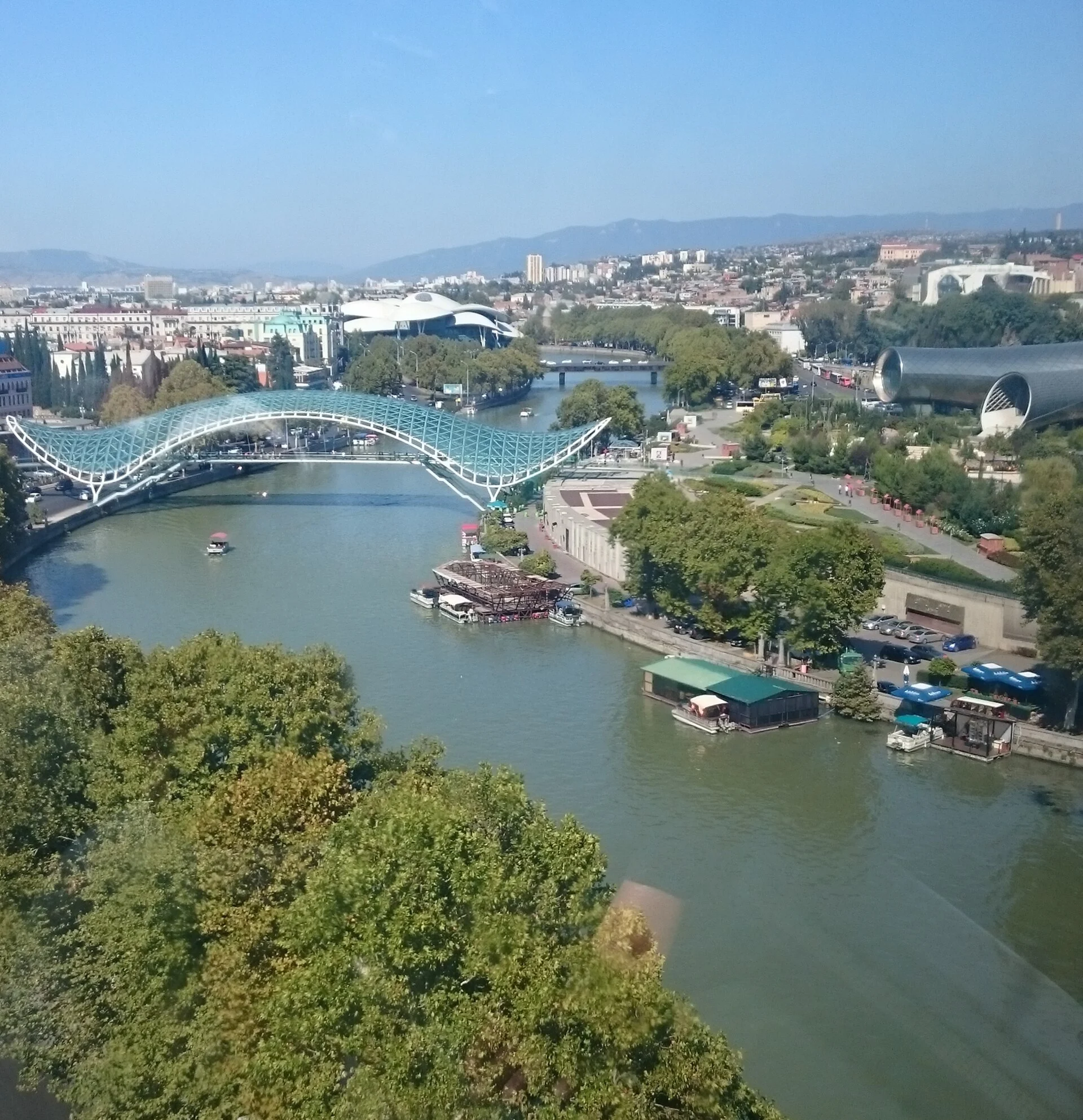
The Bridge of Peace and Mtkvari River, a landmark sight for first-time visitors to Tbilisi. · Photo: BBCLCD / Wikimedia Commons, CC BY-SA 4.0
Been to Georgia? Tell us how it went — the best stories are published here.
Share your tripOne email a week: what changed for travellers in Georgia — rules, roads, flights, seasons — plus one place worth the trip. Written by the GTour desk, no advertising, unsubscribe in one click.
This story across our partner network — ქართულად: შენი დასვენება