

By Mariam Lomidze, Culture & Events Reporter · 27/10/2026
If you have a genuine emergency anywhere in Georgia, dial 112. The operator will connect you to police, ambulance or fire services and, in the main tourist areas, usually has English-speaking staff available; if not, ask for an interpreter and one will be found within the call. For passport loss, the short version is: file a police report first, then contact your embassy or, if your country has no mission in Georgia, the Public Service Hall can issue a document allowing exit in some cases, though an embassy-issued emergency travel document is the normal route.
This guide sets out, in one place, the numbers and procedures that matter most to visitors: how 112 works in practice, where to find tourist police in Tbilisi and Batumi, which hospitals and pharmacies are commonly used by foreigners, how to reach your embassy, what to do after a car accident, and how mountain rescue works in Kazbegi, Svaneti and Tusheti. Rules and contact details are updated by the relevant Georgian agencies from time to time, so each section links to the official page to check before you travel rather than relying on a number printed here.
112: the single emergency number
Georgia operates one national emergency number, 112, for police, ambulance and fire brigade, free of charge from any mobile or landline, including with no local SIM card and with the phone locked, in the same way as 999 or 911 operate elsewhere. The service is run by the Ministry of Internal Affairs and is the correct first call for a medical emergency, a crime in progress, a road accident with injuries, a fire, or a person missing in the mountains.
- State clearly: your location (the nearest landmark, street name or GPS coordinates if you have them), the nature of the emergency, and the number of people involved.
- English is spoken by 112 operators in most cases in Tbilisi, Batumi, Kutaisi and the main tourist regions; in remote areas you may be connected to an interpreter, which takes a little longer, so stay on the line.
- Save 112 in your phone before you travel and tell your driver or guide you have done so.
Tourist police in Tbilisi and Batumi
Georgia created a dedicated tourist police unit within the Ministry of Internal Affairs to handle the kinds of problems visitors actually face: overcharging by taxis, disputes with vendors, lost property, and minor harassment, as well as acting as a first point of contact if you need help filing a report in English. In practice you reach tourist police the same way as any other police response, through 112, and ask the operator for the tourist police specifically; in central Tbilisi (Old Town, Rustaveli Avenue, Freedom Square) and along the Batumi seafront and boulevard, officers are also visible on patrol and can be approached directly. There is no separate phone number to memorise beyond 112, and claims of a dedicated tourist hotline should be checked against the current Ministry of Internal Affairs guidance rather than assumed, since staffing and locations change.
Hospitals used by foreign visitors
Tbilisi has several private multi-profile hospitals and clinics with English-speaking staff that are routinely used by foreign residents and visitors, alongside the public hospital network. Batumi and Kutaisi have smaller but functioning private clinics; in rural regions (Svaneti, Tusheti, Racha) medical facilities are basic, and serious cases are stabilised locally and transferred by road or, if necessary, by helicopter to Tbilisi.
| City | What to expect | Notes |
|---|---|---|
| Tbilisi | Several private hospitals with 24-hour emergency departments and English-speaking doctors | Most accept direct payment and provide invoices for travel insurance claims; confirm your insurer’s cashless network before you travel |
| Batumi | Private clinics and the regional hospital handle most tourist cases | Serious trauma or specialist surgery is often referred to Tbilisi |
| Kutaisi | Regional hospital plus smaller private clinics | Useful as a base for Imereti and Svaneti-bound travellers |
| Mountain regions (Kazbegi, Mestia, Tusheti) | Basic first-aid points and small local hospitals | Emergency evacuation can take hours; see the mountain rescue section below |
Call 112 for an ambulance in an emergency, or ask your guesthouse, hotel or driver to take you directly to the nearest hospital’s emergency department for anything short of life-threatening. Keep all receipts and ask for a written diagnosis for your insurer.
24-hour pharmacies
Georgia has an extensive pharmacy network, and the main chains (GPC, PSP and Aversi, among others) run branches around the clock in Tbilisi, Batumi and Kutaisi, identifiable by green cross signage, as is common across Europe. Staff in central branches in Tbilisi and Batumi generally speak some English, though pharmacies in smaller towns may not. Many common medicines, including some that require a prescription in other countries, are sold over the counter, but bring a copy of any prescription for controlled or specialist medication, and carry enough of your regular medicine for the full trip since not every brand is stocked locally.
Embassies and consulates: what to expect
Most embassies and consulates accredited to Georgia are based in Tbilisi, with a small number of honorary consulates elsewhere, including in Batumi. Addresses, phone numbers and opening hours change periodically and are not reliable to print in a static guide, so the only sure method is to check the current, official list of diplomatic missions maintained by Georgia’s Ministry of Foreign Affairs, and separately your own country’s travel advice page, before and during your trip.
- If you lose a non-Georgian document, your own embassy or consulate, not a Georgian authority, issues the replacement or emergency travel document.
- If your country has no mission in Georgia, check whether your government has a regional embassy (commonly in Ankara, Yerevan or Moscow) handling Georgia, or whether a third country provides consular assistance to your nationals under a formal arrangement; this is listed on your government’s own travel advice site.
- Keep your embassy’s emergency number saved before travelling; most operate a 24-hour duty line for citizens in genuine distress, separate from routine office hours.
Georgia’s own Ministry of Foreign Affairs publishes the current roster of foreign missions, consular hours and contact details on its diplomatic missions page, which is the correct reference rather than any list reproduced elsewhere.
Lost or stolen passport: step by step
- Report to the police first. Go to the nearest police station or call 112 to file a loss or theft report; ask for a written confirmation or reference number, since most embassies require this to issue a replacement document.
- Contact your embassy or consulate. Explain the situation and ask what emergency travel document or replacement passport process applies to your nationality; procedures, fees and required photographs differ by country, so follow your embassy’s instructions exactly.
- Check your onward travel documents. If you entered on a visa or under Georgia’s electronic entry system, ask your embassy whether the replacement passport needs a new entry stamp, transit letter or matching visa reissued through the relevant portal.
- Keep copies in advance. A photo or scan of your passport’s data page, stored in cloud storage or emailed to yourself before you travel, substantially speeds up every one of the above steps.
- Allow time. Emergency travel documents can usually be issued within one to a few working days depending on your embassy’s capacity and whether consular staff are present in Tbilisi full-time; budget extra days if your mission is a smaller honorary consulate or located outside Georgia.
Car accident procedure
If anyone is injured, call 112 immediately and do not move the vehicles until police and, if needed, an ambulance arrive. For accidents without injury and only vehicle damage, Georgian practice (as in much of Europe) still generally expects you to call 112 or the patrol police, since insurance claims and any dispute over fault usually require an official police protocol. Move vehicles to the hard shoulder only if it is safe to do so and local practice allows it, and use hazard lights and a warning triangle if you have one.
- Exchange details with the other driver: name, licence, vehicle registration, and insurance information if available.
- Photograph the vehicles, positions, damage, and any road signs or skid marks before anything is moved.
- If you rented the car, call the rental company’s helpline immediately, since most agreements specify how accidents must be reported and will void cover if you do not follow the stated procedure.
- Mountain roads such as the Jvari Pass towards Kazbegi or routes into Svaneti and Tusheti close in poor weather; check current conditions before departure through the Georgian Road Department’s status page, and see GTour’s own road status page for a plain-language summary before any mountain trip.
Mountain rescue and remote emergencies
Mountain regions popular with visitors, including Kazbegi, Svaneti and Tusheti, have limited mobile coverage, basic medical facilities and long response times by road, so prevention matters more than anywhere else in the country. Rescue in these areas is coordinated through 112, which dispatches Emergency Management Service teams, and in genuinely remote terrain evacuation may rely on ground teams rather than helicopter, depending on weather and location.
- Tell your guesthouse host or guide your planned route and expected return time before setting out, even on a short walk; this is the single most useful thing hikers routinely skip.
- Carry a paper map or an offline map on your phone, since data coverage disappears quickly off the main roads in Tusheti and much of upper Svaneti.
- If travelling independently in Tusheti, Svaneti or other high routes, a certified local or mountain guide materially reduces risk and knows the nearest points with reception.
- In a real emergency in the mountains, call 112 as soon as you have any signal, state your last known landmark or GPS coordinates, and stay where you are unless moving to known shelter is clearly safer.
Travellers wanting a guided route through these regions, with a driver and licensed guide who know local conditions, can see GTour’s Kazbegi, Mestia and Ushguli, and Tusheti itineraries for options that build in local knowledge and realistic timings rather than treating mountain roads as ordinary highways.
If this guide is part of a trip you are planning, our Adjara Highlands by 4×4 — Beshumi, Goderdzi and the Alpine Villages, 2 Days and Western Georgia in 5 Days — Kutaisi, Canyons, Svaneti and Batumi cover the places it describes with a private guide and driver; a GTour travel expert adapts the route to your dates.
Practical summary
- Save 112 in your phone before arrival; it covers police, ambulance and fire across all of Georgia, free of charge.
- Ask 112 specifically for tourist police if your issue is a tourist-related dispute, overcharging or lost property in Tbilisi or Batumi.
- For medical emergencies, call 112 for an ambulance; for non-urgent care, go to a private hospital emergency department in Tbilisi, Batumi or Kutaisi and keep all paperwork for your insurer.
- 24-hour pharmacies (GPC, PSP, Aversi and others) operate in all major cities; bring prescriptions and extra supply of regular medication for remote regions.
- Check your embassy’s current Tbilisi address and emergency line on Georgia’s Ministry of Foreign Affairs diplomatic missions list before you travel, not from a static printed source.
- Lost passport: police report first, then your embassy; keep a digital copy of your passport’s data page from before departure.
- After a car accident, call 112, do not move vehicles if anyone is injured, photograph everything, and follow your rental company’s reporting procedure.
- In the mountains, tell someone your route and return time, carry offline maps, and consider a certified guide for Tusheti, Svaneti and other high routes.
Sources
- Entry rules and electronic visa information
- Road conditions and pass closures
- Tourism administration visitor information
- Tbilisi City Hall – Tourist Information Centers
Questions this guide does not answer? Write to info@castle.ge or WhatsApp +995 577 41 63 14 — a person in Tbilisi replies. See also our travel services and all guides.
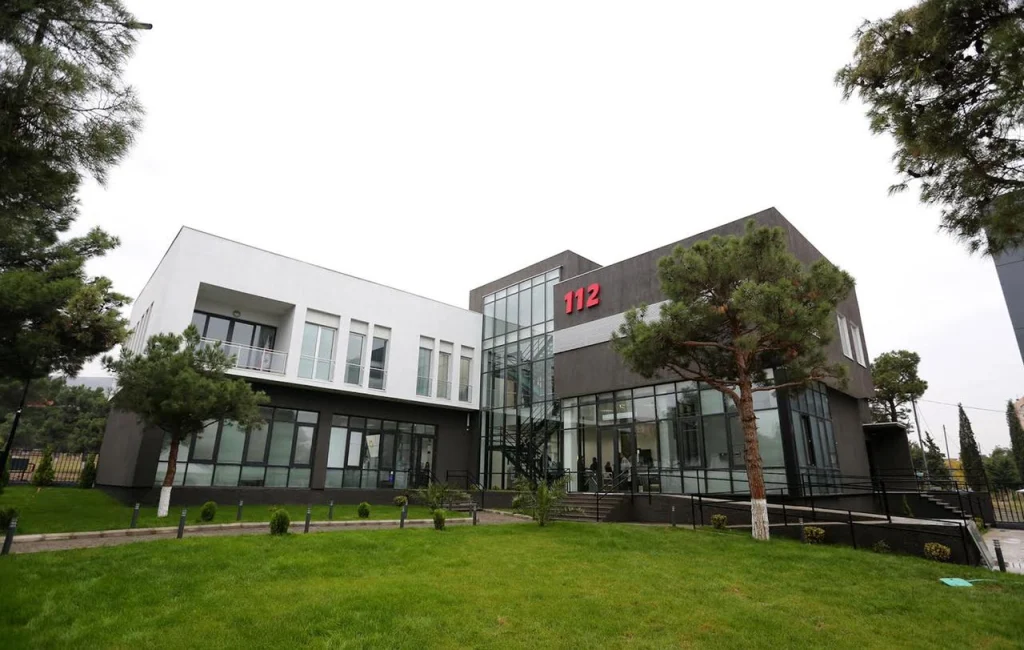
The 112 Emergency and Operative Response Center building in Tbilisi, Georgia. · Photo: Malkhaz Tchubabria / Wikimedia Commons, CC BY-SA 4.0
Been to Georgia? Tell us how it went — the best stories are published here.
Share your tripOne email a week: what changed for travellers in Georgia — rules, roads, flights, seasons — plus one place worth the trip. Written by the GTour desk, no advertising, unsubscribe in one click.
This story across our partner network — ქართულად: შენი დასვენება