

By Mariam Lomidze, Culture & Events Reporter · 29/10/2026
The short answer: Georgia’s wildflower season runs from April in the lowland forests to late August in the high Caucasus, with three distinct peaks. Rhododendron slopes in Adjara and Racha flower from late May into June; Javakheti‘s volcanic steppe is at its best from June through August; and true alpine meadows above 2,200 metres in Tusheti, Svaneti and Kazbegi peak in July. Autumn brings a second, quieter show as beech and chestnut forests in Lagodekhi, Borjomi-Kharagauli and Svaneti turn colour through October.
Because Georgia packs five climate zones into a small country — humid subtropical on the Black Sea coast, semi-desert in the southeast, and alpine tundra above 3,000 metres — no single month or valley gives you everything. This guide sets out where to go and when, names the plants worth knowing, and flags where to double-check current conditions before you travel, since snowmelt and rainfall shift bloom dates by two to three weeks from year to year.
Month by month: a working calendar
| Month | What is flowering | Where |
|---|---|---|
| April–May | Forest floor bulbs, primroses, early orchids | Lagodekhi lower trails, Mtirala rainforest, Kolkheti lowlands |
| Late May–June | Rhododendron luteum (yellow azalea) and early Rhododendron caucasicum | Goderdzi Pass, Beshumi, Bakhmaro approach, Racha ridgelines |
| June–July | Subalpine meadows, gentians, anemones, early steppe bloom | Javakheti plateau, Borjomi-Kharagauli high trails, Kazbegi lower slopes |
| July | Peak alpine meadow, Caucasus endemics at altitude | Tusheti, Svaneti (Koruldi, Chalaadi), Juta and the Abudelauri lakes |
| July–August | Steppe wildflowers at full density, wetland margins | Javakheti lakes (Paravani, Khanchali, Madatapa), Samtskhe plateau |
| September | Late composites, crocus, meadow saffron | Lagodekhi upper zone, Borjomi-Kharagauli, Tusheti before snow |
| October | Autumn forest colour, not flowers | Lagodekhi, Borjomi-Kharagauli, Svaneti valleys, Mtirala |
Treat these as working dates, not guarantees. Altitude, aspect and the previous winter’s snowpack all shift timing, and a wet or dry spring can move the Javakheti steppe bloom by weeks either way. For road and trail conditions before a mountain trip, check the current status pages at gtour.ge/road-status and the national park pages below.
The rhododendron slopes of June
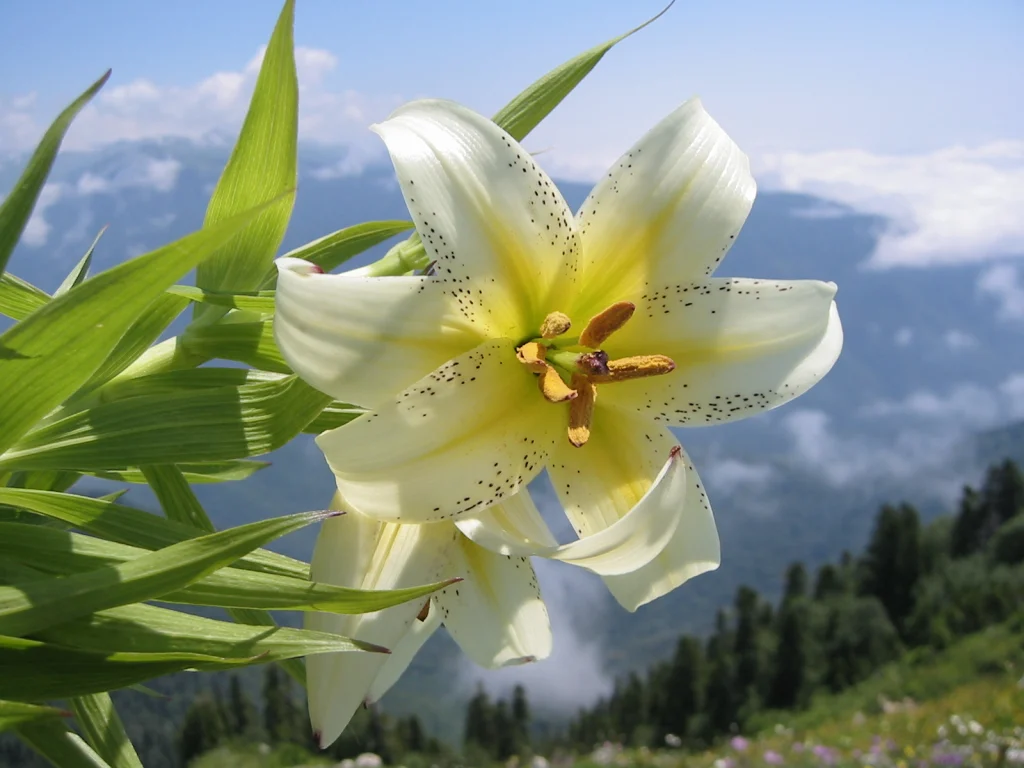
Adjara’s highlands, inland from Batumi, carry the country’s most reliable rhododendron display. The road up to the Goderdzi Pass and the villages around Beshumi pass through yellow azalea (Rhododendron luteum) in late May, giving way to the pink-flowered Caucasian rhododendron (Rhododendron caucasicum) on the exposed ridges above 1,800 metres through June. The display is weather-dependent and can run a week or two earlier on south-facing slopes. Our Adjara Highlands — Khulo, the Goderdzi Pass and the Green Lake day trip and the two-day Adjara Highlands by 4×4 — Beshumi, Goderdzi and the Alpine Villages both time their mountain legs for this window.
A second, less-visited rhododendron belt sits above Racha and Lechkhumi, reachable on the Racha and Lechkhumi by 4×4 three-day trip, with sparser crowds and similar timing. Mtirala National Park, closer to Batumi, flowers earlier in spring and favours the humid-forest species rather than open-slope rhododendron; it pairs well with a half day at the Batumi Botanical Garden on the same trip, covered on our Mtirala Rainforest and the Chakvi Tea Plantations day and Gonio Fortress, Sarpi and the Batumi Botanical Garden tour.
Javakheti’s volcanic steppe
South of Borjomi, the Javakheti plateau is a different ecosystem entirely: a treeless, wind-exposed volcanic highland above 2,000 metres, dotted with crater lakes and seasonal wetlands that are internationally recognised wetland sites under the Ramsar Convention. Here the flora is steppe and alpine-meadow species rather than forest understorey — feather grass, pasque flowers, wild tulips in late spring, then a denser carpet of composites and legumes through July and August as the lake margins dry out. The protected landscape falls under Georgia’s Agency of Protected Areas, whose Javakheti sites are worth checking for current access rules before a visit, since parts of the plateau sit close to a border zone with seasonal permit requirements.
Javakheti does not currently sit on our fixed itineraries list, so the practical way to see it is to combine it with a Borjomi stay and a private car and driver for the day, arranged through our car with driver service, or to ask a licensed guide with steppe-botany experience to build a custom day from Akhaltsikhe or Borjomi.
Lagodekhi’s forest understorey
Lagodekhi Protected Areas, on the Dagestan border in eastern Kakheti, holds one of the largest unbroken stretches of Caucasus forest left in the country, rising from Colchic-influenced broadleaf woodland at the gate to subalpine and alpine meadows above the treeline near Black Rock Lake. The lower trails flower earliest, with spring ephemerals and orchids from April; the walk up toward the lake crosses into true alpine meadow by midsummer, with gentians, campanulas and buttercups typical of Caucasus high pasture. September brings crocus and meadow saffron as the first frosts approach, and by October the beech canopy itself is the attraction.
Lagodekhi is a two-to-three day undertaking if you want to reach the alpine zone and come back comfortably. We run it as the Black Rock Lake Trek — 2 Days in Lagodekhi, the longer Lagodekhi — Black Rock Lake Trek, 3 Days on the Dagestan Border, and as a single long day combined with Kakheti’s wineries on the Eastern Kakheti — Nekresi, Gremi, Kvareli and the Lagodekhi Forest trip for travellers who only want the lower forest.
Endemic and notable species
The Caucasus is recognised as a global biodiversity hotspot, and Georgia’s share of that flora includes a meaningful number of narrow endemics found nowhere else. Identification in the field is genuinely difficult even for experienced botanists, and we would rather name the uncertainty than overstate it: the list below gives commonly cited examples and where they are usually reported, not a guarantee of what you will find on any given day.
| Plant | Typical habitat | Usual bloom window |
|---|---|---|
| Rhododendron caucasicum | Subalpine and alpine slopes, Adjara, Racha, Kazbegi | June–July |
| Rhododendron luteum (azalea) | Forest edge and open slope, Adjara, Guria | Late May–June |
| Rhododendron ungernii | Colchic forest understorey, Adjara, Guria | June |
| Primula species (Caucasian primroses) | Damp alpine meadow, Svaneti, Tusheti | June–July |
| Gentiana species | High pasture above 2,200 m | July–August |
| Pulsatilla (pasque flower) | Javakheti steppe, exposed alpine turf | May–June |
| Colchicum (meadow saffron) | Forest clearings, Lagodekhi, Borjomi-Kharagauli | September |
Collecting plants inside national parks and protected landscapes is restricted; stay on marked trails, and if a species matters to your trip, ask a licensed naturalist guide to confirm it rather than relying on a phone app.
Autumn colour as a second season
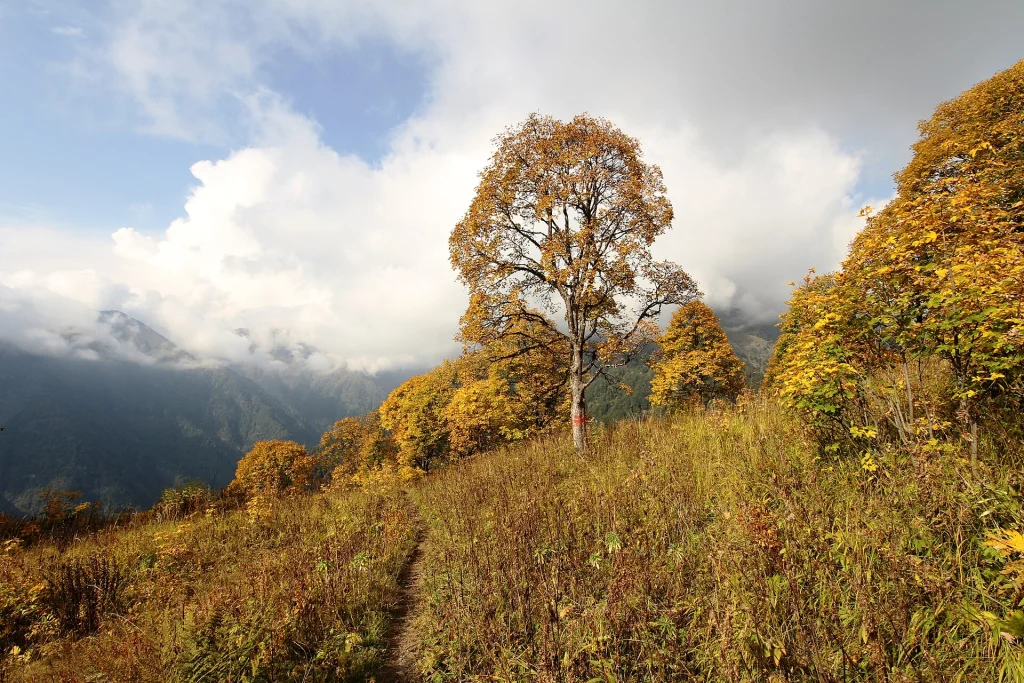
Once the alpine flowers are over, Georgia’s forests give a distinct second show. Beech, oak, hornbeam and the wild chestnut understorey in Lagodekhi, Borjomi-Kharagauli and the lower Svaneti valleys turn through late September and October, usually peaking in the second half of October at low and mid elevation, a week or two earlier above 1,500 metres. This is a comfortable season for walking, with cooler air and thinner crowds than midsummer. Our Borjomi-Kharagauli National Park Trek — 3 Days and the Eastern Kakheti day trip into Lagodekhi both work well in this window, and photographers often combine Kakheti’s vine-leaf colour with mountain forest colour on the Kakheti in Autumn — Harvest Photography, 2 Days trip.
Botanical gardens: a reliable fallback
If your travel dates miss the wild bloom, or the weather closes a mountain pass, Georgia’s two main botanical gardens give a controlled, labelled alternative. The Tbilisi National Botanical Garden, laid out below Narikala fortress along a gorge with waterfalls, holds a reference collection that includes Caucasus endemics alongside wider plantings, and is open through the cooler months when alpine trails are not. The Batumi Botanical Garden, strung along the coastal cliffs north of the city, is organised by world floristic region and is at its most colourful from spring through early autumn, independent of the mountain bloom calendar; it is included on our Batumi Half-Day — Old Town, Boulevard and the Botanical Garden tour and the combined Gonio Fortress, Sarpi and the Batumi Botanical Garden day.
Planning notes and how to verify details
- Bloom dates shift year to year with snowmelt and rainfall; treat this guide as a planning baseline, not a fixed calendar.
- Protected area access rules, border-zone permits near Javakheti and Lagodekhi, and seasonal trail closures change; check current notices through Georgia’s Agency of Protected Areas and the national tourism pages before a mountain trip.
- High routes above 2,500 metres (Tusheti, upper Svaneti, Chaukhi Pass) are usually only reliably snow-free from late June to September; ask us or check gtour.ge/road-status for the current year.
- A licensed guide familiar with the specific valley is the most reliable way to confirm what is in flower on the week you travel; our Licensed Private Guide by the Day service can be paired with any of the trips above.
If this guide is part of a trip you are planning, our Tbilisi to Borjomi or Bakuriani Transfer and Borjomi Family Spa Break — 4 Nights cover the places it describes with a private guide and driver; a GTour travel expert adapts the route to your dates.
Practical summary
- June: rhododendron slopes at Goderdzi Pass, Beshumi and Racha ridgelines.
- July: alpine meadow peak in Tusheti, Svaneti and above Juta.
- July–August: Javakheti steppe and wetland flora at full density.
- April–May and September: Lagodekhi’s lower forest and subalpine margins.
- Late September–October: forest autumn colour in Lagodekhi, Borjomi-Kharagauli and Svaneti.
- Any season: Tbilisi and Batumi botanical gardens as a labelled, weather-proof alternative.
- Always confirm park access and trail conditions close to your travel date before committing to a high route.
Sources
- Agency of Protected Areas
- IUCN — Caucasus biodiversity hotspot
- Georgian National Tourism Administration
- Georgia Travel — nature and national parks
- Gobatumi — Batumi Botanical Garden
- National Bank of Georgia — exchange rates
Questions this guide does not answer? Write to info@castle.ge or WhatsApp +995 577 41 63 14 — a person in Tbilisi replies. See also our travel services and all guides.
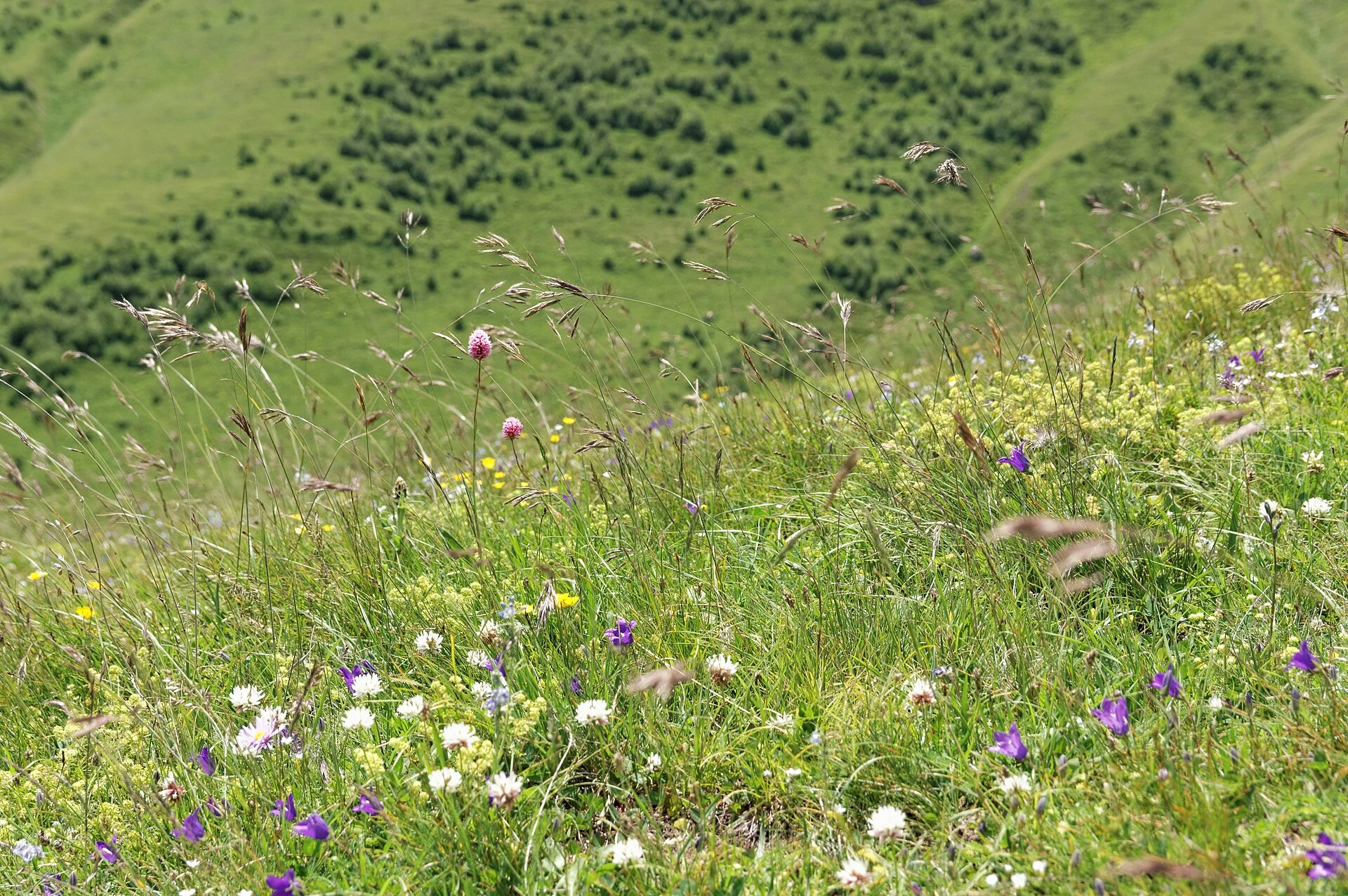
Wildflower-studded alpine meadow in Khevi, typical of Georgia's high-altitude summer bloom. · Photo: Vyacheslav Argenberg / Wikimedia Commons, CC BY 4.0
Been to Georgia? Tell us how it went — the best stories are published here.
Share your tripOne email a week: what changed for travellers in Georgia — rules, roads, flights, seasons — plus one place worth the trip. Written by the GTour desk, no advertising, unsubscribe in one click.
This story across our partner network — ქართულად: შენი დასვენება
