

By Nino Gelashvili, Travel News Editor · 29/10/2026
The best stargazing in Georgia is found away from the Tbilisi-Rustavi-Kutaisi urban belt, in three very different landscapes: the high Tusheti valleys in the northeast, the Javakheti volcanic plateau in the south, and the Udabno semi-desert near David Gareji, less than two hours from the capital. For telescope viewing rather than naked-eye stargazing, the Abastumani Astrophysical Observatory in Samtskhe-Javakheti, founded in 1932 and still operated by Ilia State University, is the one place in the country where you can look through a working research instrument with a guide.
None of these places is marketed primarily as an astro-tourism destination, so facilities are modest: there are no permanent public telescope domes outside Abastumani, no paid “dark sky park” infrastructure, and mobile signal is patchy or absent in Tusheti and Udabno after dark. What they share is low or near-zero light pollution, dry mountain or steppe air, and, for several months each year, an unobstructed view of the Milky Way’s galactic core. This guide sets out where to go, when the sky is darkest, how to plan around the moon, and what to check before you travel, since road access to Tusheti and observatory visiting hours can change from one season to the next.
Why these particular places are dark
Light pollution in Georgia concentrates tightly around Tbilisi, Batumi, Kutaisi and Rustavi. Once you are roughly 60 to 80 kilometres from any of these, especially behind a mountain ridge, skyglow drops away quickly. Altitude helps too: Tusheti’s villages sit at 1,800 to 2,100 metres, Javakheti’s plateau around Lake Paravani and Lake Khanchali sits above 2,000 metres, and both benefit from thinner, drier air with less atmospheric turbulence, which astronomers call good “seeing.” Udabno, by contrast, is low and close to Tbilisi, but its semi-desert climate, documented in national park material from the Agency of Protected Areas, gives it an unusually high number of clear, cloudless nights a year, which matters as much as absolute darkness.
Abastumani Astrophysical Observatory
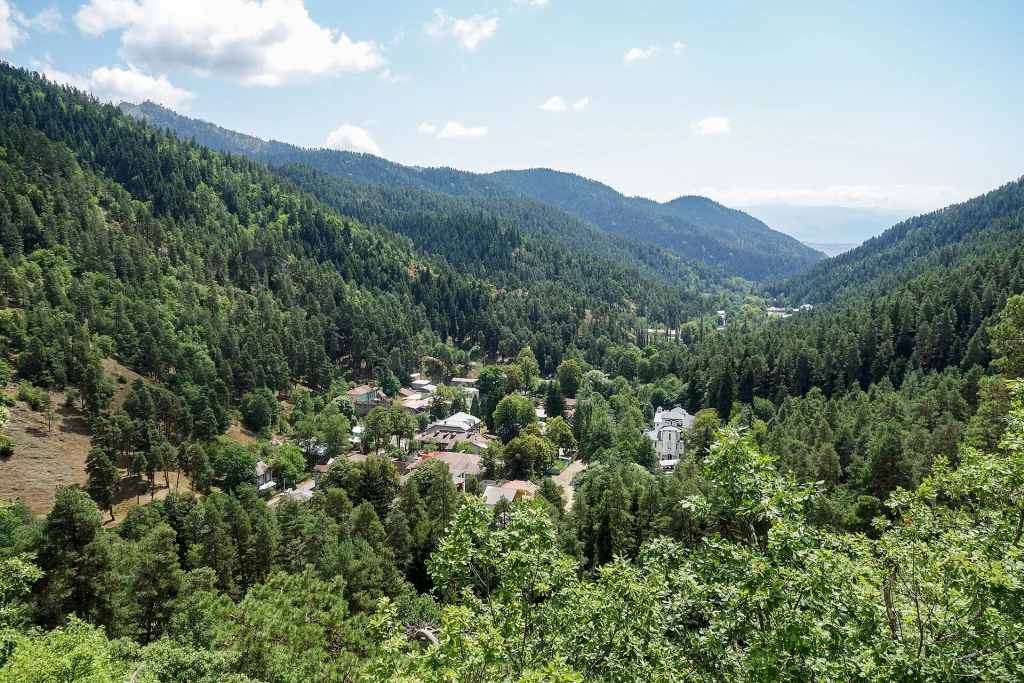
The Abastumani Astrophysical Observatory sits on Mount Kanobili above the spa town of Abastumani in Samtskhe-Javakheti, at around 1,650 metres. Built in the 1930s under Georgian astronomer Evgeni Kharadze, it still houses historic refracting and reflecting telescopes, including instruments of 40cm and 70cm aperture, and operates today as a research and teaching facility of Ilia State University. Visits are possible but need to be arranged in advance through the university rather than turning up on the day, and group sizes and opening nights can vary with staff availability and ongoing research programmes, so confirm current visiting terms directly with Ilia State University before building a trip around it.
Abastumani is not a casual stop: the access road climbs steeply through forest, the dome is unheated, and a guide-led visit typically lasts one to two hours including an explanation of the historic instruments before any night viewing. It pairs naturally with a wider swing through Samtskhe-Javakheti. Our The South in 3 Days — Borjomi, Vardzia, Rabati and Abastumani and Sairme and Abastumani — Mountain Spas 4 Nights both route through the town, and either itinerary can be adjusted to arrive before dusk on a clear, moonless night if an observatory slot is confirmed in advance.
Tusheti: the wildest dark sky in Georgia
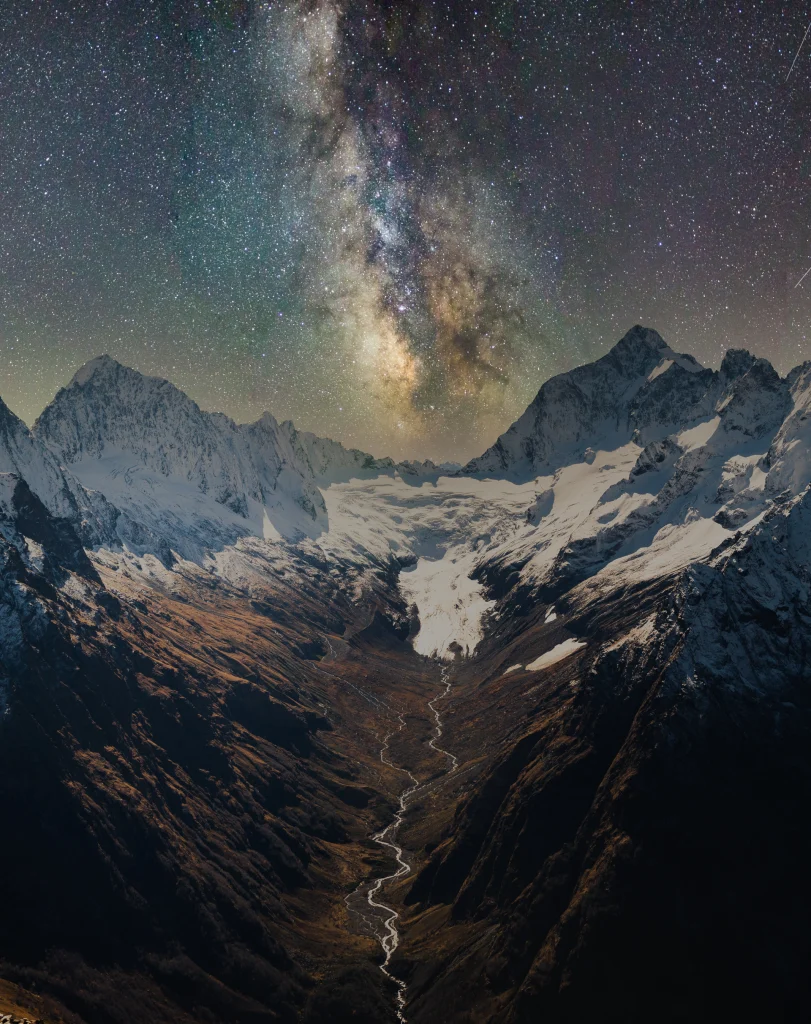
Tusheti, reached over the Abano Pass at around 2,850 metres, is Georgia’s most isolated inhabited region and has close to no artificial light beyond the handful of solar-lit guesthouses in Omalo, Dartlo and Shenako. On a clear, moonless August or September night the Milky Way is bright enough to cast a faint shadow, and the horizon-to-horizon view is unobstructed by any town glow in any direction. The trade-off is access: the dirt road over Abano Pass is open roughly from June to late September or early October depending on snow, is impassable in winter, and should only be driven by 4×4 with an experienced driver. Always check current conditions on the Abano Pass before travelling.
We run Tusheti — Georgia’s Last Wild Frontier (4 Days), Tusheti by 4×4 — Omalo, Dartlo and Diklo in 3 Days, and a dedicated Tusheti Photography Expedition — 5 Days built around early starts, late sunsets and open evenings for night photography. For travellers combining Tusheti with neighbouring Khevsureti, Khevsureti and Tusheti by 4×4 — 5 Days and Tusheti to Khevsureti — Omalo to Shatili over the Atsunta Pass, 6 Days both include multiple nights at altitude away from any town.
Javakheti plateau
South of Borjomi and Akhalkalaki, the Javakheti plateau is a high volcanic steppe dotted with crater lakes, including Paravani, Georgia’s largest lake by surface area, and Khanchali, a Ramsar-listed wetland. Settlements are small and widely spaced, there is little traffic after dark, and the plateau’s elevation above 2,000 metres means thinner air and, in summer, noticeably fewer hazy nights than in the valleys below. It is less visited by tour groups than Tusheti or Kazbegi, so facilities for travellers are basic: plan to bring your own food and water, confirm guesthouse availability ahead of time, and expect no mobile signal in parts of the plateau. A private guide and 4×4 for the day, booked through our Car with Driver by the Day service, is the most practical way to reach a chosen viewpoint and return safely after an evening of observation.
Udabno and the David Gareji semi-desert
Udabno village and the David Gareji monastery complex sit in a semi-desert landscape of eroded clay hills on the Azerbaijani border, about 90 minutes from Tbilisi. The appeal for stargazers is proximity combined with genuine darkness: once you are past the last streetlight of Udabno village, the terrain is flat, open and essentially uninhabited, with the monastery’s low stone buildings the only structures for kilometres. The region’s dry climate means a high proportion of cloud-free nights through most of the year, including winter, when Tusheti and Javakheti are already closed by snow or made difficult by cold. This makes Udabno the most realistic year-round dark-sky day trip from Tbilisi.
Both David Gareji — Desert Monasteries on the Edge of Georgia and Davit Gareji and the Semi-Desert — Monastery, Steppe and Rainbow Hills run as day tours and can be timed to linger past sunset with advance notice, though returning to Tbilisi on the unlit steppe road after dark should always be done with a driver who knows the route.
Milky Way season and planning around the moon
The galactic core of the Milky Way, the bright, dense band most people picture when they imagine the night sky, is below the horizon in Georgia’s winter months. It becomes visible low in the south after dark from roughly April, climbs higher through the short summer nights of June and July, when it is visible for much of the night, and remains a good, if lower, target through August and into September before dropping out of easy view by October. Outside this window you can still see a dense scatter of stars and, in Tusheti or Javakheti, the fainter outer arms of the galaxy, but not the bright core itself.
Moon phase matters more than most first-time astro-travellers expect. A full moon brightens the whole sky and will wash out all but the brightest stars and planets, while a new moon or a thin crescent gives the deepest, most contrasted view of the Milky Way. As a rule of thumb, plan for the four or five nights either side of a new moon, and avoid the three nights either side of full moon if the Milky Way is the goal. Exact moon phase dates shift every year and are easy to get wrong from memory, so check a current moon-phase calendar for your travel month before fixing a date, rather than relying on a printed table in any guide, including this one.
| Location | Altitude | Best access season | Notes |
|---|---|---|---|
| Abastumani Observatory | ~1,650 m | Year-round, by prior arrangement | Only site with a working telescope; book through Ilia State University |
| Tusheti | 1,800–2,100 m | June to late September | Abano Pass closed by snow outside this window |
| Javakheti plateau | 2,000 m+ | Late spring to early autumn | Cold at night even in summer; bring layers |
| Udabno / David Gareji | ~600–900 m | Year-round | Most reliable clear skies in winter; closest to Tbilisi |
Astrophotography tips for Georgia’s skies
- Bring a sturdy tripod; none of these sites has artificial perches or railings for cameras, and ground is often uneven in the dark.
- A wide, fast lens (f/2.8 or faster) with manual focus set to infinity in daylight and taped in place works better than relying on autofocus after dark.
- Exposures of 10 to 20 seconds at ISO 1600 to 3200 are a reasonable starting point for the Milky Way; longer exposures on a static tripod will show star trails rather than points.
- Pack a red headlamp if you have one, since white light ruins your own and other travellers’ night vision for up to 20 minutes.
- Temperatures drop fast at altitude after sunset even in July and August, particularly in Tusheti and on the Javakheti plateau; dress as you would for a cold evening hike, not a summer night in Tbilisi.
- Batteries drain faster in cold air, so carry a spare and keep it inside a jacket pocket rather than in a camera bag.
If this guide is part of a trip you are planning, our Tbilisi to Borjomi or Bakuriani Transfer and Caucasus Highlands in 7 Days — Kazbegi, Khevsureti and Tusheti cover the places it describes with a private guide and driver; a GTour travel expert adapts the route to your dates.
Practical summary
- For a working telescope: Abastumani Astrophysical Observatory, book ahead with Ilia State University, pair with a Samtskhe-Javakheti itinerary such as The South in 3 Days.
- For the darkest naked-eye sky: Tusheti, June to late September only, 4×4 and experienced driver required, check the Abano Pass road status before travelling.
- For a high, quiet alternative to Tusheti: the Javakheti plateau around Paravani and Khanchali, reachable by private car with driver.
- For the easiest year-round dark-sky night from Tbilisi: Udabno and David Gareji, under two hours each way.
- Best season for the Milky Way core: April to September, peaking June and July.
- Plan around the moon: aim for nights near new moon, avoid the three nights either side of full moon, and verify exact 2026 moon phase dates before booking rather than relying on memory.
- Always confirm current road conditions, observatory visiting hours, and protected-area rules directly with the relevant official source before departure.
Sources
- Ilia State University
- Agency of Protected Areas, Georgia
- Georgian Road Department, road condition
- Georgia National Tourism Administration
- Georgia Travel, official tourism portal
- Agenda.ge
- Georgia Today
- National Environmental Agency
Questions this guide does not answer? Write to info@castle.ge or WhatsApp +995 577 41 63 14 — a person in Tbilisi replies. See also our travel services and all guides.
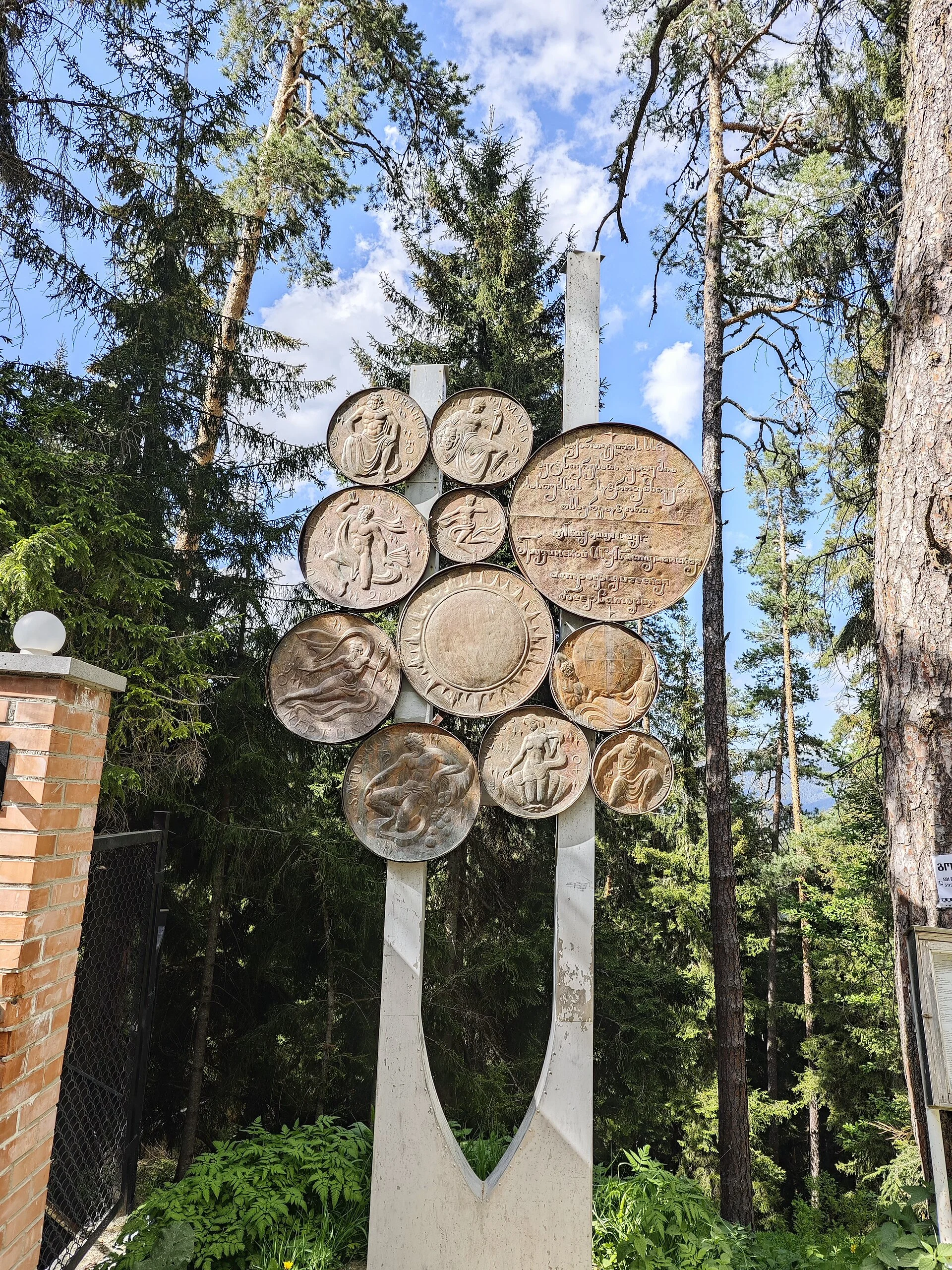
Decorative metal plate marks the entrance to Abastumani Astrophysical Observatory. · Photo: Unrecognizablepineapple / Wikimedia Commons, CC0
Been to Georgia? Tell us how it went — the best stories are published here.
Share your tripOne email a week: what changed for travellers in Georgia — rules, roads, flights, seasons — plus one place worth the trip. Written by the GTour desk, no advertising, unsubscribe in one click.
This story across our partner network — ქართულად: შენი დასვენება
