

Zedazeni Monastery — opening hours, tickets, how to get there and what to see
Zedazeni Monastery stands on a forested ridge above Mtskheta, reached by a rough mountain road rather than the tour-bus circuit that covers Jvari and Svetitskhoveli. Tradition holds it was founded around the mid-sixth century by Ioane (John) Zedazneli, one of the Thirteen Syrian Fathers credited with reinforcing Christianity in Kartli, and it remains a working monastery today. It is not part of the UNESCO-inscribed “Historical Monuments of Mtskheta” (1994), which covers only Jvari, Svetitskhoveli and Samtavro, so it draws a smaller, quieter crowd.
What you see
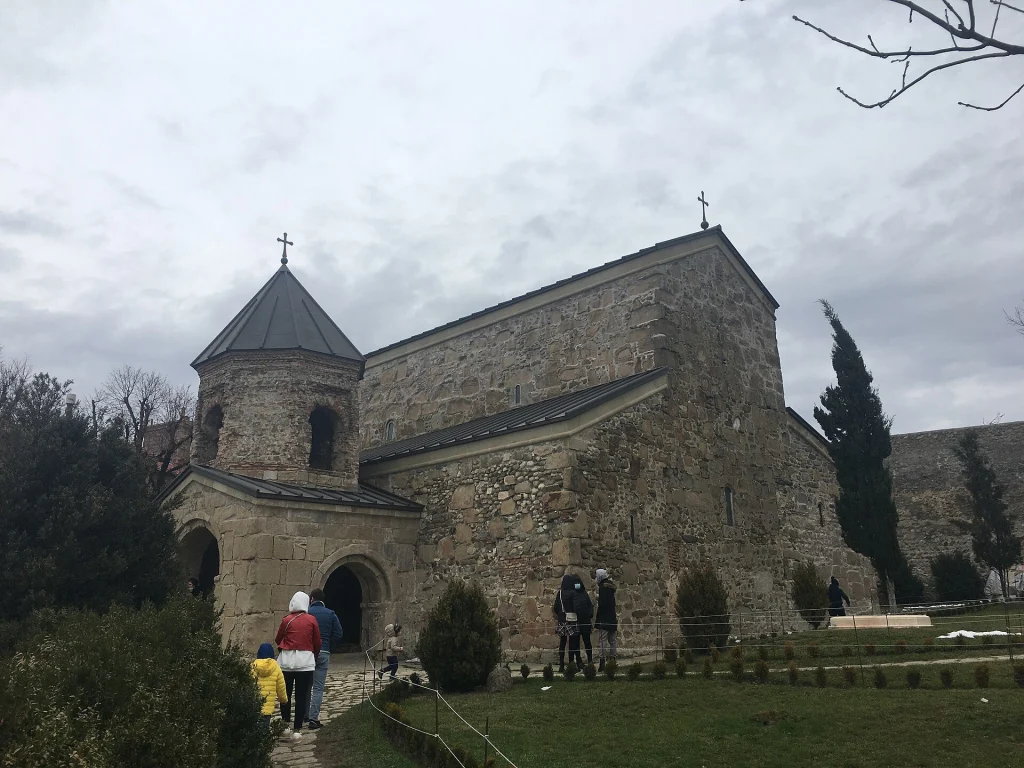
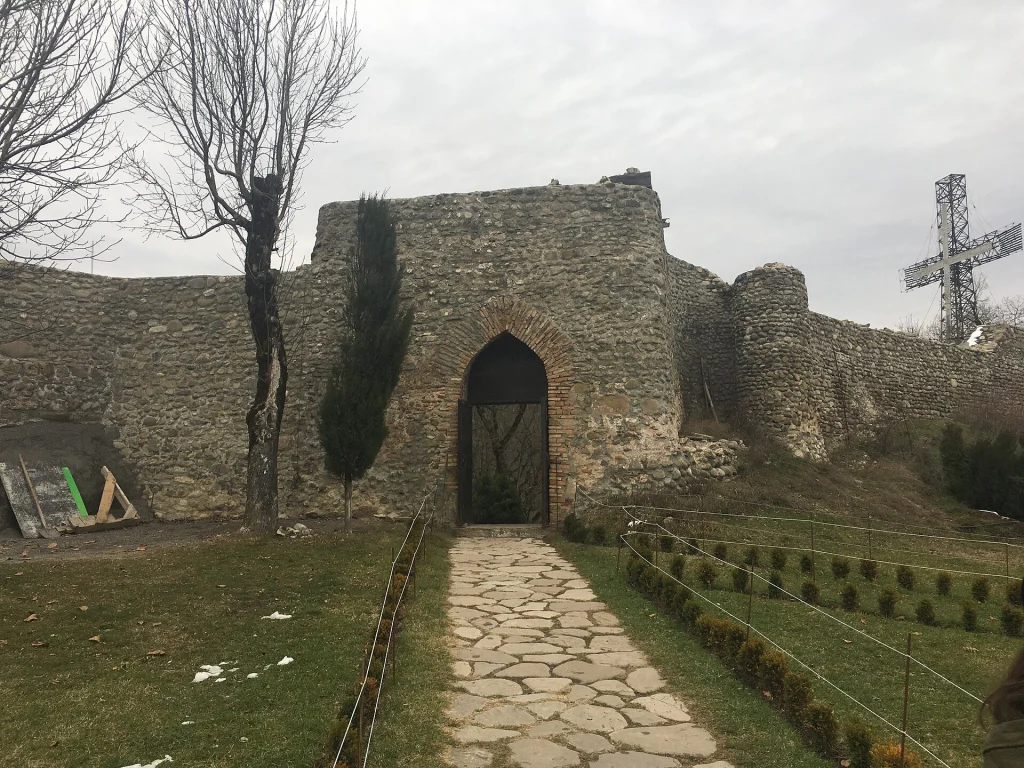
Zedazeni sits at roughly 1,200 metres on Mount Zedazeni, inside the forested Tbilisi National Park, with the Mtkvari and Aragvi river valleys and the roofs of Mtskheta spread out below. The complex is modest in scale: a stone basilica church, monastic cells, a bell tower and a low perimeter wall, rebuilt and repaired across several centuries so that the visible fabric is a patchwork rather than a single period. A handful of monks live here year-round, and the atmosphere is working and quiet rather than curated for visitors. The main draw for many pilgrims is the grave of St Ioane Zedazneli inside the church, and the setting itself, reached only by climbing through oak and hornbeam forest.
History
According to Georgian church tradition, Zedazeni was founded around the 540s by Ioane Zedazneli, who arrived from the Byzantine-Syrian world with twelve companions, the group later known as the Thirteen Syrian (Assyrian) Fathers, sent to strengthen Christianity in Kartli two centuries after it had become the state religion under King Mirian in the early fourth century. The site is said to have stood on or near an earlier pre-Christian shrine, which is consistent with the hill’s older Georgian name and its long-standing role as a landmark over the ancient capital (see Britannica’s entry on Mtskheta for the city’s wider early history). Ioane’s disciple Shio is said to have left Zedazeni to found what became Shio-Mgvime, one of the valley’s other major monasteries. Like most of Kartli’s early religious sites, Zedazeni was damaged and rebuilt more than once over the following centuries as the region came under successive invasions; the present buildings reflect this layered repair history rather than a single sixth-century fabric. The monastery is not included in the 1994 UNESCO inscription “Historical Monuments of Mtskheta,” which covers only Jvari, Svetitskhoveli and Samtavro (UNESCO World Heritage Centre, list entry 708); Zedazeni is best understood as part of the same early Christian landscape, administered and visited separately. Mtskheta’s broader age and standing as a historic capital are also covered in general travel reporting, for instance a feature describing it as a city older than Rome in its urban origins (BBC Travel on Mtskheta).
Opening hours and tickets
| Item | Typical pattern |
|---|---|
| Grounds and church | Open daily, roughly 09:00–19:00 in summer and 09:00–18:00 in winter; no formal ticket office or published timetable (checked at booking) |
| Entry fee | Free; donations toward the monastery’s upkeep are welcome |
| Dress code | Shoulders and knees covered for everyone; women usually need a headscarf and a wrap skirt over trousers, often available at the gate |
How to get there
From Tbilisi, it is about 30 km to Mtskheta (45–60 minutes by car in normal traffic), then a further climb of around 7–8 km up an unpaved mountain road to the monastery, adding another 30–40 minutes; allow 1.5–2 hours door to door. There is no marshrutka or train service up the mountain, so a private car, taxi, or the hiking trail from Saguramo village through Tbilisi National Park (roughly 2–3 hours on foot) are the only practical options. An ordinary sedan can usually manage the road in dry weather, but a higher-clearance vehicle is safer after rain or snow. Because Zedazeni sits off the standard Mtskheta circuit, our central Mtskheta tours such as Tbilisi & Mtskheta — The Essential First Day and St Nino’s Way do not include it as standard; the straightforward way to add it is a private car with driver from Tbilisi (sedan, around €150 for the day, see gtour.ge/data) or as a custom stop on our Monasteries of Georgia — 3 Days itinerary, arranged in advance.
How long and the best time
Budget half a day from Tbilisi, including travel, if driving directly to the monastery and back (2.5–3.5 hours round trip plus 30–45 minutes on site). Those hiking up from Saguramo should plan a full day. Late spring through autumn (May–October) gives the most reliable road conditions and forest colour; winter can bring snow and ice on the access road, occasionally closing it to ordinary cars, so timing should be checked locally before setting out.
Tips
- Dress modestly before arriving; scarves and wrap skirts are usually available at the gate but supply can run short on busy weekends.
- Photography of the exterior and grounds is generally fine; ask before photographing inside the church or of monks.
- Check road conditions after rain or snow, since the final stretch is unpaved and can become slick; a 4×4 or experienced driver is worth arranging in winter.
- There are no real crowds here, which is part of the appeal, but there is also no café or shop on site, so bring water.
- Combine the visit with Saguramo village, home to the Ilia Chavchavadze house museum, which sits at the base of the mountain.
Nearby
- Jvari Monastery
- Svetitskhoveli Cathedral
- Samtavro Monastery and Convent
- Shio-Mgvime Monastery
- Saguramo (Ilia Chavchavadze house museum)
Zedazeni Monastery is on these private tours: Georgia in 10 Days — Tbilisi to Svaneti to the Sea · Tbilisi in a Day — Old Town, Sulphur Baths, Mtatsminda and the Markets · Mtskheta, Gori and Uplistsikhe — Kartli in a Day. A travel expert adapts any of them to your dates.
Questions
Is Zedazeni Monastery part of the UNESCO World Heritage Site in Mtskheta?
No, the 1994 inscription covers only Jvari, Svetitskhoveli and Samtavro; Zedazeni is a separate, unlisted site nearby.
Can I drive to Zedazeni in a normal rental car?
Often yes in dry weather, but the final stretch is unpaved mountain road, and a higher-clearance vehicle or a hired driver is safer after rain or in winter.
Is there an entrance fee?
No official fee; donations toward the monastery's upkeep are welcome.
Can I walk up instead of driving?
Yes, a marked trail runs from Saguramo village through Tbilisi National Park, taking roughly 2–3 hours uphill.
Sources
The stone church and bell tower of Zedazeni Monastery near Mtskheta. · Photo: Milan Tvrdy / Wikimedia Commons, CC BY 2.0