

Vardzia Cave Monastery — opening hours, tickets, how to get there and what to see
Vardzia is a 12th–13th century cave monastery carved into a cliff above the Mtkvari river in Samtskhe-Javakheti, about 30 kilometres southwest of Akhaltsikhe. Built under King Giorgi III and expanded by Queen Tamar, it once held several thousand rooms and a garrison church; a large section collapsed in the earthquake of 1283. It remains one of the largest rock-hewn settlements in Georgia and a working monastery, with a handful of monks in residence today.
What you see
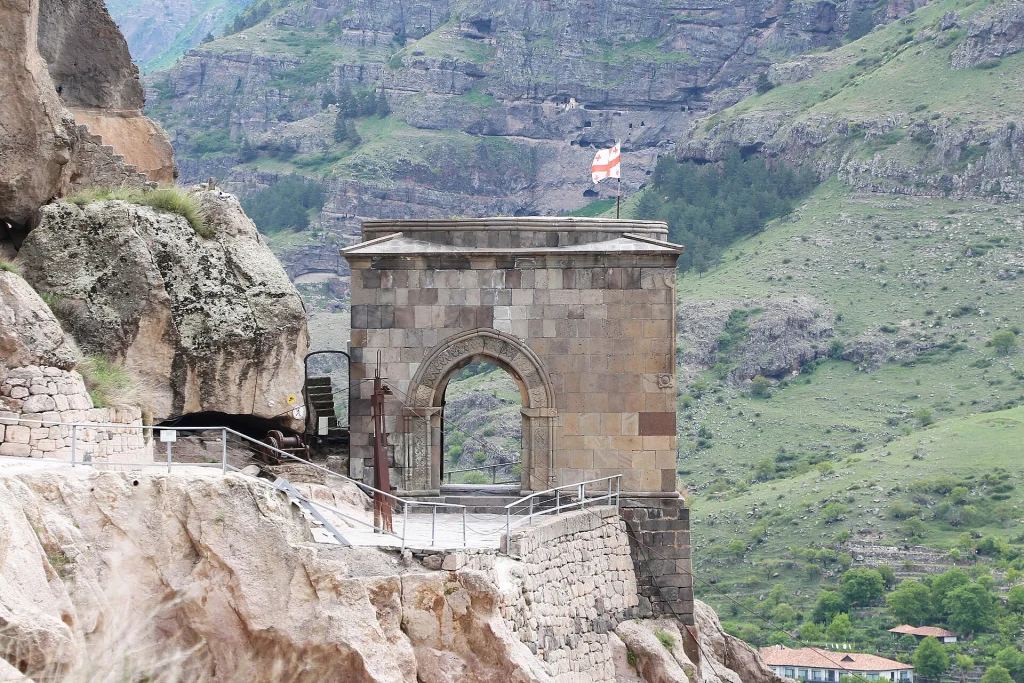
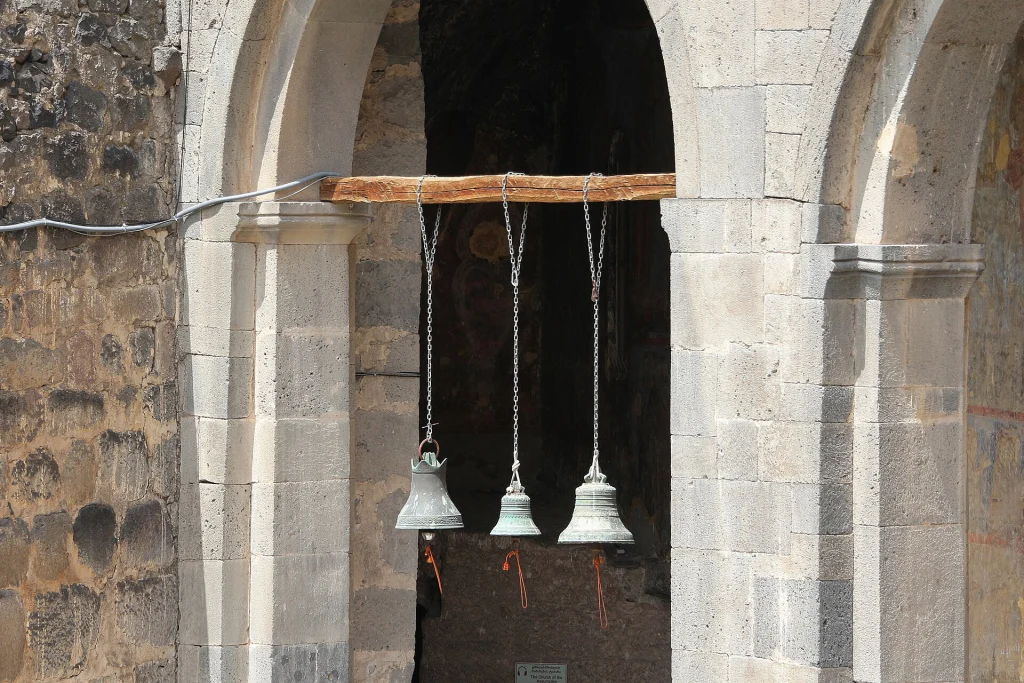
Vardzia is a multi-level complex cut into a sandstone cliff on the left bank of the Mtkvari river. A single stepped path and a short tunnel link roughly 750 to 800 surviving rooms out of an estimated 6,000 original chambers: living cells, stables, a wine cellar with carved marani jars, a bakery, and the Church of the Dormition at the centre of the complex. The church keeps its 1180s frescoes, including a donor portrait of Queen Tamar shown as a young, unmarried ruler, one of the few contemporary images of her. A bell tower was added in the 19th century. From the upper terraces there are open views down the river gorge toward Khertvisi.
History
Construction began under King Giorgi III in the 1180s as a fortified monastic refuge against Seljuk raids, and the site was completed and consecrated under his daughter Queen Tamar, whose reign (1184–1213) is remembered as the high point of medieval Georgian power. The name is said to derive from a story of Tamar getting lost as a child among the caves and calling “ბავშვო, აქ ვარ ძია” (“child, I am here, uncle”), shortened to Vardzia, though this is folk etymology rather than documented fact. At its height the complex held a full monastic community, a water supply system, and defensive galleries meant to withstand siege. A major earthquake in 1283 sheared off the outer rock face, exposing much of the interior to the open air and destroying an unknown number of upper chambers; the Ottoman capture of the region in the 16th century ended continuous monastic life for several centuries. The site was restored and resettled by monks in the Soviet and post-Soviet periods and is today managed as a state heritage site, with Vardzia named together with Khertvisi fortress on Georgia’s tentative list for UNESCO World Heritage status (see the UNESCO tentative lists database for the current entry).
Opening hours and tickets
Vardzia is open year-round with shorter winter hours and is usually closed, or partially closed, on Mondays for maintenance. Ticket prices are modest and typically higher for the church interior than for general site access. All figures below should be checked at booking, since both hours and prices change without much notice.
| Season | Usual hours | Note |
|---|---|---|
| April–October | approx. 10:00–18:00 | last entry about an hour before closing |
| November–March | approx. 10:00–17:00 | some upper sections may be roped off in ice or snow |
| Monday | reduced hours or closed | confirm before visiting midweek |
How to get there
From Tbilisi, Vardzia is roughly 230 kilometres and a drive of about 3 to 3.5 hours via Borjomi and Akhaltsikhe, most of it on a paved two-lane road; the final stretch from Akhaltsikhe follows the Mtkvari gorge and is slower in places. From Kutaisi the drive is about 3 hours via Borjomi. There is no direct train to Vardzia; the nearest rail link is Tbilisi–Borjomi, after which a car or marshrutka is needed for the remaining 90 minutes or so. Public marshrutka service from Akhaltsikhe runs a limited number of times a day and is not reliable for a tight schedule. With us, Vardzia is covered as a day trip from Tbilisi (Vardzia Cave City — Day Trip, 12 hours) or combined with Rabati Castle and Borjomi over two days (Vardzia, Rabati & Borjomi, 2 Days); a private car with driver can also be booked by the day for a custom route through Samtskhe-Javakheti.
How long and the best time
Plan on 1.5 to 2.5 hours on site, including the climb through the cave levels and the church, plus time at the small museum near the entrance. Add travel time of 6 to 7 hours round trip from Tbilisi if doing it as a single long day. Spring and autumn bring the mildest temperatures for the uphill walking involved; midsummer afternoons on the exposed cliff face can be hot with little shade, and winter visits are quieter but colder, with occasional ice on the stone steps.
Tips
- Wear shoes with grip: the path includes uneven stone steps and a dark tunnel section.
- Modest dress is expected in the Church of the Dormition, shoulders and knees covered.
- Photography is generally allowed outside; check signage before photographing frescoes inside the church.
- Arrive early or late morning to avoid tour-bus groups, which cluster around midday in high season.
- Combine with Khertvisi fortress, a 15-minute drive away, and with Akhaltsikhe’s Rabati Castle on the way back.
Nearby
- Khertvisi Fortress
- Rabati Castle, Akhaltsikhe
- Vanis Kvabebi cave monastery
- Sapara Monastery
- Borjomi town and Borjomi-Kharagauli park entrance
Vardzia Cave Monastery is on these private tours: The South in 3 Days — Borjomi, Vardzia, Rabati and Abastumani · Vardzia and Rabati — the Long Day South · Borjomi and Bakuriani — Spa Town and Mountain Air in a Day. A travel expert adapts any of them to your dates.
Questions
How much does it cost to visit Vardzia
Entry is a modest fixed fee, usually lower for site access and slightly more if combined with the church; confirm the exact figure at booking since prices are revised periodically.
Can you do Vardzia as a day trip from Tbilisi
Yes, the round trip takes a full day, around 6 to 7 hours of driving plus 1.5 to 2.5 hours on site, and is offered as a 12-hour guided day trip.
Is Vardzia a UNESCO World Heritage Site
Not yet inscribed; Vardzia and Khertvisi fortress are jointly listed on Georgia's UNESCO tentative list, a preliminary step before possible full inscription.
Is Vardzia suitable for visitors with limited mobility
Not fully, the site involves stepped paths, a narrow tunnel and uneven cave floors with no lift or ramp access to the upper levels.
Sources
Wide view of the cliffside cave city of Vardzia overlooking the valley below. · Photo: Bernard Gagnon / Wikimedia Commons, CC BY 4.0