

Tusheti Protected Areas — opening hours, tickets, how to get there and what to see
Dartlo is a stone-tower village inside the Tusheti Protected Areas, a cluster of nature reserves and a national park in the Tusheti highlands of northeastern Georgia, administratively linked to Mtskheta-Mtianeti for travel planning. The protected areas were established in 2003 to safeguard the region’s alpine forests, pastures and the Tush highland culture that built villages like Dartlo. Because the single access road over the Abano Pass is normally open only from roughly June to mid-October, Dartlo’s 16th–18th century defensive towers survive largely unaltered.
What you see
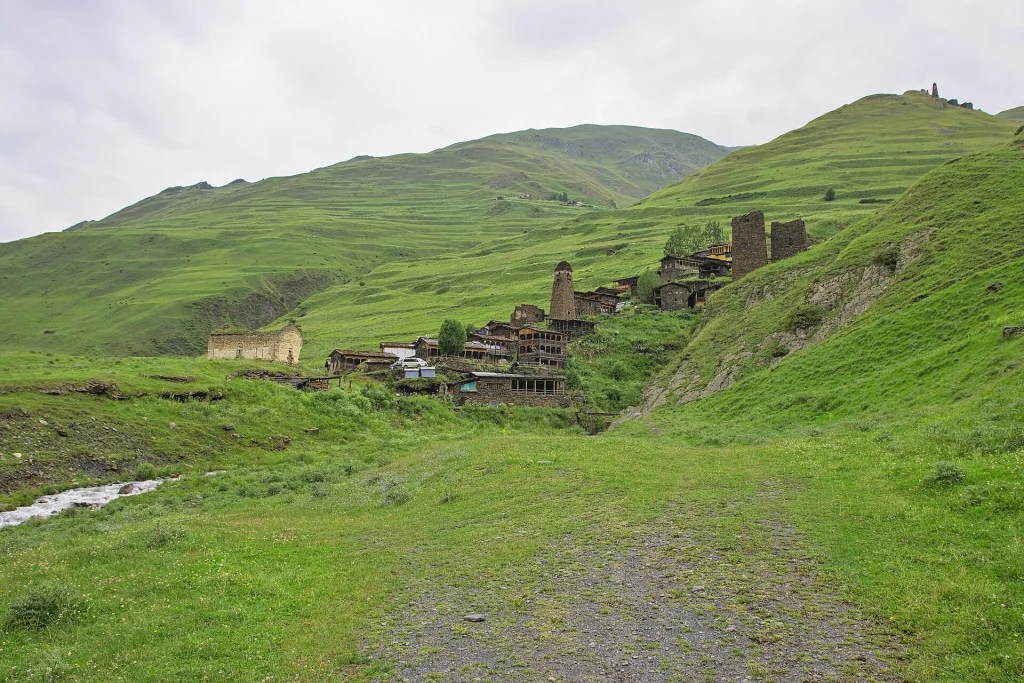
Dartlo sits at about 1,870 metres in the Pirikiti Alazani gorge, a tight cluster of stone dwellings and defensive towers rising three to five storeys above narrow lanes. The towers were built for refuge during clan conflict and raids rather than for permanent living, and several still stand to their original height with corbelled stone roofs. Small chapels (locally called khati) sit at the edges of the settlement, tied to Tush religious practice that blends Christian and pre-Christian elements; some of these sites restrict access for women, a custom still observed locally. Around the village, hay meadows, birch stands and the Alazani river gorge frame views toward the main Caucasus ridge, and waymarked trails connect Dartlo to neighbouring villages such as Omalo and Shenako.
History
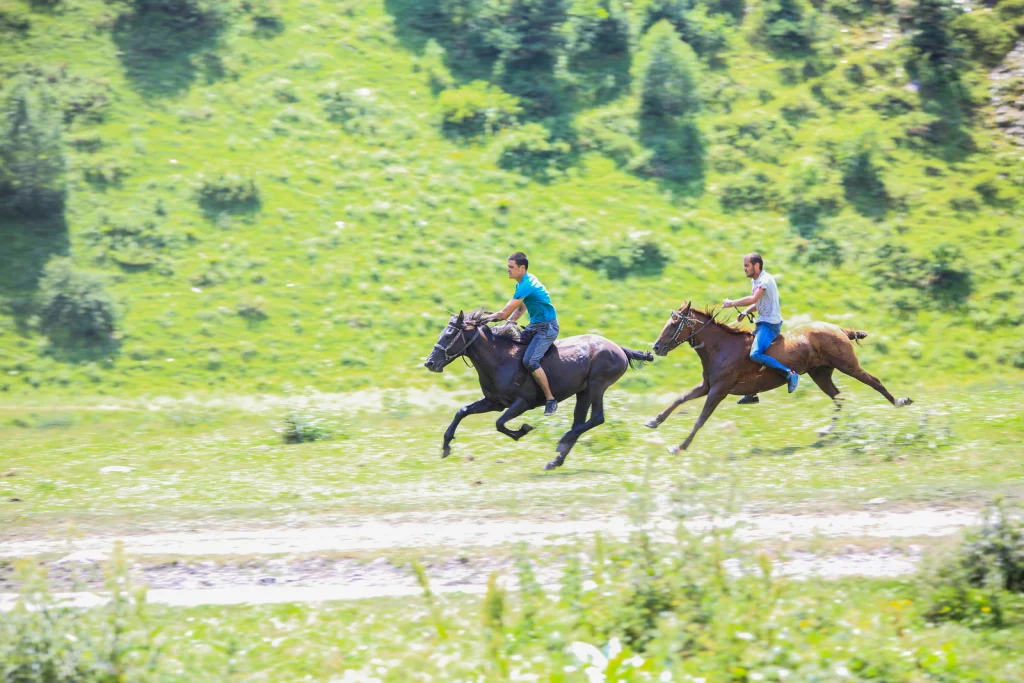
Tusheti’s highland architecture developed from the medieval period through the 18th century, when tower-houses were a practical response to the region’s exposure and isolation. Dartlo’s cluster is considered one of the best-preserved groups of this type and is listed among Georgia’s protected immovable cultural heritage monuments (heritagesites.ge). The wider Tusheti Protected Areas — a strict nature reserve, a national park, a protected landscape and a managed reserve — were created by Georgian government decree in 2003 to conserve the region’s forests, alpine pastures and wildlife, and are managed today by the Agency of Protected Areas (apa.gov.ge). Seasonal transhumance, in which Tush families and their flocks move between Tusheti’s summer pastures and winter grazing in the Alazani valley near Kakheti, continues to shape the region’s calendar and is one reason the villages empty out for much of the year.
Opening hours and tickets
| Item | Usual pattern |
|---|---|
| Access to Dartlo village | Open year-round to residents; practically reachable by vehicle only when the Abano Pass road is open, usually June to mid-October (checked at booking) |
| Entrance fee, village or national park | No standard entrance fee as of the most recent check; camping inside the strict nature reserve may require a permit from the ranger post in Omalo (checked at booking) |
| Road condition updates | Published seasonally; see road status before travelling |
There is no ticket booth or fixed visiting hours for Dartlo itself; it is a living village, and visits are organised around daylight and the state of the access road rather than a schedule. Current conditions are posted at georoad.gov.ge and on our own road-status page.
How to get there
From Tbilisi, Dartlo is about 150 km in a straight line but a full day’s drive by road: roughly 2.5–3 hours to Alvani near Telavi on paved roads, then 5–6 hours on the unpaved mountain road over the 2,850-metre Abano Pass to Omalo, followed by another 30–45 minutes on a rough track to Dartlo. A high-clearance 4×4 is required for the Abano Pass section; ordinary sedans cannot make the climb safely. In summer, shared minivans run on most days from Alvani to Omalo, but onward transport to Dartlo usually has to be arranged locally. There is no rail or scheduled bus service into Tusheti. With GTour, the drive is covered on our 4×4 multi-day route, and the Tusheti — Georgia’s Last Wild Frontier (4 Days) itinerary builds the journey time into the schedule rather than trying to compress it into a day trip.
How long and the best time
Walking through Dartlo itself takes one to two hours, but almost nobody visits it as an isolated stop, because reaching it consumes most of a day. Most visitors see Dartlo as one stage of a three- to four-day loop through Tusheti that also takes in Omalo, Shenako, Diklo or Parsma. The practical season is June to late September, when the road is reliably open, trails are dry and guesthouses in the villages are operating; July and August bring the most settled weather and the fullest range of accommodation. Early October can still be possible but carries real risk of an early snow closure on the pass, and the road is effectively closed from late autumn to late spring.
Tips
- Dress in layers: even in July, nights above 1,800 metres are cold, and afternoon rain is common on the pass road.
- Photograph towers from the lanes and surrounding slopes; some chapels restrict entry, and it is customary to ask locally before approaching khati shrines closely.
- Weather on the Abano Pass changes quickly, and fog can close visibility with little warning, so build flexibility into any one-day plan.
- There are no queues in Dartlo, but guesthouse beds are limited in high season, so book ahead for July and August.
- Mobile signal is patchy to absent beyond Omalo; download maps and confirm arrangements before leaving Alvani.
- Pair Dartlo with a short walk toward Chigho or Kvavlo for views over the gorge without adding driving time.
Nearby
- Omalo (administrative centre of Tusheti, with the restored Keselo tower complex)
- Shenako (village with a red-roofed church, a short drive or walk from Dartlo)
- Diklo (border village with older defensive towers, further along the gorge)
- Parsma (village known for its covered gallery houses)
- Alazani river gorge trails (day walks linking several Tusheti villages)
Tusheti Protected Areas is on these private tours: 4×4 Expedition — Tusheti, Khevsureti and Kazbegi in 8 Days · Tusheti by 4×4 — Omalo, Dartlo and Diklo in 3 Days · Tusheti to Khevsureti — Omalo to Shatili over the Atsunta Pass, 6 Days. A travel expert adapts any of them to your dates.
Questions
Is Dartlo a UNESCO World Heritage Site?
No, it is a protected cultural heritage monument site and sits within Georgia's state-managed Tusheti Protected Areas, not a UNESCO-inscribed site.
Can I drive to Dartlo in an ordinary car?
No, the Abano Pass road requires a high-clearance 4×4; sedans cannot safely make the climb.
When is the road to Tusheti open?
Usually from June to mid-October, snow permitting; always check current status before travelling.
Is there an entrance fee for Dartlo or the national park?
There is no standard entrance fee as of the latest check, though camping in the strict nature reserve may need a permit, confirm at booking.
Sources
Aerial view of Dartlo's stone towers perched above the Tusheti valley. · Photo: Paata vardanashvili / Wikimedia Commons, CC BY-SA 4.0