

Svetitskhoveli Cathedral — opening hours, tickets, how to get there and what to see
Svetitskhoveli Cathedral stands in the centre of Mtskheta, about 20 km north of Tbilisi, and is the burial church of Georgia’s Bagrationi kings and the traditional resting place of Christ’s robe. The present building was completed in 1029 under King Giorgi I, replacing an earlier fourth-century church on the same site. It forms part of the UNESCO World Heritage property “Historical Monuments of Mtskheta,” inscribed in 1994.
What you see
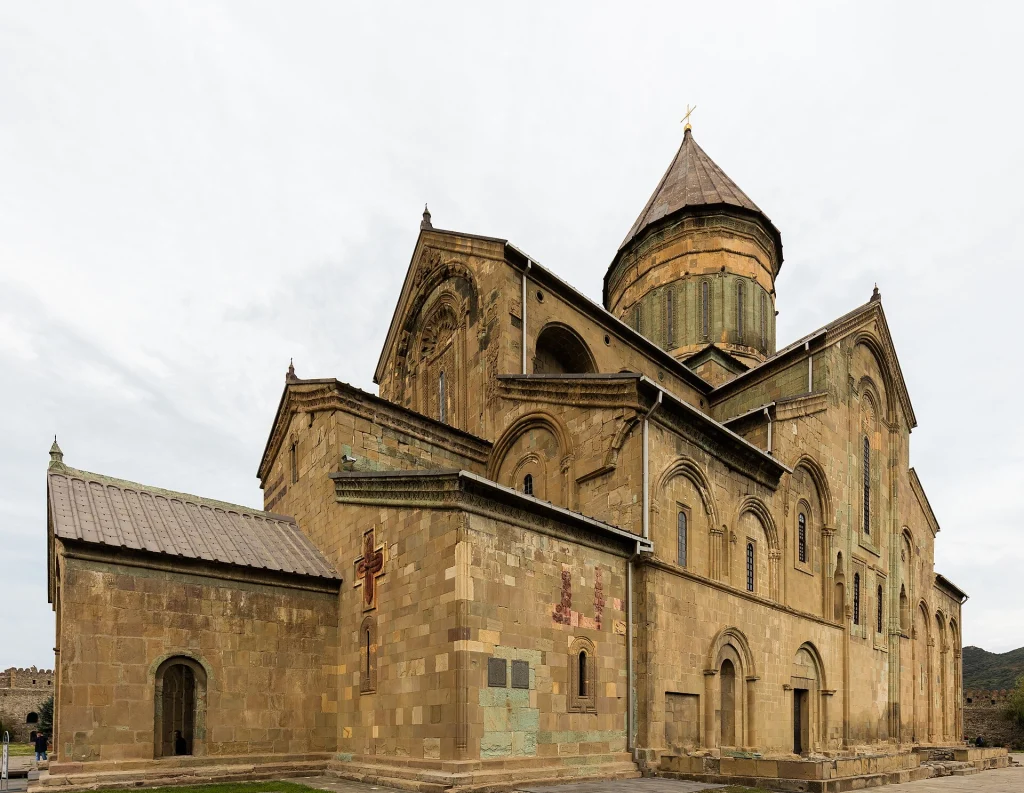
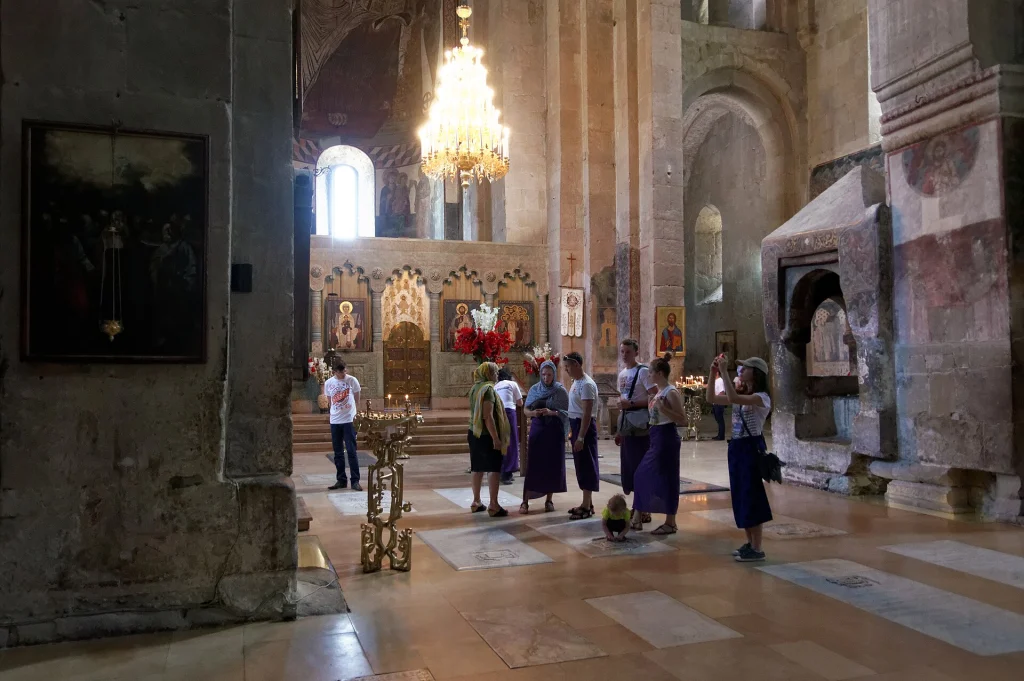
Svetitskhoveli (“Living Pillar”) is a large cross-domed cathedral built of pale stone, enclosed by a defensive wall with corner towers that was added in the seventeenth century. Inside, the nave is dominated by a tall cupola drum carved with blind arcades, and the walls carry fragments of fresco work, some dating to the eleventh century and others repainted after later damage. A carved stone font and a replica of the original pillar mark the spot where tradition says Christ’s robe lies buried. The floor holds the tombs of several kings of Georgia, including members of the Bagrationi dynasty, marked with inscribed slabs rather than raised monuments. On the west facade, a relief of a hand holding a builder’s square is said to belong to the master architect Arsukisdze.
History
A wooden church is recorded on this site from the early fourth century, built after King Mirian III adopted Christianity as the state religion of Iberia around 326. King Vakhtang I Gorgasali raised a stone basilica here in the fifth century, and that structure was replaced by the current cathedral between 1010 and 1029, commissioned by Catholicos Melkisedek I and King Giorgi I, and built by the architect Arsukisdze. The cathedral was damaged by earthquakes and by the invasions of Timur in the late fourteenth century, and it was restored and partly rebuilt several times, including repairs under Russian imperial administration in the nineteenth century. Svetitskhoveli, Jvari Monastery and related sites in Mtskheta were jointly inscribed by UNESCO in 1994 as “Historical Monuments of Mtskheta,” recognising their testimony to medieval religious architecture in the Caucasus (UNESCO World Heritage Centre). The cathedral remains an active seat of the Georgian Orthodox Church and is used for major liturgical events, including royal and patriarchal ceremonies (Patriarchate of Georgia).
Opening hours and tickets
| Item | Usual pattern |
|---|---|
| Opening hours | Daily, roughly 09:00–19:00 in summer and 09:00–18:00 in winter; closes briefly during services |
| Entrance fee | Free; donations welcomed |
| Dress code | Shoulders and knees covered; women cover their heads, wraps usually available at the entrance; no shorts |
| Photography | Generally allowed in the courtyard and nave outside services; flash and tripods discouraged |
These are the usual patterns, not a guarantee. Hours shift around major feast days (notably 14 October, Mtskhetoba) and during Orthodox Easter week. Checked at booking.
How to get there
From Tbilisi, Mtskheta is about 20–25 minutes by car on the Tbilisi–Mtskheta highway, roughly 20 km. Marshrutkas leave frequently from Tbilisi’s Didube station (about 30–40 minutes, a few lari); the cathedral is a short walk from the drop-off point in the old town. Mtskheta also has a railway halt on the Tbilisi–Gori line, but services are infrequent and a car or marshrutka is more practical for a single visit. From Kutaisi, allow about 3.5–4 hours by car on the main east–west highway; from Batumi, closer to 5 hours. With us: the half-day Tbilisi & Mtskheta — The Essential First Day tour and the St Nino’s Way — Mtskheta, Sioni and Bodbe in a Day tour both include Svetitskhoveli, or book a car with driver for a half or full day in and around Tbilisi (see Tours and Services at gtour.ge).
How long and the best time
Most visitors spend 45–60 minutes inside and in the courtyard, longer if combined with a walk through the rest of Mtskheta’s old town. Early morning, before coach groups arrive from Tbilisi, is quieter, and spring and autumn bring milder weather for the walk around the walled compound. Midday on weekends and around church holidays can be crowded, with queues for the entrance during major services.
Tips
- Cover shoulders and knees; women should bring a headscarf, though simple wraps are usually lent at the gate.
- Photography is fine in general, but step back and lower cameras during an active service.
- The courtyard is exposed stone with little shade; bring water in summer and a warm layer in winter, as the Aragvi valley can be windier than Tbilisi.
- Pair the visit with Jvari Monastery on the hill opposite for the classic view described in Georgian literature.
- Mtskheta’s old town around the cathedral has small cafes and church-craft shops, useful for a short break before continuing on to Kakheti or Gori.
Nearby
- Jvari Monastery
- Samtavro Convent
- Mtskheta Archaeological Museum-Reserve
- Armazi archaeological site
- Shiomgvime Monastery
Svetitskhoveli Cathedral is on these private tours: Georgia in 10 Days — Tbilisi to Svaneti to the Sea · Tbilisi in a Day — Old Town, Sulphur Baths, Mtatsminda and the Markets · Mtskheta, Gori and Uplistsikhe — Kartli in a Day. A travel expert adapts any of them to your dates.
Questions
Is there an entrance fee for Svetitskhoveli Cathedral?
No, entry is free, though donations are welcomed; dress rules apply and are enforced at the gate.
How far is Svetitskhoveli from Tbilisi?
About 20 km, roughly 20–25 minutes by car or 30–40 minutes by marshrutka from Didube station.
Can I combine Svetitskhoveli with Jvari Monastery in one visit?
Yes, both sit within Mtskheta and are commonly visited together within a half-day trip.
Why is Svetitskhoveli important to Georgian Orthodoxy?
It is said to hold Christ's robe and is the traditional burial church of Georgia's Bagrationi kings, making it a central pilgrimage site.
Sources
The facade of Svetitskhoveli Cathedral rises above the fortified walls in Mtskheta. · Photo: Diego Delso / Wikimedia Commons, CC BY-SA 4.0