

Rabati Castle, Akhaltsikhe — opening hours, tickets, how to get there and what to see
Rabati Castle is the restored citadel complex that dominates the skyline of Akhaltsikhe, capital of Samtskhe-Javakheti region in southern Georgia. Built up over centuries by Georgian nobles and later Ottoman governors, it combines a church, a mosque and a synagogue quarter within one set of walls, a physical record of the borderland’s mixed Christian, Muslim and Jewish past. The complex as visitors see it today dates mostly from a government-led reconstruction completed in 2012.
What you see
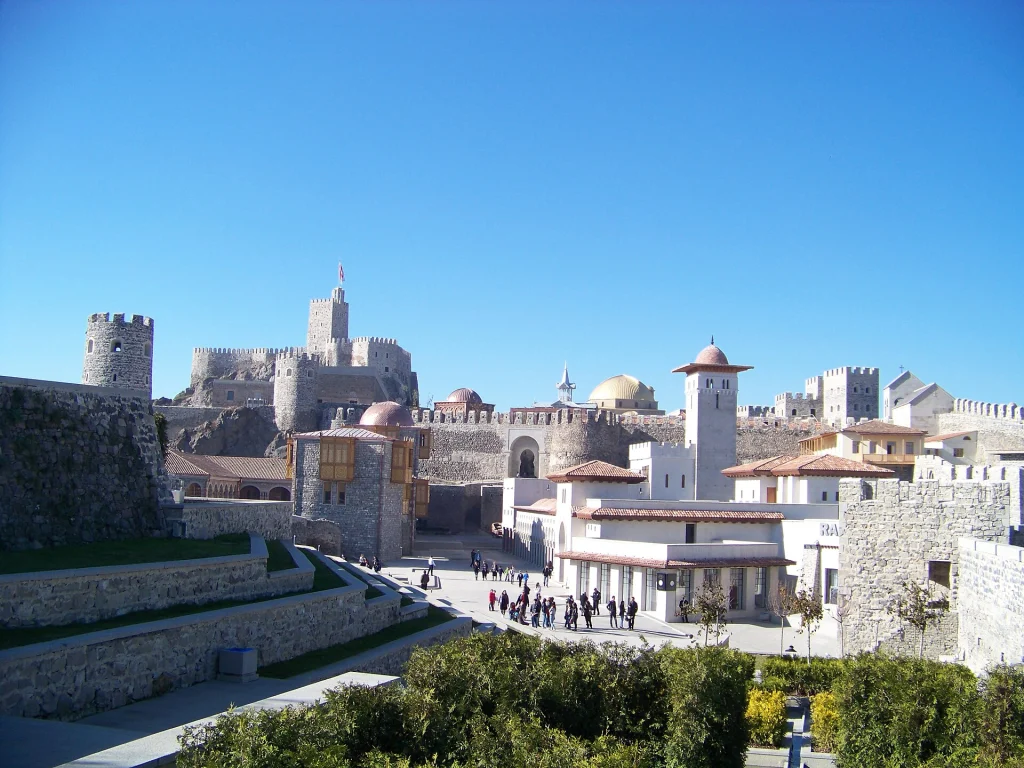
Rabati sits on a low hill above the Potskhovi River, its walls enclosing a compact walled town rather than a single building. Inside the outer ramparts stand a citadel tower with viewing platforms over the valley, the restored Akhmediye Mosque with its minaret, a small domed church, the foundations and signage marking a former synagogue quarter, a madrasah-style building, and the Samtskhe-Javakheti History Museum, which covers the region from prehistory through the Ottoman period to the 20th century. Cobbled lanes, reconstructed merchant houses and a few cafes fill the lower part of the complex, which is built in a deliberately uniform “Rabati style” rather than reproducing any single historical layer exactly.
History
A fortress on this site is recorded from the 9th century, under the control of local Georgian noble houses and later the Jakeli dynasty, who ruled the semi-independent principality of Samtskhe-Saatabago. The fortress and the surrounding region came under Ottoman control in 1578 and remained part of the empire as the Akhaltsikhe Pashalik for roughly 250 years, during which the mosque, madrasah and much of the citadel’s current layout were built, including the mosque traditionally dated to 1752. The Ottoman garrison surrendered the fortress to Russian imperial forces in 1828, during the Russo-Turkish War, after which Akhaltsikhe was absorbed into the Russian Empire and later the Georgian SSR. The complex fell into disrepair over the Soviet period, when parts were used for municipal and military purposes. A large-scale state restoration project rebuilt the walls, towers, mosque and museum between 2011 and 2012, and the site reopened as a cultural and tourism complex in August 2012, a renovation widely reported at the time by Georgian and international press (agenda.ge) and noted in regional heritage listings maintained by the National Agency for Cultural Heritage Preservation of Georgia.
Opening hours and tickets
| Area | Typical pattern |
|---|---|
| Castle grounds and walls | Open daily, roughly 10:00–19:00 in summer, shorter in winter; outer grounds often free to walk |
| History museum and mosque interior | Separate ticket, small fee, same daily hours as the grounds |
| Citadel tower / viewpoint | Included with museum ticket at most visits |
Hours and prices change with the season and have been adjusted more than once since 2012, so treat the above as the usual pattern and confirm current hours and fees when booking, for example via the Georgian National Tourism Administration listings.
How to get there
From Tbilisi, Rabati Castle is about 2 hours 45 minutes by car, roughly 180–190 km via Borjomi. From Kutaisi or Batumi the drive is around 3 hours 20 minutes. Marshrutka minibuses run from Tbilisi’s Didube station to Akhaltsikhe several times a day, with the castle a short walk or taxi ride from the bus station; there is no passenger rail service to Akhaltsikhe. With us, the castle is included on the Borjomi, Bakuriani & Rabati 2-day tour and the Vardzia, Rabati & Borjomi 2-day tour, or it can be arranged with a car with driver for a day trip from Tbilisi or Borjomi.
How long and the best time
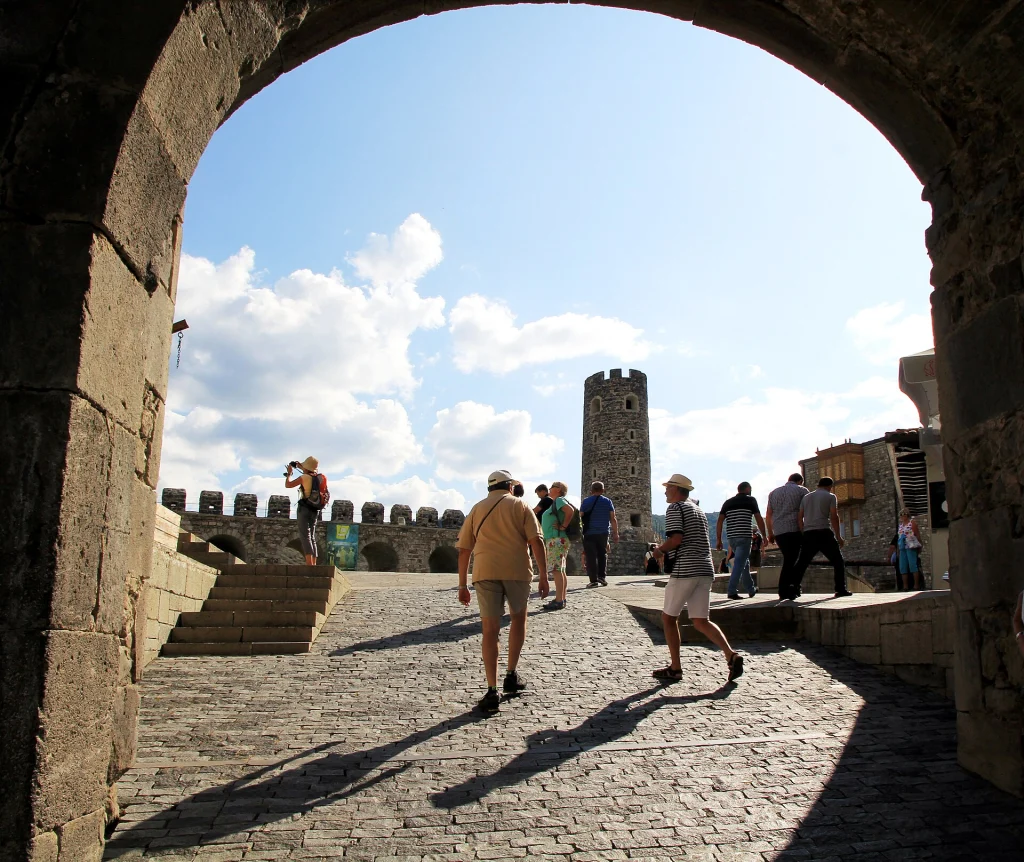
Plan 1.5 to 2 hours to walk the grounds, climb the tower and see the museum and mosque. Late spring and early autumn give the most comfortable weather for the exposed hilltop; midsummer afternoons can be hot with little shade inside the walls, and winter visits are cold and occasionally icy underfoot on the cobbles. Weekends and July–August see the most domestic and regional tour groups, with weekday mornings quieter.
Tips
- Dress modestly for the mosque interior, shoulders and knees covered, shoes off before entering the prayer hall.
- Photography is unrestricted outdoors; the tower platforms give the best wide views of the old town and valley, especially in early morning light.
- The site has little shade, so bring water and sun protection in summer and warm layers in winter.
- Queues are rare outside peak summer weekends; buy the combined museum ticket at the entrance kiosk rather than at each building separately.
- Combine the visit with the old town streets just below the castle, which have a few modest guesthouses and restaurants.
Nearby
- Vardzia cave monastery
- Khertvisi Fortress
- Sapara Monastery
- Vanis Kvabebi cave complex
- Borjomi spa town
Rabati Castle, Akhaltsikhe is on these private tours: The South in 3 Days — Borjomi, Vardzia, Rabati and Abastumani · Vardzia and Rabati — the Long Day South · Borjomi and Bakuriani — Spa Town and Mountain Air in a Day. A travel expert adapts any of them to your dates.
Questions
Is Rabati Castle an original medieval structure
No, the core dates from the 9th century onward but most of what is visible today is a 2011–2012 reconstruction on the old foundations.
Is entry free
The outer grounds are usually free to walk; the museum, mosque interior and tower typically require a small separate ticket, checked at booking.
Can Rabati Castle be visited as a day trip from Tbilisi
Yes, it is about 2 hours 45 minutes each way by car, and it is often combined with Borjomi or Vardzia on a single or two-day route.
Is the mosque still an active place of worship
The Akhmediye Mosque functions partly as a museum space and partly for occasional religious use, so modest dress is expected inside.
Sources
Aerial view of Rabati Castle's restored fortress complex and gardens in Akhaltsikhe. · Photo: I kynitsky / Wikimedia Commons, CC BY-SA 4.0