

Khertvisi Fortress — opening hours, tickets, how to get there and what to see
Khertvisi Fortress stands on a rocky spur above the confluence of the Mtkvari and Paravani rivers in Samtskhe-Javakheti, about 15 kilometres south of Akhaltsikhe on the road to Vardzia. It is among the oldest fortified sites in Georgia, with the present walls dated mainly to the 10th and 14th centuries, and it controlled the main route between the Mtkvari valley and the historic Meskheti highlands for centuries. The fortress passed between Georgian, Ottoman and Russian control, and the surrounding region was formally annexed to the Russian Empire under the Treaty of Adrianople in 1829.
What you see
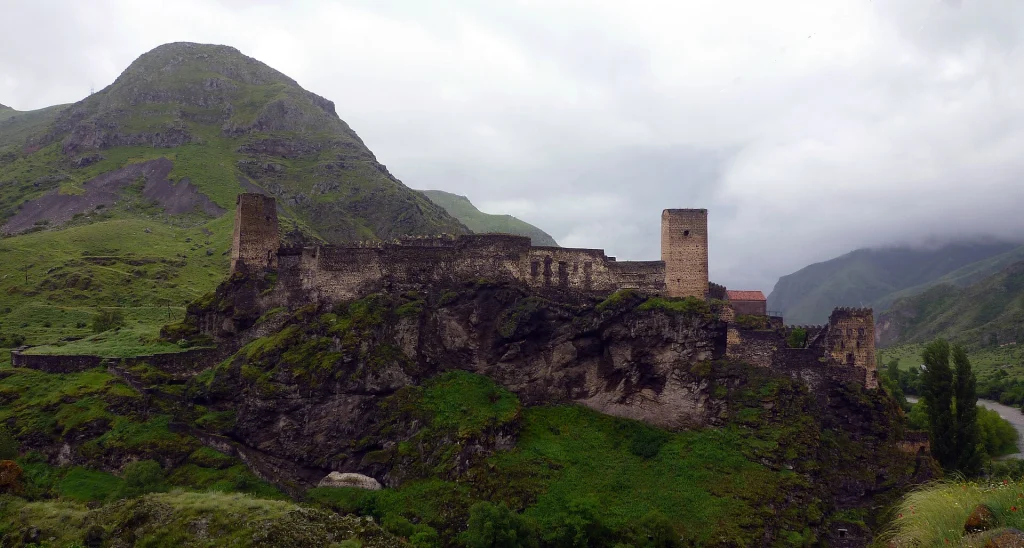
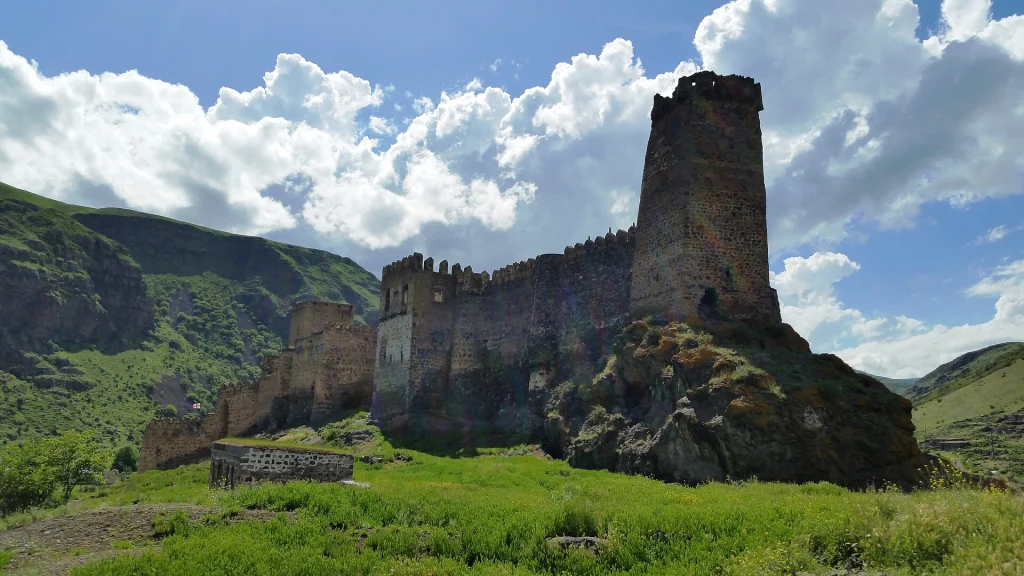
Khertvisi is a roughly triangular fortress built on a steep rock outcrop where the Paravani river joins the Mtkvari. The outer walls follow the natural contours of the cliff, with a lower citadel, a small church, a cistern cut into the rock and remains of a bathhouse inside the enceinte. Round and square towers punctuate the walls at irregular intervals, a sign of construction over several centuries rather than a single building campaign. From the upper platform there are open views down both river valleys and across to the cave settlements of the Vardzia-Khertvisi gorge, which lies a short drive further south. The site is unroofed and largely unrestored, so visitors walk over bare stone and uneven ground rather than through reconstructed rooms.
History
Local tradition links an early fortification on this rock to the campaigns of Alexander the Great in the region, a story with no archaeological confirmation but still repeated by Georgian historians. Documented building phases are later: a stone fortress is recorded here from around the 10th century, when it guarded the southern approaches of the Georgian kingdom, and the structure seen today was substantially rebuilt in the 14th century under the Jaqeli princes who ruled Samtskhe as a semi-independent principality. The Ottoman Empire took Khertvisi and the wider Akhaltsikhe region in the 16th century, holding it for roughly three centuries before it was ceded to the Russian Empire after the 1828–29 Russo-Turkish war, formalised by the Treaty of Adrianople of 1829. The fortress is listed as an immovable cultural heritage monument of national significance by Georgia’s heritage authorities, and it forms part of the wider Vardzia-Khertvisi historical landscape that has been on Georgia’s tentative list for UNESCO World Heritage status since 2007 (UNESCO World Heritage Centre, tentative lists).
Opening hours and tickets
Khertvisi is an open-air, unmanned archaeological site rather than a staffed museum, so access is generally free and unrestricted during daylight hours, though a small entrance fee is sometimes collected in peak season. There is no fixed ticket office schedule published by the national heritage agency; the pattern below is typical but should be checked at booking.
| Item | Usual pattern |
|---|---|
| Access hours | Daylight hours, roughly 9:00–19:00 in summer, shorter in winter |
| Entrance fee | Free, or a nominal fee (a few GEL) collected on site in high season |
| Facilities | None on site; nearest cafes and toilets in Akhaltsikhe or at Vardzia |
| Official listing | Monument database, National Agency for Cultural Heritage Preservation of Georgia (checked at booking) |
How to get there
From Tbilisi, Khertvisi is about 3 hours by car (around 200 km) via Borjomi and Akhaltsikhe. From Akhaltsikhe itself it is a straightforward 20–25 minute drive (about 15 km) south on the road to Vardzia, and most visitors combine the two sites in one trip since Khertvisi sits directly on the route. From Kutaisi or Batumi the drive to Akhaltsikhe takes roughly 3 hours 20 minutes, matching the figures on our Akhaltsikhe town page. Marshrutka minibuses run from Akhaltsikhe toward Vardzia and pass the fortress, but schedules are infrequent and a taxi or private car is more practical for a short stop. With us, Khertvisi is included as a stop on the Vardzia Cave City day trip from Tbilisi and on the two-day Vardzia, Rabati & Borjomi itinerary, both of which pair it with Vardzia and Rabati Castle in Akhaltsikhe.
How long and the best time
Most visitors spend 20 to 40 minutes at Khertvisi, enough to walk the perimeter walls and climb to the upper platform for the view over the two rivers. It is usually visited as a brief stop between Akhaltsikhe and Vardzia rather than a destination in its own right. Spring and autumn offer the clearest light for photographs and cooler conditions for the uphill walk; summer afternoons can be hot with little shade, and winter brings snow and ice on the stone paths, so sturdy footwear matters more here than at most sites.
Tips
- Wear flat, closed shoes; the paths and stairs are uneven natural rock with no handrails in most places.
- There is no shade inside the fortress, so bring water and sun protection in summer.
- The best photographs of the fortress itself are from the road bridge below, looking up at the confluence of the two rivers.
- The site rarely sees crowds; it is usually quiet even when Vardzia nearby is busy with tour buses.
- Combine the stop with Vardzia cave monastery and Rabati Castle in Akhaltsikhe for a full day in the region.
Nearby
Vardzia cave monastery, Rabati Castle in Akhaltsikhe, Vanis Kvabebi cave complex, Sapara Monastery, and the spa town of Borjomi.
Khertvisi Fortress is on these private tours: The South in 3 Days — Borjomi, Vardzia, Rabati and Abastumani · Vardzia and Rabati — the Long Day South · Borjomi and Bakuriani — Spa Town and Mountain Air in a Day. A travel expert adapts any of them to your dates.
Questions
Is Khertvisi Fortress free to enter
Access is generally open and often free, though a small fee is sometimes collected in season; confirm current practice at booking.
How far is Khertvisi from Vardzia
About 15–18 km, roughly 20–25 minutes by car, and the two sites are usually visited together.
Can I combine Khertvisi with a day trip from Tbilisi
Yes, it is included on our Vardzia Cave City day trip and on the two-day Vardzia, Rabati & Borjomi tour.
Is there a visitor centre or guide on site
No, Khertvisi is an unstaffed open site; guided visits can be arranged through a licensed guide booked separately or as part of a tour.
Sources
Full northern view of Khertvisi Fortress perched on its rocky ridge above the valley. · Photo: Gaga.vaa / Wikimedia Commons, CC BY-SA 4.0