

Ateni Sioni Church — opening hours, tickets, how to get there and what to see
Ateni Sioni is a early medieval cross-dome church in the Ateni gorge south of Gori, built in the first half of the 7th century and closely related in design to Jvari Monastery near Mtskheta. It is valued for its carved stone reliefs and for an 11th-century fresco cycle that survives on most of the interior walls, documented and partly restored with US-funded conservation work completed in 2017. The church remains an active parish of the Georgian Orthodox Church and sits in a valley still known for small-scale winemaking.
What you see
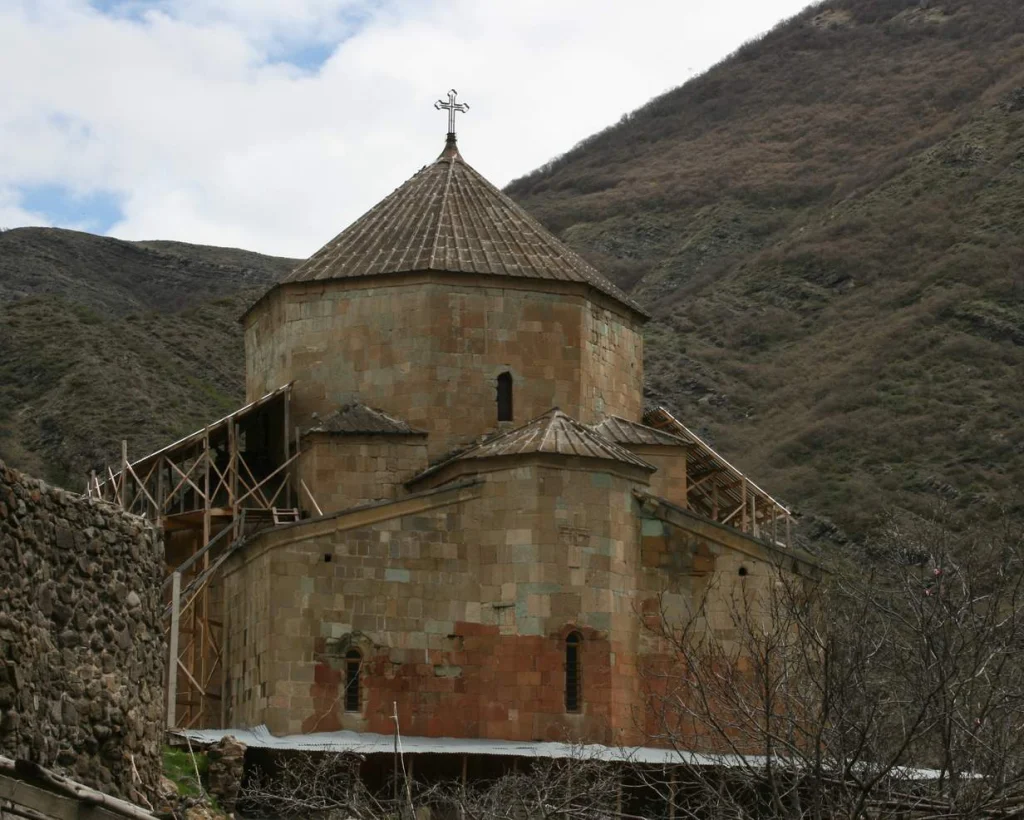
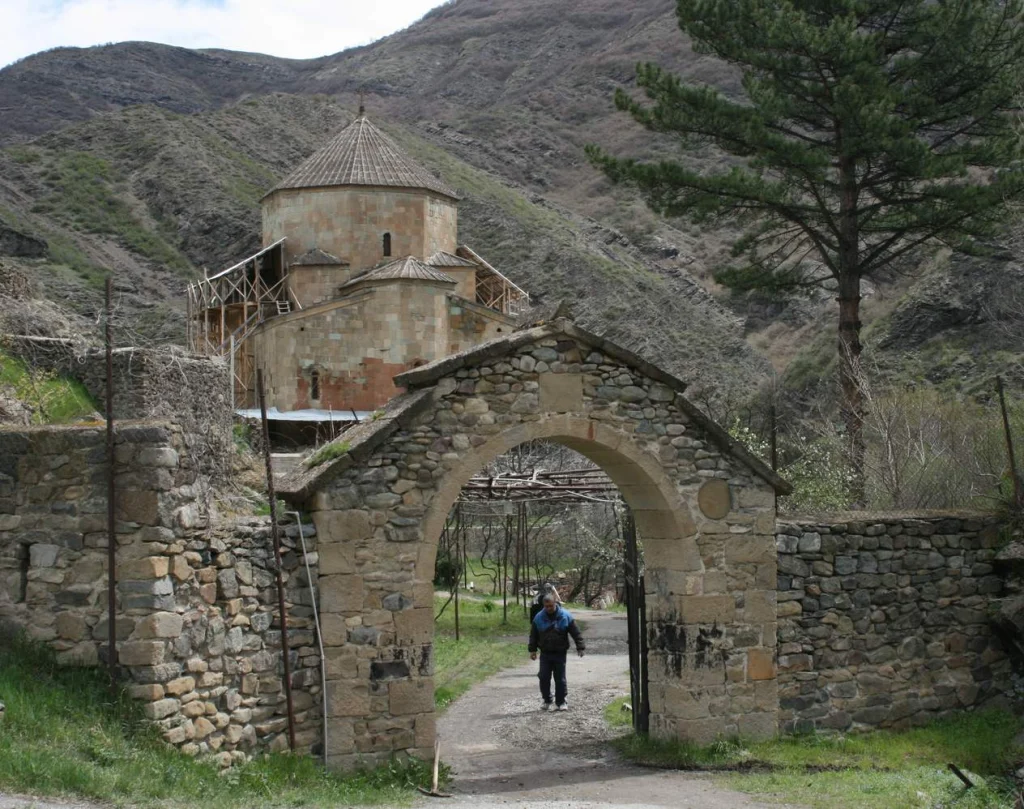
Ateni Sioni stands on a low terrace above the Tana river, about 10 kilometres south of Gori, inside the narrow Ateni gorge. The building is a tetraconch, or four-apse, cross-dome church built of dressed grey-yellow stone, with a drum and dome rising over the crossing. Architecturally it belongs to the same early 7th-century group as Jvari Monastery, sharing the stepped, centrally planned layout that Georgian builders used for a short period before church plans shifted toward longer basilicas.
The exterior carries carved stone friezes similar in style to those at Jvari: vine scrolls, animal figures and a well-known relief of a mounted hunter on the south facade. Inside, the walls are covered with fresco layers from several periods, the most extensive dating to the 11th century, including donor portraits of local nobility and scenes from the life of the Virgin, to whom the church is dedicated (Sioni churches in Georgia are usually linked to the Dormition). Traces of earlier, 7th to 9th-century painting survive beneath later layers in places. The church is still consecrated and used for services, so visitors share the space with an active parish rather than a museum interior.
History
Construction is dated by art historians to the first half of the 7th century, placing Ateni Sioni among the small group of early medieval tetraconch churches that also includes Jvari Monastery near Mtskheta. The Ateni valley was a populated and defended district of Kartli through the early medieval and feudal periods, and the church’s reliefs and masonry are studied together with Jvari’s as evidence of a shared school of builders. The 11th-century fresco programme was added during a period of extensive church decoration across Kartli, and later layers and repairs reflect the area’s exposure to Persian, Ottoman and local feudal conflict in subsequent centuries. The church and its frescoes underwent a documented conservation project supported by the United States Ambassadors Fund for Cultural Preservation, reported as completed in 2017, which addressed moisture damage and losses in the painted plaster (Agenda.ge). The building is registered as an immovable cultural heritage monument of national significance under Georgian heritage law, placing it under the protection of the national heritage agency (Heritage Sites of Georgia).
Opening hours and tickets
| Item | Usual pattern |
|---|---|
| Access | Open as an active church, roughly daylight hours, no fixed timetable posted |
| Entry fee | None; donations welcome |
| Guided access | A caretaker or priest may need to unlock the interior; a local guide or driver who knows the village helps |
There is no ticket office and no published schedule online. Hours can shift around services, feast days and the caretaker’s availability, so treat the above as a general pattern, checked at booking.
How to get there
From Tbilisi, Ateni Sioni is about 95 kilometres, roughly 1 hour 25 minutes by car via Gori on the main Tbilisi–Gori highway, then a signed side road south into the Ateni gorge. From Gori itself the drive is about 15 to 20 minutes. There is no direct marshrutka to the village; the practical public option is a taxi from Gori’s town centre or bus station. From Kutaisi, allow around 2 hours 30 minutes by car via Gori. With GTour, the church can be added to a private car-with-driver day from Tbilisi (from €150 per day, sedan, up to 10 hours and 250 km) combined with Gori and Uplistsikhe, since it is not currently on our fixed-itinerary Gori & Uplistsikhe day trip.
How long and the best time
Allow 30 to 45 minutes at the church itself, longer if the interior is open and you want to study the frescoes closely. Combine it with a half or full day that also covers Gori’s fortress, the Stalin Museum and Uplistsikhe, which together make a full day from Tbilisi. Spring and autumn bring the mildest weather and the clearest light for the exterior reliefs; the gorge is shaded and can feel cool even when Gori is warm. Visit on a weekday morning to improve the chance of finding the church unlocked and quiet.
Tips
- Dress modestly, as at any active Georgian Orthodox church: covered shoulders and knees, headscarves for women are available at the entrance if needed.
- Photography of the exterior reliefs is straightforward in daylight; interior photography of frescoes may be restricted during services, ask first.
- The access road narrows in the village; a sedan is fine in dry weather, but check conditions after heavy rain.
- There are no queues, this is a quiet rural site, but that also means no staffed ticket desk or fixed opening times.
- The Ateni valley produces local wine, including the semi-sweet style associated with the area, and small roadside cellars sometimes offer tastings.
Nearby
- Gori Fortress
- Stalin Museum, Gori
- Uplistsikhe cave town
- Ateni gorge wine cellars
Ateni Sioni Church is on these private tours: Gonio Fortress, Sarpi and the Batumi Botanical Garden · Racha in a Day — Shaori Lake, Nikortsminda and Khvanchkara · Mtskheta, Gori and Uplistsikhe — Kartli in a Day. A travel expert adapts any of them to your dates.
Questions
Is Ateni Sioni the same style as Jvari Monastery?
Yes, both are early 7th-century tetraconch cross-dome churches attributed to the same architectural tradition in Kartli.
Is there an entrance fee?
No fixed fee; the church is an active parish and accepts donations, checked at booking.
Can I visit Ateni Sioni and Uplistsikhe in one day from Tbilisi?
Yes, both can be combined with Gori on a single private day trip by car, roughly 9 to 10 hours round trip.
Are the frescoes always visible?
Access depends on whether the church is unlocked; a local guide or driver can often help arrange entry.
Sources
Ateni Sioni church nestled among vineyards and mountains near Gori, Georgia. · Photo: Alf Altendorf / Wikimedia Commons, CC BY-SA 2.0