

Abastumani Astrophysical Observatory — opening hours, tickets, how to get there and what to see
Abastumani Astrophysical Observatory is a working research observatory on the forested slopes above the spa town of Abastumani, in the Samtskhe-Javakheti region of southern Georgia, at roughly 1,650 metres above sea level. Founded in 1932 by the Georgian astronomer Evgeni Kharadze, it grew into one of the principal observatories of the Soviet Union and remains Georgia’s national astrophysics institute, now run by Ilia State University. Travellers visit for the Soviet-era telescope domes, the views over the Lesser Caucasus, and occasional evening stargazing sessions that must be arranged in advance.
What you see
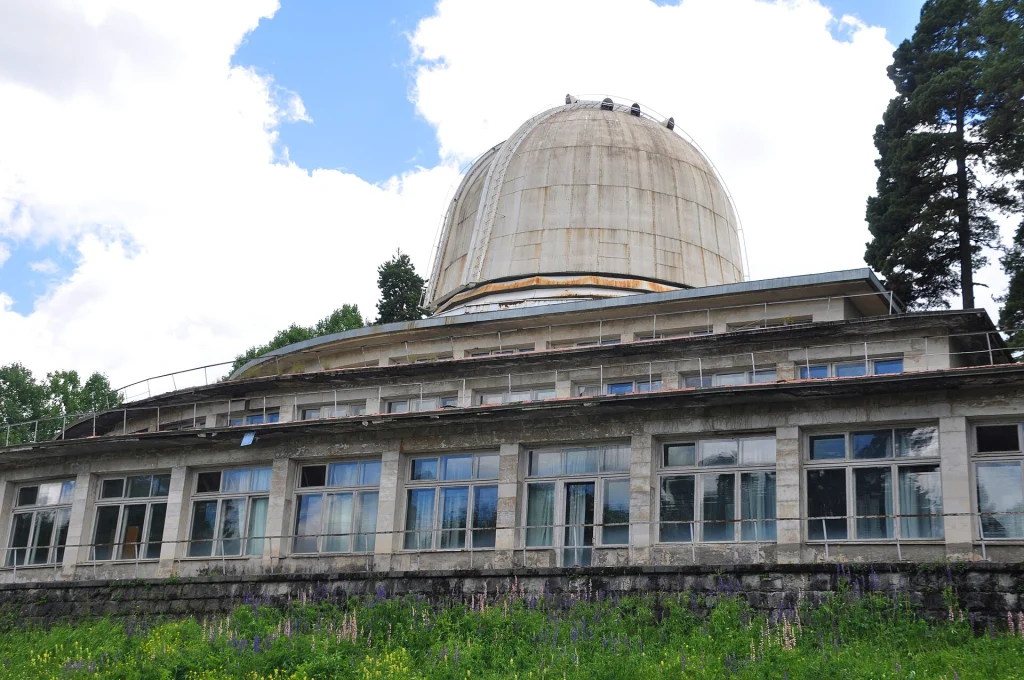
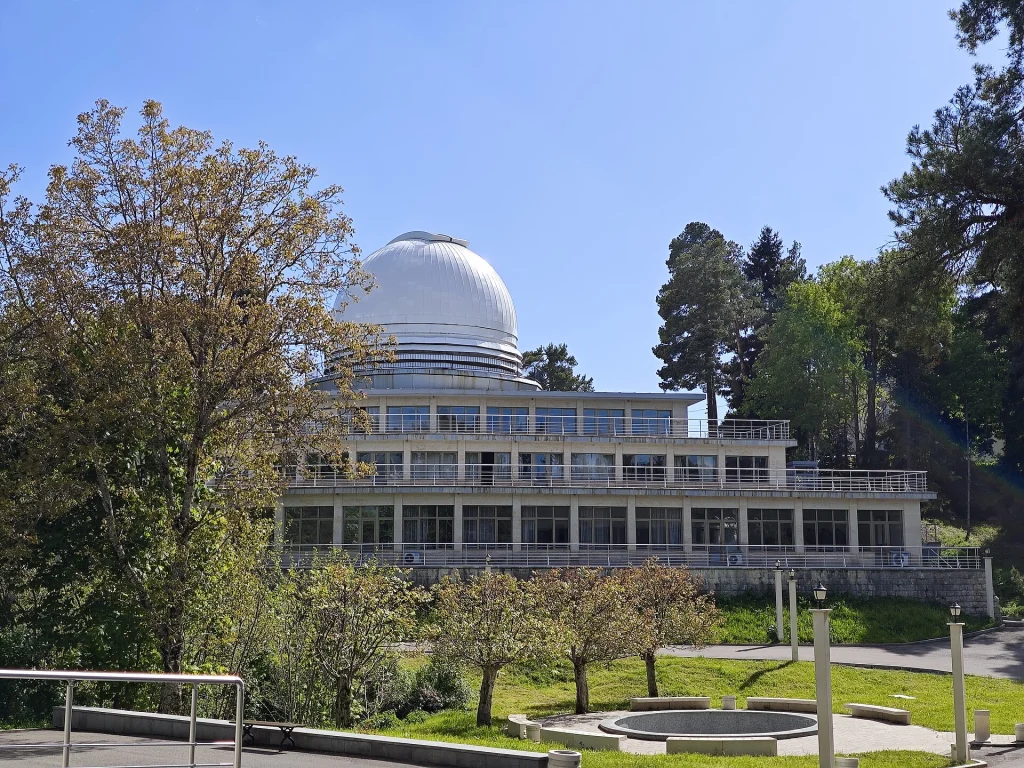
The observatory complex sits on a wooded ridge a short drive above Abastumani town, reached by a steep access road through pine and fir forest. The grounds hold a cluster of white telescope domes built between the 1930s and the 1970s, service buildings, and staff housing from the same period, giving the place the feel of a small scientific village rather than a single monument. The largest instrument is a reflecting telescope installed in the 1950s, alongside a Schmidt-type telescope once used for systematic photographic surveys of asteroids and comets; a solar tower telescope stands apart from the main cluster. Most domes are not open for walk-in interior visits, so the usual experience is seeing the exteriors, the mountain setting, and, where arranged, a guided look at one working instrument.
History
The observatory was founded in 1932 on the initiative of Evgeni Kharadze, who directed it for much of the Soviet period and after whom it is now officially named. It developed as part of the Georgian branch of the Soviet Academy of Sciences, benefiting from Abastumani’s clear mountain air and relatively stable atmosphere, qualities that had already made the town a nineteenth-century health resort. From the 1960s through the 1980s, astronomers at Abastumani ran a long-running photographic search programme that contributed to the discovery and cataloguing of numerous minor planets, several named after Georgian cultural and scientific figures. After the Soviet Union’s collapse, state funding fell sharply and some instruments fell into disuse. In 2006 the observatory was transferred into Ilia State University, which still operates it as Georgia’s national astrophysical research institute and maintains the site described on the university’s observatory page. The wider Abastumani resort, including the observatory’s access road and nearby Romanov-era buildings, is covered in regional tourism material from the national tourism administration, and the observatory’s status as part of Georgia’s scientific infrastructure is noted in material from the Ministry of Education, Science and Youth.
Opening hours and tickets
This is an active research facility, not a conventional museum, and it does not keep fixed public visiting hours. Daytime views of the domes from outside the perimeter are generally possible without formal arrangement; entry to telescope buildings or evening observing sessions depends on staff availability and is usually arranged in advance through a local guide, guesthouse, or the university. There is no posted ticket price structure; group stargazing sessions, where offered, are typically paid informally on the day. Treat the figures below as the usual pattern and confirm specifics when booking.
| Access | Usual pattern |
|---|---|
| Grounds and dome exteriors | Daylight hours, no fixed schedule, checked at booking |
| Interior or telescope demonstration | By prior arrangement only, subject to staff availability |
| Evening stargazing | Clear nights, arranged in advance via guide or guesthouse, checked at booking |
How to get there
Abastumani town is about 3 hours 55 minutes by road from Tbilisi, 4 hours 10 minutes from Kutaisi, and 5 hours 55 minutes from Batumi, via the Borjomi valley and Akhaltsikhe road. From the town centre, the observatory is a further climb of roughly 8 to 9 kilometres up a narrow mountain road, about 20 to 30 minutes by car; there is no marshrutka or train service to the observatory itself, so a taxi arranged in town or a private vehicle is the only practical option. With us, this is best done as part of a private car-with-driver day from Tbilisi, Borjomi, or Akhaltsikhe, or combined with our Vardzia, Rabati & Borjomi — 2 Days tour or Borjomi, Bakuriani & Rabati — 2 Days tour, with the observatory added as a half-day detour; see https://gtour.ge/tour/vardzia-rabati-borjomi/ and https://gtour.ge/tour/borjomi-bakuriani-rabati-2-days/.
How long and the best time
Allow 1 to 2 hours at the site itself, plus driving time from Abastumani town or from Borjomi. May to October is the most reliable period, with clear roads and a reasonable chance of a clear night sky for stargazing; the access road can be icy or snow-covered in winter. Evening visits depend entirely on weather and should be confirmed on the day, since cloud cover in the Lesser Caucasus can change quickly.
Tips
- Bring warm layers even in summer; the site is colder and windier after dark than the town below.
- Photograph the domes and the forest setting freely from outside; interior photography depends on staff permission during an arranged visit.
- Check weather and cloud forecasts before planning a stargazing evening, since sessions are cancelled in overcast conditions.
- There are no ticket queues, but there is also no visitor centre, café, or fixed staff presence, so arrange access in advance rather than arriving unannounced.
- Combine the visit with a night in Abastumani town, which has its own Romanov-era park and church, and with Borjomi or Akhaltsikhe for a fuller day.
Nearby
- Abastumani town centre and Romanov-era park
- Zekari Pass
- Borjomi-Kharagauli National Park
- Rabati Castle, Akhaltsikhe
- Vardzia cave monastery
Abastumani Astrophysical Observatory is on these private tours: Georgia Classic in 7 Days — Tbilisi, Kazbegi, Kakheti and Mtskheta · Culinary Georgia in 6 Days — Tbilisi, Kakheti, Imereti and the Sea · Tbilisi Market and Street-Food Walk — Dezerter Bazaar to the Old Town. A travel expert adapts any of them to your dates.
Questions
Can visitors go inside the observatory domes?
Not casually; interior access or telescope demonstrations require prior arrangement with staff or a local guide, subject to availability.
Is there a fixed entrance fee?
No published fixed ticket price; any charge for a guided or evening visit is agreed locally and should be confirmed when booking.
How do I get from Abastumani town to the observatory?
By taxi or private car up a mountain road of about 8 to 9 kilometres; there is no public transport to the site.
What is the observatory best known for?
A long-running Soviet-era programme, from the 1960s to the 1980s, that discovered and catalogued numerous asteroids using its Schmidt telescope.
Sources
The main building and dome of Abastumani Astrophysical Observatory in Georgia. · Photo: Sarah Murray from South Bend, IN, USA / Wikimedia Commons, CC BY-SA 2.0