

By Mariam Lomidze, Culture & Events Reporter · 28/10/2026
For most visitors the cheapest and simplest way to get lari is a mix: withdraw cash from a bank ATM inside Georgia using a debit or credit card, pay by card wherever possible, and carry a modest cash float for villages, marshrutkas, small guesthouses and market stalls. Street exchange booths in Tbilisi, Batumi and Kutaisi are legitimate and often give rates close to the National Bank of Georgia’s official reference rate, but airport booths and hotel desks are usually the worst value. The single costliest mistake is agreeing to “pay in your home currency” at a card terminal or ATM abroad, known as dynamic currency conversion, which almost always costs more than letting the Georgian bank convert at its own rate.
On 27 October 2026 the National Bank of Georgia’s reference rate was GEL 2.9082 per euro and GEL 2.5966 per US dollar. This official rate moves daily and is only a benchmark; commercial banks and exchange booths apply their own spread around it. Because the rate changes every business day, treat any figure in this guide as indicative and check the current rate before you travel.
How the lari works and the NBG reference rate
Georgia’s currency is the lari (GEL), divided into 100 tetri. It floats freely and the National Bank of Georgia publishes a daily reference rate used as a benchmark by banks, exchange offices and government bodies. It is not the rate you will personally receive. Banks and licensed exchange bureaus set their own buy and sell rates around it, with a spread that is typically small for major currencies (euro, US dollar, British pound) and wider for less common ones. Georgia has no capital controls on bringing cash in or out for personal travel, but amounts above a threshold set by customs legislation must be declared in writing when crossing the border; if you are carrying a large sum, check current limits with the relevant Georgian authority before you fly rather than relying on hearsay.
Exchange offices vs banks vs airport counters
Private exchange booths (“sakurs valutad gacvla”) are common on Rustaveli Avenue, around Liberty Square, in Batumi’s Old Town and near Kutaisi’s Green Bazaar. They are licensed, quote live buy and sell rates on an electronic board, require no commission beyond the spread, and usually beat bank branches for cash-to-cash exchange of euros and dollars. Compare two or three boards before committing, since rates can differ meaningfully between booths fifty metres apart, especially outside business hours or at weekends.
- Street exchange bureaus — best rates for cash, no paperwork for small amounts, open long hours in city centres.
- Bank branches — reliable and regulated, slightly wider spread than street booths, useful for larger sums or if a booth looks unlicensed.
- Airport counters (Tbilisi, Kutaisi, Batumi) — convenient on arrival for a small amount of immediate cash, but consistently the worst rates in the country; change only enough for a taxi or your first meal.
- Hotel reception — avoid for anything beyond pocket change; rates are rarely competitive.
Never exchange money with people approaching you on the street outside a licensed booth, and always count the lari handed to you before you leave the counter.
ATMs: withdrawal limits and fees
ATMs are plentiful in every town and most villages with a paved road, run chiefly by Bank of Georgia, TBC Bank and Liberty Bank, plus smaller networks. Withdrawing lari from a Georgian ATM with a foreign Visa or Mastercard is usually the best overall value once you add up exchange margin and convenience, because the conversion uses the card network’s rate rather than a tourist spread.
| Bank | What to expect | Notes |
|---|---|---|
| Bank of Georgia | Dense ATM network in cities and larger towns; per-withdrawal and daily limits set per card type | Machines sometimes offer a DCC choice at the screen — always select “lari”/GEL, not your home currency |
| TBC Bank | Equally widespread; app-based rate and fee disclosure before each withdrawal | Some TBC machines allow higher single withdrawals than smaller banks |
| Liberty Bank | Strongest presence in smaller towns and rural areas, including many mountain regions | Useful fallback where Bank of Georgia or TBC machines are scarce |
Exact withdrawal caps and the flat fee charged for a foreign card change over time and depend on your own card issuer as much as the Georgian bank, so do not rely on a fixed number. Before departure, check your home bank’s foreign ATM fee and daily limit, and once in Georgia, read the fee shown on the ATM screen before confirming — you can always cancel and try a different machine or bank if the quoted fee looks high. Withdrawing a slightly larger amount less often reduces the number of flat per-transaction fees you pay.
Cards and the dynamic currency conversion trap
Dynamic currency conversion, or DCC, happens when a card terminal or ATM offers to charge you in your home currency “for your convenience” instead of in lari. The exchange rate used for DCC is set by the terminal operator or acquiring bank, not by Visa or Mastercard, and is almost always worse than your card issuer’s own rate, sometimes by several percent. The rule is simple: whenever a machine or card terminal asks “charge in EUR/USD/GBP or GEL”, always choose GEL. If a cashier or waiter asks the same question verbally, say “in lari, please.” This applies equally to hotel bills, restaurant card machines and ATMs.
Card acceptance in villages
Card acceptance is near-universal in Tbilisi, Batumi, Kutaisi, Telavi and other regional centres, including most restaurants, supermarkets and mid-range hotels. It thins out quickly once you leave the main towns. In mountain villages such as those in Svaneti, Tusheti, Khevsureti, Racha and much of rural Adjara, many guesthouses, family cellars, small shops and minibus drivers take cash only, and mobile signal is too patchy in places for a card terminal to connect reliably. Road tolls do not exist in Georgia, but informal parking attendants, rural fuel stations and roadside fruit stalls generally expect cash. If you are travelling with a driver or guide on a multi-day itinerary, for example a Svaneti by 4×4 or Tusheti by 4×4 trip, ask in advance which stops are cash-only and carry enough small-denomination lari notes, since change for a 100 GEL note is not always available in a village shop.
How much cash to carry
A reasonable working rule for leisure travellers in 2026 is to carry the lari equivalent of two to three days of expected spending in cash, topped up from ATMs as needed, with a larger cash reserve only for multi-day mountain routes where machines disappear. For a Tbilisi-based city trip, GEL 200 to 400 in small notes (10s, 20s, 50s) covers taxis, markets, tips and incidentals between card payments. For a trip into Tusheti, Khevsureti, Svaneti or rural Racha, carry enough cash for the whole stretch where you expect no ATM, plus a margin, since the nearest working machine may be a full day’s drive away.
- City break (Tbilisi, Batumi, Kutaisi): GEL 200–400 cash, card for the rest.
- Kakheti wine country day trips or overnight stays: GEL 150–300, since many cellars and family guesthouses still prefer cash for tastings and homestays.
- Multi-day mountain routes (Svaneti, Tusheti, Khevsureti, Racha): carry most of your expected spending in cash before departure, as the last reliable ATM is usually in the regional town (Mestia, Telavi, Ambrolauri) rather than the villages themselves.
If this guide is part of a trip you are planning, our Georgia in 4 Days — Tbilisi, Kazbegi and Kakheti and Sighnaghi at Sunset — Afternoon Wine Trip from Tbilisi cover the places it describes with a private guide and driver; a GTour travel expert adapts the route to your dates.
Practical summary
- Check the National Bank of Georgia’s daily reference rate before travel as a benchmark, not as the rate you will receive.
- Exchange only a small amount at the airport; use street bureaus or bank branches in town for better rates, and compare two or three boards.
- Withdraw lari from Bank of Georgia, TBC or Liberty ATMs with a foreign card for the best overall value; read the fee shown on screen before confirming.
- Always choose to be charged in GEL, never in your home currency, at any ATM or card terminal — refuse dynamic currency conversion every time.
- Expect cash-only conditions once you leave main towns, especially in Svaneti, Tusheti, Khevsureti, Racha and rural Adjara; stock up on small notes before heading into the mountains.
- Carry GEL 200–400 for a city stay, more for multi-day mountain routes where ATMs are scarce or absent.
- If carrying a large sum of cash across the border, check Georgia’s current customs declaration threshold before you fly.
Sources
- Georgian National Tourism Administration
- Georgia Travel official tourism portal
- Ministry of Economy and Sustainable Development
- National Statistics Office of Georgia
- Legislative Herald of Georgia (Matsne)
- Government of Georgia portal
- Ministry of Foreign Affairs of Georgia
Questions this guide does not answer? Write to info@castle.ge or WhatsApp +995 577 41 63 14 — a person in Tbilisi replies. See also our travel services and all guides.
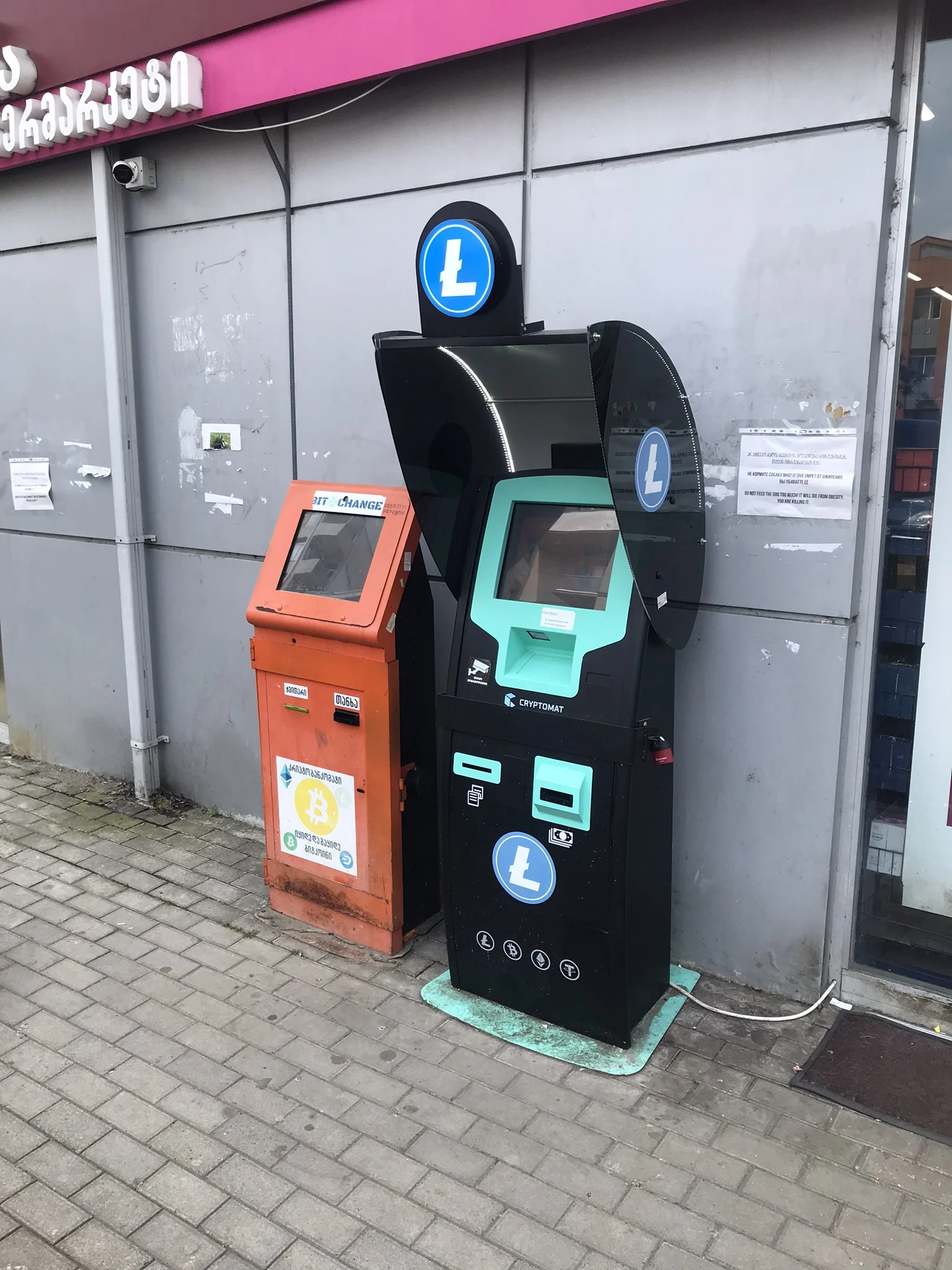
A cryptocurrency and currency exchange kiosk on a street in Batumi, Georgia. · Photo: Vitaly Zdanevich / Wikimedia Commons, CC BY 4.0
Been to Georgia? Tell us how it went — the best stories are published here.
Share your tripOne email a week: what changed for travellers in Georgia — rules, roads, flights, seasons — plus one place worth the trip. Written by the GTour desk, no advertising, unsubscribe in one click.
This story across our partner network — ქართულად: შენი დასვენება