

By Nino Gelashvili, Travel News Editor · 30/10/2026
The four trails serious hikers ask about are Mestia to Ushguli in Svaneti, Juta to Roshka over the Chaukhi Pass in Khevsureti, Omalo to Shatili across the Atsunta Pass linking Tusheti and Khevsureti, and the Lagodekhi routes to Black Rock Lake on the Dagestan border. All four are walkable without technical climbing gear, all four demand real fitness and weather sense, and all four are best attempted between mid-June and late September, with July and August the reliable window at altitude. None require a specialist mountaineering guide, but Omalo–Shatili and the high passes above Juta are remote enough that a local guide, a satellite messenger and a flexible schedule are not luxuries.
Georgia’s hiking infrastructure is improving but remains uneven: expect good guesthouse networks in Svaneti and Tusheti, sparser facilities in Khevsureti, and a well-run protected-area system in Lagodekhi. Mobile signal is patchy or absent on the high passes, border-zone rules apply in Tusheti, Khevsureti and along the Lagodekhi frontier, and shepherd dogs are a genuine, manageable hazard from June through September. The sections below cover each trail, the season windows, where to sleep, and the permits, rescue and water questions that come up every year.
The four great trails at a glance
| Trail | Typical days | Approx. distance | High point | Difficulty | Best season |
|---|---|---|---|---|---|
| Mestia–Ushguli | 3–4 | 55–65 km | ~2,700 m (ridge variants) | Moderate | mid-June to September |
| Juta–Roshka (Chaukhi Pass) | 1–2 | ~17 km one way | 2,700 m | Moderate to strenuous | July to mid-September |
| Omalo–Shatili (Atsunta Pass) | 4–6 | 60–70 km | ~2,900 m | Strenuous | mid-July to mid-September |
| Lagodekhi (Black Rock Lake) | 2–3 | 35–42 km round trip | ~2,750 m | Moderate | June to October |
Distances and altitudes vary by route variant and are approximate; check current trail notes with the Agency of Protected Areas before you go, since reroutes and bridge closures happen after flood years.
Mestia to Ushguli, Svaneti
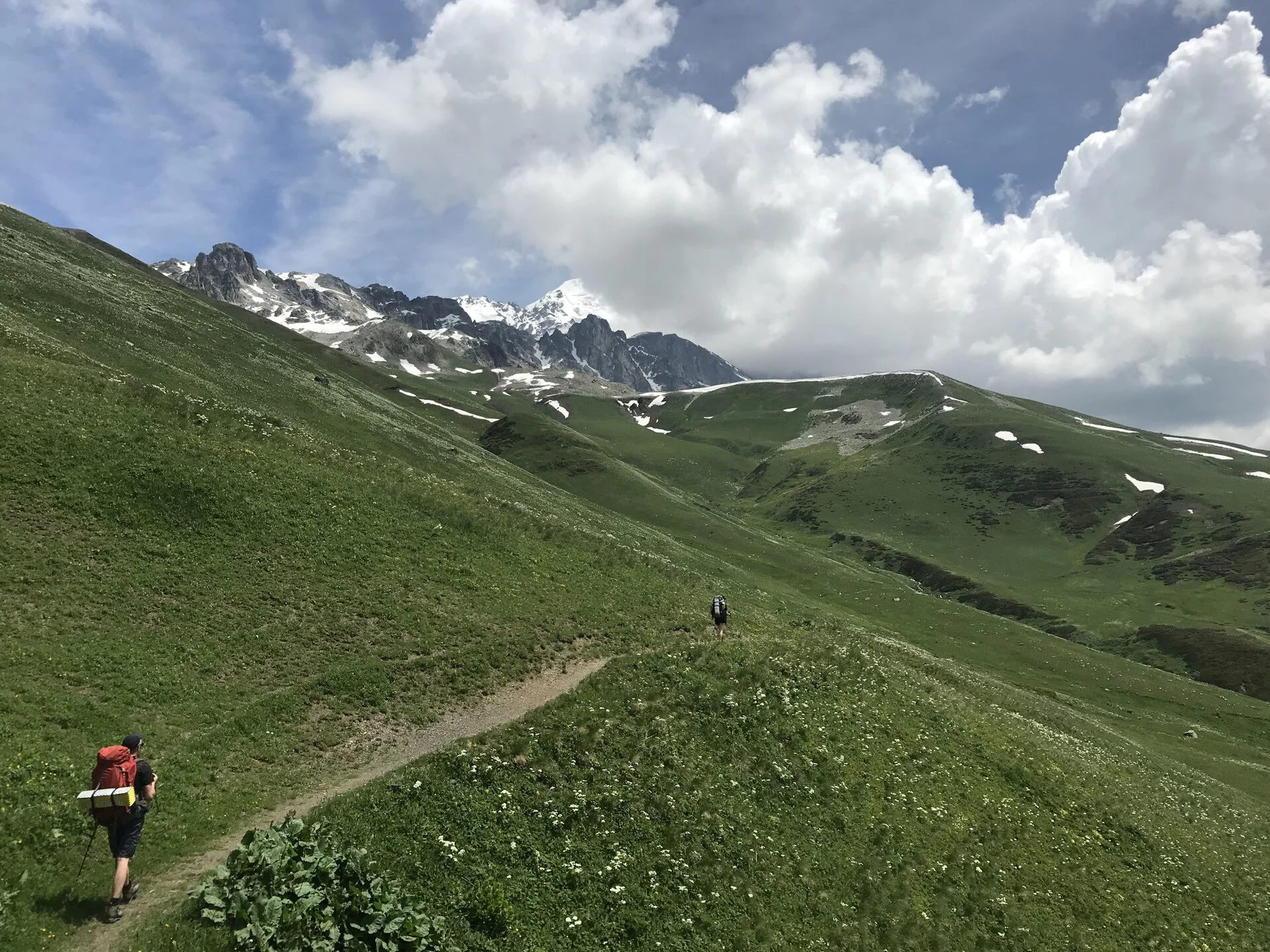
This is Georgia’s best-known multi-day walk, following old inter-village paths past Ushba and the Svan defensive towers, with a night or two in family guesthouses in Zhabeshi, Adishi or Iprali depending on the route chosen. Three days is tight but doable for fit walkers; four is more comfortable and allows the Adishi glacier crossing to be done in daylight rather than a rush. Glacial rivers near Adishi can run high after rain or on hot afternoons when snowmelt peaks, so mornings are the safer time to cross and a guide who knows that day’s water level is worth the fee. We run this as the Mestia Ushguli Trek 4 Days and as part of the Mestia and Ushguli 3 Days itinerary for travellers who want transfers at each end rather than a full point-to-point trek.
Juta to Roshka over the Chaukhi Pass
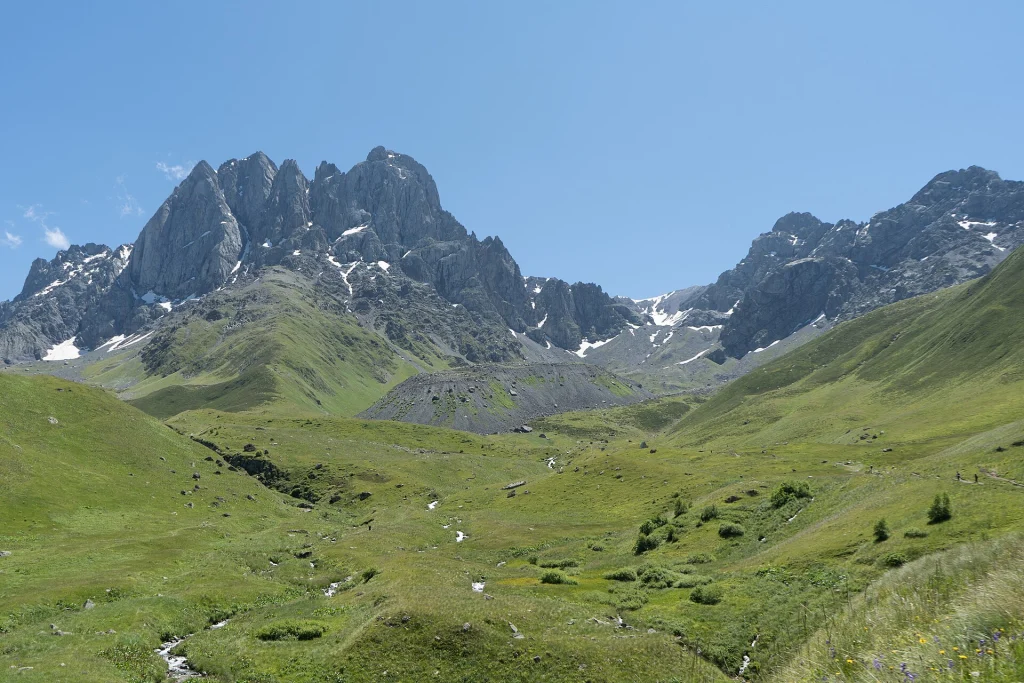
This is the most accessible of the four: a single long day from Juta, above Kazbegi, over the 2,700-metre Chaukhi Pass and down past the Abudelauri lakes to Roshka in Khevsureti. Fit hikers do it in 8–10 hours; most people prefer to camp or stay a night in Roshka and continue or return the next day, and some extend onward toward Shatili for a longer Khevsureti circuit. The pass holds snow into July most years and afternoon thunderstorms build quickly above the tree line in August, so an early start is standard advice from local guides, not caution for its own sake. We offer this as a single Chaukhi Pass Day Hike and as a slower three-day version, Juta, Chaukhi Pass and Roshka 3 Days, with a night in each village.
Omalo to Shatili over the Atsunta Pass
The toughest and least crowded of the four, this route links Tusheti and Khevsureti across the roughly 2,900-metre Atsunta Pass, usually in five to six days with nights in Dartlo, Girevi, Shatili or wild camps between. There is no vehicle access across the pass, no mobile signal for long stretches, and limited resupply, so parties typically carry several days of food and a tent even when planning to use guesthouses at the ends. This is squarely in the territory where a local guide and a satellite communicator change the risk profile for the better; several guesthouse owners in Omalo and Shatili also work as trekking guides. We run the full crossing as Tusheti to Khevsureti Omalo to Shatili over the Atsunta Pass 6 Days, and for travellers who prefer the villages without the high pass, the Khevsureti and Tusheti by 4×4 5 Days and the Shatili and Mutso Day Trip cover the same valleys by road.
Lagodekhi: Black Rock Lake and the eastern forests
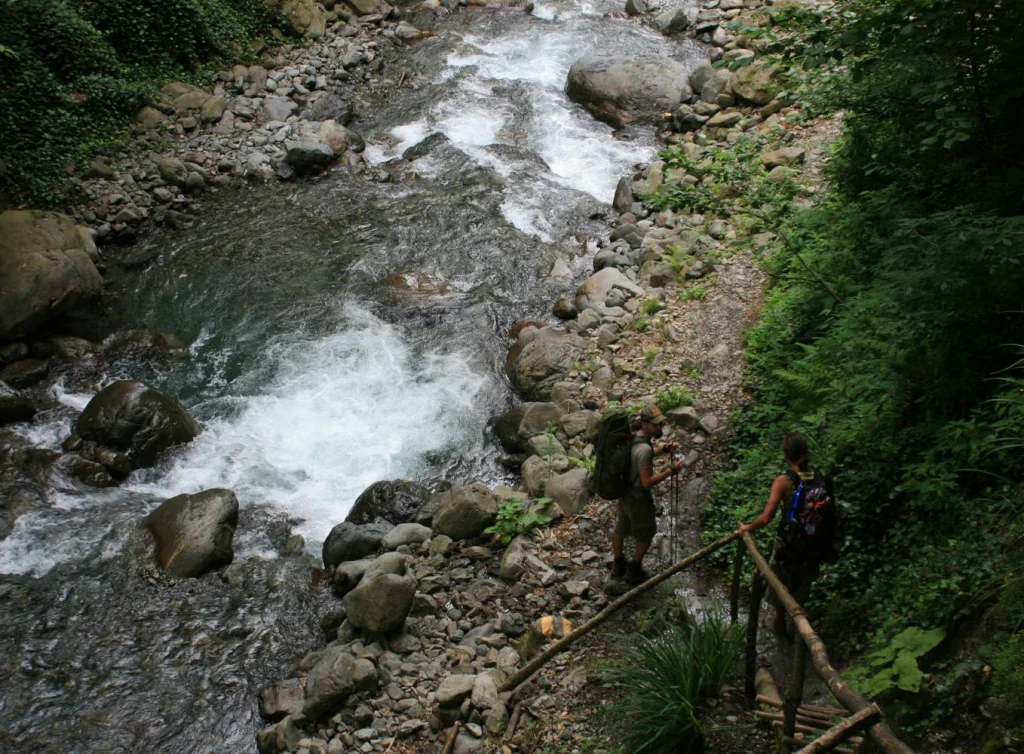
Lagodekhi Protected Areas, on the Dagestan border in the far east, is Georgia’s oldest reserve and the most formally managed of the four destinations: marked trails, ranger huts, a visitor centre and an online booking system through the Agency of Protected Areas. The classic trek to Black Rock Lake (Ninigori) is a two to three-day there-and-back through beech forest into subalpine meadow, well within reach of a moderately fit hiker, with simpler waymarking than the high passes further north. It suits people who want a genuine wilderness trek without the remoteness of Tusheti. Our Black Rock Lake Trek 2 Days in Lagodekhi and the longer Lagodekhi Black Rock Lake Trek 3 Days both use the park’s registered route.
Season windows and weather
Snow typically clears from the high passes (Chaukhi, Atsunta, the Svaneti ridge routes) from mid-June, and the first autumn snow can close them again from late September, sometimes earlier in a cold year. July and August are the dependable months; June and September are workable for lower-altitude sections but risk a closed pass. Afternoon thunderstorms are routine in the Caucasus in summer, which is why guides start before dawn on pass days. Check short-range mountain forecasts from the National Environment Agency before committing to a pass crossing, and build a spare day into any itinerary that depends on one weather window.
Guesthouses, huts and camping
Svaneti and Tusheti have the most developed family guesthouse networks of the four regions: simple rooms, home-cooked dinners, and owners who know the trail conditions better than any app. Khevsureti has fewer beds, so booking ahead in Roshka and Shatili matters in August. Lagodekhi’s park huts and campsites are bookable through the protected area’s own reservation system. Wild camping is widely tolerated outside protected-area restrictions but is not a substitute for asking locally about water sources, dog-guarded flocks and river crossings that change with the season. A tent, a stove and at least one emergency bivy remain sensible even on guesthouse-to-guesthouse routes, since any of these trails can strand a party above a swollen river for a night.
Border zone permits, rescue, dogs, water and the Transcaucasian Trail
- Border zone permits: parts of Tusheti, Khevsureti and the Lagodekhi border strip sit inside Georgia’s border zone, which can require a permit obtained in advance or checked at a local police post. Rules and the list of affected villages are set by the Ministry of Internal Affairs and have changed before, so confirm current requirements through gov.ge or the travel advisory pages at mfa.gov.ge, and ask your guide or guesthouse host locally. On our own guided and 4×4 itineraries, including the Tusheti Expedition and Khevsureti and Tusheti by 4×4 5 Days, permit arrangements are handled on our side.
- Protected area rules: Lagodekhi and Borjomi-Kharagauli require advance registration and sometimes a modest entry fee, bookable through the Agency of Protected Areas. There is no fee for the open trails of Tusheti or Khevsureti, which fall outside this system.
- Rescue: dial 112 anywhere in Georgia for police, ambulance or mountain rescue; operators generally speak English. Save the number before you lose signal, carry a power bank, and where possible a satellite messenger on Omalo–Shatili and the higher Svaneti variants, since phone coverage disappears for hours at a time.
- Shepherd dogs: Caucasian shepherd and Tush dogs guard flocks from late spring to autumn and can be aggressive to strangers. Keep distance from flocks, do not run, let a shepherd call the dogs off if one appears, and a trekking pole held low is a standard, non-aggressive deterrent.
- Water: mountain springs away from grazing areas are generally drunk untreated by locals, but any stream below a pasture should be treated or filtered; carry a filter or tablets rather than relying on finding bottled water on the trail.
- Transcaucasian Trail: a long-distance route is being waymarked in stages across Georgia and Armenia by the volunteer-led Transcaucasian Trail Association, with completed and signed sections in Svaneti, Tusheti and Lagodekhi and others still in progress. Treat any map or app marking the TCT as a route-finding aid rather than a guarantee of signage, and confirm the current state of a specific stage before relying on it exclusively.
For most first-time visitors, a guided version of any of these trails, with transfers, permits and a knowledgeable guide arranged in advance, removes the largest share of the genuine risk without removing the experience. Options across all four trails, plus shorter day hikes such as the Svaneti Day Hikes around Mestia or the Gergeti Glacier and Kazbek Base Camp trek, are listed on our hiking pages.
If this guide is part of a trip you are planning, our Caucasus Highlands in 7 Days — Kazbegi, Khevsureti and Tusheti and Western Georgia in 6 Days — Kutaisi, Svaneti and the Sea cover the places it describes with a private guide and driver; a GTour travel expert adapts the route to your dates.
Practical summary
- Hike mid-June to late September; count on July–August for the Atsunta and Chaukhi passes.
- Mestia–Ushguli (3–4 days, moderate) and Lagodekhi’s Black Rock Lake (2–3 days, moderate) suit most fit hikers; Omalo–Shatili (4–6 days, strenuous) and the high passes above Juta need stronger legs and a weather buffer day.
- Book guesthouses ahead in Svaneti, Tusheti and Khevsureti in August; reserve park huts and campsites for Lagodekhi through the Agency of Protected Areas.
- Check border-zone permit rules for Tusheti, Khevsureti and the Lagodekhi frontier via gov.ge or mfa.gov.ge before travel.
- Save 112 for police, ambulance and mountain rescue; carry a power bank and, on remote passes, a satellite messenger.
- Give flocks and their guard dogs a wide, calm berth; treat or filter water drawn below pasture land.
- Treat Transcaucasian Trail markings as a work in progress and confirm the current status of any specific stage before relying on it.
Sources
- Georgian National Tourism Administration hiking
- Weather and mountain forecasts
- Travel advice for foreign visitors
- Road conditions and pass closures
- Mestia-Ushguli UNESCO Upper Svaneti Listing
- Lonely Planet Mestia to Ushguli Trek Guide
Questions this guide does not answer? Write to info@castle.ge or WhatsApp +995 577 41 63 14 — a person in Tbilisi replies. See also our travel services and all guides.
Hikers on the Mestia–Ushguli trail crossing green alpine meadows with snowy peaks behind. · Photo: GidiD / Wikimedia Commons, CC BY-SA 4.0
Been to Georgia? Tell us how it went — the best stories are published here.
Share your tripOne email a week: what changed for travellers in Georgia — rules, roads, flights, seasons — plus one place worth the trip. Written by the GTour desk, no advertising, unsubscribe in one click.
This story across our partner network — ქართულად: შენი დასვენება
