

By Mariam Lomidze, Culture & Events Reporter · 27/10/2026
Suriname and Georgia have almost no direct link: no embassy, no direct flight, and no sizeable community in either direction. That makes this a straightforward practical trip rather than a sentimental one. For most Surinamese passport holders, a visa or e-visa is likely to be required (Georgia’s visa-free list changes periodically, so check it before booking), the journey takes two flights with a change in Europe or the Gulf, the lari is the only currency that matters on the ground, and English covers tourist Tbilisi, Batumi, Kazbegi and Kakheti comfortably.
The honest summary: Georgia works well for a Surinamese traveller who plans ahead on the visa, carries a card and some cash, and accepts that this is a country to discover on its own terms rather than one with existing ties to home. Below is what to check, what to pack, and where a private guide from G Tour (gtour.ge) removes the friction.
Visa and entry rules for Surinamese citizens
Georgia operates a unilateral visa-free regime for a long list of countries, and that list is reviewed by the government from time to time, so a rule that is true in October 2026 can change by the following year. Surinamese citizens should not assume visa-free entry; the only reliable way to confirm your status is the consular page of Georgia’s Ministry of Foreign Affairs, geoconsul.gov.ge, which lists current visa categories and exemptions by nationality.
If Suriname is not on the visa-free list at the time you travel, you will need to apply for an electronic visa before departure through the official portal, evisa.gov.ge. The portal issues short-stay tourist e-visas, typically processed within a stated number of business days once the application, passport scan, photo and travel details are submitted; processing times are published on the portal itself and can lengthen around holidays, so apply at least two to three weeks before your flight. Do not rely on third-party visa agencies for Georgia; use the government portal directly and keep the approval PDF with you on arrival, since border officers may ask to see it alongside your passport.
Getting there from Suriname
There is no direct flight between Suriname and Georgia, and none is likely to appear soon given the small volume of traffic. Surinamese travellers from Paramaribo normally connect through Amsterdam, Miami or Panama City to reach one of the long-haul hubs that serve Tbilisi, then take a second flight into Georgia. The three hubs that realistically apply are:
- Istanbul — Turkish Airlines connects from Amsterdam, Miami and other Western hemisphere cities to Istanbul, with frequent onward flights to Tbilisi, Kutaisi and Batumi.
- Dubai — reachable via a European or North American gateway, with onward flights to Tbilisi.
- Doha — Qatar Airways serves Tbilisi from Doha, reachable via similar connections.
Warsaw and Munich hubs, useful for travellers from Western Europe, are a less natural fit from Suriname unless your first leg already routes through Amsterdam or another European city with onward LOT or Lufthansa connections. Check live routes and schedules directly with the airports you will use; Georgia’s own three international airports publish current destinations at tbilisiairport.com, kutaisiairport.com and batumiairport.com. Budget for a journey of roughly 18 to 24 hours door to door, including connection time, and build in a buffer at your transfer hub given the distance from Suriname.
Once you land, a pre-booked airport transfer avoids any confusion after a long journey; G Tour’s fixed-price transfers (gtour.ge/services) start at a set rate per car from Tbilisi airport into the city, with flight tracking and free waiting included.
Money, cards and cash
Georgia’s currency is the lari (GEL). On 27 October 2026 the National Bank of Georgia quoted approximately 2.60 GEL per US dollar and 2.91 GEL per euro; rates move daily, so check the current figure at nbg.gov.ge before you change money. Suriname dollars are not exchanged in Georgia, so plan to carry US dollars or euros in cash as a backup and use a card for the rest.
| Payment method | Where it works |
|---|---|
| Visa / Mastercard | Hotels, restaurants, supermarkets and most shops in Tbilisi, Batumi and Kutaisi; patchier in small mountain villages |
| Cash lari | Markets, minibuses (marshrutka), small guesthouses, mountain regions such as Svaneti and Tusheti |
| US dollars / euros | Exchangeable at licensed currency-exchange points in any town; not usually accepted directly for payment |
ATMs are common in cities and tourist towns but thin out in remote highland areas, so withdraw lari before heading to Kazbegi, Svaneti or Tusheti.
Staying connected: SIM and eSIM
Georgia’s mobile operators (Magticom, Silknet/Geocell and Beeline) sell inexpensive prepaid SIM cards at both airport arrivals and city kiosks, usually activated on the spot with a passport. If your phone supports eSIM, a travel eSIM bought before departure is the simplest option and avoids hunting for a physical SIM after a long journey. Coverage is reliable along main roads and in all three cities; expect gaps in high mountain valleys such as upper Svaneti or Tusheti.
Language, food and daily life
Georgian, written in its own script, is the official language, and it has no linguistic relation to Dutch, Sranan Tongo or the other languages commonly used in Suriname, so do not expect to recognise words on signage. English is spoken reasonably well by younger staff in hotels, tour operators and city restaurants, and reliably at the main sights. Russian remains a working second language for many older Georgians, which will not help a Surinamese traveller directly but explains why some signage is bilingual in Georgian and Russian rather than English. A translation app is worth having for menus and rural guesthouses.
Georgian food centres on bread, cheese and grilled or stewed meat, alongside a strong vegetarian backbone that suits travellers avoiding pork or seeking plant-based meals: lobio (bean stew), pkhali (vegetable pâtés with walnut), and the many bread and cheese pastries known as khachapuri. Khinkali, the filled dumpling, comes with meat or mushroom and potato fillings. Halal food is not the default in most of Georgia, but Adjara, the region around Batumi, has a historic Muslim population, and halal-labelled restaurants and butchers exist there and, in smaller numbers, in Tbilisi; it is reasonable to ask directly when booking a tour or restaurant. Georgian wine, made in clay qvevri vessels for thousands of years and recognised by UNESCO as part of the country’s intangible cultural heritage, is central to the table and to any Kakheti itinerary such as Kakheti Grand Wine & Heritage or the Rtveli harvest tours from gtour.ge.
Historical ties, diaspora and trade — an honest picture
There is little to report here, and it would be misleading to invent connections. Georgia and Suriname have no shared colonial, migratory or religious history, no meaningful diaspora in either direction, and no established direct trade relationship; Georgia’s National Statistics Office publishes external trade by partner country, and Suriname does not currently feature among Georgia’s listed trading partners, a fact you can check yourself at geostat.ge. The two states maintain only the ordinary minimal diplomatic recognition typical between a Caucasus and a Caribbean-rim country, with neither operating a resident embassy in the other. Practically, this means a Surinamese traveller should route consular questions through whichever Georgian mission is formally accredited to Suriname (confirm the current one via the missions list at mfa.gov.ge, since accreditations are reassigned from time to time) and should not expect any cultural shorthand on arrival; this is a trip best approached as pure discovery.
Health, insurance and safety etiquette
Georgia has at times required inbound foreign travellers to hold valid travel medical insurance, a rule introduced and adjusted around the pandemic years; whether it is in force, and in what form, for 2026 should be confirmed before departure on the e-visa portal, evisa.gov.ge, and on the government’s official information pages. Independent of any legal requirement, travel insurance covering medical evacuation is strongly advisable given the distance between Suriname and Georgia and the remoteness of some itineraries (Tusheti, Svaneti, high Caucasus passes). For any pre-travel vaccination or health question specific to your situation, consult your own physician and Georgia’s public health authority rather than general travel advice.
Georgia is a generally safe destination for independent travellers, including women travelling alone. Standard etiquette applies: modest dress and covered shoulders/legs when entering Orthodox churches and monasteries, a toast is customary (though never obligatory) if invited to a Georgian supra, and tipping 10 percent in restaurants is appreciated but not required. Mountain driving licence rules follow the general Law of Georgia on Road Traffic, available via matsne.gov.ge; a Surinamese driving licence printed in Latin script is generally usable for a limited period after entry, but an International Driving Permit removes any ambiguity at a rental counter or checkpoint, and renting a car for mountain routes without one is not advisable.
What a G Tour private guide adds
For a traveller coming this far with no shared language base, no familiar currency, and no existing travel infrastructure between the two countries, a private guide removes the guesswork rather than adding luxury. A G Tour licensed guide handles the Georgian-language side of hotel check-ins, menu questions and church etiquette, pre-arranges the airport transfer so there is no confrontation with unfamiliar taxi pricing after a 20-hour journey, and can tailor a route around halal or vegetarian needs in advance rather than improvising on the road. Day tours such as Tbilisi & Mtskheta — The Essential First Day or Kakheti Wine Country — Day Trip work well as a gentle introduction after the long flight, while multi-day routes like Georgia in 7 Days — The Classic Grand Tour suit a traveller who has already committed the time to get here and wants to see the country properly. Full pricing for guides, drivers and transfers is listed at gtour.ge/services.
If this guide is part of a trip you are planning, our Georgia in 10 Days — Tbilisi to Svaneti to the Sea and Monasteries of Georgia — Mtskheta, the Thirteen Fathers and Kakheti in 3 Days cover the places it describes with a private guide and driver; a GTour travel expert adapts the route to your dates.
Practical summary
- Confirm your visa status for Suriname passport holders on geoconsul.gov.ge before booking flights; apply on evisa.gov.ge if required, allowing two to three weeks.
- Expect two flights via Istanbul, Dubai or Doha; no direct or one-stop-only option exists from Paramaribo.
- Carry a card plus some US dollars or euros to exchange for lari; ATMs are reliable in cities, scarce in the high mountains.
- Buy a local SIM or activate an eSIM on arrival; coverage drops in Tusheti and upper Svaneti.
- English works in tourist Tbilisi, Batumi, Kazbegi and Kakheti; carry a translation app elsewhere.
- Halal and vegetarian food is findable, especially in Adjara; ask ahead when booking.
- There is no meaningful historical, trade or diaspora tie between Georgia and Suriname — treat this as a first-time discovery, not a heritage trip.
- Check current mandatory insurance rules on the e-visa portal and carry evacuation-level travel insurance regardless.
- Carry an International Driving Permit if you plan to self-drive in the mountains.
- Consider a private guide or driver for the first day or two to handle logistics while you adjust.
Sources
- Consular services and visa conditions
- Georgian diplomatic missions abroad
- National Bank of Georgia exchange rates
- Geostat external trade statistics
- Law of Georgia on Road Traffic
Questions this guide does not answer? Write to info@castle.ge or WhatsApp +995 577 41 63 14 — a person in Tbilisi replies. See also our travel services and all guides.
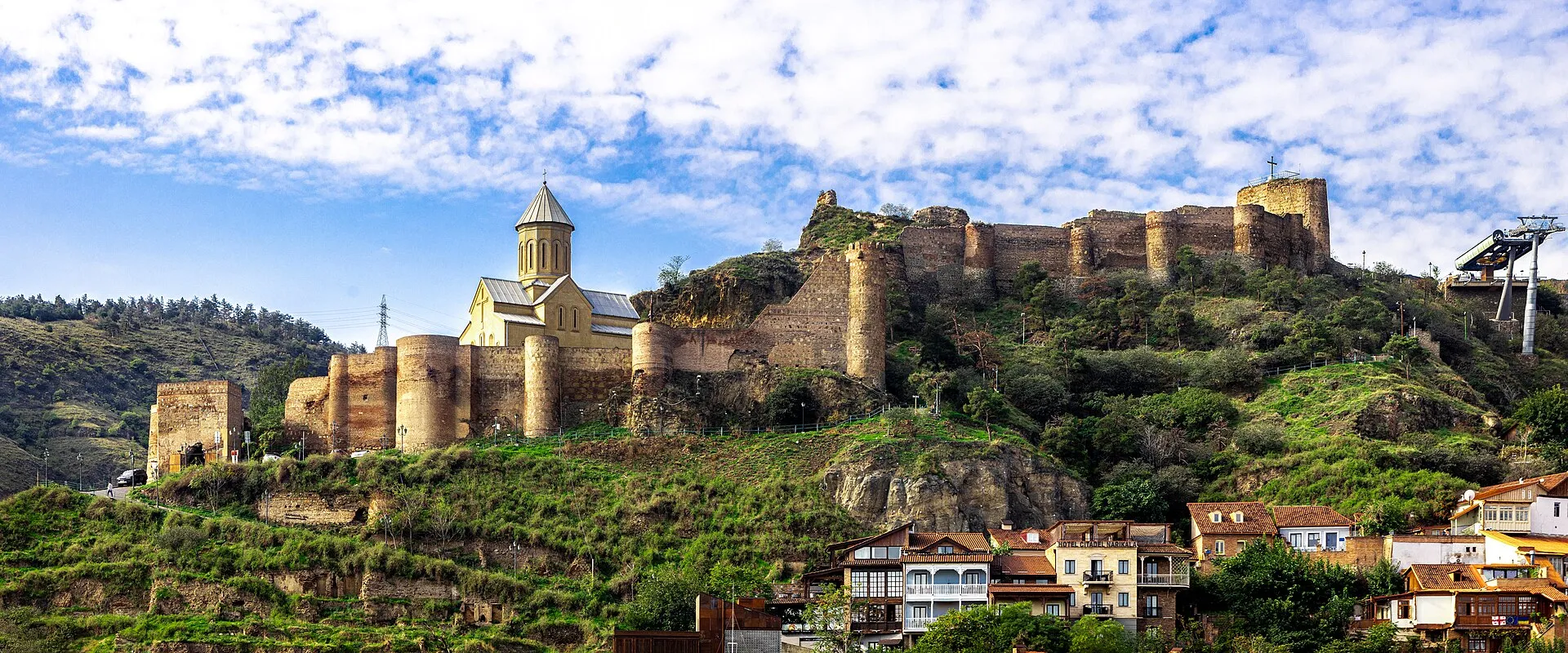
Narikala Fortress overlooks Tbilisi's old town, the city most Surinamese visitors will explore. · Photo: This Photo was taken by Supanut Arunoprayote.
Feel free to / Wikimedia Commons, CC BY 4.0
Been to Georgia? Tell us how it went — the best stories are published here.
Share your tripOne email a week: what changed for travellers in Georgia — rules, roads, flights, seasons — plus one place worth the trip. Written by the GTour desk, no advertising, unsubscribe in one click.
This story across our partner network — ქართულად: შენი დასვენება
