

By David Kiknadze, Transport & Openings Reporter · 27/10/2026
Serbian citizens travelling to Georgia in 2026 do not normally need a visa for short tourist stays, but the exact length of stay allowed, and whether that changes, is decided by the Georgian government and can be revised with little notice. The practical route for most Serbs is a one-stop flight through Istanbul, Munich, Doha or Warsaw, since there is no direct Belgrade–Tbilisi service at the time of writing. The currency is the Georgian lari (GEL), cards are accepted in Tbilisi, Batumi and Kutaisi but cash is still the norm in villages and mountain regions, and since 2023 Georgia has required inbound travellers to carry valid travel medical insurance, a rule worth re-checking before you fly.
Ties between Serbia and Georgia are modest rather than deep: both are Orthodox Christian countries with small diplomatic footprints in each other’s capitals, and there is no meaningful Serbian diaspora in Georgia or vice versa. This guide sets that honestly and focuses instead on what actually matters for a Serbian traveller planning a trip: entry rules, how to get here, money and connectivity, language, food, and the few cultural overlaps (wine culture, Orthodox calendar, roštilj-like grilled meat) that make Georgia feel less foreign than the distance suggests.
Visa and entry rules for Serbian citizens
As of October 2026, Georgia’s unilateral visa-free regime has historically covered Serbian passport holders for tourism, business and private visits, though the permitted length of stay and any conditions are set by government decree and are not guaranteed to stay the same from year to year. Before booking, Serbian travellers should check the current rule directly on Georgia’s e-visa portal, evisa.gov.ge, which lists visa-free countries, e-visa eligible countries and standard visa requirements in one place, and on the Ministry of Foreign Affairs’ consular portal, geoconsul.gov.ge (reachable through mfa.gov.ge). If an e-visa is ever required for Serbian citizens, the application is submitted online through evisa.gov.ge, typically processed within a few working days, and should be applied for at least two to three weeks before travel to allow for delays. Carry a passport valid well beyond your planned stay, and keep a printed or saved copy of any visa or entry confirmation.
Flights from Serbia: routes and connecting hubs
There is no scheduled direct flight between Belgrade and any Georgian airport, so Serbian travellers connect through a hub. The routings that typically apply are:
- Belgrade–Istanbul–Tbilisi or Kutaisi, the shortest and most frequent connection given Turkish Airlines’ dense Istanbul network.
- Belgrade–Munich–Tbilisi, a Lufthansa-group routing used by travellers who prefer a European hub.
- Belgrade–Doha–Tbilisi, a longer but comfortable option via Qatar Airways for those combining Georgia with a wider trip.
- Belgrade–Warsaw–Tbilisi, an occasional LOT routing worth checking for price rather than assuming availability.
Dubai connections exist from Belgrade and separately from Dubai to Tbilisi and Batumi, but a single-ticket Belgrade–Dubai–Georgia itinerary is less commonly offered than the Istanbul or Munich routes; check both legs independently if considering it. Always verify current schedules and whether Tbilisi, Kutaisi or Batumi is the better arrival point for your itinerary on the airports’ own pages: tbilisiairport.com, kutaisiairport.com and batumiairport.com. Kutaisi, served by several low-cost carriers from European hubs, is often the cheapest arrival point if your plan starts in western Georgia; see our Kutaisi & Western Georgia route for how that works as a first stop.
Driving, money, cards and staying connected
Serbian national driving licences, printed in Latin script, are generally usable for short tourist stays in Georgia, but an International Driving Permit is the safer choice if you plan to rent a car, since enforcement and rental-company requirements can be stricter than the legal minimum. Georgia’s road traffic rules are published through the legislative register at matsne.gov.ge; rental companies and Patrol Police checkpoints are the practical final word, so confirm with your rental agency before driving, especially for mountain routes like the Kazbegi highway or Svaneti roads where conditions and permit rules can differ. Many visitors prefer a car with an English-speaking driver rather than self-driving on unfamiliar mountain roads; see our road status page for seasonal closures.
The lari (GEL) is the only legal tender. On 26 October 2026 the National Bank of Georgia’s reference rate was approximately 2.9082 GEL to 1 EUR; rates move daily, so check the current figure before changing money. Cards are widely accepted in Tbilisi, Batumi, Kutaisi and most tourist-facing businesses, but cash is still needed in villages, for marshrutka minibuses, small guesthouses and some mountain regions, so carry lari in small denominations outside the main cities. ATMs are common in towns but scarce in places like Tusheti or upper Svaneti.
Local SIM cards from Magti, Geocell or Beeline are sold at the airports and in city centres with a passport, and prepaid data packages are inexpensive; eSIM options from international providers also work well if your phone supports them and you want connectivity from the moment you land.
Language and consular support
Georgian is the official language and uses its own script, so written signage will not be readable by sight. English is spoken in hotels, restaurants and tour services in Tbilisi, Batumi, Kutaisi, Kazbegi and Kakheti‘s wine towns, less reliably in smaller villages. Serbian is not understood, and the two languages share no useful vocabulary; Russian is still spoken by much of the older generation and by many in the tourism and hospitality trade, so travellers who speak some Russian may find it more useful than expected, though relying on it is not guaranteed to work with younger Georgians, many of whom prefer English.
Serbia does not maintain a resident embassy in Tbilisi; consular coverage for Georgia is typically handled from a regional Serbian mission, and the arrangement can change, so Serbian travellers should confirm the responsible embassy and its current contact details with Serbia’s own Ministry of Foreign Affairs before travelling, and check Georgia’s side of bilateral relations at mfa.gov.ge. In an emergency, Georgia’s own emergency number is 112, and your travel insurer’s assistance line should be the first call for anything medical.
Food and dietary notes for Serbian travellers
Georgian food has enough overlap with Serbian cooking that the cuisine rarely feels unfamiliar. Mtsvadi, skewered grilled pork or beef, sits close to Serbian roštilj and ćevapi in spirit if not in spicing. Khinkali, the large soup dumplings, and khachapuri, cheese-filled bread, are the two dishes every visitor should try at least once. Vegetarians are well served by Georgia’s Orthodox fasting tradition, which produced an entire category of meat-free dishes: lobio (bean stew), pkhali (vegetable pastes with walnut), and lobiani (bean-filled bread) are all naturally vegetarian and widely available even outside dedicated vegetarian restaurants. Halal food is not systematically certified in Georgia, but it is available, particularly in Batumi and Adjara where a Muslim population and strong Turkish culinary influence mean halal-leaning restaurants are easier to find; in Tbilisi, Turkish and some Azerbaijani-run restaurants are the most reliable option, and it is worth asking directly rather than assuming. Wine is central to any Georgian meal and is not optional at a traditional supra (feast), so non-drinkers should say so clearly and early; Georgian hosts generally respect a polite but firm no.
Cultural and historical ties, and when Serbians usually visit
The honest picture is that direct historical and trade ties between Serbia and Georgia are thin. Both countries are predominantly Orthodox Christian, share a broadly similar church calendar, and both carry histories of navigating larger regional powers, which gives visiting Serbs a loose cultural familiarity with Georgia’s religious architecture and festival calendar rather than any deep historical connection. There is no significant Serbian diaspora in Georgia and no major bilateral trade relationship to speak of; travel between the two countries is a recent and still small phenomenon, driven mostly by Georgia’s growing reputation for wine, mountains and affordable travel rather than any older link.
Serbian travellers tend to arrive in the warmer months, June to September, for Tbilisi, Kakheti wine country and the Black Sea coast around Batumi, and in December to March for skiing in Gudauri or Bakuriani. Because both countries follow the Orthodox calendar, Serbian visitors travelling around Orthodox Christmas (7 January) or Easter will find Georgian churches and monasteries, including Mtskheta and Kakheti’s wine-region monasteries, particularly active and worth planning around.
Health, insurance and safety
Georgia requires visitors to hold valid travel medical insurance to enter the country, a rule introduced in recent years and confirmed through official government channels at gov.ge; check the current minimum coverage and any exemptions before you fly, since the requirement and its thresholds have been adjusted before and may be adjusted again. Buy a policy that explicitly covers mountain activities if you plan to hike, ski or travel to Svaneti, Tusheti or Kazbegi, since standard city-only policies sometimes exclude these. For any personal medical question, including vaccination advice or pre-existing conditions, consult your own doctor before travelling rather than relying on general guidance.
Georgia is generally a safe destination for tourists, with petty crime low by regional standards. The main practical risks for visitors are mountain road conditions in winter, unmarked rural roads, and the physical demands of high-altitude hikes in Svaneti and Tusheti. Etiquette at a Georgian supra involves toasting led by a tamada (toastmaster); a Serbian guest is not expected to match every round but should not refuse to participate entirely. Haggling is uncommon in shops but normal with private taxi drivers who have not quoted a fixed fare in advance.
What a G Tour private guide adds
For a nationality with no established travel infrastructure or community network in Georgia, a private guide removes most of the friction: a licensed, English-speaking guide handles navigation in a script you cannot read, confirms halal or vegetarian options at each stop, manages toasting etiquette at a supra so it stays comfortable rather than overwhelming, and knows which mountain roads are open on a given week. G Tour’s private guides are priced per group rather than per person, from €70 for a half-day city walk to €120 per day on multi-day routes, with a car and driver bookable alongside for a complete private itinerary; see our services page for the full price list, or start with a ready-made route such as Tbilisi & Mtskheta — The Essential First Day, the Kakheti Wine Country day trip, or the Kazbegi — Gergeti Trinity Church in a Day tour if you want a structured first visit.
If this guide is part of a trip you are planning, our Georgia in 10 Days — Tbilisi to Svaneti to the Sea and Monasteries of Georgia — Mtskheta, the Thirteen Fathers and Kakheti in 3 Days cover the places it describes with a private guide and driver; a GTour travel expert adapts the route to your dates.
Practical summary
- Check current visa-free status and stay length for Serbian passports at evisa.gov.ge and mfa.gov.ge before booking; rules can change.
- Expect a one-stop flight via Istanbul, Munich, Doha or Warsaw; no direct Belgrade–Georgia service exists.
- Carry an International Driving Permit alongside your Serbian licence if renting a car; confirm with the rental company.
- Bring lari cash for villages and small towns; cards work in all major cities. Check the daily EUR/GEL rate before exchanging money.
- Buy mandatory travel medical insurance that covers mountain activities before you fly, per current gov.ge requirements.
- Russian may help with older Georgians, but do not assume it, and expect no Serbian to be understood.
- Confirm the Serbian embassy or consulate currently responsible for Georgia with Serbia’s own foreign ministry, since there is no resident mission in Tbilisi.
- Ask ahead about halal options; vegetarian Georgian dishes like lobio and pkhali are reliably available everywhere.
Sources
- Georgia e-visa and visa-free information
- Georgia Ministry of Foreign Affairs
- Georgian government portal
- Legislative Herald of Georgia (traffic law)
- Georgian Railway Passenger Timetable
- Geostat – International Travel and Tourism Statistics
- Law of Georgia on the Legal Status of Aliens and Stateless Persons
Questions this guide does not answer? Write to info@castle.ge or WhatsApp +995 577 41 63 14 — a person in Tbilisi replies. See also our travel services and all guides.
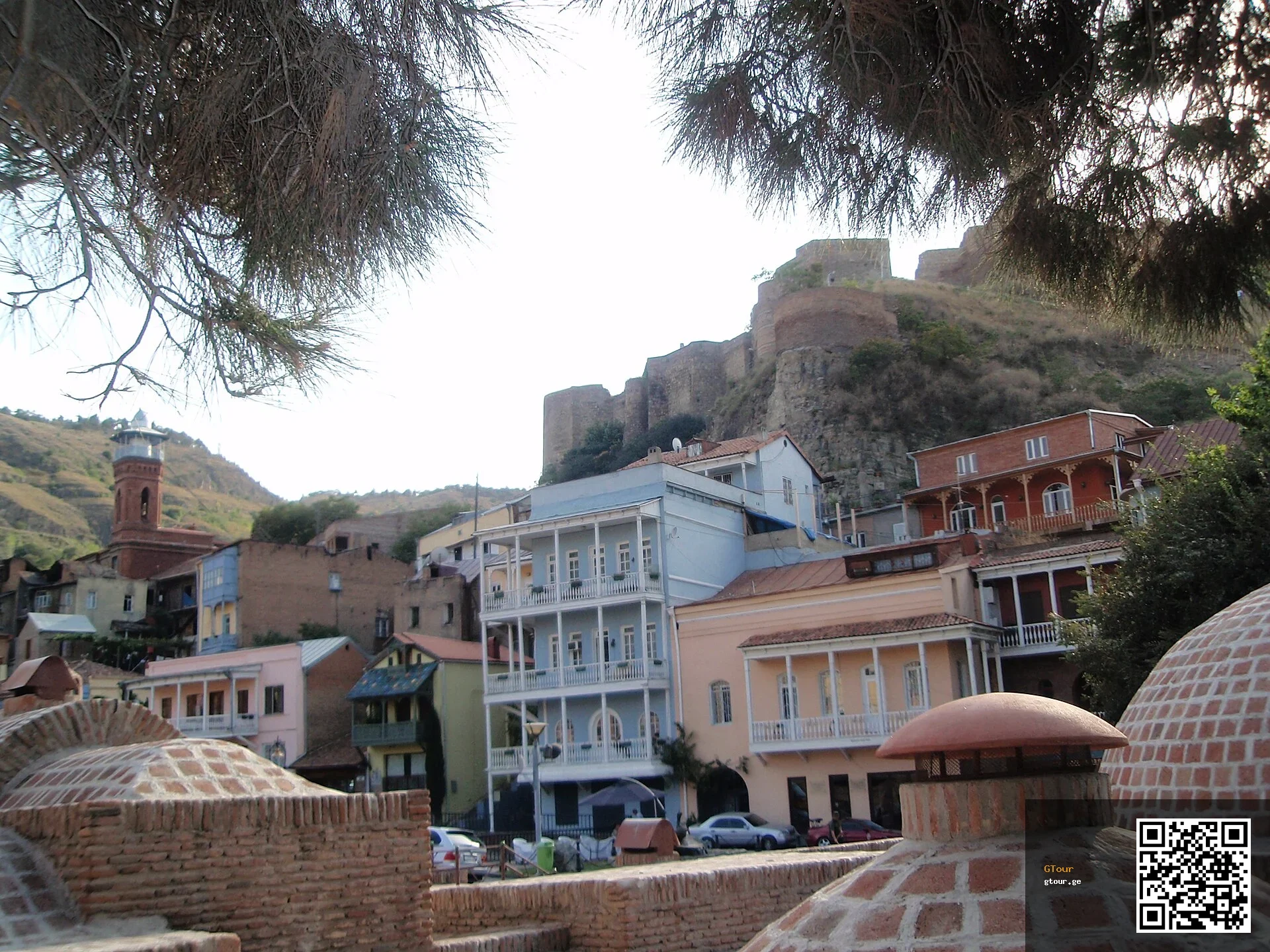
Tbilisi's Sulphur Baths district with Narikala Fortress, a classic sightseeing stop for visitors. · Photo: Ephraim Stillberg / Wikimedia Commons, Public domain
Been to Georgia? Tell us how it went — the best stories are published here.
Share your tripOne email a week: what changed for travellers in Georgia — rules, roads, flights, seasons — plus one place worth the trip. Written by the GTour desk, no advertising, unsubscribe in one click.
This story across our partner network — ქართულად: შენი დასვენება