

By Mariam Lomidze, Culture & Events Reporter · 27/10/2026
Canadian citizens do not need a visa to enter Georgia for tourism. Under Georgia’s long-standing visa liberalisation policy, holders of a valid Canadian passport can enter visa-free and stay for a period that has run as long as 365 days in recent years, though the exact length is set by government decree and has been adjusted before. Because this is the single most important thing to get right before booking flights, verify the current stay limit on Georgia’s official consular channels rather than relying on older blog posts, including yours truly’s.
Everything else about visiting Georgia from Canada is straightforward but has its own quirks: there is no direct flight, the currency is the lari and cards work almost everywhere in cities but not in mountain villages, and English is common in Tbilisi and tourist areas but thins out fast once you leave them. This guide works through entry rules, routes from Canada, money, connectivity, language, food, the (thin) historical ties between the two countries, and what to expect on the ground, with honest notes on where rules can change and how to double-check them yourself.
Visa and entry rules for Canadian citizens
As of October 2026, Canadian passport holders are among the nationalities Georgia admits visa-free for tourism, business and private visits, with stays historically permitted up to 365 days depending on the current decree in force. This is a generous policy by global standards and one that has made Georgia popular with Canadian remote workers and long-stay travellers, not only short-trip tourists. Because stay limits, document checks and conditions are set by government regulation and can be revised, do not assume last year’s rule still holds. Before you book, check the current position on Georgia’s Ministry of Foreign Affairs consular pages at mfa.gov.ge, which lists visa-free countries and permitted stay lengths.
If a future rule change ever requires Canadians to obtain an e-visa, the process runs entirely through Georgia’s official portal, evisa.gov.ge. Typical e-visa processing on that platform, for nationalities that do need one, is normally a few business days, though the portal itself states the expected turnaround for each visa category at the time of application. Never use a third-party site that charges a “service fee” for something the government portal does for free. Bring a passport valid well beyond your planned stay, and keep a digital and paper copy of your passport bio page and any entry stamp.
Flights from Canada: routes and connecting hubs
There is no non-stop flight between Canada and Georgia, and none is likely in the near term given the market size, so plan on one or two connections. The practical routings for Canadian travellers in 2026 run through a handful of hubs:
- Istanbul (IST) — usually the shortest connection from Toronto or Montreal, with onward flights to Tbilisi, Kutaisi or Batumi; this is normally the fastest overall routing for Eastern Canada.
- Doha or Dubai — convenient if you are already flying from Western Canada or combining Georgia with a Gulf stopover; both hubs connect onward to Tbilisi.
- Warsaw or Munich — useful if you are routing through a European carrier alliance from Toronto, Montreal or Vancouver, with a same-alliance connection onward to Tbilisi.
Tbilisi International Airport is the main gateway and handles the largest share of long-haul connecting traffic; check live arrivals, terminal maps and transfer information at tbilisiairport.com. Kutaisi International Airport, used heavily by European low-cost carriers, is a practical second entry point if your connection routes through a European hub that serves it, with details at kutaisiairport.com. Batumi’s airport, mainly serving regional and seasonal routes, is covered at batumiairport.com. From any of the three, GTour runs fixed-price airport transfers, for example a sedan between Tbilisi airport and any address in the city at €25 per car, or a Kutaisi-airport-to-Tbilisi transfer at €120 by sedan; the full fixed list is on our services page.
Driving licence, money, cards and cash
A valid Canadian driving licence is generally usable for short-term driving in Georgia, and an International Driving Permit is advisable and sometimes requested by rental agencies, particularly for provincial licences without a photo or Latin-script details. Rules on foreign licence recognition sit in Georgian traffic legislation, published through the official legislative herald at matsne.gov.ge; rental companies and road-condition updates are also tracked on georoad.gov.ge. If you plan to self-drive into the high mountains, note that winter passes close without much notice and a 4×4 is genuinely necessary for routes like Tusheti or Ushguli, not just recommended.
Georgia’s currency is the lari (GEL). On 27 October 2026 the National Bank of Georgia’s reference rate was roughly 2.60 GEL per US dollar and 2.91 GEL per euro; Canadian dollars are not quoted directly by most exchangers, so expect your bank or card network to route a CAD transaction through USD or EUR. We publish the daily official rate and a short how-to-pay guide on gtour.ge/data/. Cards are accepted almost everywhere in Tbilisi, Batumi and Kutaisi, including by taxis and mid-range restaurants, but carry cash for rural guesthouses, market stalls, church donation boxes and small mountain villages where card machines are unreliable or absent. ATMs are widespread in cities; withdraw lari directly rather than accepting a “guaranteed” home-currency conversion at the machine, which is almost always a worse rate.
SIM cards, eSIM and staying connected
Local SIM cards from Georgia’s main carriers are inexpensive and sold at the airport and in city kiosks with a passport for registration; data coverage is reliable in cities and along main roads, and patchier in remote valleys such as Tusheti or parts of Svaneti. Many travel eSIM providers now cover Georgia, which is convenient if you want connectivity the moment you land without hunting for a kiosk, though a physical local SIM is usually cheaper for a stay longer than a week. Hotel and café wifi is common and generally fast in urban areas.
Language, food and dietary notes for Canadian visitors
Georgian is the official language, written in its own unique Georgian script, and Russian is still widely understood by older generations. English is spoken reliably in Tbilisi’s hotels, restaurants and tourist sites, in Batumi’s seafront district, and by most licensed guides and younger people generally, but it thins out quickly in villages, on marshrutka minibuses, and among older shopkeepers outside the capital. Basic greetings in Georgian are appreciated and a little goes a long way; menus in tourist towns are usually bilingual, but rural guesthouses may not have an English menu at all, which is where a guide or driver who can translate becomes genuinely useful rather than a nicety.
Georgian food will feel approachable to most Canadian travellers: khachapuri (cheese-filled bread), khinkali (dumplings), grilled meats, and the communal supra feast are the staples, alongside a wine culture built around qvevri clay-vessel fermentation that UNESCO recognises as intangible cultural heritage, documented at ich.unesco.org. Vegetarians are well served, since Georgian cuisine has a deep tradition of bean, walnut, eggplant and vegetable dishes (lobio, badrijani, pkhali) that are vegetarian by default, often vegan. Halal options exist mainly in Tbilisi and Batumi, concentrated near mosques and in areas with Turkish or Azerbaijani-run restaurants, but are not standard in rural guesthouses, where pork and homemade wine are common; travellers with religious or allergy-related dietary needs should say so clearly in advance, ideally through a guide who can brief guesthouse hosts ahead of arrival.
Canada-Georgia ties: honest context
There is no deep historical relationship between Georgia and Canada to romanticise, and it is more useful to say that plainly than to invent one. Diplomatic and trade ties are modest: Canada does not maintain a resident embassy in Tbilisi, and Canadian consular coverage for Georgia is typically handled by a Canadian mission elsewhere in the region, so Canadian travellers should check Canada’s own government travel-advisory channels for the currently designated office before departure, since this arrangement can change. What does exist is a small but visible Georgian diaspora in Canadian cities such as Toronto and Montreal, growing people-to-people interest driven by Georgia’s visa-free policy and relatively low cost of long stays, and a trickle of Canadian academic, wine-trade and tourism-sector visitors. For most Canadian travellers, the honest framing is that you are visiting a country with little shared history with Canada but an increasingly easy, low-friction entry process and a tourism sector used to English-speaking North American visitors.
Health insurance, safety, season and etiquette
Georgia required visitors to carry proof of medical insurance during the pandemic years; that blanket requirement has eased for most travellers since, but entry conditions are reset by government decree and spot checks are possible, so confirm the current position before flying via mfa.gov.ge and evisa.gov.ge, and carry travel medical insurance regardless of whether it is formally mandatory, since Georgia’s public healthcare system is not designed around foreign-visitor costs and private clinics bill directly. Georgia is generally a safe destination for Canadian travellers, with low rates of violent crime against tourists; the main practical risks are mountain-road driving, altitude and weather in places like Kazbegi, Svaneti and Tusheti, and the usual petty-theft caution in crowded markets.
Canadian visitors tend to arrive in two clusters: the warm-weather months of May to September for hiking, wine country and the Black Sea coast around Batumi, and the ski season from December to March, centred on Gudauri. Etiquette notes worth knowing: dress modestly when entering Orthodox churches and monasteries (covered shoulders, and headscarves for women are often requested at the door), expect generous hospitality including toasts at a supra that are a genuine social institution rather than a performance, and tipping of roughly 10 percent is appreciated but not strictly obligatory outside Tbilisi’s higher-end restaurants.
What a GTour private guide adds
For a long-haul trip with one shot at the country, the value of a private guide is less about convenience and more about translation in the fullest sense: language, menu, customs, and the judgement call on which mountain pass is actually open today. A licensed city guide runs €70 for a half-day walk around Old Tbilisi or Mtskheta, and €110 for a full day with your own transport; specialist guides for wine, architecture or hiking run €140 a day. Paired with a car and driver, for example a sedan at €90 for a day trip around Tbilisi, Kakheti or Kazbegi, this becomes a complete private alternative to a group bus tour, at a price that is often comparable once you count a group tour’s fixed schedule and shared vehicle. Ready-made options worth a look for a first Georgia trip from Canada include Georgia in 7 Days — The Classic Grand Tour and the shorter Tbilisi & Mtskheta — The Essential First Day, both scalable from solo travel to small groups with per-person pricing dropping as group size grows.
If this guide is part of a trip you are planning, our Georgia in 10 Days — Tbilisi to Svaneti to the Sea and Monasteries of Georgia — Mtskheta, the Thirteen Fathers and Kakheti in 3 Days cover the places it describes with a private guide and driver; a GTour travel expert adapts the route to your dates.
Practical summary
- Check Georgia’s current visa-free stay limit for Canadians on mfa.gov.ge before booking; if an e-visa is ever required, apply only at evisa.gov.ge.
- Expect one or two connections from Canada via Istanbul, Doha, Dubai, Warsaw or Munich; no non-stop flights exist.
- Bring an International Driving Permit alongside your Canadian licence if self-driving, and budget for a 4×4 in the high mountains.
- Carry cash for rural areas and markets; cards work well in Tbilisi, Batumi and Kutaisi; check the daily GEL rate via gtour.ge/data/.
- Get a local SIM or eSIM on arrival; coverage is strong in cities, patchy in remote valleys.
- English works well in tourist zones, less so in villages; a guide helps close the gap for menus, hosts and etiquette.
- Carry travel medical insurance regardless of current entry rules, and reconfirm Canada’s consular arrangements for Georgia before departure.
- Consider a private guide and driver combination, from €70 for a half-day guide to a full custom itinerary, for a trip that is otherwise once-in-a-while from Canada.
Sources
- Georgia MFA consular information
- Georgia e-visa portal
- Georgian wine-making qvevri tradition, intangible heritage
- Georgian legislative herald, traffic and licence regulations
Questions this guide does not answer? Write to info@castle.ge or WhatsApp +995 577 41 63 14 — a person in Tbilisi replies. See also our travel services and all guides.
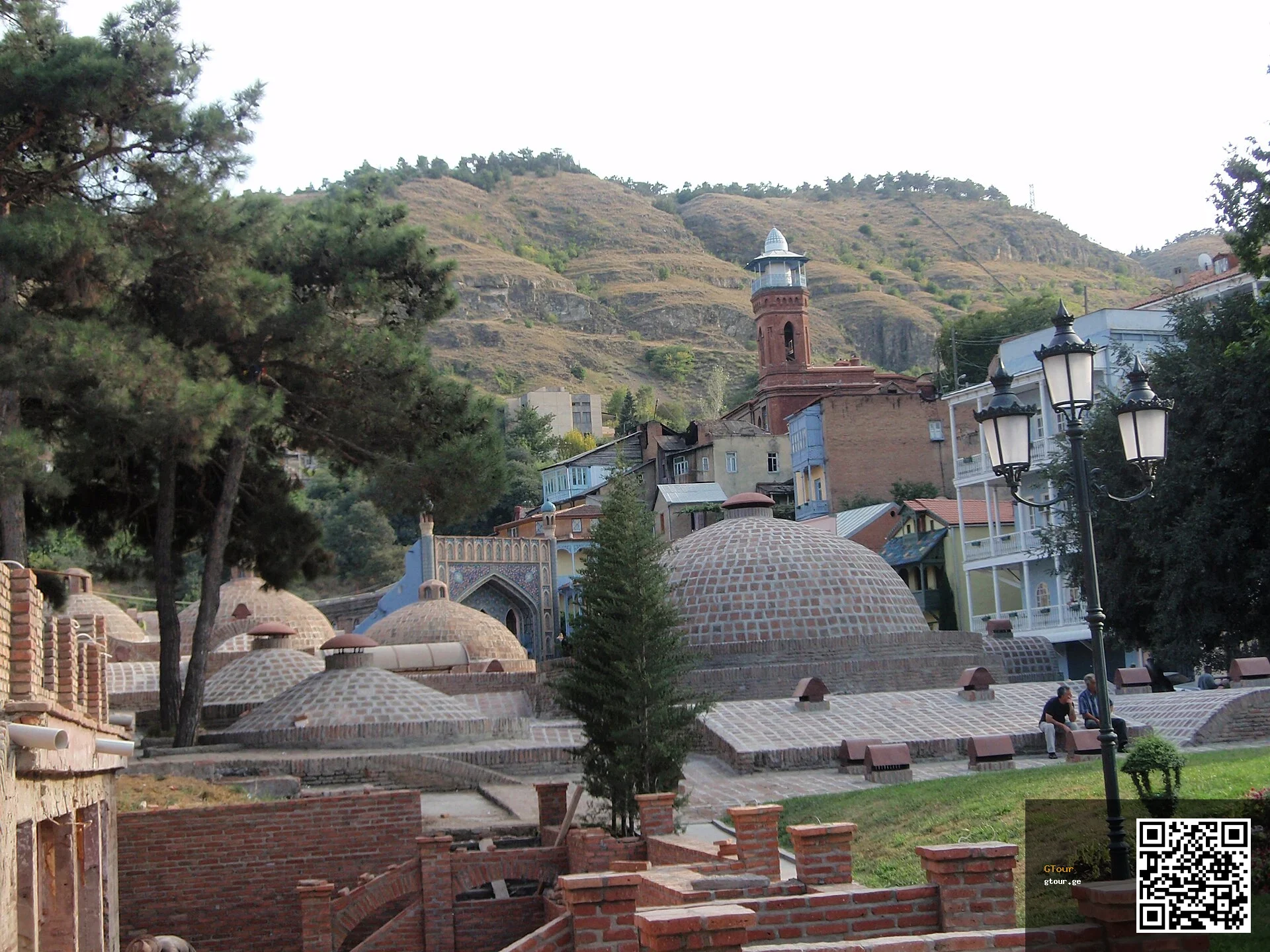
Domed sulphur bathhouses in Tbilisi's historic Abanotubani district, a top sight for visiting Canadians. · Photo: Ephraim Stillberg / Wikimedia Commons, Public domain
Been to Georgia? Tell us how it went — the best stories are published here.
Share your tripOne email a week: what changed for travellers in Georgia — rules, roads, flights, seasons — plus one place worth the trip. Written by the GTour desk, no advertising, unsubscribe in one click.
This story across our partner network — ქართულად: შენი დასვენება