

By Nino Gelashvili, Travel News Editor · 27/10/2026
Short answer: at the time of writing, Bhutan is not on Georgia’s unilateral visa-free list, which leans toward the EU, the Gulf, the Americas, Japan, South Korea and a handful of others. Most Bhutanese citizens should plan on applying for either an ordinary Georgian visa or an electronic visa through the official evisa.gov.ge portal before travelling, and should confirm the exact category on the Ministry of Foreign Affairs consular pages, because Georgia reviews its visa lists periodically and rules can change with little notice. There are no direct flights between Bhutan and Georgia, so every journey routes through at least one, usually two, connecting hubs such as Delhi, Bangkok, Dubai, Istanbul or Doha.
This guide, from Nino Gelashvili at GTour, sets out what a traveller from Thimphu, Paro or Phuntsholing actually needs to know: entry rules, realistic flight routings, money and SIM cards, where English is understood, food that will feel familiar or unfamiliar, the (honestly thin) historical and trade links between the two countries, and where a private guide earns its keep. Ties between Georgia and Bhutan are not deep, so this guide focuses on the practical side of the trip rather than pretending otherwise.
Visa and entry rules for Bhutanese citizens
Georgia’s visa policy is unilateral and asymmetric: it grants visa-free entry to a defined list of nationalities, issues e-visas to a wider second list, and requires an ordinary visa from everyone else. Bhutan has not, to our knowledge, appeared on the short visa-free list in recent years. The safest working assumption for 2026 is that Bhutanese passport holders need to apply in advance, either through the e-visa system or at a Georgian diplomatic mission, and should not travel on the assumption that a visa can be obtained on arrival.
Start at evisa.gov.ge, Georgia’s official e-visa portal, which lists eligible nationalities, the documents required (passport scan, photo, proof of funds and onward travel, sometimes an invitation or hotel booking) and the processing time, typically a few working days, though peak season can take longer. Before booking flights, cross-check the current rule on the Ministry of Foreign Affairs consular information at mfa.gov.ge, since this is the authoritative source and the one GTour’s own team checks before advising clients. If Bhutan is not e-visa eligible, the ordinary visa route runs through the nearest Georgian embassy or an honorary consul; contact details for Georgian missions worldwide are listed on the same MFA site.
Getting there: flights and typical routings
Bhutan’s own carriers, Druk Air and Bhutan Airlines, fly a short list of international routes from Paro, commonly to Delhi, Kolkata, Guwahati, Kathmandu, Bangkok, Singapore and Dubai. None of these connect directly onward to Georgia, so a Bhutanese traveller is realistically looking at a two-leg or three-leg journey. The three hub patterns that apply are:
| From Bhutan | Connecting hub | Onward to Georgia |
|---|---|---|
| Paro–Dubai (Druk Air/Bhutan Airlines) | Dubai | Dubai–Tbilisi direct, or Dubai–Istanbul–Tbilisi |
| Paro–Bangkok or Paro–Delhi | Istanbul | Istanbul–Tbilisi (Turkish Airlines, frequent) |
| Paro–Delhi | Doha | Doha–Tbilisi (Qatar Airways) |
Istanbul tends to give the most frequent onward schedules to Tbilisi, Kutaisi and Batumi. Total travel time from Paro to Tbilisi, including a reasonable connection, usually runs 16 to 22 hours door to door. Check live schedules and arrivals directly with the airports: tbilisiairport.com for the main international gateway, kutaisiairport.com for budget carriers serving Western Georgia, and batumiairport.com for the Black Sea coast. If your routing lands you in Kutaisi rather than Tbilisi, GTour runs fixed-price transfers (sedan €120, minivan €150 to Tbilisi; see gtour.ge/services) that are simpler to book in advance than arranging a taxi after a long flight.
Driving licence, money, cards and SIM cards
Georgia generally allows foreign driving licences to be used for a limited period after entry, but the exact rule (often tied to whether the licence is in Latin script or accompanied by an International Driving Permit) is set out in national traffic legislation. Bhutanese licences are not in Latin script, so carrying an International Driving Permit alongside your national licence is the safer approach; confirm the current requirement through Georgia’s legislative herald at matsne.gov.ge or by asking a car rental desk directly, since enforcement and documentation requirements are checked at the point of rental, not at the border.
Georgia’s currency is the lari (GEL). As of 26 October 2026, the National Bank of Georgia’s reference rate was roughly GEL 2.60 per US dollar and GEL 2.91 per euro; Bhutanese ngultrum is not convertible locally, so bring US dollars or euros to exchange, or use an international card. Cards are widely accepted in Tbilisi, Batumi and Kutaisi hotels, restaurants and larger shops, but small guesthouses, mountain villages (Svaneti, Tusheti, Khevsureti) and market stalls are often cash-only, so carry lari in smaller denominations once outside the main cities. Bhutanese eSIM-compatible phones work with local prepaid SIMs from Georgian operators available at both international airports on arrival; eSIM profiles from global providers are also widely usable, though checking compatibility before departure saves time.
Language, food and daily life
Georgian is the state language, written in its own Georgian script, and Russian is still understood by older generations. English is spoken reliably in Tbilisi’s hotels, by tour guides, in Batumi’s tourist areas and by younger staff generally, but is patchier in villages and smaller towns. Dzongkha will not be understood anywhere; a translation app and a private guide bridge this gap more reliably than relying on signage, most of which is in Georgian only outside the capital.
Georgian food centres on bread, cheese, walnuts and grilled or stewed meat, with khachapuri (cheese-filled bread) and khinkali (dumplings) as the best-known dishes. Vegetarian Bhutanese travellers will find it straightforward: Georgian Orthodox fasting cuisine produces a long tradition of meat- and dairy-free dishes such as lobio (bean stew) and pkhali (vegetable and walnut pâté), served widely even outside fasting periods. Halal food is available in Tbilisi and Batumi at a small number of dedicated restaurants and through Turkish and Central Asian eateries, but it is not the default at most Georgian restaurants, so asking in advance or booking through a guide who knows which kitchens cater to dietary needs is the practical approach. Rice, chilli-based condiments and dairy (Georgian cheeses rather than yak cheese) give some points of familiarity, though the flavour profile is distinct from Bhutanese cooking.
Georgia and Bhutan: ties, holidays and seasons
Honestly, direct historical, trade or diaspora ties between Georgia and Bhutan are thin to the point of being negligible. Both countries sit at the edge of larger regional stories, Georgia on the Silk Road between Europe and Asia, Bhutan on trans-Himalayan trade routes, but there is no documented direct exchange between them historically. Formal diplomatic relations and whether either country maintains an embassy or honorary consul covering the other should be checked directly via mfa.gov.ge; as of our research neither country appears to maintain a resident mission in the other’s capital, so Bhutanese travellers in difficulty should contact the nearest Bhutanese mission abroad (commonly in Delhi, Dhaka, Bangkok or Kuwait) alongside Georgia’s own foreign ministry. Bilateral trade figures, if any exist, would be tracked by Georgia’s statistics office at geostat.ge.
Where the countries do align is season and festival rhythm. Bhutan’s monsoon (June to September) pushes many Bhutanese travellers toward autumn trips abroad, which happens to coincide well with Georgia’s grape harvest season, the rtveli, and with mild, clear weather in Tbilisi, Kakheti and the mountains through late September and October. Georgia’s own public holidays and the Tbilisoba city festival (usually October) can affect hotel availability in the capital, so checking dates against gtour.ge/today before booking is worthwhile.
Health, insurance and safety etiquette
Georgia has at times required visitors to carry travel medical insurance covering a minimum sum for the duration of their stay; this rule has been adjusted more than once in recent years, so Bhutanese travellers should verify the current requirement directly through gov.ge or the MFA consular pages before departure, and buy a policy that clearly covers emergency treatment, evacuation and COVID-related care regardless of whether it is formally mandatory at the time of travel. For any personal medical concerns, including altitude considerations if travelling into the Caucasus mountains (Kazbegi, Svaneti, Tusheti sit well above 1,500 metres), consult a doctor before the trip rather than relying on general travel advice.
Georgia is a generally safe destination for visitors, with low rates of violent crime against tourists; standard precautions around valuables in crowded markets and on night transport apply as anywhere. Georgians are warm but direct hosts; a toast at a shared table (supra) is a genuine cultural institution, and politely trying a small amount rather than refusing outright is appreciated, while Bhutanese Buddhist travellers who prefer not to drink alcohol can simply say so and will not cause offence. Dress modestly when visiting the many working Orthodox churches and monasteries on any Georgian itinerary, covering shoulders and, for women, the head with a scarf, which is usually available at the entrance.
What a G Tour private guide adds
Given the genuine language gap between Dzongkha-speaking visitors and Georgian-speaking hosts outside the capital, and the thinness of ready, English-language information connecting the two countries, a private guide removes the single biggest source of friction on this trip. GTour’s licensed guides (from €70 for a half-day city walk, €110 for a full day, €120 per day on multi-day routes; see gtour.ge/services) handle dietary requests such as locating halal or strictly vegetarian kitchens, explain Orthodox church etiquette on the spot, and translate menus and museum labels that would otherwise be opaque.
For a first visit, Tbilisi & Mtskheta — The Essential First Day gives a compact introduction to the capital and Georgia’s spiritual centre in a single day. Travellers with more time often combine this with Kakheti Wine Country — Day Trip or the longer Kakheti Grand Wine & Heritage — 3 Days, and those arriving in the October harvest window may prefer Rtveli — Wine Harvest in Kakheti. For mountain scenery closer to what Bhutanese travellers know at home, Kazbegi — 2-Day Mountain Journey and Mestia & Ushguli — 3 Days in Svaneti are the two routes GTour recommends most. All can be built around a fixed-price airport transfer and a car-with-driver package, quoted in writing before confirmation.
If this guide is part of a trip you are planning, our Georgia in 10 Days — Tbilisi to Svaneti to the Sea and Monasteries of Georgia — Mtskheta, the Thirteen Fathers and Kakheti in 3 Days cover the places it describes with a private guide and driver; a GTour travel expert adapts the route to your dates.
Practical summary
- Visa: assume you need an e-visa or ordinary visa; verify on evisa.gov.ge and mfa.gov.ge before booking flights, as rules change.
- Flights: no direct route; expect to connect via Dubai, Istanbul or Doha, 16 to 22 hours total.
- Driving: carry an International Driving Permit alongside your Bhutanese licence; confirm validity period via matsne.gov.ge.
- Money: bring USD or EUR cash to exchange; cards work in cities, cash is needed in villages and mountain areas.
- Language: English covers Tbilisi and tourist sites; Dzongkha is not understood anywhere, so a guide or translation app helps outside the capital.
- Food: vegetarian dishes are easy to find; halal is available in Tbilisi and Batumi but should be arranged in advance.
- Ties: historically and commercially thin between the two countries; plan the trip on practicalities rather than existing connections.
- Health: buy comprehensive travel medical insurance and confirm the current mandatory-insurance rule via gov.ge before departure; see a doctor for any personal health questions.
Sources
- Georgia e-visa portal
- Ministry of Foreign Affairs, consular information
- Georgian National Tourism Administration
- Georgia Travel, official tourism site
- Legislative Herald of Georgia
- National Statistics Office of Georgia
Questions this guide does not answer? Write to info@castle.ge or WhatsApp +995 577 41 63 14 — a person in Tbilisi replies. See also our travel services and all guides.
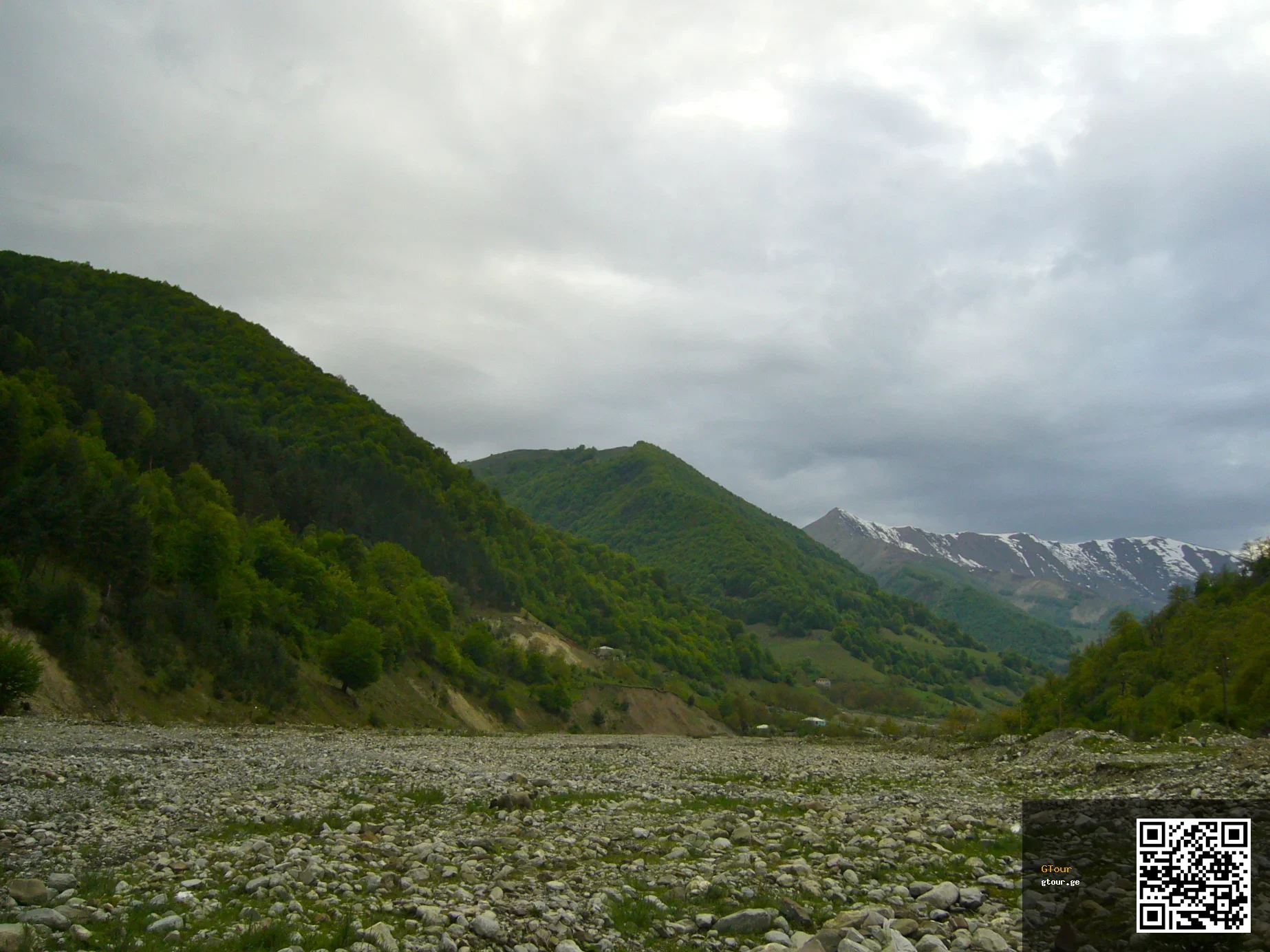
Mountain valley landscape in Georgia, typical of the country's scenic terrain. · Photo: Fif' from Paris, France / Wikimedia Commons, CC BY-SA 2.0
Been to Georgia? Tell us how it went — the best stories are published here.
Share your tripOne email a week: what changed for travellers in Georgia — rules, roads, flights, seasons — plus one place worth the trip. Written by the GTour desk, no advertising, unsubscribe in one click.
This story across our partner network — ქართულად: შენი დასვენება