

By Nino Gelashvili, Travel News Editor · 10/11/2026
Georgia packs an improbable number of waterfalls into a small country, from a glacial curtain at the foot of Mount Kazbek to a jungle-green canyon a short walk from Batumi‘s beaches. The honest answer to “which are the best” depends on what you want: Gveleti and Shdugra reward people willing to drive and then walk through mountain scenery; Makhuntseti, Mirveti and Kinchkha are easy, swimmable, family-friendly stops; Legvtakhevi and Dashbashi sit inside or just outside Tbilisi for an afternoon out. None of the fifteen below needs technical gear, though a few need a 4×4 or a long day.
This guide groups the falls by region, gives approximate one-way walking times from the nearest parking or village, notes when each one actually runs (snowmelt falls thin out by August, spring-fed ones do not), and flags where swimming is realistic rather than just photogenic. Trail conditions, opening gates and park fees change from year to year, so for anything inside a protected area we link the managing agency’s page and recommend checking georoad.gov.ge for road status before driving into the mountains, especially Svaneti, Racha and Kazbegi outside May to October.
Georgia’s 15 best waterfalls at a glance
| Waterfall | Nearest town | Walk, one way | Runs best | Swimming |
|---|---|---|---|---|
| Greater and Lesser Gveleti | Stepantsminda (Kazbegi) | 40–60 min | June–September | Cold, not advised |
| Legvtakhevi | Tbilisi Old Town | 5 min from Abanotubani | Year-round, thinner in late summer | No |
| Dashbashi | Tsalka | 20–30 min into the canyon | April–June for volume | Local pools, use caution |
| Makhuntseti | Keda, Adjara | 2 min from the car park | Year-round | Yes, popular |
| Mirveti | Machakhela valley, Adjara | 10–15 min | Year-round | Yes |
| Mtirala (several falls) | Chakvi / Kobuleti, Adjara | 30–90 min depending on trail | April–October | Shallow pools, yes |
| Kinchkha | Near Okatse Canyon, Imereti | 15–20 min | April–July | No, strong current |
| Toba | Near Sachkhere, Imereti | 20–30 min | Spring | No |
| Oniore | Oni, Racha | 30–40 min | May–August | Cold pools, some swim |
| Shdugra | Mazeri, Svaneti | 1.5–2 hours | July–September | No, glacial melt |
| Khadori | Pankisi Gorge, Kakheti | 30 min | Spring and early summer | Yes, shallow pools |
| Ninoskhevi | Lagodekhi | 1–2 hours on marked trail | Spring–autumn | Yes, inside protected area |
| Materi | Khulo district, Adjara | 15 min | Year-round | Shallow, yes |
| Kvabiskhevi falls | Borjomi-Kharagauli National Park | 1–3 hours, marked trails | April–October | No |
| Okatse Canyon falls | Imereti, near Kinchkha | On the Okatse walkway, 15–40 min | April–July | No, viewing only |
Kazbegi: Gveleti, close to the Russian border
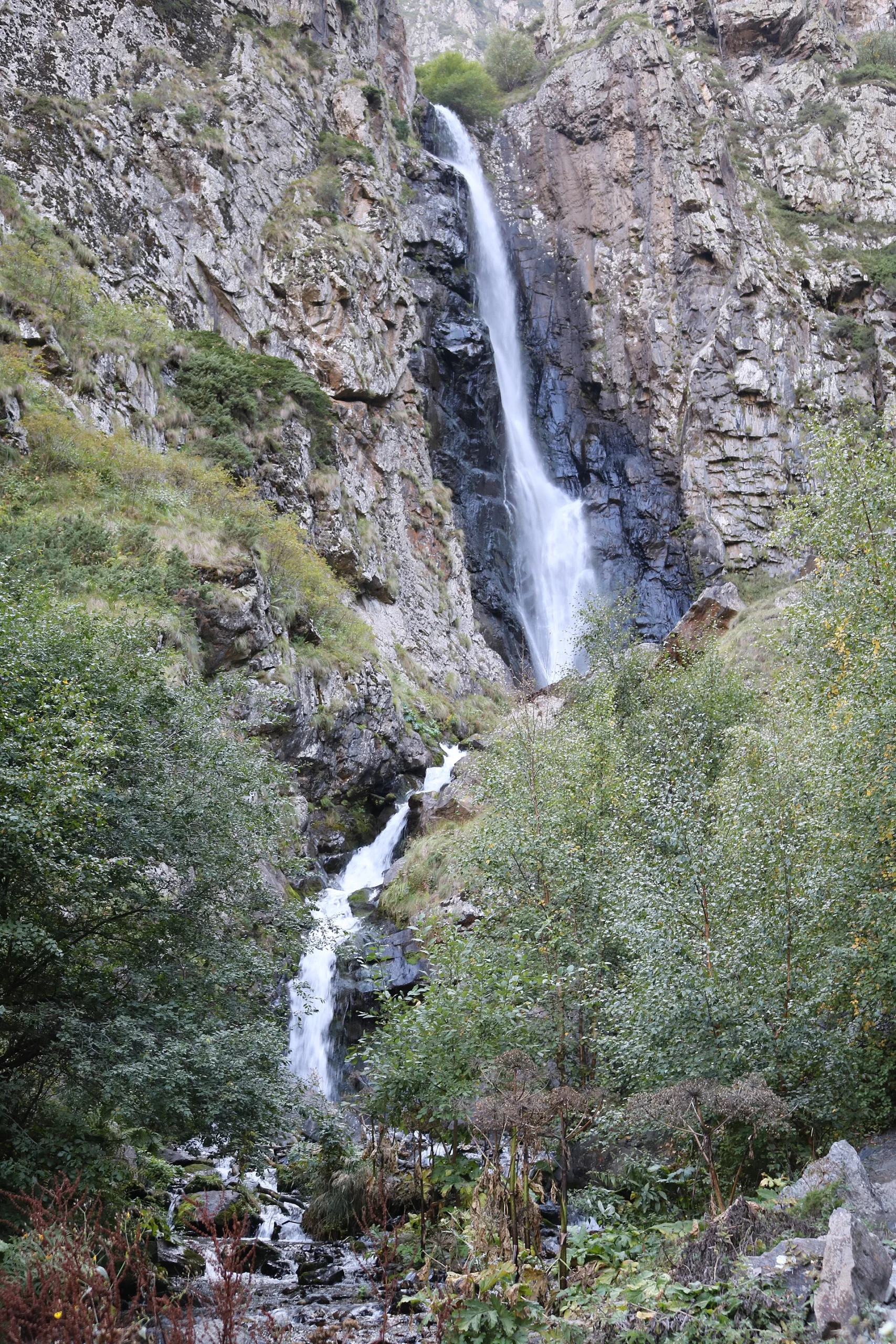
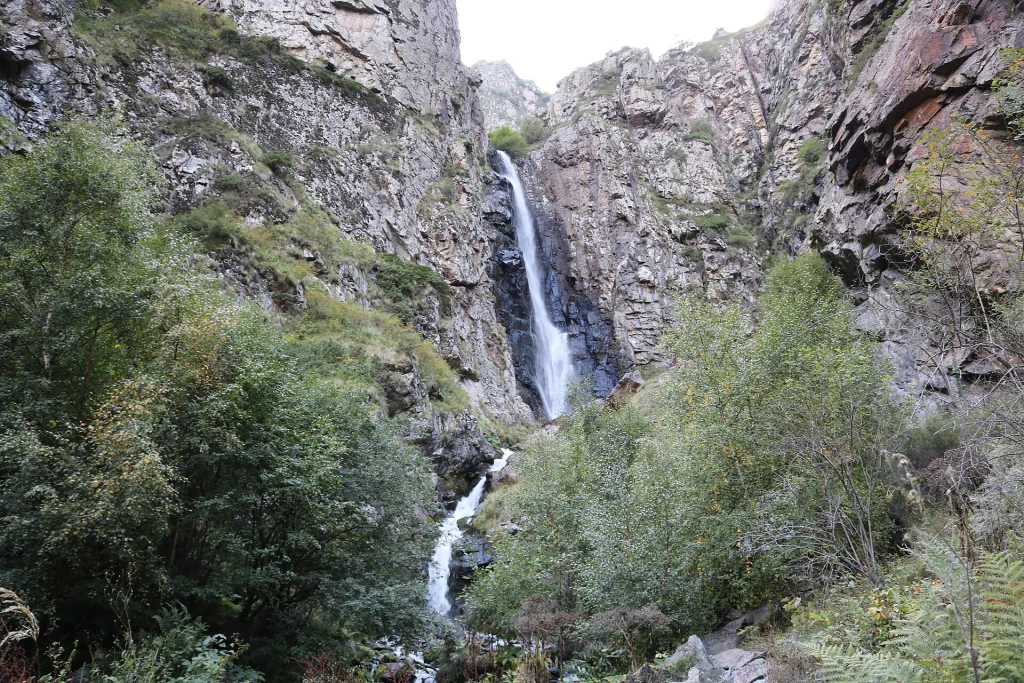
Greater Gveleti waterfall drops out of a hanging valley on the Georgian side of the Dariali gorge, a short drive north of Stepantsminda along the Georgian Military Highway and then a 40 to 60 minute walk up a clear path from the Gveleti village car park. Lesser Gveleti is a smaller, closer fall reached from the same trailhead. Both run strongest from snowmelt in June, thin by late August, and are frequently iced over and closed in winter; the road itself can be affected by avalanches, so check georoad.gov.ge before driving the Georgian Military Highway in winter. The water is glacial and genuinely cold; swimming is not advised even in midsummer. This is usually combined with Gergeti Trinity Church and the Kazbegi region on tours such as the Georgian Military Highway — Ananuri, Gudauri and Gergeti in a Day, or over two days on Kazbegi — 2-Day Mountain Journey.
Tbilisi and Kvemo Kartli: Legvtakhevi and Dashbashi
Legvtakhevi is Tbilisi’s own waterfall, tucked into a narrow ravine behind the sulphur bathhouses of Abanotubani, a five-minute walk from the Old Town. It is small, partly fed by a spring and partly by run-off, and best seen after rain; it can be reduced to a trickle in a dry August. It is not a swimming spot, more a five-minute detour on an Old Tbilisi walk, easily paired with the Sulphur Baths Experience or the Old Tbilisi Walking Tour.
Dashbashi Canyon, near Tsalka about two hours from Tbilisi, is a deeper and more dramatic basalt gorge with a waterfall and turquoise pools fed by a river that runs stronger in spring. Paths down into the canyon are informal rather than fully engineered, so sturdy shoes matter, and locals do swim in the pools below the falls in summer though depth and current vary by year, so judge it on the day. It appears on the Dashbashi Canyon, Tsalka and the Diamond Bridge day trip and combined with a hike on Birtvisi Fortress Hike and Dashbashi Canyon.
Adjara’s highlands: Makhuntseti, Mirveti and Mtirala
Makhuntseti, roughly 90 minutes from Batumi on the road to Khulo, is one of Georgia’s most photographed waterfalls because the car park is beside an arched stone bridge and the fall itself needs only a two-minute walk. It runs year-round and has a shallow pool where people swim in summer; it is usually visited on the way to or from the Adjara Highlands — Khulo, the Goderdzi Pass and the Green Lake day trip.
Mirveti sits in the Machakhela valley, a quieter green corridor of old arched bridges southeast of Batumi, reached by a 10 to 15 minute walk from the road. It runs all year and has swimmable pools, and is the centrepiece of the Machakhela Valley — Arched Bridges, Mirveti Waterfall and a Village Lunch tour.
Mtirala National Park, inland from Chakvi and Kobuleti, protects Georgia’s wettest forest and several falls reached by marked trails of 30 minutes to a couple of hours depending on which loop you take; current trail status and any seasonal closures are on the Protected Areas Agency’s page for the park. The falls run strongest April to October and some pools are shallow enough for a dip. It features on Mtirala Rainforest and the Chakvi Tea Plantations.
Imereti: Kinchkha, Toba and the Okatse falls
Kinchkha, near the Okatse Canyon reserve outside Kutaisi, is reached by a short 15 to 20 minute path and is at its most powerful April to July; the current at the base is strong enough that swimming is not recommended. Toba, further east near Sachkhere, is a quieter, less-visited fall with a 20 to 30 minute approach, best seen in spring before the river drops. Both are usually combined with the dramatic Okatse Canyon walkway, which has its own series of falls visible from the suspended path, on tours such as Martvili & Okatse Canyons + Prometheus Cave — Day Trip from Kutaisi or the fuller Prometheus Cave, Martvili Canyon and Okatse — the Big Three from Kutaisi. Verify current entrance fees and walkway status with the Protected Areas Agency before you go, since the Okatse reserve periodically closes sections for maintenance.
Racha and Svaneti: Oniore and Shdugra
Oniore, close to the Racha capital Oni, is a 30 to 40 minute walk and runs best from May through August once the spring flood has settled; some of its pools are cold but swimmable. It fits naturally into Racha — Khvanchkara Wine & Mountain Lakes (2 Days) or the longer Racha and Lechkhumi by 4×4 — 3 Days.
Shdugra, near Mazeri at the foot of Ushba in Svaneti, is the most physically demanding fall on this list: a 1.5 to 2 hour walk through forest and moraine from the village, with a dramatic glacial curtain of water at the end. It runs fullest July to September and the water is too cold and fast for swimming. It is a natural extension of the Ushba Glacier Hike from Mazeri, or can be folded into a longer Svaneti by 4×4 — Mestia, Ushguli and the Zagar Pass to Lentekhi, 4 Days itinerary.
Five more worth the detour
- Khadori, in the Pankisi Gorge near Akhmeta: a 30-minute walk to shallow pools popular with local families in summer.
- Ninoskhevi, inside Lagodekhi Protected Areas on the Dagestan border: a marked trail of one to two hours leading to a swimmable pool, well suited to a long Black Rock Lake Trek — 2 Days in Lagodekhi or a day on Eastern Kakheti — Nekresi, Gremi, Kvareli and the Lagodekhi Forest.
- Materi, in the Khulo district of Adjara: a short, shallow fall often seen alongside Makhuntseti on the Adjara Highlands by 4×4 — Beshumi, Goderdzi and the Alpine Villages route.
- Kvabiskhevi falls, inside Borjomi-Kharagauli National Park: reached on marked trails of one to three hours, best timed to the park’s spring and early-summer trail reports, and a highlight of the Borjomi-Kharagauli National Park Trek — 3 Days.
- Okatse Canyon’s smaller falls, seen from the suspended walkway rather than approached on foot, a 15 to 40 minute walk along the boardwalk depending on how far you go.
Seasons, swimming and sensible caution
Snowmelt waterfalls such as Gveleti, Shdugra, Kinchkha, Toba and Kvabiskhevi are strongest in late spring and early summer and can be reduced to a fraction of their size by late August; spring-fed or forest falls such as Makhuntseti, Mirveti and Legvtakhevi are more consistent year-round. Water everywhere in Georgia’s mountain rivers is cold even in July, currents near waterfall bases are frequently stronger than they look, and rocks are slippery; treat any posted warning signs as final and do not swim where locals are not swimming. For anyone with a heart condition or who is pregnant, sudden immersion in very cold water carries recognised health risks and is worth discussing with a doctor before travel. None of the fifteen falls above requires a guide, but a guide earns their fee on Shdugra, Dashbashi and anything inside Lagodekhi or Borjomi-Kharagauli, where trail junctions are not always obvious; see our Licensed Private Guide by the Day or Car with Driver by the Day for custom routing between falls that are not on a fixed tour.
If this guide is part of a trip you are planning, our Georgia Off the Beaten Track — 9 Days in Racha, Samegrelo and Guria and Racha and Lechkhumi by 4×4 — 3 Days cover the places it describes with a private guide and driver; a GTour travel expert adapts the route to your dates.
Practical summary
- Easiest, most reliable, swimmable: Makhuntseti and Mirveti, Adjara, 2 to 15 minutes’ walk, year-round.
- Best spring-flood drama: Gveleti, Kinchkha, Toba and Shdugra, June to July, no swimming.
- Closest to Tbilisi for a half-day: Legvtakhevi inside the Old Town, Dashbashi two hours south near Tsalka.
- Inside protected areas, check the agency page first: Mtirala, Okatse, Lagodekhi, Borjomi-Kharagauli, all on apa.gov.ge.
- Check mountain-road status before driving to Kazbegi, Svaneti or Racha outside May to October, at georoad.gov.ge and gtour.ge/road-status.
- Cold water everywhere: treat all falls as too cold for prolonged swimming regardless of air temperature.
Sources
- Adjara region attractions, Gobatumi
- Visit Batumi official guide
- Kutaisi region travel guide
- Georgia road and pass status
- Georgian National Tourism Administration
Questions this guide does not answer? Write to info@castle.ge or WhatsApp +995 577 41 63 14 — a person in Tbilisi replies. See also our travel services and all guides.
Gveleti waterfall near Kazbegi, one of the fifteen listed Georgian waterfalls. · Photo: UG-GE / Wikimedia Commons, CC BY-SA 4.0
Been to Georgia? Tell us how it went — the best stories are published here.
Share your tripOne email a week: what changed for travellers in Georgia — rules, roads, flights, seasons — plus one place worth the trip. Written by the GTour desk, no advertising, unsubscribe in one click.
This story across our partner network — ქართულად: შენი დასვენება
